


Accounting records review services help enterprises inspect, identify, and promptly resolve errors arising during accounting book entries, tax declarations, and financial statement preparations.
Throughout their operation, businesses may encounter various issues such as missing invoices, invalid supporting documents, discrepancies between accounting data and tax reports, misclassified accounts, or inaccurate determinations of deductible expenses for corporate income tax. If not detected and adjusted in a timely manner, these errors can lead to tax arrears, late payment interest, administrative penalties, and compromised accuracy and transparency of financial statements.
Viet An Tax Agent provides comprehensive accounting records review services in Vietnam, including the review of accounting documents, ledger systems, tax filing dossiers, and financial reporting services. Through this review process, enterprises can proactively supplement dossiers, adjust data, and mitigate tax risks prior to tax audits and inspections or before undertaking major corporate transactions such as bank loan applications, fundraising, equity transfers, restructuring, and mergers and acquisitions (M&A).
What is accounting records review?
Accounting records review is the process of checking, comparing, and evaluating the completeness, accuracy, and consistency of accounting documents, data, tax reports, and financial statements of a business.
The review aims not only to detect accounting errors but also to determine:
- Whether accounting documents are complete and valid;
- Whether the data between invoices, tax returns, and accounting records is consistent;
- Whether revenue and expenses have been recorded in the correct period;
- Whether expenses are eligible for tax deduction;
- Whether accounts payable, inventory, fixed assets, and bank deposits are accurately tracked;
- Whether financial statements accurately reflect the business’s operational situation.
Depending on the status of the records, the review may be conducted for one fiscal year, multiple consecutive years, each tax category, or groups of high-risk transactions.
What are accounting records in Vietnam?
Accounting records are a system of documents used to record, reflect, and summarize economic and financial transactions arising during the operation of a business.
Accounting records can be prepared in paper form, electronic data, or created through accounting software. Depending on the accounting system and operational characteristics, a business’s accounting system may include:
- General journal;
- Ledger of accounts;
- Detailed account ledger;
- Cash book;
- Bank deposit book;
- Accounts receivable and payable book;
- Inventory book and summary of inventory receipts, issues, and balances;
- Fixed asset tracking book;
- Fixed asset depreciation allocation table;
- Prepaid expense allocation table;
- Receipts and payment vouchers;
- Inventory receipt and issue vouchers;
- Other related statements, documents, and accounting books.
Accounting records are the basis for businesses to prepare tax reports, financial statements, determine business results, and prove the legality of revenue and expenses incurred.
The purpose of tax records review
Reviewing accounting records serves several important purposes, regardless of whether a business uses paper ledgers, digital records, or reports generated from accounting software.
Prepare accurate financial reports
One of the primary purposes of accounting record review is to ensure that financial statements are complete, accurate, and reliable.
Reports such as the balance sheet, income statement, cash flow statement, and notes to the financial statements provide crucial information about a company’s financial position, business performance, and solvency.
This information is used by management, shareholders, investors, banks, and other stakeholders to make decisions regarding governance, investment, credit granting, or business partnerships.
Supporting businesses in complying with the law
Reviewing accounting records helps businesses verify compliance with regulations regarding accounting, taxes, invoices, labor, wages, and social insurance.
Accurate and transparent financial reports and tax records are crucial in minimizing the risk of tax arrears, late payment penalties, or administrative fines.
Providing information to stakeholders
Financial reports provide information to shareholders, investors, banks, partners, and government regulatory agencies.
Through these figures, stakeholders can assess the financial health, profitability, debt obligations, cash flow, and operational efficiency of a business before making investment, capital contribution, loan, or partnership decisions.
Internal management support
The review also helps management identify shortcomings in accounting processes, accounts receivable management, cash management, inventory, fixed assets, and operating expenses.
Based on this, the business can rebuild internal control processes, define responsibilities between departments, and improve the quality of financial management.
When should a business review its accounting records in Vietnam?
Businesses should conduct a review of their accounting records in the following cases:
- Before preparing and submitting annual financial statements;
- Before tax settlement;
- Before tax audits or inspections;
- When changing the chief accountant or accounting personnel;
- When the accounting system is interrupted for several periods;
- When tax reporting figures do not match accounting figures;
- When the business loses or has missing invoices or supporting documents;
- When the business temporarily suspends operations or prepares for dissolution;
- When the business changes its legal form;
- When increasing, decreasing, or transferring capital;
- When borrowing from banks or raising capital from investors;
- Before selling the business or conducting M&A transactions;
- When the business has many transactions with parent companies, subsidiaries, or affiliated parties;
- When FDI businesses need to reconcile data with their parent company abroad.
Proactively reviewing documents before a tax audit allows businesses time to supplement records, explain data, and correct errors accordingly.
Some common mistakes when reviewing accounting records in Vietnam
During the review process, businesses often encounter the following errors:
- Lost invoices or accounting documents;
- Missing supporting documents to prove the reasonableness of expenses;
- Tax reports do not match the figures in the accounting records;
- Beginning balances do not match the ending balances of the previous year;
- Lack of consistency between years in accounting methods and journal entries;
- Accounting transactions recorded at the wrong time;
- Incorrect accounting accounts;
- Revenue or expenses recorded in the wrong period;
- Failure to reconcile accounts receivable and payable;
- Bank deposit balances do not match bank statements;
- Inventory figures do not match reality;
- Inappropriate depreciation of fixed assets;
- Inaccurate allocation of tools, equipment, and prepaid expenses;
- Missing labor records;
- Inconsistencies in employment contracts, time sheets, and payroll records;
- The payroll system is not in compliance with regulations on personal income tax, social insurance, and labor laws;
- Under-declaration or incorrect declaration of personal income tax obligations;
- Incorrect determination of deductible and non-deductible expenses when settling corporate income tax;
- Lack of supporting documentation for large-value transactions or transactions with related parties;
- Failure to separately track loans, interest, capital contributions, and distributed profits;
- Financial statements do not accurately reflect the nature of economic transactions.
Documents required for accounting record review in Vietnam
Depending on the scope of the review and the business’s operational status, the required documents may include:
- Enterprise registration certificate;
- Company charter and registration amendment documents;
- Value-added tax return;
- Personal income tax return;
- Corporate income tax final settlement return;
- Report on the use of invoices or electronic invoice data;
- Financial statements for each year;
- General journal;
- General ledger and detailed account ledgers;
- Input and output invoices;
- Economic contracts;
- Acceptance and contract liquidation minutes;
- Receipts and payment vouchers;
- Bank statements and subsidiary ledgers;
- Fixed asset records;
- Inventory records;
- Payroll records, time sheets, and employment contracts;
- Social insurance records;
- Loan application documents and credit agreements;
- Documents related to capital contribution, capital increase, or capital transfer;
- Documents relating to transactions with parent companies, subsidiaries, or affiliated parties;
- Other documents related to the company’s accounting and tax activities.
In cases where the company lacks documents, Viet An Tax Agency will specifically identify the missing documents and guide the company in supplementing and completing them.
Viet An Tax Agency’s accounting review services in Vietnam
Viet An Tax Agency’s bookkeeping review services include the following main tasks:
Review of Value Added Tax (VAT) records:
- Check all output and input invoices;
- Compare invoices with contracts, payment documents, and delivery records;
- Compare invoice summaries with monthly or quarterly VAT declarations;
- Check eligibility for input VAT deduction;
- Verify revenue and output VAT;
- Identify invoices with errors or those that do not meet the declaration requirements;
- Provide guidance on preparing supplementary declarations when errors are discovered.
Review of personal income tax records:
- Check payroll and attendance records;
- Check employment contracts and employee records;
- Compare actual income paid with declared figures;
- Check dependent registration;
- Check family allowance deduction records;
- Review personal income tax deductions;
- Compare periodic tax returns with annual tax settlement records;
- Identify cases of incomplete or inaccurate declarations.
Review of corporate income tax records:
- Checking revenue accounting;
- Checking incurred expenses;
- Determining deductible and non-deductible expenses;
- Checking supporting documents for each expense;
- Reviewing depreciation of fixed assets;
- Reviewing prepaid expenses and tools and equipment;
- Checking salary, bonus, and benefits expenses;
- Checking interest expenses and financial transactions;
- Comparing accounting profit with taxable income;
- Reviewing the corporate income tax return.
Financial statement review
- Review all accounting entries for economic transactions;
- Compare beginning and ending balances;
- Verify the balance between accounts;
- Compare accounts receivable and payable;
- Compare cash and bank deposits;
- Verify inventory;
- Verify fixed assets and depreciation;
- Verify prepaid expenses;
- Verify equity;
- Verify revenue, expenses, and business results;
- Compare financial statements with tax returns;
- Provide guidance on adjusting inappropriate journal entries.
Reviewing labor, wage, and social insurance records:
- Checking employment contracts;
- Checking time sheets and payroll records;
- Comparing contract salaries with actual salaries;
- Checking social insurance registration records;
- Comparing social insurance data with salary expenses;
- Checking salary, bonus, and allowance regulations;
- Identifying additional documents needed to substantiate labor costs.
Accounting record review services for FDI companies
Foreign-invested companies often engage in many specific transactions such as foreign currency capital contributions, foreign loans, cross-border payments, buying and selling with parent companies, collecting management fees, royalties, technical service fees, or conducting transactions with related parties.
Therefore, reviewing accounting records for FDI companies goes beyond simply checking invoices and journal entries; it also requires comparing accounting data with investment records, foreign exchange records, internal group contracts, and reports submitted to the parent company.
Viet An Tax Agency’s accounting record review for FDI companies focuses on the following:
- Comparing registered charter capital and investment capital with actual contributed capital;
- Checking capital contribution documents and direct investment capital accounts;
- Checking the recording of foreign currency transactions;
- Reviewing the valuation of exchange rate differences;
- Checking foreign loans and interest expenses;
- Review transactions with parent company, subsidiaries, and related parties;
- Examine management fees, consulting fees, royalties, and service fees paid abroad;
- Compare contracts with invoices, payment documents, and supporting documents;
- Verify tax obligations for payments to foreign organizations and individuals;
- Review export and import revenue and customs records;
- Compare Vietnamese accounting data with the group’s management reports;
- Examine the allocation of internal costs among companies within the same group;
- Review related party transaction records;
- Examine financial statements and periodic reports related to investment activities.
Transactions with related parties are a key area of concern for FDI companies because transaction prices, cost allocation methods, and supporting documents can directly impact the company’s tax obligations. Viet An Tax Agency will compile a list of non-compliant information, assess the risk level, and guide FDI companies in completing their documentation according to each transaction group.
Accounting record review services before company transfer or M&A
Before transferring capital, buying or selling a company, or conducting an M&A transaction, the buyer typically needs to assess the financial situation, tax obligations, liabilities, and potential risks of the target business.
The figures in the financial statements can directly affect the transfer price, payment methods, guarantee terms, and responsibilities of the parties after the transaction is completed.
Viet An Tax Agency’s pre-transfer or M&A accounting review service includes:
- Checking the accuracy of financial statements;
- Determining actual revenue, expenses, and profits;
- Checking cash and bank deposits;
- Reconciling accounts receivable and payable;
- Verifying overdue or uncollectible debts;
- Checking loan obligations and collateral;
- Reviewing inventory;
- Checking fixed assets and ownership;
- Identifying unrecorded expenses;
- Review undeclared or unpaid tax obligations;
- Examine potential tax arrears;
- Verify salaries, social insurance, and employee obligations;
- Review transactions with shareholders, contributing members, and related parties;
- Verify full capital contribution;
- Compare member registers or shareholder registers;
- Examine advances, loans, or receivables from shareholders;
- Identify debts and financial obligations that have not been fully reflected;
- Assess the impact of accounting errors on the enterprise value.
The results of the review will serve as the basis for the buyer and seller to determine the scope of responsibility, adjust the transfer price, or agree on a guarantee mechanism for obligations arising before the completion of the transaction.
For businesses with assets being contributed, transferred, or restructured, documentation regarding the origin, valuation, and transfer of assets also needs to be fully checked according to client requirements. Viet An can coordinate the review of accounting records along with the appraisal of legal documents, investment documents, contracts, labor, assets, and intellectual property rights in M&A transactions.
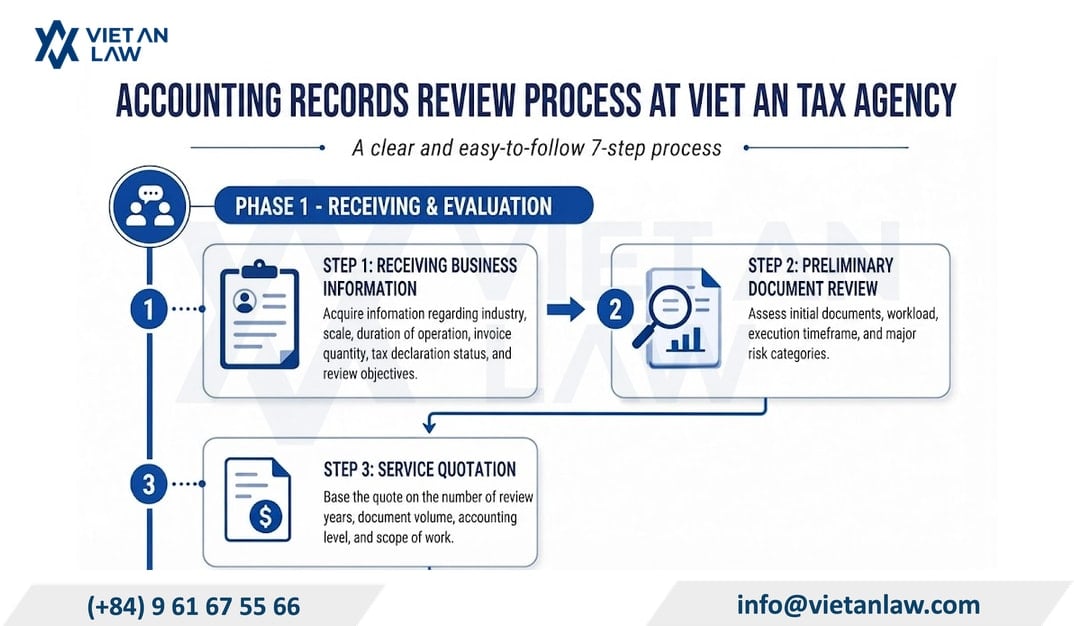
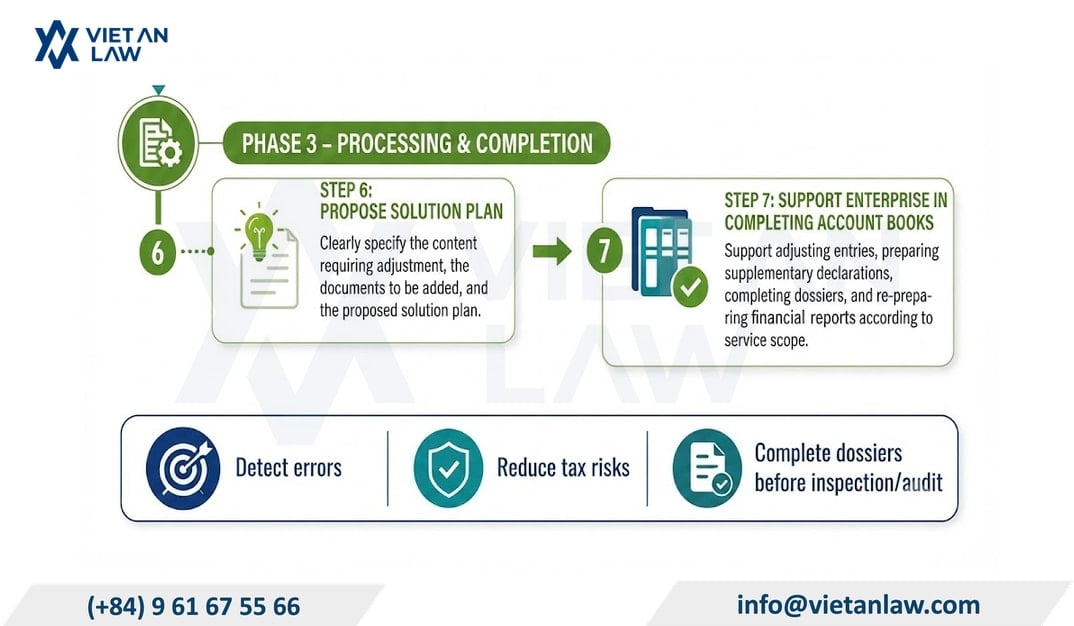
Accounting records review process at Viet An Tax Agency
Accounting record review service fee in Vietnam
Service fees are determined based on the specific circumstances of each business, including:
- Number of fiscal years to be audited;
- Number of invoices and supporting documents;
- Scale of operation;
- Business sector;
- Number of employees;
- Status of complete accounting records;
- Number of tax types to be reviewed;
- Scope of adjustments and document completion;
- Request for resubmission of tax returns or financial reports.
The typical service fee is from VND 5,000,000 per audit. The specific fee may vary depending on the volume of documents, the level of errors, and the required processing.
After receiving the initial documents, Viet An Tax Agency will conduct a preliminary check, determine the scope of work, and send a detailed quotation to the client.
Why choose Viet An Tax Agency?
Accounting audits are not just about checking figures; they also require evaluating the relationship between accounting documents, tax obligations, and the legal status of the business.
Viet An Tax Agency provides services based on a combination of knowledge in accounting, taxation, investment, and corporate law.
Key differences of our services include:
- The scope of the audit is designed according to the actual situation of each business;
- Simultaneous checking of accounting and tax risks;
- Clear classification of issues requiring immediate action, issues requiring adjustment, and issues requiring continued monitoring;
- Providing specific corrective actions for each error;
- Can be coordinated with tax accounting services, financial reporting, and business consulting;
- Suitable for domestic and foreign-invested businesses;
- Capable of providing support before tax settlement, dissolution, capital transfer, or M&A;
- Protecting the financial, tax, and internal transaction information of clients.
Through the review process, businesses not only identify errors that have occurred but also have a basis to improve their accounting system, enhance the quality of internal control, and mitigate risks in subsequent periods.
Distinguishing between accounting record review and financial statement audit in Vietnam
| Criteria | Accounting records review | Financial statement audit |
|---|---|---|
| Purpose | Detect errors in documents, journal entries, tax declarations, accounting ledgers, and financial statements to guide enterprises on adjustments. | Express an auditor’s opinion on whether the financial statements are presented true and fairly. |
| Scope of verification | Accounting vouchers, invoices, journal entries, detailed ledgers, general ledgers, tax reports, financial statements, and related records. | Mainly focus on financial statements, internal control systems, and related audit evidence. |
| Operational basis | Based on legal regulations on accounting, tax, and the scope of work requested by the enterprise. | Conducted in accordance with procedures, auditing standards, and relevant legal regulations. |
| Performed by | Accountants, accounting-tax consultants, or tax accounting service providers. | Practicing auditors and eligible auditing firms as prescribed by law. |
| Work output | Report on errors, risks, data discrepancies, and proposed solutions to adjust and perfect accounting records. | Audit report accompanied by the auditor’s opinion on the financial statements. |
| Legal value | Serves as advisory and support for the enterprise to complete accounting records and minimize tax risks. | Holds independent verification value and is used for purposes required by law, investors, banks, or regulatory authorities. |
| Mandatory nature | Optional; proactively conducted by the enterprise when needing to inspect and perfect accounting records. | Mandatory for foreign-invested enterprises (FDI enterprises) and other entities subject to statutory audit as prescribed by law. |
| Substitutability | Cannot replace financial statement audits in cases where the enterprise is subject to mandatory audit. | Satisfies mandatory audit requirements when performed by an eligible audit firm. |
| Suitable timing | Can be conducted periodically, prior to tax finalization, prior to auditing, or when the enterprise detects signs of data discrepancies. | Usually conducted after the end of the accounting period and once the enterprise has prepared its financial statements. |
| Relationship between the two services | Enterprises can review accounting records before auditing to detect and resolve errors, standardizing vouchers and data. | The audit process can proceed more smoothly when accounting records and financial statements have been fully reviewed and adjusted. |
Some questions related to accounting services in Vietnam
After the review, does Viet An provide guidance on handling errors?
Yes. Viet An Tax Agency will compile the errors, assess the risk level, and guide businesses in supplementing documents, adjusting data, or handling specific issues.
Can incomplete accounting records from many years be reviewed?
Yes. Viet An can review them year by year, by tax type, or by group of transactions. High-risk items will be prioritized.
Do businesses with no revenue need a review of their accounting records?
Yes. Businesses without revenue may still have expenses, capital contributions, salaries, bank fees, and other accounting transactions that need to be fully recorded.
Can each type of tax be reviewed separately?
Yes. Businesses can request a separate review of VAT, corporate income tax, personal income tax, or a specific group of records. Viet An will advise on the appropriate scope after a preliminary check.
How long does the accounting record review take?
The time required depends on the number of years to be reviewed, the number of documents, the condition of the books, and the scope of work. Viet An will notify you of the specific timeframe after receiving your application.
How much does an accounting book review cost?
The cost is determined based on the number of years to be reviewed, the number of invoices, the level of completeness of the books, and the required processing. Viet An will conduct a preliminary check and send a detailed quote.
When should a business review its accounting books?
Businesses should review their books before tax settlement, tax audits, financial statement preparation, borrowing capital, capital transfer, dissolution, or M&A transactions.
Contact Viet An Tax Agency to review your records and receive appropriate solutions.
Tax Expert: Ms. Nguyen Thi Ngoc Diep
Hotline/Zalo/ WhatsApp: 0961 37 18 18.