(+84) 9 61 67 55 66
info@vietanlaw.vn

Electronic Labor Contracts in Vietnam: New Standards under Decree 337/2025

Electronic labor contracts in Vietnam is becoming an inevitable trend in the context of strong digital transformation at enterprises. Aiming to create a unified legal corridor for signing online labor contracts, the Government has issued Decree 337/2025/ND-CP, officially setting standards for electronic labor contracts applicable from 2026. This Decree not only clarifies the legal validity of signing a digital employment contract online but also specifies the forms, conditions for execution, and responsibilities of parties when concluding contracts in the digital environment.

Table of contents

Hide

    Electronic labor contracts have the same legal validity as paper documents

    According to Clause 1, Article 14 of the Labor Code 2019, labor contracts are no longer limited by traditional paper forms but can be legally executed in a digital environment.

    Accordingly, a labor contract concluded via electronic means in the form of a data message in accordance with the law on electronic transactions has the same validity as a written labor contract.

    To concretize and unify practical application, Clause 1, Article 3 of Decree 337/2025/ND-CP continues to clarify the concept and legal validity of electronic labor contracts:

    “An electronic labor contract is a labor contract concluded and established in the form of a data message in accordance with labor laws and laws on electronic transactions, having the same legal validity as a written paper labor contract.”

    This regulation creates a full legal basis for enterprises and employees to confidently sign labor contracts online, while promoting the digital transformation process in human resource management.

    Conditions for executing electronic labor contracts via eContract

    The information system serving electronic transactions in concluding and performing electronic labor contracts (hereinafter referred to as eContract) is linked to the Electronic Labor Contract Platform to allow employees and employers to create, digitally sign, store, retrieve, and manage electronic labor contracts, as well as report on labor usage and authenticate electronic labor contracts.

    According to Clause 1, Article 6 of Decree 337/2025/ND-CP, the conclusion of electronic labor contracts via eContract must ensure the following conditions:
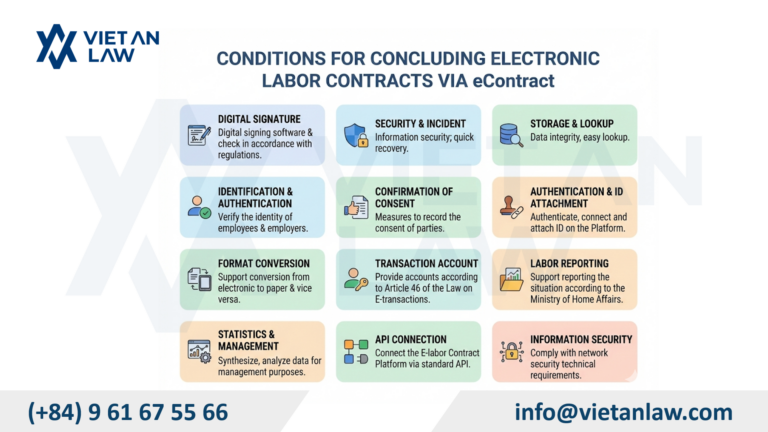
    Conditions for executing electronic labor contracts via eContract

    • Digital Signature: Have digital signature software and check digital signatures in accordance with the law.
    • Security & Incident: Ensure customer information safety; have technical plans to maintain and quickly remedy incidents.
    • Storage & Lookup: Ensure data integrity and the ability to look up contracts easily.
    • Identification & Authentication: Have functions to authenticate the correct identity of the employee and employer.
    • Confirming Consent: Have technical measures to record that parties have agreed to the contract content.
    • Authentication & ID Attachment: Have functions to authenticate electronic contracts and connect to attach IDs on the shared Platform.
    • Format Conversion: Support flexible conversion from electronic contracts to paper documents and vice versa.
    • Transaction Account: Provide accounts complying with Article 46 of the Law on Electronic Transactions.
    • Labor Reporting: Support reporting on labor usage in the format of the Ministry of Home Affairs.
    • Statistics & Management: Have functions to aggregate and statistically analyze data to serve periodic or ad-hoc management.
    • API Connection: Link with the Electronic Labor Contract Platform via standard application programming interfaces.
    • Information Security: Strictly comply with technical requirements on cyber information security.

    Meeting these conditions fully is not only a mandatory legal compliance requirement but also the “key” for enterprises to successfully implement HR digital transformation.

    This new eContract system establishes a maximum safety corridor by tightening identification and data integrity, helping to minimize labor dispute risks. Simultaneously, API connectivity and reporting automation will help HR departments significantly cut operation time and costs compared to traditional signing methods.

    However, it should be noted that according to Clause 4, Article 6 of Decree 337/2025/ND-CP, electronic labor contracts must not only be signed and stored on the system of the enterprise or service provider but must also be sent to the Electronic Labor Contract Platform to be assigned an identification code (ID) in accordance with the regulations of the Ministry of Home Affairs.

    Within 24 hours from the time the last party digitally signs, the eContract provider is responsible for transferring the completed contract to this platform.

    Requirements for identification and identity authentication of employees and employers

    Another new foundational point of Decree 337/2025/ND-CP is the requirement to identify the correct contracting subject

    According to Clause 2, Article 6 of Decree 337/2025/ND-CP, employers and employees must ensure the following conditions:

    For individuals

    Identity authentication is performed through valid documents such as citizen identification cards, electronic identification, level 2 electronic identification accounts, or valid passports.

    For employees who are foreign nationals, the system must also check the visa status; or documents proving visa exemption.

    For enterprises, agencies, organizations, cooperatives, households

    For agencies or organizations, signing electronic labor contracts requires full legal files proving legal status along with identification papers and the digital signature of the legal representative.

    This is the point where enterprises are most prone to risks if they do not carefully review signing authority, especially in corporations, branches, or enterprises with multiple management levels participating in signing contracts.

    Authenticating the correct subject from the beginning not only helps the contract have solid legal validity but also limits disputes related to signing authority, contract validity, and legal liability of the parties.

    Electronic labor contracts take effect from the time the last party digitally signs

    Decree 337/2025/ND-CP specifically regulates the effective time of electronic labor contracts, helping to eliminate previous disputes related to the time rights and obligations of parties arise.
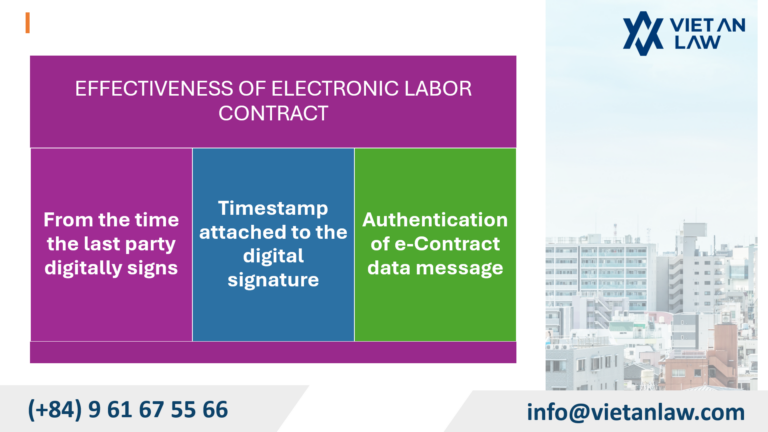
    Electronic labor contracts take effect from the time the last party digitally signs

    According to Article 7 of Decree 337/2025/ND-CP, an electronic labor contract takes effect from the time the last party digitally signs, accompanied by a timestamp and data message authentication by the eContract provider, unless the parties have another agreement.

    Not stopping at initial validity, the Decree also allows the amendment, supplementation, suspension ; or termination of electronic labor contracts to be performed entirely electronically.

    For contracts previously signed in paper form, enterprises can convert to electronic contracts to continue managing and adjusting according to the digital process, provided they meet all conditions according to regulations.

    Questions and Answers regarding Electronic Labor Contracts in Vietnam: New Standards under Decree 337/2025

    How to sign labor contracts via phone/email?

    The signing of a contract is not “sending files back and forth via email” but is done through a secure link:

    • Via Email: The employer sends a link via the eContract system. You click the link, the system requests authentication (eKYC/OTP), and then allows digital signing.
    • Via Phone: Perform on a mobile web browser or specialized application (Zalo/Internal App). The process is similar to email but optimized for touch screens.

    Do electronic contracts have legal validity in disputes?

    Electronic contracts have value equal to paper versions according to Clause 1, Article 3 of Decree 337/2025/ND-CP. According to this:

    • When there is a dispute, System Log Data (Transaction Log) and ID Codes are the most important original evidence, not merely the PDF file.
    • According to Clause 1, Article 14 of Decree 337/2025/ND-CP, management data includes information on transaction logs, transaction event chains, data messages, authentication times, IDs, along with technical data (metadata).
    • The PDF file is just a display form, while the evidence lies in the log files recording every second of your actions.

    Digital signatures in Labor Contracts: Which signature is valid?

    Decree 337/2025/ND-CP (Article 6.2.c) requires a Digital Signature and Timestamp. Accordingly, accepted types of digital signatures include:

    • USB Token (Plugging hardware into the computer);
    • Remote Signing (Remote digital signature stored on Cloud, signed via App); etc..

    Regulations on how long to store electronic files? Is it necessary to print to paper for hard copy storage?

    • Storage duration: Must comply with the Law on Archives and Data Law. Typically, HR records/labor contracts must be stored for at least 05 – 10 years (or permanently for some core information).
    • Printing to paper: Not mandatory. The electronic version has the same value as the original. Only print when needed for comparison or submitting paper files.

    What are the advantages of electronic labor contracts?

    • Simplifies labor contract conclusion procedures, increasing flexibility in both space and time for concluding labor contracts.
    • Modernizes enterprise management, helping enterprises save time, costs ; save personnel, and space for managing and storing records….
    • Increases the level of safety and security of labor contract information, increases transparency and publicity in concluding and performing labor contracts (authenticating information of employees, enterprises…) ; minimizes risks related to errors in providing information by parties, storage, and management of labor contracts.
    • Convenient in resolving public services related to labor contracts (such as unemployment insurance, social insurance…).

    From July 1, 2026, the electronic labor contract platform eContract will officially go into operation.

    From this time, the conclusion and performance of electronic labor contracts will be implemented synchronously nationwide, marking an important transformation in labor management and administrative digitization.

    When labor contracts are standardized, authenticated, and centrally managed, not only do enterprises reduce administrative costs and increase transparency, but employee rights are also more clearly guaranteed, limiting disputes.

    For HR administrators, this is not just a change in signing tools, but a turning point liberating HR from manual administrative tasks, creating a premise to build a professional, safe, and lean digital employee experience.

    The above is an update on regulations under Electronic Labor Contracts in Vietnam: New Standards under Decree 337/2025. If customers have questions or need advice on concluding electronic labor contracts, please contact Viet An Law for the best advice and support!
    Related Acticle

    Vietnam Labor Export Regulations 2026: 5 Key Changes in Decree 372/2025

    Vietnam Labor Export Regulations 2026: 5 Key Changes in Decree 372/2025

    Vietnam Labor Export Regulations 2026 updated by Decree 372/2025. Discover 5 key changes: simplified licensing, online notifications, reduced deposits, and new Taiwan-Japan requirements.
    Decree 353/2025/ND-CP: Guiding Vietnam’s Law on Digital Technology Industry

    Decree 353/2025/ND-CP: Guiding Vietnam’s Law on Digital Technology Industry

    Decree 353/2025/ND-CP guides Vietnam's Digital Technology Industry Law with 4 preferential policies, 5 HR criteria, and sandbox testing mechanism effective 2026.
    Vietnam IP Law 2025 Update: Copyright Exceptions for AI Model Training

    Vietnam IP Law 2025 Update: Copyright Exceptions for AI Model Training

    Vietnam IP Law 2025 allows AI training using published works from April 2026. Learn copyright exceptions, legal requirements, and restrictions for AI model training.
    Vietnam’s Amended Law on Insurance Business 2025: Compliance New regulations

    Vietnam’s Amended Law on Insurance Business 2025: Compliance New regulations

    Vietnam's Amended Law on Insurance Business 2025 explained. Key compliance regulations, reduced barriers, new investment rules, and simplified procedures effective January 2026.
    Vietnam Household Business Accounting: New Guidelines under Circular 152/2025/TT-BTC

    Vietnam Household Business Accounting: New Guidelines under Circular 152/2025/TT-BTC

    Vietnam Household Business Accounting new guidelines under Circular 152/2025/TT-BTC effective 2026. Learn 5 key changes: mandatory records, relative accountants, retention rules.

    CONTACT VIET AN LAW

    In Hanoi: (+84) 9 61 67 55 66
    (Zalo, Viber, Whatsapp, Wechat)

    WhatsApp Chat

    whatsapp-1

    In Hochiminh: (+84) 9 61 67 55 66
    (Zalo, Viber, Whatsapp, Wechat)

    WhatsApp Chat

    whatsapp-1

    ASSOCIATE MEMBERSHIP