(+84) 9 61 67 55 66
info@vietanlaw.vn

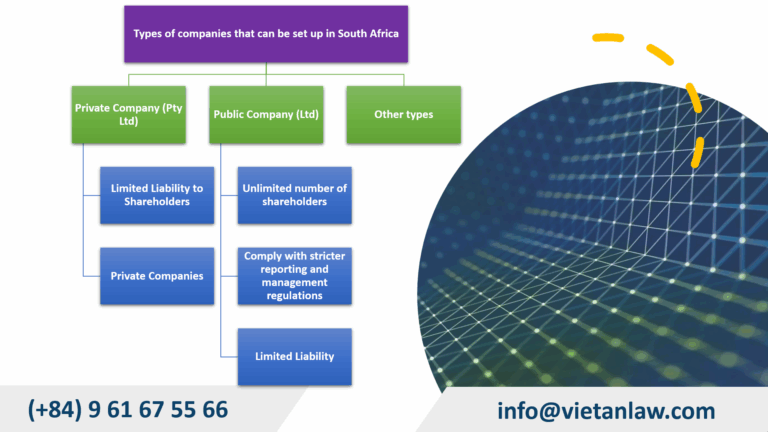
Types of companies that can be set up in South Africa

In the context of the constantly fluctuating global economy, South Africa is now emerging as a promising destination for company formation and international business expansion. With its strategic location as a gateway to the vast African market, along with the continent’s leading developed infrastructure, South Africa is currently known as a relatively stable business environment with a lot of growth potential. In particular, the resurgence of business confidence and opportunities in emerging sectors such as renewable energy and financial technology further strengthens the reason to choose South Africa as the location for your business’s next move. Regarding types of companies can investors establish in South Africa, Viet An Law would like to provide some information through the article below.
Types of companies that can be set up in South Africa

Types of companies that can be set up in South Africa

Private Company (Pty Ltd)

In South Africa, Private Companies, abbreviated as Pty Ltd (Proprietary Limited), are the most popular type of established business, especially favored by domestic and international investors. This type has the following main characteristics:

  • Limited Liability to Shareholders: This means that there is a clear legal separation between the company and the individuals who are the owners (shareholders). In the event that the company encounters debts, financial obligations, or legal issues, the personal assets of the shareholders will be protected. The financial responsibility of each shareholder is limited to the amount of capital they have contributed or committed to contribute to the company.
  • Unlike public companies, Private Companies are not allowed to offer shares to the public. In addition, the transfer of shares is often restricted by the company’s charter or agreements between existing shareholders, ensuring privacy and internal control.

Public Company (Ltd)

A Public Company is an ideal type of company for businesses that plan to expand their scale and raise a significant amount of capital from the public. The main purpose of this type is to allow the company to sell shares to the public, which usually comes with listing on a stock exchange. This type has the following main characteristics:

  • Unlimited number of shareholders: Retail individual investors to large financial institutions can become shareholders through the purchase of publicly offered shares.
  • Comply with stricter reporting and management regulations than a private company. Public Companies are subject to strict supervision by regulatory bodies (such as the Companies and Intellectual Property Commission – CIPC and the Johannesburg Stock Exchange – JSE if listed). They are obliged to disclose financial information and business activities in a transparent and regular manner (e.g., quarterly and annual reports), organize the Annual General Meeting of Shareholders and comply with strict corporate governance standards to protect the interests of the majority of shareholders.
  • Limited Liability: Their liability for the company’s debts or liabilities is limited to the value of the shares they own. This encourages investors to participate in the company without fear of losing more than the amount they have invested.

Some other company types can be set up in South Africa

Company Type Main features Responsibility Purpose/Conformity
Personal Liability Company (Inc.) Often used for professional professions. Directors (current and former) are jointly and severally liable together with the company for debts/obligations. Professional associations (lawyers, engineers, accountants, etc.).
Non-Profit Company (NPC) Established for public interest or charitable purposes. Do not share profits with members. Usually limited liability (of executives/managers). Charity, non-governmental, community, cultural and social organizations.
Sole Proprietorship Owned and operated by a single individual. There is no legal separation. Unlimited Liability: The owner is liable with the entire personal property. Individual business is small, operates independently, and has little risk.
Partnership Established by two or more individuals/legal entities doing business together under an agreement. Unlimited liability: Partners are often jointly and severally liable for debts. Two or more people want to do business together, share profits and risks.
External Company / Branch As a branch of the company established outside of South Africa, it operates in South Africa. The overseas parent company has unlimited liability for the obligations of the South African branch. The foreign company wants to expand its operations or establish a presence in South Africa as a branch.

Fast & Reliable Legal Assistance
Fill out the form below and get connected with a lawyer quickly.

    Related Acticle

    Procedures for Establishing a Company Branch in Hanoi (2026 Guide)

    Procedures for Establishing a Company Branch in Hanoi (2026 Guide)

    Complete guide to company branch registration in Hanoi 2026: requirements, procedures, costs, and address selection. Expert legal support for Vietnamese and foreign enterprises establishing branches in Vietnam.
    US Trademark Registration in Vietnam (brand protection)

    US Trademark Registration in Vietnam (brand protection)

    Protect your brand with US Trademark Registration in Vietnam. Understand the first-to-file rule, application steps, and legal requirements.
    Circular 55/2026/TT-BTC on Investment Forms: Key 2026 Updates for Businesses

    Circular 55/2026/TT-BTC on Investment Forms: Key 2026 Updates for Businesses

    On May 15, 2026, the Ministry of Finance promulgated Circular 55/2026/TT-BTC prescribing the forms of documents and reports related to investment activities in Vietnam and investment promotion. This represents a…
    Timeframe for company formation in Vietnam 2026

    Timeframe for company formation in Vietnam 2026

    Company formation in Vietnam 2026 takes 3-5 days for domestic enterprises and 18-35 days for FDI companies. Complete guide to registration timelines and requirements.
    Outbound Investment Under VND 7B (2026): No IRC Required

    Outbound Investment Under VND 7B (2026): No IRC Required

    Outbound Investment under 7 billion VND in Vietnam (2026): No IRC required for non-conditional sectors. Learn declaration, foreign exchange registration & compliance steps.

    CONTACT VIET AN LAW

    In Hanoi: (+84) 9 61 67 55 66
    (Zalo, Viber, Whatsapp, Wechat)

    WhatsApp Chat

    whatsapp-1

    In Hochiminh: (+84) 9 61 67 55 66
    (Zalo, Viber, Whatsapp, Wechat)

    WhatsApp Chat

    whatsapp-1

    ASSOCIATE MEMBERSHIP