Vietnam Tax Administration Law 2025: Key Changes to Filing & Payment from 7/2026
The Vietnam Tax Administration Law 2025 represents a major shift in the regulatory landscape, fundamentally transforming how taxpayers and authorities interact through automated income reconciliation and enhanced oversight of e-commerce activities. To mitigate legal risks and optimize cash flow before the new regulations take effect, it is essential to stay informed about the Vietnam Tax Administration Law 2025: Key changes to filing & payment from 7/2026. Join Viet An Law as we provide a comprehensive breakdown of the most critical updates to tax declarations and payment procedures that will reshape compliance requirements starting July 1, 2026.
Table of contents
Hide
Vietnam Tax Administration Law 2025: Key changes to filing & payment from 7/2026
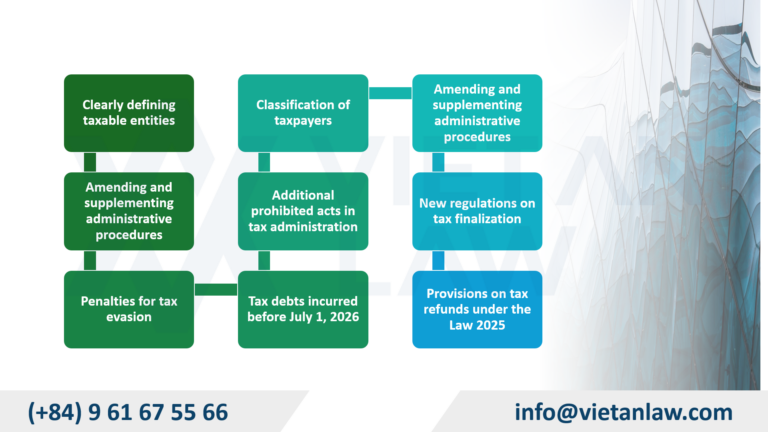
Clearly defining taxable entities: Including both foreign organizations and individuals
Previously, the concept of taxpayers was defined quite generally, only listing basic groups such as organizations, households, business households, and individuals paying taxes according to the law. This way of expressing it grouped domestic and foreign entities together, without clearly separating the obligations of non-resident entities.
Conversely, with the new regulations in Clause 1, Article 2 of the Tax Administration Law 2025, the regulations on taxpayers have been specified more clearly, especially with the emergence of two new groups of entities: foreign organizations and individuals with income in Vietnam, and particularly those operating on e-commerce and digital platforms.
This clear legalization not only ends the debate over taxable entities but also places direct legal responsibility on foreign suppliers and e-commerce platforms, while clarifying the obligations of those withholding and remitting taxes in the context of digital transformation.
Classification of taxpayers in tax administration
This is a new regulation added to Article 3 of the Tax Administration Law 2025. Specifically:
The tax authority will categorize taxpayers according to the following criteria:
Determine priority regimes for taxpayers in tax administration and allocate management resources;
Apply tax management measures, monitor tax compliance, and implement tax management procedures appropriate to each taxpayer subgroup;
Apply methods for analyzing and evaluating tax risk levels, tax law compliance levels of taxpayers, and their compliance history.
The criteria for classifying taxpayers include:
Industry, sector, specific characteristics, and operating methods;
Legal form and ownership structure;
Scale of operation, revenue scale, and tax contributions;
Level of compliance and history of compliance with tax laws by the taxpayer;
Amending and supplementing administrative procedures
Regarding administrative procedures, the Tax Administration Law 2025 does not introduce any new administrative procedures, but amends and supplements 7 existing administrative procedures, which are grouped as follows:
Tax registration
Tax declaration, other revenue declaration, tax calculation, other revenue calculation, tax deduction
Tax payment, other revenue payment, late payment penalties, fines; extension of tax payment, other revenue payment, late payment penalties, fines; handling of overpaid taxes, other revenue, late payment penalties, fines; handling of late payment of taxes, other revenue
Tax refund; tax exemption, other revenue exemption, tax reduction, no tax collection, not subject to tax
Tax debt write-off, tax debt cancellation
Tax audit
Tax assessment
Amending and supplementing to regulations on digital transformation
According to Articles 32, 33, and 35 of the Tax Administration Law 2025, which regulate the infrastructure, systems, and application of technology in tax administration, specifically:
Article 32 of the Tax Administration Law 2025 stipulates that priority should be given to the application of modern information technology and automation in data collection, processing, and assessment of compliance levels and risk levels.
Article 33 of the Tax Administration Law 2025 stipulates that tax authorities shall apply the Tax Management Information System to integrate and process data to serve the application of risk management and automation in tax administration operations.
Article 35 of the Tax Administration Law 2025 stipulates that tax authorities will apply a mechanism for automatically issuing notices, administrative decisions, and tax documents through the Tax Management Information System. These documents will be digitally signed and have the same legal validity as paper documents. In particular, the entire processing history will be stored in the system, allowing taxpayers to easily search, provide feedback, or make suggestions directly on the digital platform.
Additional prohibited acts in tax administration
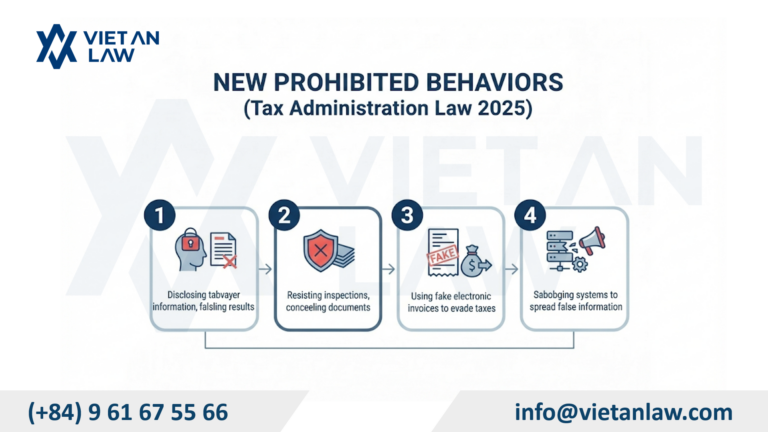
Article 8 of the Tax Administration Law 2025 adds several prohibited acts, such as:
Prohibited acts in tax administration
Abusing one’s position or authority to disclose or leak taxpayer information in violation of regulations. Falsifying the results of tax audits and handling of tax law violations.
Resisting, delaying, or failing to provide information and documents for tax audits and supervision of other revenue.
Creating illegal electronic invoices or documents to facilitate violations in the field of tax administration.
Falsifying, misusing, illegally accessing, or destroying taxpayer information systems. Providing or disseminating false information that affects the reputation and operations of tax authorities, tax administration information systems, and taxpayers.
New regulations on tax settlement under the Vietnam tax law update
Reduce the deadline for filing supplementary tax dossiers
According to Clause 5, Article 12 of the Tax Administration Law 2025, taxpayers who discover errors or omissions in their tax returns or other payments already submitted to the tax authorities are allowed to submit supplementary tax returns or other payments within 5 years from the deadline for submitting the tax returns or other payments for the tax period with errors or omissions in the following cases:
Before the tax authority or competent authority announces the inspection or audit decision;
The dossier does not fall within the scope or period of the tax or other revenue inspection or audit as stated in the inspection or audit decision;
The dossier does not fall under the cases where the investigating agency requests that supplementary tax or other revenue declarations not be submitted to serve the investigation of the case…
Household businesses and individuals determine their own annual revenue to calculate taxes
Previously, the tax authorities would determine the amount of tax payable using a lump-sum tax method for business households and individual as stipulated in Article 51 of the Tax Administration Law 2019.
According to Article 13 of the Tax Administration Law 2025:
Household businesses and individual determine for themselves whether their revenue from the production and sale of goods and services is subject to tax or not.
They declare and calculate taxes for each type of tax according to the tax period. The tax authority will use the tax management database to provide information to support household businesses and individual in declaring and calculating taxes.
Supplementing regulations on tax declaration for e-commerce businesses of household businesses and individuals
Compared to the regulations issued in 2019, Article 13 of the Tax Administration Law 2025 has added provisions on tax declaration for e-commerce businesses of household businesses and individual:
For household businesses and individual owners conducting business on e-commerce platforms or other digital platforms:
In cases where business activities take place on e-commerce platforms or other digital platforms with online ordering and payment functions, the owner of the e-commerce platform or other digital platform (domestic or foreign) is responsible for deducting, declaring, and paying the deducted tax on behalf of the business household or individual business;
In cases where business activities take place on e-commerce platforms or other digital platforms without online ordering and payment functions, the business household or individual business directly declares, calculates, and pays taxes according to regulations.
Regulations on tax refunds will be in effect from 2026
Articles 18 and 19 of the amended and supplemented Law on Tax Administration 2025 provide for the mechanism of automatic tax refunds, exemptions, and reductions.
The tax authority implements automated tax refunds based on databases, risk management criteria, automated processing procedures, and information security. The tax authority is responsible for implementing automated tax refunds in stages, in accordance with actual conditions, infrastructure, and information technology applications.
The tax authority implements automated tax exemptions and reductions for taxpayers based on databases, risk management criteria, automated processing procedures, and information security. The tax authority is responsible for implementing automated tax exemptions and reductions in stages, in accordance with actual conditions, infrastructure, and information technology applications.
Tax debts incurred before July 1, 2026 will be handled according to the new law
Article 53 of the Law on Tax Administration 2025 stipulates:
Taxes that are exempted, reduced, or not collected according to the provisions of the relevant laws for each period, arising before July 1, 2026, shall continue to be processed according to the provisions of the Law on Tax Administration 2019.
Tax debts outstanding until June 30, 2026, shall be processed according to the provisions of the Law on Tax Administration 2025.
Penalties for tax evasion in 2026
According to Official Letter 307 dated January 19th, if tax authorities detect fraudulent activities or concealment of revenue leading to tax evasion, business households and individuals will be penalized according to Decree 125/2020, amended and supplemented by Decree 310/2025/ND-CP. Specifically, administrative violations related to taxes and invoices may result in a warning or a fine. The maximum fine is up to 200 million VND for organizations and 100 million VND for individuals violating tax procedures; 100 million VND for organizations and 50 million VND for individuals violating invoice regulations. Incorrect declarations are punishable by a 20% penalty for the evaded tax amount, while tax evasion is punishable by a penalty of 1-3 times the amount of tax evaded.
In addition to fines, individuals and organizations may have their invoice printing operations suspended. Violators are required to pay all outstanding and evaded taxes, late payment penalties, adjust tax declarations, comply with invoice regulations, and return any illegal profits. The specific penalty is determined based on the average of the penalty bracket, adjusted up or down by 10% for each circumstance; business households are subject to the same penalties as individuals. In serious cases, criminal prosecution for tax evasion may be initiated.
10 behaviors considered tax evasion from July 1, 2026
On December 10, 2025, the National Assembly passed the Law on Tax Administration 2025 (Law No. 108/2025/QH15). This law regulates the management of various taxes and other revenues belonging to the state budget.
Clause 4 of Article 45 of the Tax Administration Law 2025 stipulates 10 acts considered as tax evasion from July 1, 2026, as follows:
Failure to submit tax registration documents; tax returns; or submitting tax returns more than 90 days after the deadline for submitting tax returns or the extended deadline for submitting tax returns as prescribed by this Law, resulting in a shortfall in the amount of tax payable or an increase in the amount of tax exempted, reduced, or refunded;
Failure to record or document in the accounting books any income related to determining the amount of tax payable;
Failure to issue invoices and declare taxes when selling goods or services as required by law, or recording a value on sales invoices lower than the actual payment value of the goods or services sold in order to declare taxes;
Using illegal invoices or documents, or illegally using invoices or documents to account for purchased goods and services in activities that generate tax obligations, thereby reducing the amount of tax payable or increasing the amount of tax exempted, reduced, deductible, refunded, or not payable;
Using documents or records that do not accurately reflect the nature or actual value of the transaction to incorrectly determine the amount of tax payable, the amount of tax exempted, the amount of tax reduced, the amount of tax refunded, or the amount of tax not payable;
Making false declarations regarding exported or imported goods, and the violating individual or organization does not voluntarily rectify the consequences by paying the full amount of tax due as prescribed;
Intentionally failing to declare or making false declarations regarding taxes on exported or imported goods;
Colluding with consignors to import goods for the purpose of tax evasion;
Using goods that are not subject to tax, are exempt from tax, or are eligible for tax exemption for purposes other than those specified without declaring the change of purpose to the tax authorities;
Taxpayers conducting business during periods of business suspension or temporary suspension without notifying the tax authorities.
The above is the Vietnam tax payment regulations and filing changes 2026. For any related questions or legal advice regarding tax and accounting, please contact Viet An Law – Tax Agency for the best advice and support.
Fast & Reliable Legal Assistance
Fill out the form below and get connected with a lawyer quickly.
Discover high-growth industries for company incorporation in Singapore. Explore finance, IT, logistics, and consulting sectors with government incentives and market advantages.
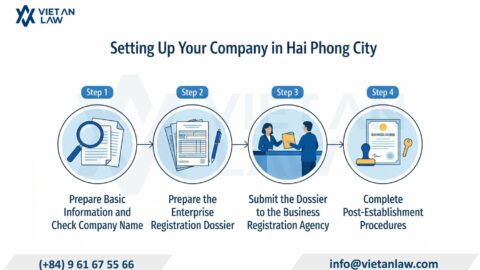
Hai Phong City merger 2025 guide: Complete information on business registration, company formation procedures, and administrative updates after the merger with Hai Duong province.
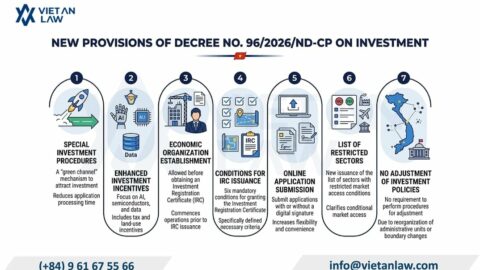
Decree 96/2026/ND-CP Guiding the Vietnam Investment Law 2025 introduces special investment procedures, new incentives for AI and semiconductors, and streamlined processes effective March 31, 2026.
Immigration consulting company establishment business lines in Vietnam explained. Complete guide to required licenses, registration procedures, and legal business codes for 2025.
Environmental company establishment business lines in Vietnam 2025. Complete guide to waste management, wastewater treatment, and environmental services registration procedures.