Vietnam E-commerce Law 2025: Key Regulations Taking Effect in 2026
Previously, e-commerce activities were mainly regulated by Decree 52/2013/ND-CP, while in practice, many complex business models arose, going beyond the current framework. Facing that urgent requirement, on December 10, 2025, the Law on E-commerce 2025 was officially passed. This is considered the latest Law on E-commerce, marking the first time Vietnam has a specialized law to comprehensively manage this field. Below, Viet An Law Firm will summarize notable new points in Vietnam E-commerce Law 2025: Key regulations taking effect in 2026.
Table of contents
Hide
Expanding the scope of application, not only traditional e-commerce trading floors but also covering many new types of platforms
One of the important new points of the Law on E-commerce is that the scope of regulation is significantly expanded compared to Decree 52/2013/ND-CP and Decree 85/2021/ND-CP. From July 1, 2026, the 2026 e-commerce trading floor regulations will not only apply to Shopee, Lazada, or TikTok Shop. The Law has covered newly arising platform models, including:
Specialized digital services: Platforms providing lottery services, online insurance.
Digital information intermediaries: Platforms with commercial elements (advertising, connecting transactions) even if not directly selling goods.
This expansion aims not only to protect the maximum benefits of consumers on every digital platform but also to create a fair competitive environment for all enterprises and help state agencies effectively manage cash flow and tax payment for online sales in new digital service fields.
Classification and identification of 4 e-commerce platform models
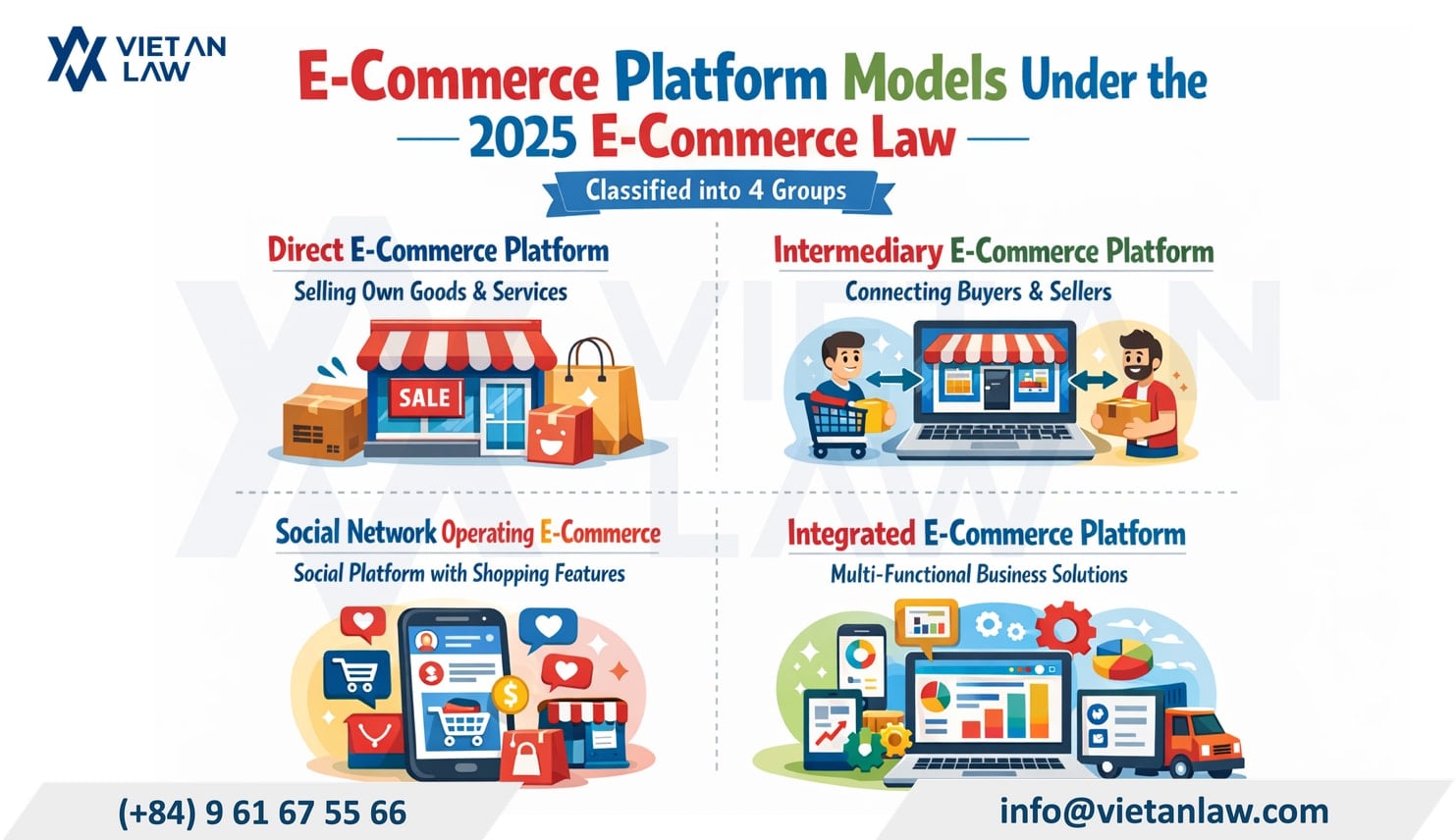
One of the core changes of the latest Law on E-commerce is the establishment of a transparent legal corridor for platforms. Clause 2, Article 3 of the Law on E-commerce 2025 has specifically classified 4 groups of subjects to apply corresponding legal responsibilities:
Direct e-commerce platform: Self-selling their own goods/services.
Intermediary e-commerce platform: Trading floors connecting buyers and sellers.
Social network operating e-commerce: Community platforms integrating buying and selling features.
Integrated e-commerce platform: Multi-functional models combining many business tools.
This stratification is based on 3 core function groups, including online ordering function; livestream sales function; and online communication/exchange function between subjects. On that basis, the law continues to classify platforms by scale, including ordinary e-commerce platforms and large e-commerce platforms.
Sellers must verify identity, provide business registration information, goods quality
“Official owner” identity verification and business information
This is a turning point in the 2026 e-commerce trading floor regulations. Article 21 of the Law on E-commerce prescribes that sellers are no longer allowed to be anonymous but must:
Provide identification data: Submit full personal or enterprise information to the floor owner to verify electronic identity.
Publicize registration information: Must clearly display the name, residence address (for individuals), or head office/business location (for business households, enterprises) exactly as registered with the State. This helps functional agencies strictly control tax payment for online sales.
Transparency of goods quality and labels
To protect consumers, the Law on E-commerce 2025 requires sellers to publicize:
Product information: Quality, usage, and related licenses.
Details of goods labels: Must fully display mandatory contents such as: expiry date, production lot number, chassis number, engine number (if any)… except for information that changes according to the production date.
Responsibility for defective goods: If goods are found to have defects, the seller is obliged to notify the floor to make it public, and at the same time perform a recall and compensate for damages to the client.
Specific regulations for trading floors with “Online Ordering” function
If doing business on Shopee, TikTok Shop, Lazada, or social networks with shopping carts, clients need to note further:
Payment account: Only allowed to use one’s own “official owner” bank account to transact on the platform. This is the basis for transparent cash flow and serving tax payment for online sales later.
Special industry licenses: For conditional business items (functional foods, drugs, cosmetics…), you must provide full licenses to the floor owner before posting for sale.
Cooperation with State agencies: Always be ready to provide business operation data upon request for inspection and examination.
Tightening management of Livestream and Affiliate marketing
The Law 2025 officially “fills” the legal gap regarding current sales forms via livestream and affiliate marketing:
For Livestream sales (Article 22): This is one of the most important new points of the Law on E-commerce. Accordingly, the platform owner is responsible for verifying the electronic identity of the livestreamer, and at the same time must store all audio and image data of the live session to serve inspection work. The Law also requires the floor to establish a complaint receiving channel right during the livestream to protect buyers. Especially, sellers are strictly prohibited from promoting false information about the use or quality of goods.
For Affiliate marketing (Article 25): The 2026 e-commerce trading floor regulations require the service provision unit to verify the identity of the marketer (KOLs, KOCs). At the same time, these platforms are responsible for controlling, preventing, and timely removing links leading to products and services that violate the law.
These regulations not only help ensure safety for the market and consumers but also create a solid premise for functional agencies to control cash flow and ensure individuals selling online pay taxes correctly according to the regulations of the latest Law on E-commerce.
Supplementing conditions for foreign e-commerce having e-commerce activities in Vietnam
To protect consumer rights and ensure fairness for domestic enterprises, Article 27 of the Law on E-commerce 2025 supplements conditions for foreign platforms having e-commerce activities in Vietnam:
Legal presence: Foreign trading floors using the Vietnamese language or having a “.vn” domain name must establish a legal entity or appoint a representative in Vietnam.
Deposit obligation: Platforms without a head office in Vietnam are required to make a deposit at a bank to ensure compensation for users and fulfill full tax obligations (including tax payment for online sales for foreign sellers generating revenue in Vietnam).
Transparent algorithms and consumer protection in e-commerce
The Law raises safety standards for the digital environment through regulations:
Seller verification: Only individuals/organizations that have verified electronic identity are allowed to do business.
Algorithm disclosure: Trading floors must be transparent about criteria for prioritizing goods display, avoiding market manipulation.
Support ecosystem: Clearly defining the responsibilities of logistics, payment, and e-contract authentication units in coordinating to handle violations.
E-commerce violations can result in platform locking, fines, and criminal handling
The Law on E-commerce prescribes very clearly in Article 39 regarding the handling of violations for individuals and organizations based on the severity and consequences caused.
Fines and administrative penalties
This is the most common sanction. Acts such as evading tax payment for online sales, providing false information, or not having business registration according to regulations will be fined according to the current legal framework.
“Killing” the booth and blocking access
Functional agencies have the right to:
Block access: Temporarily suspend or permanently suspend the transaction function of the platform/booth.
Remove account: Completely remove violating content and accounts on the e-commerce trading floor or social network.
Remove title: Withdraw the name from the list of reputable e-commerce platforms confirmed or registered by the Ministry of Industry and Trade.
Forced compensation for damages
If the violation act (such as selling counterfeit goods, poor quality goods, leaking client information) causes damage to the buyer or related parties, the seller is obliged to:
Financial compensation: Refund and compensate for actual damages according to legal regulations.
Remedying consequences: Restore rights and honor for the injured party.
Criminal prosecution
In case business activities show signs of crime (fraud to appropriate property on a large scale, trading in banned goods, cross-border financial fraud…), the violating subject will be considered for criminal handling according to the Penal Code.
It can be seen that the newly enacted Law on E-commerce 2025 will contribute to minimizing commercial fraud, protecting the rights of consumers and genuine enterprises, and at the same time creating a more transparent, fair, and safe online business environment.
Summary of new points of Vietnam E-commerce Law 2025: Key regulations taking effect in 2026
Expanding the scope of application, not only traditional e-commerce trading floors.
Classification and identification of 4 e-commerce platform models.
Sellers must verify identity, provide business registration information, goods quality.
Tightening management of Livestream and Affiliate marketing.
Supplementing conditions for foreign e-commerce in Vietnam.
Transparent algorithms and consumer protection in e-commerce.
E-commerce violations can result in platform locking.
Above is the update on new regulations in Vietnam E-commerce Law 2025: Key regulations taking effect in 2026. If clients have related questions or have needs for legal advice on e-commerce activities, please contact Viet An Law Firm for the best advice and support!
Fast & Reliable Legal Assistance
Fill out the form below and get connected with a lawyer quickly.
Navigating the legal framework for the Alcohol Distribution License in Vietnam (2026): Requirements, Procedures & Costs is a critical compliance step for businesses aiming to operate at the highest level…
Learn how to start a sporting goods business in Vietnam with our complete guide. Covers business registration, legal requirements, capital needs, and company formation procedures.
Discover high-growth industries for company incorporation in Singapore. Explore finance, IT, logistics, and consulting sectors with government incentives and market advantages.
Change Business Registration in Saigon Ward, HCMC guide. Complete procedures, required documents, timelines, and online submission process for enterprises in 2025.
Hai Phong City merger 2025 guide: Complete information on business registration, company formation procedures, and administrative updates after the merger with Hai Duong province.