


In the rapidly growing creative economy, commercializing works through copyright transfer in Vietnam has become increasingly popular. However, to ensure legal security and mitigate potential future disputes, involved parties must thoroughly understand the governing legal framework. In this article, Viet An Law provides a detailed guide on contracts and essential procedures regarding copyright assignment activities.
General overview of copyright assignment in Vietnam
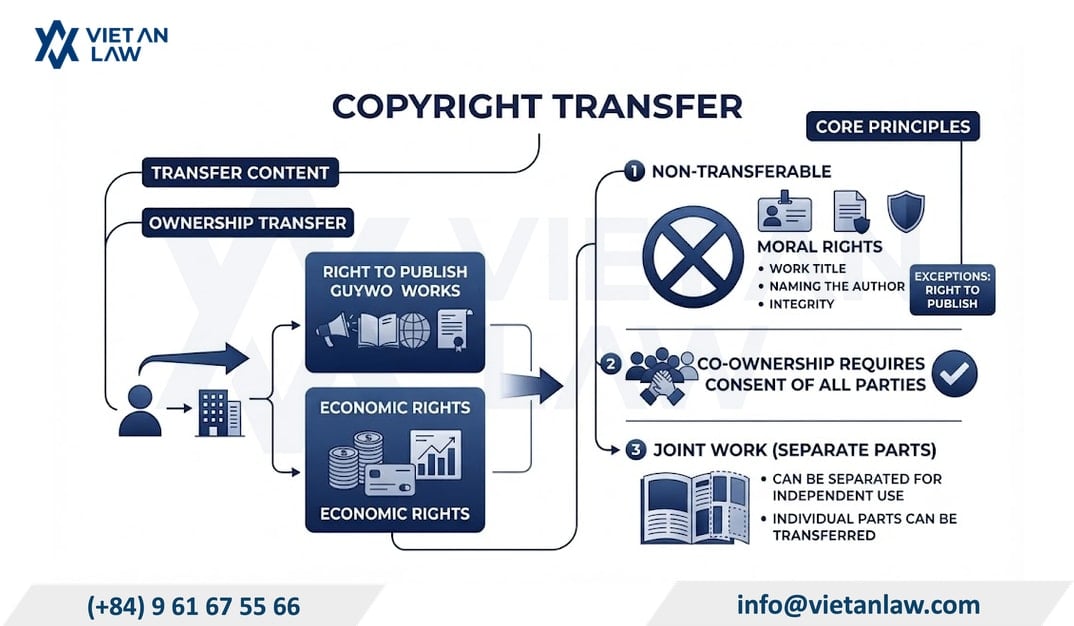
Pursuant to Clause 1, Article 45 of the Vietnamese Law on Intellectual Property, the copyright assignment involves the copyright owner transferring ownership rights – specifically the right to publish the work and economic rights – to another organization or individual via a contract or in accordance with relevant legal provisions.
When proceeding with an assignment, clients should note the following key regulations:
- Authors are not permitted to assign moral rights (such as the right to have their name attached to the work, the right to name the work, and the right to protect the integrity of the work), except for the right to publish the work.
- In cases where a work has co-owners, the assignment requires the agreement and consent of all co-owners.
- If joint work contains distinct parts that can be separated and used independently, an owner has the right to assign their specific portion of rights to another organization or individual.
Comparing copyright assignment and copyright licensing in Vietnam
In practice, many clients often confuse the transfer of copyright ownership with the granting of usage rights. Viet An Law provides the following comparison table to clarify the differences based on legal regulations:
| Criteria | Copyright assignment | Copyright licensing | |
| Legal basis | Articles 45 and 46 of the Law on Intellectual Property | Articles 47 and 48 of the Law on Intellectual Property | |
| Nature of transaction | The copyright holder permanently transfers ownership of transferable rights to another party | The copyright holder permits another organization or individual to use their rights for a specified term | |
| Scope of moral rights | Authors cannot transfer moral rights, except for the right to publish the work | Authors cannot license the rights to have their real name/pen name attached to the work or the right to protect the integrity of the work | |
| Rights of the transferee/licensee | The transferee becomes the new copyright owner of the transferred rights | The licensee is only permitted to use the work within the scope and term defined in the contract. The licensee may sub-license to another party if agreed upon by the copyright holder | |
Copyright Transfer in Vietnam: Contracts and Procedures
Legal regulations on copyright transfer agreements
For the assignment to take effect, the parties are required to enter into a contract. Pursuant to Article 46, Clause 1 of the Law on Intellectual Property, a copyright assignment contract must be made in writing and must include the following essential terms:
- Full names and addresses of the assignor and the assignee.
- Basis for the assignment.
- Price and payment method.
- Rights and obligations of the contracting parties.
- Liability for breach of contract.
The performance, amendment, termination, or rescission of this assigning copyright ownership contract shall be governed by the provisions of the Civil Code.
Procedures for registering changes to transfer of copyright in Vietnam
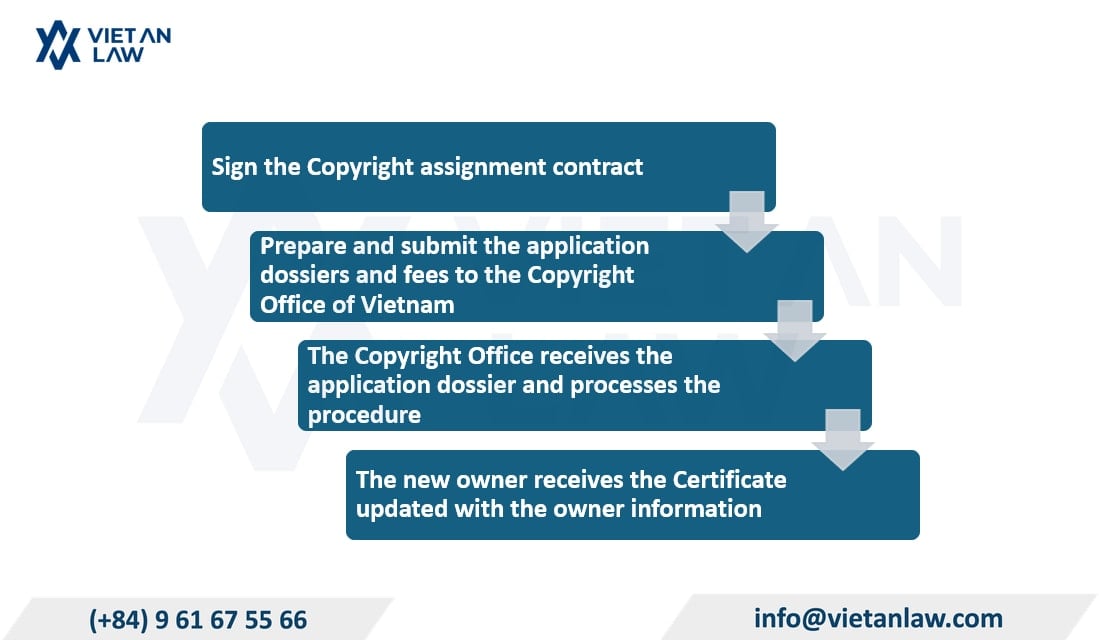 Under Clause 2, Article 49 of the Law on Intellectual Property, filing an application for a copyright registration certificate is not a mandatory procedure for enjoying copyright protection. However, if work has already been registered and a certificate issued, a procedure to reissue the certificate is required upon the transfer of rights to record the new owner.
The procedure involves the following steps:
- Required application documents (documents in foreign languages must be translated into Vietnamese):
- Copyright registration declaration: Use the prescribed form and fully complete information regarding the transferor, the transferee, the work, and the request for reissuance. The declaration must be signed or thumb printed by the new owner (or an authorized representative).
- Copyright transfer agreement
- Transfer price and payment method.
- Rights and obligations of the parties; liability for breach of contract.
- Copies of the work: 02 copies of the work subject to the transfer recordal request.
- Original copyright registration certificate.
- Power of attorney (if applicable):
- Written consent from relevant parties (in cases of joint ownership):
- Receiving agency and submission method
- Competent authority: Copyright Office or representative office of the Copyright Office.
- Submission method: Submit via the online public service portal.
- Fee payment: Pursuant to Circular 211/2016/TT-BTC, the fees for re-issuance of the Copyright Registration Certificate (due to a change of owner) are prescribed as follows:
- 50,000 VND: Applicable to works such as literary and scientific works, lectures, musical works, photographic works, articles, and folklore works.
- 150,000 VND: Applicable to architectural works; and sketches, diagrams, maps, and drawings related to topography or scientific works.
- 200,000 VND: Applicable to fine art works and applied art works.
- 250,000 VND: Applicable to cinematographic works and theatrical works (fixed on tapes or discs).
- 300,000 VND: Applicable to computer programs (software), data collections, or programs with similar modes of expression.
- Processing time and procedure: 12 working days, calculated from the date the competent state agency receives a complete and valid dossier.
Frequently asked questions about copyright transfer in Vietnam
Can an author sell all their moral rights?
An author cannot sell all their moral rights. Pursuant to Clause 2, Article 45 of the Law on Intellectual Property, an author may not transfer the moral rights specified in Article 19, except for the right to publish the work or to authorize others to publish it. Consequently, other moral rights inherent to the author – such as the right to name the work, the right to have their name associated with the work, and the right to protect the integrity of the work – cannot be transferred or sold in any form.
Is an oral copyright transfer agreement legally valid?
Under Clause 1, Article 46 of the Law on Intellectual Property, a copyright transfer agreement must be made in writing. The written contract must include essential details such as the names and addresses of the parties, the basis for the transfer, the price and payment method, the rights and obligations of the parties, and liabilities for breach of contract. Therefore, an oral transfer agreement may be deemed invalid.
Can one person unilaterally sell a work created jointly by multiple people?
Pursuant to Clause 3, Article 45 of the Law on Intellectual Property, if a work has co-owners, any transfer requires the agreement of all co-owners. However, if the work contains distinct parts that can be used independently, each co-owner has the right to separately transfer the copyright regarding their own distinct part.
Who becomes the copyright owner when anonymous work is transferred?
The organization or individual managing or receiving the transferred rights to anonymous work shall enjoy the rights of the copyright owner. Pursuant to Article 41, Clause 2 of the Law on Intellectual Property, this status of ownership remains in effect until the identity of the author or co-authors is established. Once the author’s identity is determined, ownership rights over the work, as well as related rights and obligations, shall be redetermined in accordance with the law.
What should be done if a state agency refuses to issue a replacement Certificate recording the transfer?
When refusing to issue a replacement Copyright Registration Certificate following a transfer, the competent state agency is required to notify the applicant in writing and clearly state the reasons. This requirement is stipulated in Article 55, Clause 1 of the Law on Intellectual Property. Based on the specific grounds and reasons provided by the competent agency in the written notice, the applicant may amend or supplement the necessary documents to finalize a valid application.
Copyright transfer transactions require a thorough understanding of the law to ensure security and avoid the risk of disputes. Viet An Law hopes that this article has provided you with valuable information. Please contact Viet An Law directly for timely and professional advice and procedural support.