Taxes for Establishing FDI Limited Companies in Vietnam
Limited Liability Companies (LLCs) are a popular business entity choice in Vietnam due to their flexibility, ease of management, and limited liability for assets. However, immediately after completing the establishment procedures, businesses must begin fulfilling their tax obligations as stipulated by law. This is a crucial step to operate legally and avoid penalty risks. A clear understanding of the types of taxes to be paid, declaration deadlines, and the process of fulfilling tax obligations will help new businesses save time and costs and operate more efficiently. In the article below, Viet An Law will provide clients with information about taxes for establishing FDI limited companies in Vietnam.
Table of contents
Hide
Taxes for Establishing FDI Limited Companies in Vietnam
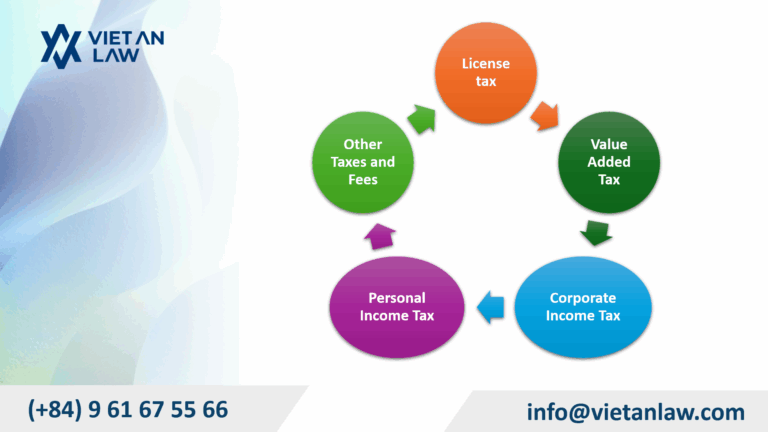
After obtaining the Enterprise Registration Certificate, businesses need to note the following basic taxes:
License tax
License tax is the tax that businesses and companies need to pay every year to the State to maintain their legal operating status.
The basis for generation: Immediately upon the enterprise being granted the Enterprise Registration Certificate and having a tax code.
Subject to fee: All LLCs, regardless of operational scale.
The rates of license tax: According to Decree 139/2016/ND-CP (amended and supplemented by Decree 22/2020/ND-CP), the business license tax rates are determined based on charter capital:
Charter capital over 10 billion VND: 3.000.000 VND/year.
Charter capital from 10 billion VND or less: 2.000.000 VND/year.
Branches, representative offices, business locations, public service units, and other economic organizations: 1.000.000 VND/year.
Note: In the first year, businesses may be exempt from business license tax if they register in accordance with preferential regulations.
Value Added Tax (VAT)
Value Added Tax is the tax calculated on the added value of goods and services arising during the process from production, and distribution to consumption.
The basis for generation: When the company sells goods or provides services subject to tax.
Tax calculation methods: Can apply either the credit method or the direct method.
Common tax rates: 0%, 5%, and 10%, depending on the type of goods or services.
Note: Immediately after establishment, the company needs to register a suitable VAT calculation method to ensure its rights regarding input tax credit.
Corporate Income Tax (CIT)
CIT is a direct tax, calculated on the taxable income that the company generates from its production and business activities.
The basis for generation: When the company makes a profit after deducting legitimate deductible expenses.
Standard tax rate: 20%.
Potential exemptions, and reductions: For businesses in industries or locations eligible for investment incentives as stipulated by law.
Note: Companies need to fully record invoices, documents, contracts,… to prove legitimate income and expenses and maximize eligible incentives.
Personal Income Tax (PIT)
The company is responsible for withholding Personal Income Tax from employees directly at the source and declaring and paying it on their behalf.
The basis for generation: When the company pays salaries, remuneration, and commissions,… to individuals whose income is subject to tax.
Calculation method: According to the partially progressive tariff (for long-term contracts) or a fixed rate (10%) for contracts under 3 months or services without signed contracts.
Note: Correctly determining the residency status and taxable income level of employees is a key factor for accurate tax calculation.
Other Taxes and Fees (if any)
Depending on the industry, an LLC may incur additional tax and fee obligations:
Special Consumption Tax: For businesses trading in alcohol, beer, tobacco, automobiles, prize-winning electronic games…
Environmental Protection Tax: Applicable to polluting products such as gasoline, coal, plastic packaging,…
Environmental protection fees in mineral exploitation, water resource usage fees, barcode registration fees…
Note: Before registering conditional business lines, businesses should thoroughly research related tax and fee obligations to avoid violations or unforeseen costs.
Key tax declaration and payment deadlines
Tax obligation
Declaration deadline
Payment deadline
License Tax
Within 10 days or the last day of the month after obtaining the Business Registration Certificate. For subsequent years, the License Tax declaration is due no later than January 30. (Once a year)
At the same time as submitting the declaration
VAT, PIT (quarterly)
No later than the 20th day of the month following the month in which the tax obligation arises for monthly declarations and payments;
No later than the last day of the first month of the quarter following the quarter in which the tax obligation arises for quarterly declarations and payments.
At the same time as submitting the declaration
CIT, PIT finalization
Before March 31 of the following year
At the same time as submitting the finalization declaration
Note: If a newly established business is formed in the last 6 months of the year and has revenue, it must still pay a business license tax for that year.
Initial tax declaration and payment process
After registering an LLC, businesses need to follow these steps to fulfill their initial tax obligations:
Step 1: Tax registration and digital signature purchase
Purchase and register a digital signature to perform electronic declarations.
Step 2: Open a business bank account and notify the account
Open an account at a commercial bank.
Send a notification of the bank account to the Department of Finance via the National Business Registration Portal.
Step 3: Submit declaration and License Tax (if not exempt)
Submit the license tax declaration within 30 days from the date of issuance of the Enterprise Registration Certificate if established after January 1st.
Submit via the electronic tax declaration system.
Step 4: Register VAT calculation method
Choose between the credit method or the direct method (if eligible).
Submit form 06/GTGT within 10 days before the invoice issuance date (if applying the credit method).
Step 5: Print and order invoices (or use e-invoices)
Register to use e-invoices with the tax authority.
Send notification of invoice issuance and sample invoice appendix.
Notes on tax declaration and payment for newly established LLCs
Identify the correct types of taxes to pay: Based on actual operations, businesses need to clearly identify appropriate tax obligations such as VAT, CIT, PIT, and other taxes (if any). Incorrect identification will lead to under-declaration or overpayment of taxes, affecting finances and reputation.
Apply accounting and tax software: Using software to support tax declaration and management helps businesses save time, increase calculation accuracy, and facilitate reconciliation with tax authorities when needed.
Comply with tax declaration and payment deadlines: Businesses need to closely monitor declaration periods and payment deadlines to avoid administrative penalties for late filing, incorrect declaration, or non-payment on time.
Maintain complete accounting records and tax documents: Accounting books, invoices, and tax-related documents must be stored according to regulations on time and format to serve inspection and examination by competent authorities.
Update local and central tax policies: Each locality may have specific regulations related to taxes, fees, and charges. Businesses should actively monitor guiding documents and announcements from the tax authorities where they are registered to operate.
Consult tax experts when necessary: For complex regulations or specific cases, consulting professional tax accountants or consulting firms will help businesses avoid errors and optimize tax obligations.
Establish clear and transparent accounting and tax procedures: Maintaining a systematic accounting system not only serves tax declarations well but also creates a solid financial management foundation for long-term development.
Support services for tax declaration and payment when establishing an LLC in Vietnam
Initial tax registration;
Submission of business license tax declaration;
Guidance on periodic tax declaration;
Registration for e-invoice usage;
Consultation on choosing appropriate tax calculation methods;
Preparation of financial statements and annual tax finalization.
Above is the advice of Viet An Law on the issue of taxes for establishing FDI limited companies in Vietnam. Clients who have related questions or need legal support, please contact Viet An Law Firm for the best support.
Fast & Reliable Legal Assistance
Fill out the form below and get connected with a lawyer quickly.
Discover high-growth industries for company incorporation in Singapore. Explore finance, IT, logistics, and consulting sectors with government incentives and market advantages.
Change Business Registration in Saigon Ward, HCMC guide. Complete procedures, required documents, timelines, and online submission process for enterprises in 2025.
Hai Phong City merger 2025 guide: Complete information on business registration, company formation procedures, and administrative updates after the merger with Hai Duong province.
Enterprise Registration Change in Xuan Hoa Ward, HCMC guide for 2026. Learn mandatory procedures, 10-day deadlines, online filing requirements, and avoid penalties up to 30M VND.