


A logo is a vital visual identifier that helps customers distinguish a business, product, or service from other entities in the market. It frequently appears across websites, signage, packaging, product labels, business documents, social media channels, mobile applications, and e-commerce platforms.
As a logo gains widespread exposure, the risk of it being copied, altered, or preemptively registered by third parties increases significantly. Therefore, individuals and businesses should establish a solid legal basis to protect their logos as soon as the design is finalized.
Under intellectual property law, a logo can be protected through two distinct mechanisms:
- Copyright registration protection as an applied art work;
- Industrial property rights as a figurative mark or a combined visual and text trademark.
These two forms of protection cover different legal aspects and do not replace each other.
In this article, “Logo copyright registration in Vietnam: Copyright or trademark protection?”, we will guide you through the logo copyright registration process and analyze how to strategically combine it with trademark registration to build a comprehensive protection strategy for your brand.
What is logo copyright registration in Vietnam?
Copyright registration for a logo in Vietnam is a common term used when individuals or organizations carry out procedures to establish and register intellectual property rights for their logo design at the competent state agency. Depending on its characteristics and intended use, a logo can be protected under two mechanisms: copyright registration for applied art works and trademark registration for signs used to distinguish goods and services.
For copyright, information about the author, owner, completion date, and characteristics of the logo are recorded in the Copyright Registration Certificate. For trademarks, the logo design, owner, and list of protected goods and services are recorded in the Trademark Registration Certificate.
Copyright for a logo arises from the moment the design is directly created and expressed in a certain physical form by the author. The arising of rights does not depend on whether the logo has been published, put into use, or registered with a state agency.
Although copyright registration is not a mandatory procedure, a copyright registration certificate still holds significant practical value. In the event of a dispute, the author or owner who has been granted the certificate is, in principle, not required to prove ownership, unless there is evidence to the contrary. Therefore, registering a logo copyright helps the owner strengthen their claim, reduce the risk of copying, and facilitates the handling of unauthorized use of the logo.
A logo can be protected under two types of IP rights in Vietnam
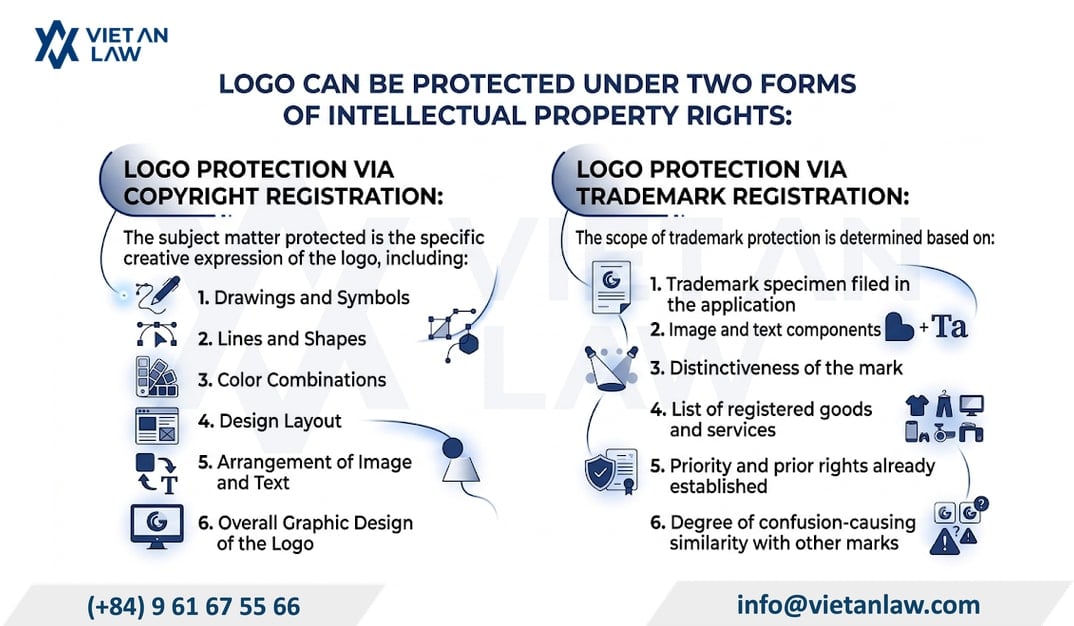
A logo can simultaneously be a copyrighted work and a sign used to distinguish goods and services in business operations.
Therefore, the same logo can be protected under two different intellectual property rights.
Logo protection via copyright registration
Logotypes often undergo copyright registration under the category of applied art works.
The protected subject matter is the specific creative expression of the logo, including:
- Drawings and symbols;
- Lines and shapes;
- Color combinations;
- Design layout;
- Arrangement of image and text elements;
- The overall graphic design of the logo.
Applied art works may include graphic designs representing emblems, brand identities, product packaging, and designs with aesthetic appeal linked to functionality. Therefore, a logo with a specific form of expression and creative imprint can be protected by copyright.
Copyright does not exclusively protect the idea behind the logo, the meaning of the symbol, the name, or the slogan as a standalone work. The scope of rights is determined based on the specific form of expression of the created work and the documents accompanying the registration application.
Logo protection via trademark registration
A logo can also be registered as a trademark if it is used or intended to be used to distinguish the owner’s goods and services from those of other organizations or individuals.
A trademark can be expressed in letters, words, drawings, images, or a combination of these elements.
Unlike copyright, trademark rights focus on protecting the commercial function of a logo. The scope of trademark protection is determined based on:
- The trademark sample submitted in the application;
- The figurative and textual components;
- The distinctiveness of the mark;
- The category of goods and services being registered;
- Priority rights and previously established rights;
- The degree of similarity or confusion with other trademarks.
The application process, classification, examination procedures, and costs for trademark registration should be referenced in Viet An Law’s trademark registration article, and not presented entirely in this logo copyright registration article.
Options for logo trademark registration in Vietnam
Depending on its structure and practical use, a logo can be registered as a figurative trademark or a trademark combining both image and text.
Register the logo as a figurative trademark
A figurative trademark is a sign whose main component is a symbol, drawing, or graphic element, excluding or independent of the brand name.
This registration option is suitable when:
- The symbol is used independently of the brand name;
- The figurative element is highly recognizable;
- The symbol is used as a representative image or application icon;
- The business frequently changes the position or presentation of the text;
- The owner wants to protect only the main visual element.
For example, a logo consists of a flower symbol and the brand name. If the flower symbol is often placed separately on packaging, uniforms, or applications, the business should consider registering the figurative element separately.
Registering a figurative trademark helps the owner protect the symbol in various presentations. However, a figurative trademark application does not automatically grant exclusive protection for the brand name if the name does not appear in the trademark design.
Register the entire logo including image and text
A combined trademark is a sign consisting of a graphic element and a textual element presented as a unified whole.
This is a common option for corporate logos, product logos, and service logos. The registration form may include:
- The symbol and name of the business;
- The image and name of the product;
- The brand name presented in a stylized manner;
- The graphic element, brand name, and slogan;
- A combination of image, text, and color.
When registering a combined graphic and textual element, rights are established primarily for the trademark design as presented. This does not always mean the owner has absolute exclusive rights to each element individually.
For example, a logo consisting of a common circle, a distinctive brand name, and a slogan describing the service. In that case, the scope of protection may focus on the logo as a whole and the distinctive name. The circle or the descriptive slogan may not be protected separately.
Should graphic elements and combined logos be registered separately?
For important brands, businesses may consider filing two trademark applications:
- One application for the symbol or figurative element;
- One application for the entire logo including the image and text.
If the brand name is frequently used independently, businesses may consider adding a word trademark application.
This option offers more flexibility but increases the number of applications and registration costs. Businesses should choose based on brand value, budget, and the practical use of each element.
Logo copyright vs trademark: Which protection strategy should be chosen in Vietnam?
Logo copyright registration and trademark registration are not interchangeable procedures.
| Criteria | Logo copyright registration | Logo trademark registration |
|---|---|---|
| Category of Rights | Copyright | Industrial property rights |
| Subject Matter of Protection | Creative form of the design | Distinctive sign for goods and services |
| Establishment mechanism | Arises automatically upon creation and fixation | In principle, established based on registration |
| Nice classification requirement | No | Yes |
| Examination content | Author, owner, origin, and artistic form of the work | Distinctiveness and conflicts with prior rights |
| Commonly actionable infringements | Copying, modifying, or unauthorized use of the design | Using identical or confusingly similar signs |
| Receiving authority | Copyright Office of Vietnam | Intellectual Property Office of Vietnam |
| Periodic renewal | No | Yes |
| Primary objective | Protect creative results | Protect commercial signs in business activities |
Registering a logo does not mean the owner has exclusive rights to that mark for all goods and services. Conversely, a trademark registration certificate does not completely replace documentation proving who directly created the design.
Should copyright and trademark be registered simultaneously for a logo in Vietnam?
Businesses should consider registering both copyright and trademark rights simultaneously when their logo:
- Is the primary identifying mark of the business;
- Is used on goods, packaging, or signage;
- Appears frequently in the digital environment;
- Has high creative value and recognition potential;
- Is designed by an external individual or entity;
- Is used in franchising or licensing;
- Is a crucial asset in fundraising, transfers, or business partnerships;
- Is at risk of being copied or pre-registered.
Copyright registration helps to acknowledge the author, owner, and design. Trademark registration helps establish rights to the logo as a commercial mark in specific categories of goods and services.
If an entity copies the logo and uses it for similar goods or services, that act may simultaneously involve copyright and trademark rights, depending on the scope of the rights established.
Conditions for registering a logo as a copyright holder in Vietnam
A logo can be registered for copyright protection if it meets the following basic conditions:
The logo must be created directly by the author
The author must be the individual who directly uses intellectual labor to create the design.
A person who only provides ideas, suggestions, information, pays costs, or manages the design process does not automatically become the author.
The director, legal representative, or founder of a business is also not automatically the author unless they directly participate in the creative process.
The logo must be presented in a specific format
A logo needs to be represented by a drawing, color, shape, layout, or a specific physical form that others can recognize.
An idea such as “a logo design in the shape of a bird’s wings represents growth” is not yet a protected work if it has not been expressed as a concrete design.
The logo must be original
Originality does not mean the logo must be completely new compared to any existing design. The important requirement is that the logo must be the original creation of the author, not a copy of someone else’s work.
If the logo uses symbols, designs, images, characters, or fonts from a third party, it must be ensured that the logo has the legal right to use them.
The logo must have a creative touch
An overly simplistic design, such as a basic geometric shape or a word presented in a standard font, may have difficulty proving the originality of the work.
The protectability should be assessed based on the overall combination of lines, colors, shapes, composition, and typography.
Who is the author and who owns the copyright to the logo in Vietnam?
The author and the copyright owner may be the same person, but they may also be different entities.
| Logo creation scenario | Author | Owner to be identified |
|---|---|---|
| Individual designing a logo for themselves | The individual who directly created the design | Usually that same individual |
| Founder designing a logo for the company | The founder who directly created the design | Individual or company, depending on transfer documents |
| Employee designing as part of assigned duties | The employee who directly created the design | The company, if there are grounds for task assignment and rights establishment |
| Hiring a freelancer for logo design | The freelancer who directly created the design | Depends on the contract and transfer documents |
| Hiring a branding agency for logo design | The individual who directly created the design at the service provider | Verification of the chain of rights transfer is required |
| Joint creation by multiple individuals | Co-authors | Joint owners or the transferee |
| Logo created through a competition | The individual who directly created the design | Depends on the contest rules and agreements |
The fact that a business has paid the full design fee does not automatically prove that all copyrights have been transferred.
A design contract should clearly specify:
- Who is the author;
- Who is the owner;
- The rights to be transferred;
- The scope of exploitation and use of the logo;
- The right to modify the design;
- The right to register copyright and trademark;
- The obligation to provide the original design files;
- Liability if the design infringes on the rights of a third party.
When should logo copyright registration be pursued in Vietnam?
Owners should register their logo immediately after finalizing the official version, especially in the following cases:
- Preparing to launch a brand;
- Preparing to launch a product;
- Logo designed by an employee or freelancer;
- Logo used on websites and social media;
- Business preparing for franchising;
- Logo used on e-commerce platforms;
- Business preparing for fundraising or transfer;
- Discovery of another entity using a similar design;
- Logo used in multiple countries;
- Logo using artificial intelligence in the design process.
Early registration helps prevent the loss of design files, inability to contact the author, or failure to complete the transfer agreement after the partnership has ended.
Documents, procedures, costs, and protection periods related to logo copyright protection in Vietnam
Copyright registration documents for a logo under the form of applied art copyright. Please refer to the article: Copyright registration by Viet An Law Firm.
Copyright registration documents for a logo under the form of a trademark. Please refer to the article: Trademark registration by Viet An Law Firm.
Common mistakes in logo copyright registration in Vietnam
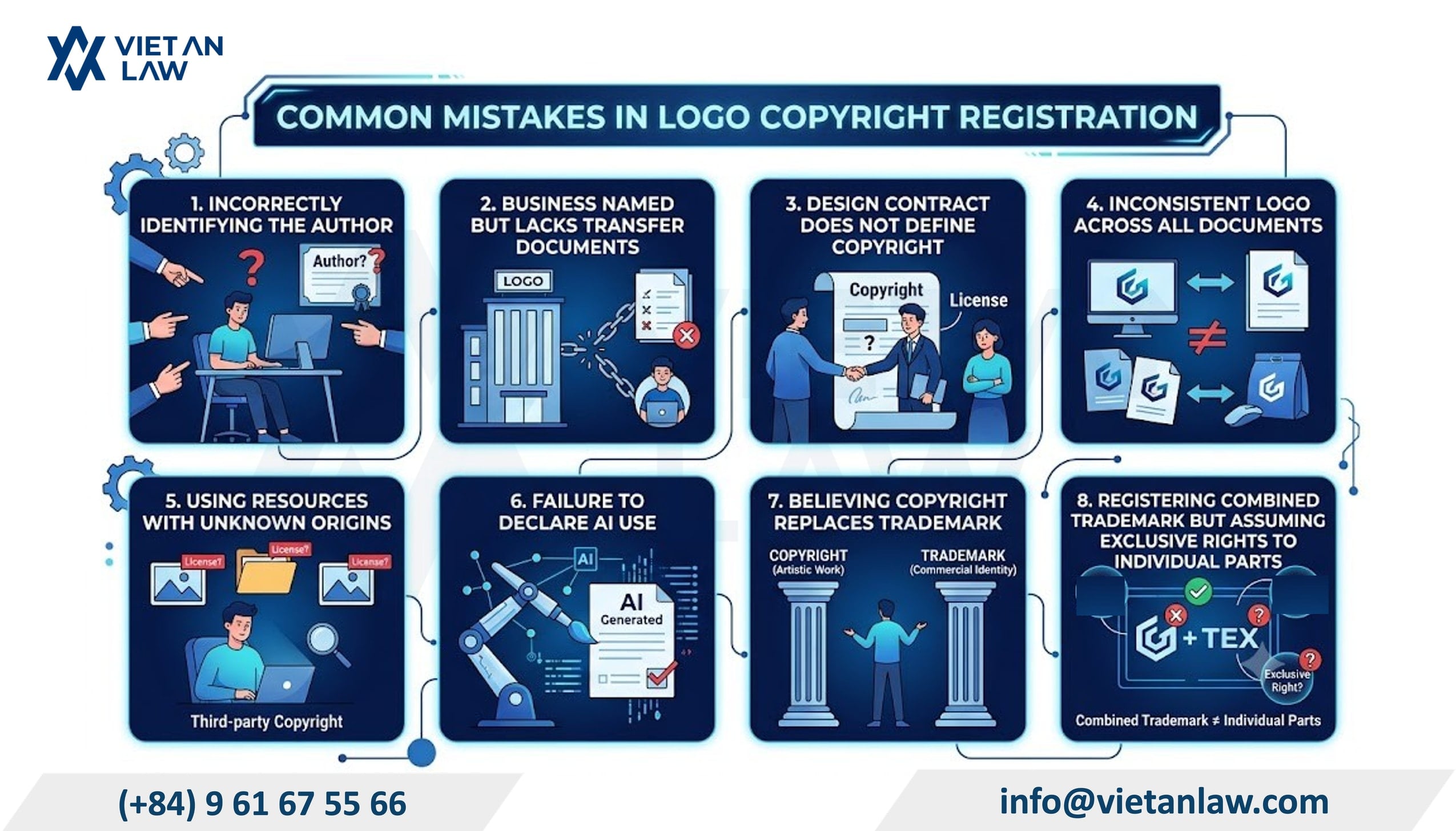
Incorrect author identification
The legal representative, director, or person paying the fees is not automatically the author. The author must be the individual directly performing the creative activity.
Business name not specifying ownership rights
If the logo was designed by the founder, employee, or freelancer, the business must provide documentation proving the basis for the creation or transfer of ownership rights.
Design contract lacking copyright provisions
A contract only recording the design price and file delivery may not be sufficient to prove that all copyright has been transferred to the client.
Inconsistent logo in documents
Differences in text, color, symbols, or layout between the declaration, printed version, contract, and handover document may lead to a request for explanation.
Use of resources from unknown sources
A logo using icons, images, characters, fonts, or design templates downloaded from the Internet may infringe on the rights of third parties or violate licensing conditions. Failure to declare the use of AI
If AI is used in the creative process but is not properly described according to the current form, the application may need to be amended or supplemented.
Assuming copyright replaces trademark
Copyright of a logo does not automatically create exclusive rights to the mark for all goods and services. Businesses still need to consider trademark registration.
Registering a combined trademark but assuming each part is exclusive
Registering a combined figure and word does not always protect each component separately. The figure, word, and overall design need to be evaluated to choose the registration strategy.
Frequently asked questions about logo copyright registration
Is logo copyright registration mandatory?
No. Copyright arises when a logo is directly created and expressed in a specific physical form. However, registration makes it easier for the owner to prove and protect their rights.
Can an individual who hasn’t established a company register a logo?
Yes. An individual who directly creates or legally owns a logo can register it under their name without being required to establish a business.
If a company hires a freelancer to design, who is the author?
Freelancers who directly create logos are usually identified as the author. The company can be the owner if the contract and transfer documents establish rights for the company.
How do you register a company logo designed by the founder?
The founder is recognized as the author. If the company is the owner, documentation proving the transfer or basis for establishing rights for the company is required.
Can a logo consisting only of text be copyrighted?
The likelihood of protection depends on the level of creativity in the presentation of the text, lines, layout, and graphic elements. A name or slogan standing alone is not automatically protected by copyright.
Is a search necessary before registering a logo for copyright?
A search is not a mandatory procedure. However, it is advisable to check existing logos, the origin of the symbol, and design resources to minimize the risk of copying or copyright conflicts.
Can a logo be registered as both a copyright and a trademark?
Yes. The two mechanisms protect different aspects of the logo and can be implemented simultaneously.
Should you register a figurative trademark or a figurative and word trademark?
If the symbol is often used independently, consider registering a figurative trademark. If the logo is always used as a symbol accompanying the brand name, you can register the figurative and word combination. For important brands, consider registering both.
Does registering a figurative and word combination provide separate protection for the brand name?
Not in every case. The scope of protection depends on the distinctiveness of each element and the overall trademark design. If the brand name is frequently used independently, consider registering additional word marks.
Can AI-generated logos be registered?
Logos using AI may be considered if humans directly participate in selecting, editing, and controlling the results, thereby demonstrating personal creative imprint. The application must include a description and assurance regarding the use of AI.
Does changing the logo’s color require re-registration?
If only minor color changes are made without fundamentally altering the form of the work, re-registration may not be necessary. If the logo is significantly altered in terms of image, layout, or text, consider registering a new version.
Viet An Law Firm’s logo copyright registration service in Vietnam
Viet An Law Firm assists clients with the following tasks:
- Assessing the protectability of copyright for logos;
- Analyzing protection options using copyright and trademarks;
- Identifying authors, co-authors, and owners;
- Reviewing design contracts;
- Drafting transfer documents;
- Advising on registration of each logo version;
- Preparing application forms according to current templates;
- Drafting author’s declarations;
- Preparing AI usage descriptions;
- Representing clients in submitting and monitoring applications;
- Responding to requests for amendments and additions;
- Receiving and delivering the Certificate;
- Advising on handling logo copying;
- Advising on registration of figurative or combined figurative and word trademarks.
Clients need to provide the logo sample, information of the designer, owner information, and contracts and documents related to the creative process. Based on your information, Viet An Law Firm will examine the chain of rights and propose a suitable solution.