The United States has long been known as an economic powerhouse with a large and diverse consumer market, creating ideal conditions for businesses to reach millions of potential customers. With the world’s leading stock exchanges and abundant investment capital, businesses can easily raise capital to scale, invest in research and development, or penetrate new markets. In addition, the business environment in the US is highly appreciated for its competitiveness and innovation. Not only that, establishing a company in the US also brings advantages in terms of prestige and brand. “Made in USA” has long been a symbol of quality and reliability, helping businesses build trust with customers and partners around the globe. In short, setting up a company in the U.S. is a decision that brings great benefits to businesses. Viet An Law would like to introduce you to the procedures for establishing a company in the US through the article below.
Table of contents
Hide
Choosing the type of company to set up in the U.S.
Small and medium-sized businesses, want to protect their assets
Large enterprises, wanting to raise capital from the stock market
Businesses that want to avoid double taxation, are eligible
What is double taxation?
“Double taxation” or “double taxation” is a situation in which an income or property is taxed twice by two different tax authorities. This usually happens in the following cases:
Domestic: A good example is the double taxation on the profits of C-Corps in the US. The company must pay corporate income tax on its profits. Then, when this profit is distributed to shareholders in the form of dividends, shareholders must pay personal income tax on this dividend. Thus, the same profit is taxed twice.
International: Double taxation can also occur when an individual or business earns income from overseas business. This income can be taxed in both the country where the income is generated and the country in which the individual or business resides.
Choosing a state to carry out the company setting up procedure in the US
When it comes to setting up a business in the US, choosing the state of registration is not only an administrative procedure, but also a decision that can profoundly affect the future of the business. Although you have the right to register in any state, Delaware, Wyoming, and Nevada are quite popular with investors.
Why are Delaware, Wyoming, and Nevada popular?
Delaware:
Delaware is well-known for its well-built and stable corporate law system, especially the Chancery Court, which specializes in handling corporate matters. This creates a credible regulatory environment that attracts large corporations and investors.
The Delaware court system is highly regarded for its efficiency and expertise, helping to resolve corporate disputes quickly and fairly.
Delaware also protects the privacy of businesses, not requiring the names of officials or directors to be made public.
Wyoming:
Wyoming attracts businesses with its low tax policy, which does not apply corporate income tax and franchise tax.
The state also stands out for its strong privacy protections, keeping the identities of business owners private.
The cost of registering a business in Wyoming is relatively low, which facilitates start-up businesses.
Wyoming is one of the first states to recognize a Limited Liability Company (LLC), with regulations that are quite preferential for this type of business.
Nevada:
Like Wyoming, Nevada also has a low tax policy, which does not apply corporate income tax and franchise tax.
Nevada also focuses on protecting the privacy of business owners.
The business environment in Nevada is considered to be very friendly, with few binding regulations.
Nevada also has strong asset protection laws, which help protect the assets of businesses and owners.
In addition to Delaware, Wyoming, and Nevada, several other states may also be considered depending on your specific business needs.
Texas:
The state has a low tax policy, especially no corporate income tax, which facilitates the growth of businesses.
Texas is a major hub for the energy industry, with many oil and gas and renewable energy companies based here. The state is also thriving in the tech sector, with many major tech companies and startups.
Although corporate taxes are low, Texas may have other taxes such as property taxes, which should be considered.
Florida:
Florida also has a low tax policy and a favorable business environment, attracting many businesses from all over the world.
The state has a warm climate and an attractive living environment, attracting many workers and entrepreneurs.
Florida is a popular tourist destination, with many opportunities in the tourism, hospitality, and related services industries.
Choosing a company name to set up a company in the U.S.
Choosing a business name is not just a simple administrative procedure, but also a decision that profoundly affects the image and success of your company.
Check availability at the state level
Go to the website of the State Secretary of State’s Office where you plan to register the business. Not only check for exact matches, but also search for similar names that can be confusing.
Understanding the name “Doing Business as” (DBA)
If you plan to operate under a different name than your business’s legal name, learn about the DBA filing process and the requirements involved.
DBA (Doing Business As) is a business term that means “doing business as”. It is also known as a fictional name, a hypothetical name, or a business name. Filing a DBA allows a business to operate under a name other than its registered legal name.
The DBA filing process typically includes the following steps
Check the availability of the name: Before filing a DBA, you need to check if the name you want to use is already registered. This is usually done through the state clerk’s office or county office.
Fill out the application form: You need to fill out the DBA application form, providing information about the legal name of the business, the DBA name you want to use, and the business address.
Submit the application and pay the fee: After completing the application form, you need to submit the application and pay the fee at the state clerk’s office or county office.
Publish the DBA name (if needed): Some states require you to publish the DBA’s name in a local newspaper for a certain period of time.
Consider a company name at the federal level
Trademark search on USPTO: Even if the company name you intend to place is likely in the state, check if it is trademarked at the federal level. Visit the website of the United States Patent and Trademark Office (USPTO) to conduct a search.
Check domain and social media availability: Make sure the domain name that corresponds to your business name is available for registration and on popular social media platforms.
Applying for company setting up in the U.S.
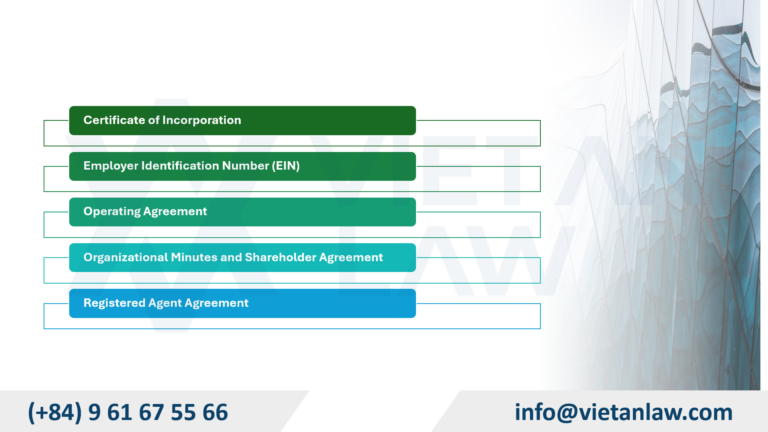
You need to prepare the following list of documents to apply for company formation in the US. Generally, each state may require additional documents, however, here is a basic set of must-haves, including:
Certificate of Incorporation: This is your company’s “birth certificate,” which is filed at the Registrar of Exchanges of the state where you registered. This document provides basic information about the company, including: Company name, Head office address, Information about the legal representative, Other details depending on the type of company (LLC or Corporation).
Employer Identification Number (EIN): An EIN is a tax identification number issued by the Federal Internal Revenue Service (IRS), similar to a corporate tax identification number in Vietnam. To apply for an EIN, you need to fill out the SS-4 form and submit it to the IRS. The instruction process can be referred to via the following link: https://www.irs.gov/businesses/small-businesses-self-employed/get-an-employer-identification-number
Operating Agreement for LLC: This is an internal document that regulates how the company operates, the distribution of profits, and the rights of its members.
Bylaws (for Corporations): These are the internal rules and regulations that govern the management and operation of the Corporation to determine how the Corporation will operate.
Organizational Minutes and Shareholder Agreement (for Corporations)
Registered Agent Agreement: A Registered Agent is a person or company authorized to receive legal notices on behalf of your company.
Opening a bank account when setting up a company in the U.S.
After establishing a company in the US, opening a corporate bank account is an important step. Steps to open a corporate bank account:
Choose a bank: Research banks whose services are tailored to your business needs. You can kindly remind factors such as service fees, interest rates, and online banking facilities.
Preparation of documents:
Articles of Incorporation/Organization.
Employer identification number (EIN).
Operating Agreement/Bylaws.
Identification document of the legal representative.
Apply for sub-licenses and business licenses with a number of conditional business lines
Permits and federal permits
Certain specific occupations require permits or permits from federal agencies. For example, businesses involved in the production or sale of alcohol, tobacco, and firearms need a license from the Alcohol, Tobacco, Firearms, and Explosives Administration (ATF). Radio businesses need a license from the Federal Communications Commission (FCC), and transportation businesses need a license from the Department of Transportation (DOT).
To determine if your business needs a federal license, refer to the Small Business Administration (SBA) website or contact the relevant federal agencies directly.
State Permits and Permits
Most states require businesses to have a general business license or certificate of registration. Additionally, specific occupations such as construction, healthcare, real estate, and cosmetology may require specialized licenses.
Detailed information about the types of permits required can be found on the website of the state licensing agency or the Secretary of State’s office.
Local Permits and Permits
Cities and counties often have their own regulations on business licenses. For example, planning permits, building permits, medical permits, and signage permits are common types of permits at the local level.
Compliance with obligations after company incorporation in the U.S.
Annual Report
Most states require businesses to file annual reports to stay afloat. This report helps keep you up to date with information about your business, including address, legal representation, and other important changes.
Tax
The tax system in the United States is complex, requiring businesses to comply with a variety of taxes, including federal, state, sales, payroll, and property taxes.
Federal Taxes
Corporate income tax: This is a tax levied on the profits of businesses. The applicable tax rate may vary depending on the type of business (C-Corp, S-Corp, LLC, etc.).
Social Security Tax and Medicare Tax (FICA Tax): This is a tax on workers’ wages. Businesses are responsible for withholding and remitting these taxes to the IRS.
Federal Unemployment Tax (FUTA): This is a tax levied on employers to support the unemployment insurance program.
State Taxes
State corporate income tax: Many states have their own corporate income tax.
Sales Tax: This is a tax levied on the sale of goods and services. Businesses are responsible for collecting and remitting sales tax to state tax authorities.
State Unemployment Tax (SUTA): Similar to the federal unemployment tax, but administered by the state.
Local taxes
Property Tax: This is a tax levied on real estate and personal property.
Local business taxes: Some cities and counties may have their own business taxes.
Fast & Reliable Legal Assistance
Fill out the form below and get connected with a lawyer quickly.
Landscape company establishment business lines in Vietnam: Complete guide on required business codes, conditions, procedures, and registration steps for 2025.
Immigration consulting company establishment business lines in Vietnam explained. Complete guide to required licenses, registration procedures, and legal business codes for 2025.
Environmental company establishment business lines in Vietnam 2025. Complete guide to waste management, wastewater treatment, and environmental services registration procedures.
E-commerce business registration business lines in Vietnam explained. Complete guide covering legal requirements, business line codes, conditions, and procedures for 2025.
Employment service business registration business lines in Vietnam explained. Complete guide covering conditions, license requirements, and registration procedures for 2025.