On December 2nd, 2025, the Government issued Decree 310/2025/ND-CP amending and supplementing several articles of Decree 125/2020/ND-CP regulating administrative penalties for tax and invoice violations. This Decree takes effect from January 16th, 2026, and includes many new regulations on the levels of administrative penalties for tax and invoice violations. Below, Viet An Law will update the notable new regulations on penalty for tax and invoice violation under Decree 310/2025.
Table of contents
Decree No. 310/2025/ND-CP amends and supplements Clause 1, Article 2 of Decree No. 125/2020/ND-CP by expanding and clarifying the concept of administrative tax violations. According to the regulations, administrative tax violations include culpable acts committed by organizations or individuals that violate regulations of the law on tax administration, tax laws, and other revenues belonging to the state budget managed by tax authorities, including:
Thus, Decree No. 310/2025/ND-CP has added violations related to revenue collection as stipulated by law on the management and investment of state capital in enterprises, which are also defined as administrative tax violations.
Decree No. 310/2025/ND-CP adds Clause 10 after Clause 9 of Article 2 of Decree No. 125/2020/ND-CP, stipulating cases of force majeure in administrative sanctions for tax and invoice violations, including:
“Natural disasters, catastrophes, epidemics, fires, unexpected accidents, wars, riots, strikes, or other unforeseeable events that the taxpayer cannot remedy despite having taken all necessary and possible measures.”
This regulation is consistent with the provisions of Clause 1, Article 156 of the Civil Code 2015 on force majeure events, as well as the provisions on force majeure cases stipulated in Clause 27, Article 3 of the Law on Tax Administration 2019.
Accordingly, in cases of force majeure, taxpayers may be considered for exemption from/not subject to administrative penalties for tax and invoice violations.
For example, according to Article 9 of Decree No. 125/2020/ND-CP, taxpayers who are late in carrying out tax procedures and issuing invoices electronically due to technical problems of the information technology system, as announced on the tax authority’s electronic portal, are considered to have committed violations due to force majeure events and are therefore not subject to administrative penalties for tax and invoice violations.
One of the notable provisions of Decree 310/2025/ND-CP amending regulations on administrative penalties for tax and invoice violations is that for invoices issued at the wrong time or for goods and services not issued at all, and still within the statute of limitations for penalties, the penalty will be based on the number of invoices.
Specifically, point b, clause 3, Article 1 of Decree 310/2025/ND-CP added the principle of administrative sanctions for tax and invoice violations to Article 5 of Decree 125/2020/ND-CP as follows:
“dd) In cases where a taxpayer commits multiple acts of issuing invoices at the wrong time, and the violations are still within the statute of limitations for penalties and are penalized in a single administrative violation case, only one act of issuing invoices at the wrong time will be penalized, with the fine corresponding to the number of invoices issued at the wrong time as stipulated in Clause 2, Article 24 of this Decree;
e) In cases where a taxpayer commits multiple acts of not issuing invoices, and these violations are still within the statute of limitations for penalties and are penalized in a single administrative violation case, the taxpayer shall only be penalized for one act of not issuing invoices, with the fine corresponding to the number of invoices issued at the wrong time as stipulated in Clause 3, Article 24 of this Decree;”
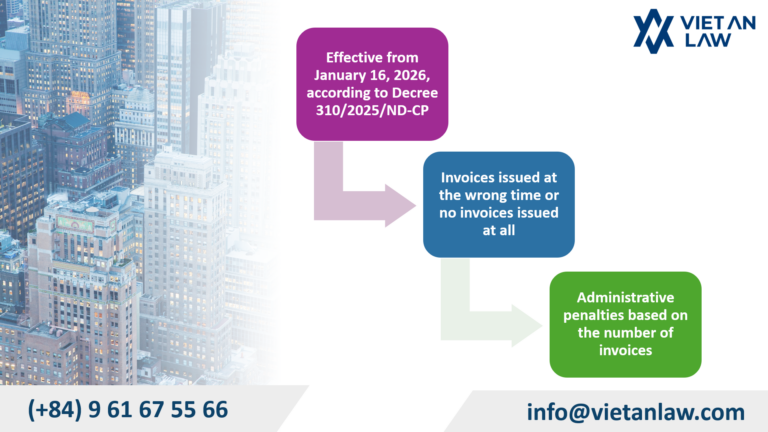
Therefore, from January 16, 2026, for invoices issued at the wrong time or for goods and services not issued at all, and still within the statute of limitations for penalties, the penalty will be based on the number of invoices.
According to the previous regulations in Article 24 of Decree 125/2020/ND-CP, invoices issued at the wrong time would be subject to penalties:
However, from January 16, 2026, the penalty for invoices issued at the wrong time will depend on the number of invoices. Specifically, Clause 14, Article 1 of Decree 310/2025/ND-CP amending and supplementing Article 24 of Decree 125/2020/ND-CP stipulates the following penalties for issuing invoices at the wrong time as prescribed by law:
| Penalties for issuing invoices at the wrong time | Invoices for goods and services related to promotions/gifts/internal comsumption/loan – borrowings -repayments | Invoice for the sale of goods and provision of services |
| Cautions | 01 invoice | x |
| 500 – 1,5 million VND | From 2 to under 10 invoices | 01 invoice |
| 2 – 5 million VND | From 10 to under 50 invoices | From 2 to under 10 invoices |
| 5 – 15 million VND | From 50 to under 100 invoices | From 10 to under 20 invoices |
| 15 – 30 million VND | 100 invoices or more | From 20 to under 50 invoices |
| 30 – 50 million VND | x | From 50 to under 100 invoices |
| 50 – 70 million VND | x | 100 invoices or more |
Note: The above fines apply to organizations; the fine for individuals is half the fine for organizations.
Thus, Decree 310/2025/ND-CP has amended the penalties for issuing invoices at the wrong time according to Decree 125/2020/ND-CP, with the maximum penalty potentially reaching 70 million VND depending on the number of violating invoices. The penalties are divided into thresholds ranging from a warning to a fine of 500,000 VND to 70,000,000 VND for organizations and half that amount for individuals, applicable to the act of issuing invoices at the wrong time for promotions, gifts, internal consumption, or when selling goods or providing services…
Decree 310/2025/ND-CP also amends and supplements Clause 3, Article 24, stipulating the following penalties for failing to issue invoices as required:
| Penalties for not issuing invoices | Invoices for goods and services related to promotions/gifts/internal comsumption/loan – borrowings -repayments | Invoice for the sale of goods and provision of services |
| Cautions | 01 invoice | x |
| 1 – 2 million VND | From 2 to under 10 invoices | 01 invoice |
| 2 – 10 million VND | From 10 to under 50 invoices | From 2 to under 10 invoices |
| 10 – 30 million VND | From 50 to under 100 invoices | From 10 to under 20 invoices |
| 30 – 50 million VND | 100 invoices or more | From 20 to under 50 invoices |
| 60 – 80 million VND | x | 50 invoices or more |
Thus, while previously, according to Article 24 of Decree 125/2020/ND-CP, the act of not issuing invoices when selling goods or providing services to buyers as required was only punishable by a fine of 10 to 20 million VND, according to the new regulations in Decree 310/2025/ND-CP, the maximum fine can reach up to 80 million VND depending on the number of violating invoices.
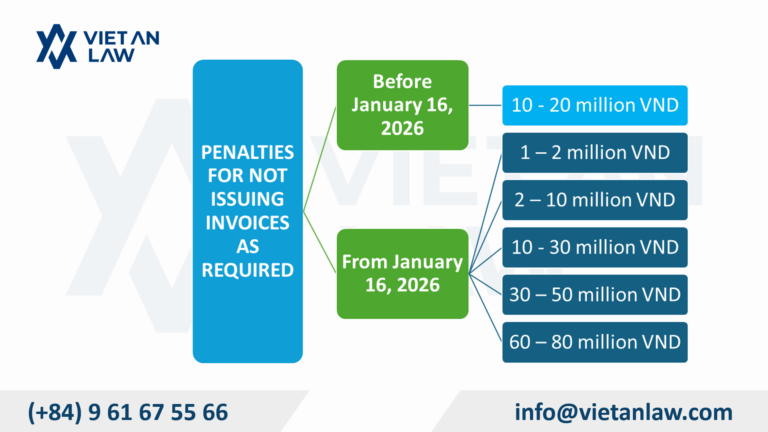
New regulations on penalties for not issuing invoices as required
Decree 310/2025/ND-CP amending regulations on administrative penalties for tax and invoice violations has added provisions related to penalties for violations of the obligation to register, notify, and submit tax declarations in accordance with the global tax base erosion prevention regulations (Resolution No. 107/2023/QH15). The subjects of penalties are the constituent units responsible for tax declaration or the constituent units assigned by the Group to send notifications of the constituent units responsible for tax declaration and the list of constituent units. Specifically:
Clause 2 of Article 2 of Decree 310/2025/ND-CP stipulates that administrative penalties for tax and invoice violations will be abolished from January 16, 2026. Specifically, one notable provision is as follows:
Article 3 of Decree 310/2025/ND-CP outlines several points to note regarding its application, specifically as follows:
The above is an update on the notable new points in penalty for tax and invoice violation under Decree 310/2025. If you have any related questions or require legal advice on tax and invoice regulations, please contact Viet An Law Firm – Tax Agency for the best advice and support!