


The important contract clauses include the subject matter, payment, rights and obligations, penalty for breach, confidentiality, intellectual property, and dispute resolution. These are the core contract provisions that help businesses minimize legal risks and protect their interests when disputes arise. Understanding key clauses in contract drafting in Vietnam is essential for any enterprise.
However, in reality, many businesses only focus on commercial value and ignore the essential clauses in contracts, leading to the risk of disputes, loss of the right to claim compensation, or difficulty in protecting their interests when a breach occurs. Therefore, comprehensively drafting the important contract clauses in a business contract not only helps limit legal risks but also creates a solid foundation for long-term and stable cooperation.
Summary of contract drafting clauses
| Clause | Purpose | Content to be prescribed |
| Subject matter clause | Determine transaction content | Name of goods/services, quantity, quality, technical standards, implementation schedule |
| Subject information | Determine legal status of the parties | Enterprise name, tax code, address, representative, signing authority |
| Payment | Control cash flow | Contract value, payment term, deposit, late payment interest, payment method |
| Contract performance guarantee | Reduce risk of breach of obligation | Deposit, margin, bank guarantee, mortgage |
| Rights and obligations | Allocate party responsibilities | Obligation to deliver, pay, coordinate, right to inspect and claim compensation |
| Penalty for breach | Increase binding nature | Penalty level, violation act, liability for damage compensation |
| Information confidentiality | Protect data and trade secrets | Scope of confidentiality, term of confidentiality, sanctions for handling violations |
| Intellectual property rights | Protect intellectual property assets | Copyright, data usage rights, commercial exploitation rights |
| Force majeure | Handle out-of-control events | Natural disasters, epidemics, wars, notification obligations |
| Contract termination | Proactively handle violations or risks | Termination conditions, notice period, post-termination obligations |
| Dispute resolution | Determine handling mechanism | Court/arbitration, applicable law, location and language of resolution |
| Limitation of liability | Limit financial risk | Maximum liability level, exemption cases |
| Personal data processing | Comply with data laws | Scope of collection, use, storage, and security of data |
| Anti-assignment of obligations | Control implementing partners | Conditions for transferring rights/obligations to a third party |
| Audit & debt reconciliation | Control financial obligations | Reconciliation time, debt confirmation, handling of discrepancies |
Key clauses in contract drafting in Vietnam
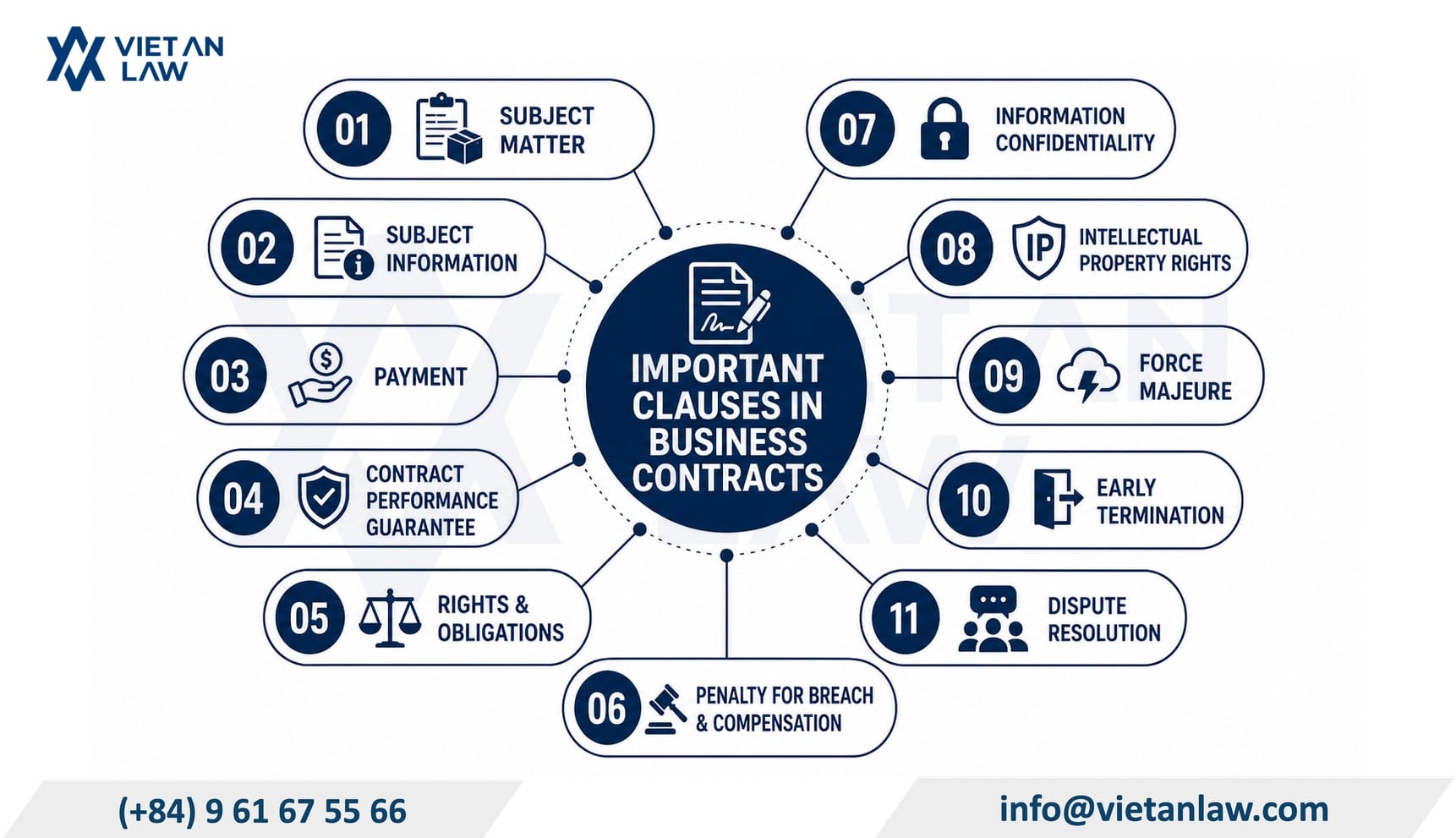
- Subject matter clause
- Subject information clause
- Payment clause
- Contract performance guarantee clause
- Rights and obligations clause
- Penalty for breach & compensation clause
- Information confidentiality clause
- Intellectual property rights clause
- Force majeure clause
- Early contract termination clause
- Dispute resolution clause
Subject matter clause
This is the most critical clause as it directly decides the transaction content between the parties. This clause needs to clearly describe the goods, services, or work to be performed, including:
- Name of goods or services;
- Quantity;
- Quality;
- Technical specifications;
- Applicable standards;
- Scope of work;
- Implementation schedule.
If not clearly specified, the parties are very prone to disputes over whether the obligations have been performed correctly. In many commercial lawsuits, just because the description of the contract subject matter was too general, businesses faced difficulties in demanding the partner to bear responsibility.
Example clause: “Party A provides 1,000 sets of electronic components Model X according to ISO 9001:2015 technical standards.” It should not be described too generally such as “providing goods on demand” because it is easy to cause disputes regarding quality, type, or actual scope of work.
Subject information clause
This clause fully records the legal information of the parties participating in the contract such as:
- Enterprise name;
- Tax code;
- Head office address;
- Legal representative;
- Position;
- Contact information.
The enterprise needs to specifically check the signing authority of the representative to avoid cases where the contract is invalidated or disputes arise over legal validity.
For contracts with foreign elements, it is necessary to further review the partner’s legal information such as the operating license, legal entity status, and signing authority according to the laws of the host country.
Example clause: “The person signing the contract on behalf of Company A is Mr. Nguyen Van B – Director according to the Enterprise Registration Certificate.” It is necessary to check whether the signer has the correct authority. In many cases, department heads or staff sign beyond their authority, leading to disputes over the contract’s validity.
Payment clause
This is a clause directly related to the cash flow and financial benefits of the enterprise, so it needs to be strictly stipulated. The content to be clarified includes:
- Contract value;
- Payment currency;
- Payment method;
- Payment term;
- Conditions for issuing invoices;
- Advance payment or deposit policy;
- Late payment interest;
- Conditions for suspending performance when the partner breaches payment obligations.
Many businesses face difficulties in recovering debts because the contract does not specifically stipulate the handling mechanism when the buyer delays payment or intentionally prolongs the financial obligation. These are key contract terms that cannot be ignored.
Contract performance guarantee clause
This clause helps minimize risks when one party fails to perform or performs commitments incorrectly.
Common guarantee measures include:
- Deposit;
- Margin;
- Mortgage;
- Bank guarantee;
For large-value contracts, construction contracts, or contracts with an extended schedule, the contract performance guarantee clause plays a particularly important role in protecting the enterprise against the risk of the partner breaching obligations.
Example clause: “Party B deposits 10% of the contract value to secure the performance of the payment obligation.” For large-value contracts, enterprises should require a bank guarantee or margin to reduce the risk of the partner breaching obligations.
Rights and obligations clause
This clause clearly defines the responsibilities of each party during the contract implementation process. The more specific the content, the higher the ability to control disputes.
Enterprises need to clearly stipulate:
- Obligation to provide goods or services;
- Payment obligation;
- Coordination obligation;
- Confidentiality obligation;
- Right to inspect and supervise;
- Right to refuse receipt of goods;
- Right to claim compensation when a breach occurs.
Clearly defining rights and obligations helps limit situations where the parties understand their responsibilities differently during the contract execution process.
Example clause: “Party A has the obligation to deliver goods on time; Party B has the obligation to pay in full according to the schedule.” Specific responsibilities of each party must be stipulated, avoiding the use of vague phrases like “fully perform related responsibilities”.
Penalty for breach and compensation clause
This is a clause that helps businesses increase binding nature and protect their rights when a partner breaches a contract obligation.
The clause needs to clearly state:
- Acts considered as a breach;
- Penalty level for breach;
- Method of calculating damages;
- Obligation to prove damages;
- Compensation time limit;
- Additional liabilities arising from the breach.
According to the provisions of commercial law, some types of contracts have limits on the level of breach penalty, so enterprises need to carefully review to ensure the clause complies with applicable law and has practical enforceability.
Example clause: “The party breaching the payment schedule shall be fined 8% of the value of the breached obligation part.” It is necessary to review the limit on penalty levels according to applicable legal provisions for each type of contract to avoid an invalid clause.
Information confidentiality clause
In the current competitive context, client data, business strategies, and internal information all have great value to an enterprise.
The confidentiality clause needs to stipulate:
- Scope of confidential information;
- Subjects with access to information;
- Term of confidentiality;
- Confidentiality obligation after contract termination;
- Sanctions for handling violations.
This is an especially important clause in technology contracts, business cooperation contracts, data transfer, or product outsourcing.
Example clause: “The parties must not disclose client data and business information to a third party for a period of 03 years from the contract termination date.” The scope of confidential information and sanctions for violations need to be clearly identified to increase binding nature.
Intellectual property rights clause
For contracts related to software, design, branding, data, or content creation, enterprises need to clearly stipulate intellectual property rights to avoid future disputes.
The content usually includes:
- Copyright owner;
- Data usage rights;
- Commercial exploitation rights;
- Product editing rights;
- Transfer of intellectual property rights;
- Liability when acts of rights infringement occur.
If the contract does not clearly stipulate, the enterprise may lose the right to exploit the product or face disputes over the right to use intellectual property assets after the project is completed.
Example clause: “All software source code developed in the project belongs to the ownership of Party A upon complete payment.” Note: If intellectual property rights are not clearly stipulated, the business may lose the right to exploit or use the product after the cooperation ends.
Force majeure clause
This clause is to handle cases beyond the control of the parties such as:
- Natural disasters;
- Epidemics;
- Wars;
- Fires;
- Widespread power outages;
- Prohibition policies of state agencies.
Enterprises need to clearly stipulate:
- Which cases are considered force majeure;
- Notification obligation;
- Suspension period;
- Right to terminate the contract if the event lasts too long.
Specific provisions help prevent the abuse of force majeure reasons to evade contract liabilities.
Example clause: “Natural disasters, wars, epidemics, or prohibition decisions by state agencies are considered force majeure events.” The notification obligation and the application period of force majeure need to be clearly stipulated to avoid abuse of this clause to evade responsibility.
Early contract termination clause
This clause helps businesses proactively handle situations when the transaction is no longer suitable or the partner commits a serious breach.
The content to be clarified:
- Cases entitled to termination;
- Notice period;
- Remaining payment obligations;
- Responsibility to hand over documents;
- Confidentiality obligation after termination;
- Mechanism for handling incurred damages.
If not clearly stipulated, unilaterally terminating the contract may result in the enterprise being considered the breaching party.
Example clause: “One party has the right to unilaterally terminate the contract if the other party is more than 30 days late in payment.” Termination conditions and post-termination handling obligations must be clearly stipulated to limit disputes.
Dispute resolution clause
This is a very important clause but is often overlooked by businesses when signing a contract.
The parties need to clearly identify:
- The dispute resolution body;
- Court or commercial arbitration;
- Location of resolution;
- Applicable law;
- Language used;
- Obligation to continue performing the contract during the dispute.
For international contracts or high-value contracts, choosing the correct dispute resolution mechanism can directly affect the ability to recover assets and protect business interests.
Example clause: “All disputes arising from the contract shall be resolved at the Vietnam International Arbitration Centre (VIAC).” For international or large-value contracts, businesses need to carefully weigh arbitration versus court to suit their dispute resolution strategy.
Important clauses businesses often forget in Vietnam
In reality, many businesses only focus on transaction value and miss essential clauses in contracts such as:
- Limitation of liability clause;
- Exemption of obligations clause;
- Audit and debt reconciliation clause;
- Data storage clause;
- Anti-competition clause;
- Anti-assignment of obligations clause;
- Personal data processing clause;
- Legal compliance and anti-corruption clause.
It is these “subsidiary” core contract provisions that often play an important role when disputes arise or violations are handled in reality. Reviewing these key clauses in contract drafting in Vietnam ensures comprehensive protection.
How to draft a strict contract in Vietnam
To review and draft strict contracts, businesses need to:
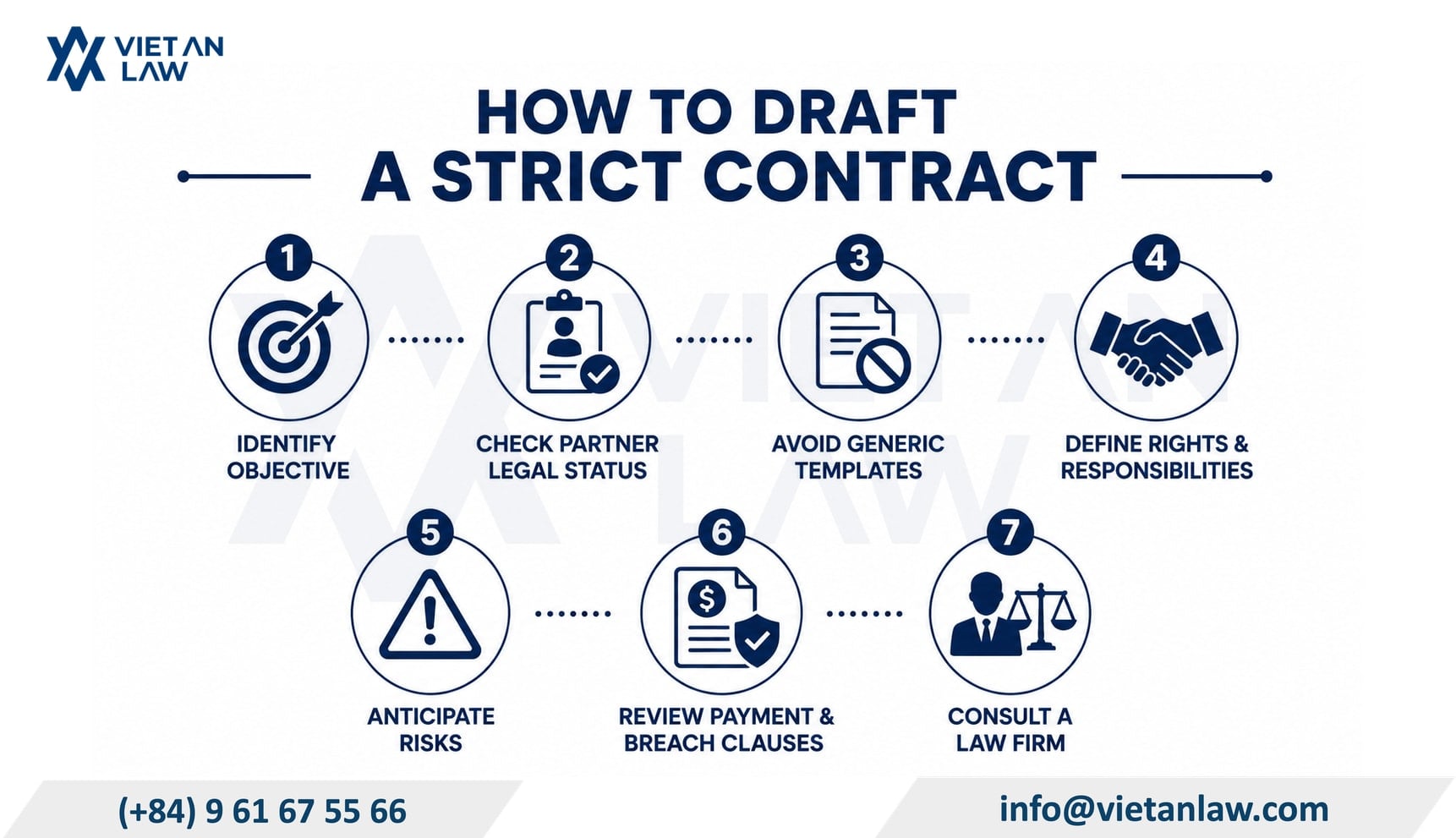
- Clearly identify the transaction objective;
- Check the legal status of the partner;
- Not use generic contract templates;
- Clearly define the rights and responsibilities of each party;
- Anticipate risk situations that may arise;
- Carefully review payment and breach handling clauses;
- Consult a Law firm before signing.
For large-value contracts, investment contracts, contracts with foreign elements, or contracts related to intellectual property, having a lawyer accompany you from the beginning will help businesses significantly limit legal and financial risks.
Related questions
Should I use contract templates downloaded from the internet?
Businesses can consult contract templates, but should not use the original text because each transaction has its own specific characteristics and legal risks. Such templates often lack key contract terms.
Does a handwritten contract have legal validity?
Yes, if it meets all the conditions for validity according to legal provisions and does not fall into cases where notarization or drafting in a prescribed written form is mandatory.
When should I ask a Law firm to review a contract?
Businesses should ask a lawyer to review large-value contracts, contracts with foreign elements, or contracts with complex clauses related to finance, investment, or intellectual property.
Which clauses often cause the most disputes?
Clauses related to payment, penalty for breach, implementation schedule, and early contract termination are the contents that most often cause disputes in reality.
Above is an analysis of the critical clauses in corporate contract drafting that businesses need to pay special attention to during the process of reviewing, negotiating, signing, and executing contracts. If Clients need in-depth contract drafting services suitable for each operating sector, Viet An Law Firm is ready to accompany you with a team of experienced lawyers in the field of corporate consulting and contract dispute resolution. Keep in mind that applying the key clauses in contract drafting in Vietnam will secure your business transactions safely.