


Intellectual property licensing in Vietnam is a form of permission that allows organizations and individuals to exploit rights to another party’s intellectual assets without receiving a transfer of ownership. This activity may concern inventions, industrial designs, trademarks, copyright, software and plant varieties, each under its own legal mechanism.
In practice, an intellectual property licensing agreement not only determines the right of use but also affects the scope of production, the ability to exploit technology, royalties and liability when disputes arise.
Viet An Law Firm analyzes the conditions, the 2026 legal regulations and the issues businesses should check before signing an IP licensing agreement in Vietnam, especially in manufacturing, technology and foreign investment transactions.
What is intellectual property licensing in Vietnam?
Intellectual property licensing is a commercial term referring to the right holder allowing another party to use one or more intellectual property rights within a defined scope.
For industrial property, Article 141 of the Law on Intellectual Property provides that the transfer of the right to use industrial property objects must be made through a written contract.
The licensee may exploit the rights as agreed but does not become the owner of the licensed subject matter.
Unlike intellectual property assignment in Vietnam, a licensing transaction mainly concerns commercial exploitation rights, not the transfer of ownership of intellectual assets.
However, the licensing scope and the validity of the contract depend on each type of right. The rules on industrial property licensing cannot be applied across the board to copyright or plant varieties.
Which intellectual property subject matters can be licensed in Vietnam?
Businesses may carry out the licensing of intellectual property rights for many different groups of intellectual assets, provided that the corresponding legal conditions are met.
| Subject matter | Legal mechanism | Issues to check |
| Inventions, utility solutions | Transfer of the right to use industrial property | Scope of protection, obligation to use, third-party rights |
| Industrial designs | Contract for the use of industrial property objects | Products, design variants, territory |
| Layout designs of integrated circuits | Contract granting exploitation rights | Scope of commercial use, manufacturing rights |
| Trademarks | Trademark use contract | Exclusivity, scope of use, quality control |
| Copyright, related rights | Use contract under Articles 47 and 48 | Specific rights permitted to be exploited |
| Plant varieties | Specific rules on transfer of the right to use | Propagation, production and trading |
Licensing of inventions and utility solutions
Patent licensing allows the licensee to perform acts of exploiting the invention within the licensed scope.
The contract should identify the protected subject matter, the related products or processes, the territory, the term and the right to sublicense.
For utility solutions, businesses must also correctly identify the protection title and the scope of the technical solution that may be used.
In particular, an exclusive patent licensee has an obligation to use the invention under Clause 5, Article 142 of the Law on Intellectual Property. This requires special attention when an exclusive contract is signed but the licensee is not yet able to put the invention into use.
Licensing of industrial designs and layout designs
For industrial design licensing, the licensee must accurately identify the protected design and the products to be exploited. The right to use a design does not automatically extend to every new design version developed afterwards.
In the semiconductor sector, licensing the use of a semiconductor integrated circuit layout design also requires clarity on the right to exploit the protected design and on the technical documents, technology or software that fall outside the licensed scope.
Copyright licensing in Vietnam for works and software
Transactions involving works, computer programs, images, documents or digital content must be determined under the mechanism for transferring the right to use copyright and related rights.
For example, a business licensed to use software for internal operations does not automatically have the right to copy it for sale, modify the source code or distribute the software to third parties.
The licensed scope must be determined for each economic right and each moral right that may be licensed under the law.
Businesses may refer to our article on copyright licensing in Vietnam for the specific conditions and specialized contracts.
For trademarks, Viet An Law Firm has a separate guide on trademark licensing in Vietnam, covering exclusive contracts, royalties and brand exploitation issues.
Subject matters not freely licensable under IP licensing law in Vietnam
Article 142 of the Law on Intellectual Property provides that the right to use trade names and geographical indications may not be transferred under an ordinary licensing mechanism.
At the same time, the right to use collective marks may only be transferred within the limits prescribed by law.
Businesses need to distinguish subject matters that cannot be licensed from rights that can be licensed but are restricted in terms of parties, scope or form of use.
Conditions for the licensing of intellectual property rights
For a transaction to have a clear legal basis, the licensor and the licensee should conduct due diligence on the rights before signing.
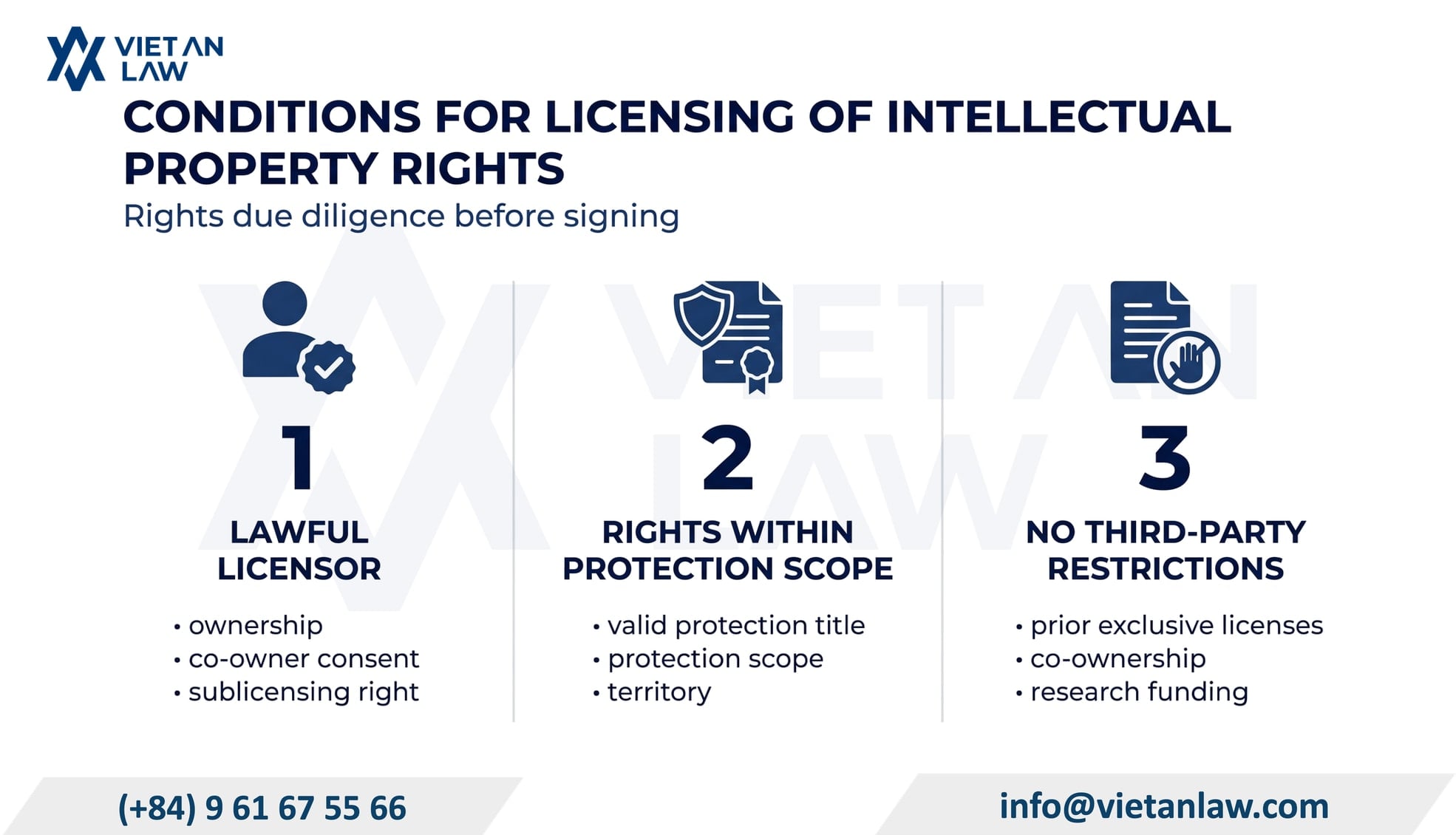
The licensor must hold lawful rights
The licensor must hold rights to the intellectual property subject matter or be permitted to grant the right of use under a contract and the law.
Where the rights belong to co-owners, the consent mechanism and the scope of each party’s rights should be checked.
If the licensor is itself a licensee under another contract, its right to sign a sublicense agreement must be verified.
The licensed rights must be within the scope of protection
For inventions and industrial designs, the validity of the protection title, the scope of protection and any territorial limits must be verified.
An invention patented in Germany or Japan is not automatically protected in Vietnam.
Therefore, a contract licensing manufacturing activities in Vietnam must be assessed based on the status of the rights in Vietnam, while also checking the rights in export markets if the products are sold abroad.
Checking existing third-party rights
The licensee needs to determine whether the rights it intends to use are restricted by a prior exclusive contract, co-ownership rights, obligations to a research sponsor or a technology cooperation agreement.
In particular, businesses should not check only the validity status of a single protection title while overlooking other intellectual property rights that may relate to the finished product.
Voluntary and compulsory patent licensing in Vietnam
IP licensing law in Vietnam distinguishes between the transfer of the right to use an invention by agreement and the mechanism of compulsory transfer of the right to use under a decision of a competent authority.
Patent licensing by agreement
A voluntary license is established on the basis of negotiation between the parties and the signing of a contract.
Under Article 143 of the Law on Intellectual Property, contracts for the use of industrial property objects take three forms:
- Exclusive contract: The licensee has the exclusive right of use within the licensed scope and term; the licensor’s right of use is limited by law.
- Non-exclusive contract: The licensor may continue to use the subject matter and grant non-exclusive rights of use to other parties.
- Sublicense contract: The licensee further grants the right of use to a third party when permitted.
The parties may choose the form of contract that suits their manufacturing, investment or market development objectives.
When can an invention be subject to compulsory licensing?
Article 145 of the Law on Intellectual Property allows a competent authority to decide to transfer the right to use an invention without the consent of the exclusive right holder in cases prescribed by law.
Notable grounds include:
- Serving public, non-commercial purposes, national defense, security or urgent social needs.
- The exclusive right holder fails to fulfill the obligation to use the invention after the statutory time limits.
- The person wishing to use the invention has tried to negotiate within a reasonable time on satisfactory commercial terms but has failed to reach an agreement.
- The exclusive right holder engages in prohibited anti-competitive practices.
- Cases relating to pharmaceutical needs under applicable international treaties.
Under Article 146, the compulsorily transferred right of use must comply with certain restrictions, mainly that it is non-exclusive, limited in scope and term, and subject to compensation as prescribed.
Legal note: Under Clause 1, Article 147 as amended by Law No. 131/2025/QH15, the provincial People’s Committee has the authority to issue decisions in the cases under Points b, c and d, Clause 1, Article 145. For the cases under Points a and dd, the authority rests with the ministry or ministerial-level agency managing the relevant sector.
Businesses may not use another party’s invention on their own initiative merely because they believe there are grounds for compulsory licensing. Such use must follow a lawful decision of the competent authority.
How does patent licensing differ from technology transfer in Vietnam?
A patent licensing transaction focuses on the right to exploit the protected subject matter, whereas a technology transfer may include processes, technical know-how, operating documents and other content under specialized laws.
A single contract may contain both groups of obligations.
For example, a Vietnamese business obtains the right to use a patented water treatment device and, at the same time, receives drawings, operating specifications and engineer training.
In this case, the licensed industrial property rights must be clearly distinguished from the technology actually transferred.
This distinction affects the obligations of handover, confidentiality, acceptance, payment and the related legal procedures.
If the contract falls within the scope of the law on technology transfer, businesses need to check the corresponding regulatory requirements. See also Viet An Law Firm’s article on technology transfer in Vietnam.
Essential clauses in an intellectual property licensing agreement in Vietnam
Under Article 144 of the Law on Intellectual Property, a contract for the use of industrial property objects must contain the main contents on the parties, the basis for the transfer, the type of contract, the scope, the term, the price and the rights and obligations of the parties.
For technology exploitation transactions, businesses should focus on clauses that directly affect how effectively the intellectual assets can be used.
Scope of exploitation and sublicensing
The contract must specify the subject matter, the permitted acts of use, the territorial limits and the term.
If the licensee is granted the right to use an invention for manufacturing but has no right to sublicense it to other manufacturers, this restriction should be stated clearly.
For transactions involving multiple subject matters, an appendix should be prepared identifying each protection title, economic right, and the corresponding licensed scope.
Rights to improvements of the invention
Improvements are one of the issues most likely to lead to disputes when a business uses a partner’s technology over a long period.
The contract should determine who has the right to register for protection of, own, or exploit newly created improvements.
However, Clause 2, Article 144 of the Law on Intellectual Property prohibits clauses that unreasonably restrict the licensee’s rights, in particular prohibiting improvements to the industrial property object (except trademarks), or forcing the licensee to transfer improvements or related rights free of charge in the cases prescribed by law.
Therefore, a clause stating that all improvements automatically belong to the licensor should not be included by default.
Instead, the parties should establish a mechanism for allocating rights based on actual contributions, the grounds for establishing rights, commercial interests and the mandatory limits of the law.
Confidentiality of documents and technical know-how
If the contract involves unpublished documents, research data or manufacturing know-how, separate confidentiality obligations should be defined.
Key provisions include the scope of confidential information, the persons given access, the purpose of use and the exceptions for lawful disclosure.
When the contract ends, the obligations to return, destroy or continue retaining documents must be determined in accordance with the agreement and the applicable law.
License fees and royalties
A license fee or royalty may be calculated as a fixed amount, based on revenue, based on output, or through a combined mechanism.
In a hypothetical example, the licensee pays an upfront fee of VND 300,000,000 and a royalty equal to 3% of the net revenue from the licensed products. If the net revenue used as the basis for calculation reaches VND 10,000,000,000, the variable royalty amounts to VND 300,000,000.
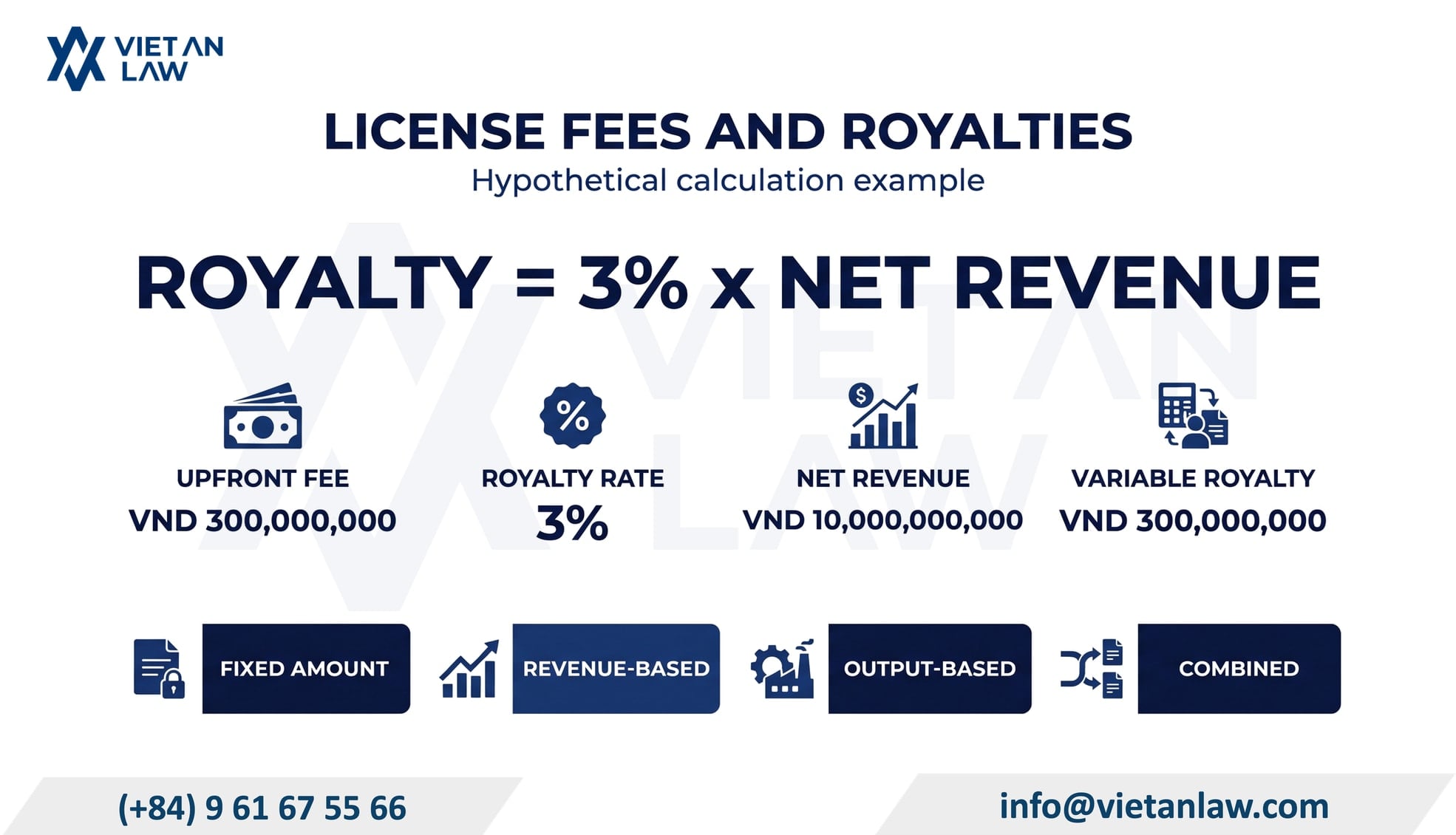
The contract must precisely define the revenue used as the basis for calculation, deductions, exchange rates, and payment dates.
For transactions between related parties or transactions with a foreign element, foreign contractor tax obligations, transfer pricing policies, and payment records should be assessed under the applicable regulations.
Liability when the rights are disputed
The licensee needs to know who is responsible when the licensed rights are subject to a request for cancellation or invalidation, or when the products give rise to claims of infringement of third-party rights.
The contract should provide for notification obligations, legal support, the right to suspend exploitation, fee adjustments and the allocation of damages.
In particular, disputes over the licensed rights themselves should be distinguished from disputes concerning other technology components not covered by the contract.
Is industrial property licensing agreement registration in Vietnam always required?
Not every licensing contract is subject to the same registration requirement.
For contracts for the use of industrial property objects established based on registration, Clause 2, Article 148 of the Law on Intellectual Property provides that the contract takes effect as agreed by the parties.
However, Clause 3, Article 148, as amended by Law No. 131/2025/QH15, provides that contracts for the use of industrial property objects under Clause 2, except trademark use contracts, must be registered with the competent state authority to be legally effective against third parties.
Accordingly, a distinction should be made between:
- Validity between the parties: As agreed, in accordance with the law.
- Legal effect against third parties: The registration requirement must be considered, together with the exception for trademark licensing in Vietnam.
- Transactions involving copyright, related rights and plant varieties: The corresponding specific regulations apply.
If the transaction also involves technology transfer, the procedures under the law on technology transfer should also be checked.
Businesses may refer to our article on industrial property licensing agreement registration in Vietnam, while checking the forms and procedural regulations in effect at the time of filing the dossier.
Does a patent license in Vietnam give enough rights to manufacture the product?
Not necessarily. Being granted the right to use an invention does not automatically guarantee that a business can manufacture and sell the entire product without infringing the intellectual property rights of others.
A technology product may simultaneously use multiple inventions, industrial designs, software, or technical solutions owned by different parties.
This concerns the freedom to exploit commercially, commonly referred to as Freedom to Operate (FTO).
FTO due diligence before commercial exploitation
Businesses should determine:
- Does the planned product use a solution within the scope of protection of another party?
- Are the related rights still in force in the country of manufacture or sale?
- Is an additional license needed for another component?
- Can the product design be adjusted to avoid the scope of protection?
- Is the existing license scope sufficient for all manufacturing and export activities?
FTO differs from checking whether an invention is protected. A valid patent does not mean that the owner or the licensee always has the freedom to manufacture every product using that invention.
When is an additional license needed?
If the finished product simultaneously uses several protected inventions, the licensee may need to negotiate additionally with the other owners.
If no agreement can be reached, the business should assess options such as adjusting the design, changing markets, or other legal mechanisms if the conditions are met.
Businesses should not invest in a production line based solely on having obtained one patent license contract.
Case study: licensing a German patent in Vietnam but facing a Japanese company’s rights
A hypothetical example to illustrate how the transaction is handled.
Company A in Germany grants Company B in Vietnam the right to use an invention relating to the control unit of an energy-saving device.
After signing the contract and preparing to invest in a production line, Company B discovers that the finished device also uses a transmission mechanism that may fall within the scope of protection of an invention owned by Company C in Japan.
Although Company B has a license contract with Company A, this transaction may not be sufficient to secure the right to manufacture the entire device.
Option 1: Check the actual scope of protection
First, Company B must determine whether Company C’s invention is protected and still in force in Vietnam or in the intended markets.
The claims and the actual technical features of the product need to be analyzed; one cannot rely solely on the title of the invention or its commercial description.
Option 2: Negotiate an additional license
If the product uses a solution within the scope of Company C’s valid rights, the business may negotiate to obtain an additional right of use.
The additional license may be granted through a separate contract or a multi-party contract structure, depending on the legal and commercial conditions.
Option 3: Adjust the product design
The business may consider an alternative design that does not use the solution within the scope of protection of Company C.
However, the alternative must be assessed both technically and legally. Not every change in form or specifications is sufficient to avoid patent infringement.
Option 4: Adjust the production and market plan
If the cost of obtaining additional rights is too high or the risk cannot be eliminated, the business may consider adjusting the product, the area of exploitation or the investment plan.
Legal lesson: When receiving a technology license, businesses need to assess the exploitability of the finished product, not just the legal status of a single licensed protection title.
Legal issues to check before signing an IP licensing agreement in Vietnam
For high-value transactions, businesses should complete a review of the following issues:
| Item to check | Documents or results required |
| Licensor | Evidence of ownership or lawful licensing rights |
| Licensed subject matter | List of protection titles, rights and related assets |
| Protection status | Validity, territory and scope of rights |
| Third-party restrictions | Exclusive contracts, co-ownership, related rights |
| Exploitability | FTO due diligence results if needed |
| Contract structure | Type of license, scope, term, right to sublicense |
| Financial obligations | Fee formula, taxes, payment records |
| Legal procedures | Registration requirements or specialized procedures |
| Contract termination | Handling of data, documents, products and remaining obligations |
The above checklist only supports an initial review. The actual due diligence depends on the type of asset, the purpose of exploitation and the countries involved.
Frequently asked questions about intellectual property licensing
Can one contract grant an intellectual property license covering multiple rights?
A contract may be structured to cover multiple intellectual property rights or assets, but each subject matter, scope of use and corresponding legal requirement must be clearly distinguished.
If the transaction includes inventions, software and the transfer of technical know-how, businesses should have an appendix setting out each group of rights and obligations separately.
Can an intellectual property license be granted free of charge?
The parties may agree on the benefits and the method of payment within the limits of the law. However, not charging a direct fee does not rule out tax, related-party transaction or other financial obligation issues, if any.
Does the licensee have the right to sue for infringement?
The right to request enforcement or to file a lawsuit depends on the type of intellectual property subject matter, the licensee’s legal standing, the scope of the contract and the applicable regulations.
Businesses should provide for the responsibility to cooperate in protecting the rights and determine which party has the authority to take the corresponding legal measures.
Can FDI enterprises be licensed to use intellectual property rights in Vietnam?
Yes, if the transaction meets the applicable conditions. For cross-border transactions, regulations on technology transfer, international payments, taxes and the relevant business lines should also be considered.
Advisory services on intellectual property licensing in Vietnam at Viet An Law Firm
A licensing contract for intellectual property rights can directly affect a business’s manufacturing capacity, technology exploitation rights and commercial value.
Viet An Law Firm provides legal advisory services on transactions granting the right to use intellectual assets, as well as on intellectual property assignment in Vietnam, including:
- Due diligence on the legal status and scope of the rights to be licensed.
- Advice on choosing a suitable licensing structure.
- Drafting, reviewing and negotiating contracts licensing the use of inventions, industrial designs and other intellectual assets.
- Advice on rights to improvements, technical know-how and third-party rights.
- Support in assessing legal issues related to FTO.
- Review of registration, tax and other legal requirements in international transactions.
- Advice on dispute resolution and obligations upon termination of the contract.
For manufacturing companies, technology companies, and foreign-invested enterprises, a legal assessment before signing the contract is important to ensure appropriate exploitation rights and limit additional costs.
Viet An Law Firm supports businesses in drafting licensing contracts for intellectual property rights that are consistent with their commercial objectives and the laws of Vietnam.
Author: Lawyer Duong Xuan Thang
Lawyer in charge and reviewer: Lawyer – Industrial Property Representative Do Thi Hong Hanh
Hotline/ Zalo/ Whatsapp: (+84) 961 571 818
Email: info@vietanlaw.com
Hanoi office: 3rd Floor, Hoang Ngan Plaza Building, No. 125 Hoang Ngan Street,
Yen Hoa Ward, Hanoi City
Ho Chi Minh City office: Room 2.26 – 2.27, Charmington La Pointe Building, 181 Cao Thang Street, Hoa Hung Ward, Ho Chi Minh City.