


The issue of IP commercialisation in Vietnam, especially in transactions & contracts, is increasingly attracting the attention of enterprises, investors, and rights holders in the context that IP assets are not only legally valuable but can also generate revenue, competitive advantages, and investment value. Trademarks, patents, industrial designs, copyrights, software, trade secrets, and other property rights can be exploited through transfer, licensing, capital contribution, commercial franchising, or business cooperation models. However, to turn intellectual property into commercial value, enterprises need to accurately determine the rights to the assets, the scope of the transaction, valuation methods, transfer mechanisms, and especially draft appropriate contracts to limit disputes.
What are IP assets in Vietnam?
IP is a legal field protecting creative products, identifiers, and legitimate benefits arising from creative and business activities. From a commercial perspective, IP assets are not only viewed as “protected objects” but also as a type of asset capable of generating economic value.
Assets that can be commercially exploited are relatively diverse, including:
- Copyrights and related rights;
- Patents, utility solutions;
- Industrial designs;
- Trademarks;
- Trade names;
- Geographical indications;
- Trade secrets;
- Plant variety rights;
- Property rights arising from other IP objects.
Significance of IP commercialisation in Vietnam
It can be understood that commercialisation of IP is the process of bringing IP rights into business operations to create economic value for the rights holder or the transferee.
The significance of IP commercialisation in Vietnam: transactions & contracts can be generalized as a chain: IP assets → rights establishment → valuation → transaction/transfer → commercial exploitation → revenue generation → reinvestment for innovation.
Creating revenue sources and increasing asset value for owners
Through transfer, licensing, franchising or other forms of exploitation, owners can generate revenue from IP assets without necessarily having to directly manufacture or trade products.
In particular, licensing allows owners to retain rights while still collecting fees from allowing other entities to exploit the assets.
Turning IP assets into resources for production and business activities
When commercialised, patents, trademarks, industrial designs, software, trade secrets, and other IP assets no longer just carry legal value but become a part of business resources.
Enterprises can use IP assets to develop products, expand markets, build brands, and create competitive advantages.
Enhancing enterprise value
For many enterprises, especially technology and innovative enterprises, the value of IP assets can account for a significant proportion of the total enterprise value.
Establishing, valuing, and effectively exploiting these assets helps enterprises prove their competitiveness, increase brand value, and create a basis for investment, cooperation, or capital mobilization activities.
Promoting innovation and research and development
When research results can be transferred and create economic benefits, organizations, enterprises, and individuals will have more motivation to invest in research, technology development, and innovation.
Expanding market access and exploiting IP assets on a larger scale
Owners do not necessarily have to exploit the full potential of the assets themselves. Through licensing or cooperating with partners capable of production, distribution, and marketing, IP assets can be brought to more markets and client groups.
Methods of IP commercialisation in Vietnam
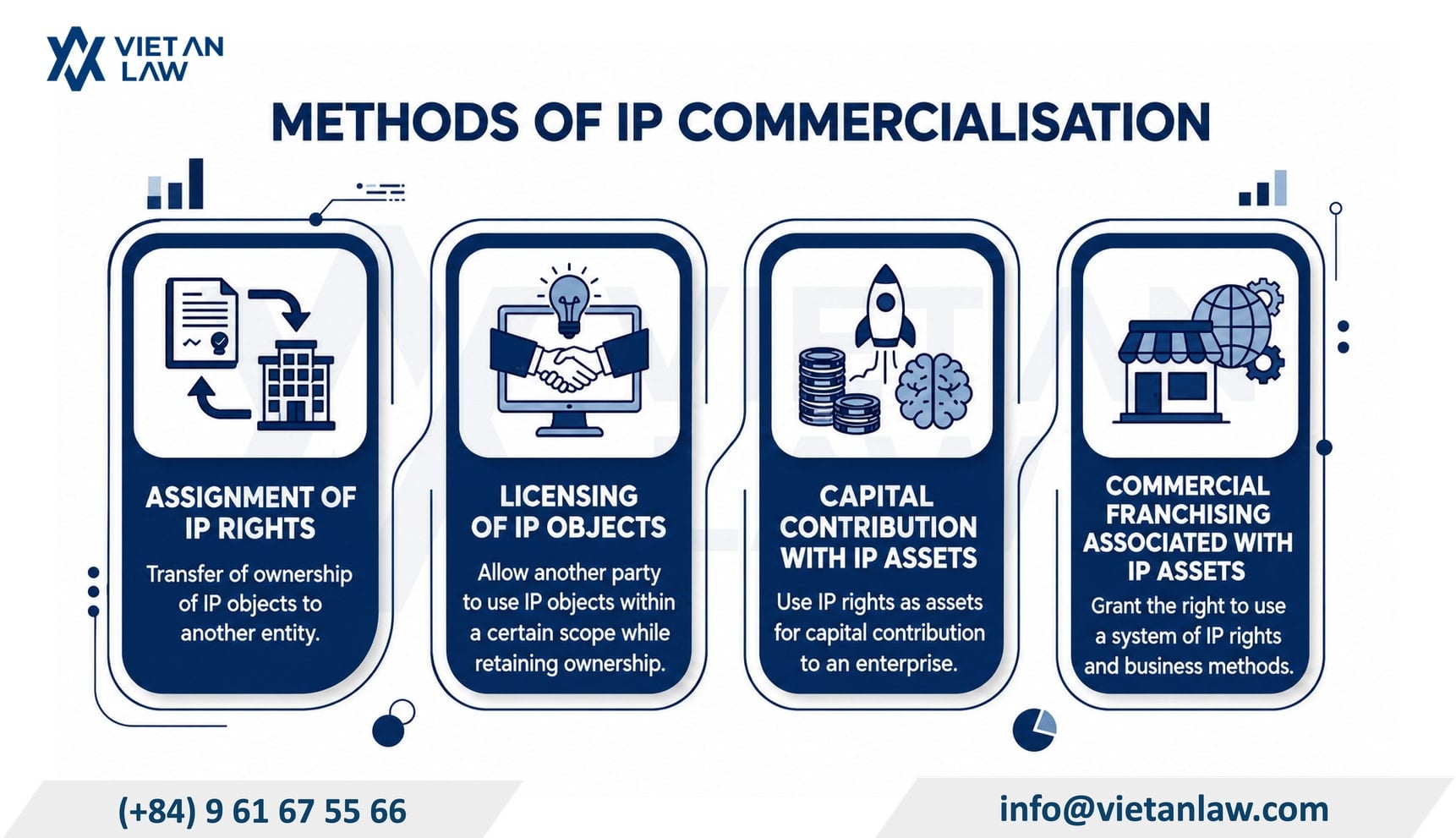
Assignment of intellectual property rights
Assignment is a commercialisation method in which the owner transfers the ownership of IP objects to another entity according to agreements and legal regulations.
This is a more “definitive” method compared to licensing. After the ownership is legally transferred, the assignee becomes the entity with rights to the assets within the transferred scope.
The assignment contract needs to pay special attention to determining:
- Subject of assignment;
- Scope of rights;
- Assignment price;
- Payment method;
- Obligation to register or record the transaction;
- Responsibility for third-party disputes;
- Time of rights transfer.
Example: Company A is the owner of the “ABC” trademark and signs a contract for the intellectual property rights assignment regarding the entire ownership of the trademark to Company B for 2 billion VND. After completing the transfer according to regulations, Company B becomes the trademark owner and has the right to exploit and dispose of the trademark within the scope permitted by law.
Licensing of IP objects
Licensing is a method that allows owners to retain rights but permits another party to exploit the IP objects within a certain scope.
The contract may stipulate the right to use according to:
- Territorial scope;
- Term;
- Business sector;
- Products or services;
- Form of use;
- Exclusive or non-exclusive rights.
Example: Enterprise A owns a trademark and licenses it to enterprise B for a term of 5 years to trade a certain group of products in Vietnam. In this case, A remains the owner but B has the right to commercially exploit the trademark within the contract’s scope.
Capital contribution with IP assets
IP rights can become assets used for capital contribution to an enterprise according to Article 34 of the Law on Enterprise 2020.
In this case, the most important issue is asset valuation and the accurate determination of the rights contributed as capital.
Example: A technology enterprise can use the ownership of software, patents, or other IP assets as capital contribution to the enterprise. However, it is necessary to clarify whether the contributed asset is the entire ownership or just the right to use.
Overvaluation can lead to disputes over the capital contribution ratio and the responsibilities of the contributing party. Conversely, undervaluation can cause damage to the asset owner themselves.
Commercial franchising associated with IP assets
In a franchise model, IP rights are usually an important part of the franchised business system.
The franchisee may be permitted to use:
- Trademarks;
- Trade names;
- Trade secrets;
- Business know-how;
- Designs;
- Brand identity systems.
The specific feature is that the commercialised subject is not just a single IP right but often a system of rights and business methods.
Comparison of IP commercialisation methods
| Criteria | Assignment | Licensing | Capital Contribution | Franchising |
| Nature | Transfer of ownership | Transfer of right to use | Bringing assets into capital contribution | Transfer of right to exploit business model |
| Initial owner | Usually no longer the owner after transfer | Retains ownership | May transfer rights per agreement | Usually retains ownership |
| Income | Assignment price | Licensing fees/royalty | Benefits from capital contribution portion | Franchise fees and related amounts |
| Scope of exploitation | According to the scope of transferred rights | Can be limited by term, territory, sector | According to agreement and law | Associated with the franchise system |
| Main risks | Loss of control over assets | Difficult to control exploitation | Asset valuation | Quality and brand control |
| Suitability | When wanting to transfer rights long-term | When wanting to exploit assets but retain rights | When needing to mobilize capital | When expanding the business model |
IP asset transactions: Legal issues to note in Vietnam
Determine the entity with transaction rights
Before signing a contract, it is necessary to determine whether the signatory actually has the right to dispose of or permit the exploitation of the assets.
For assets with co-owners, the transaction may require the participation or approval of related right holders.
For rights transferred from other entities, it is necessary to check the rights transfer chain to ensure the transacting party has sufficient rights.
Accurately determine the transaction object
This is one of the contents most prone to disputes. The contract needs to clearly answer:
- Which object is transacted?
- Transfer of all or part of the rights?
- Transfer of ownership or right to use?
- Is it exclusive or not?
- Where is the territorial scope?
- How long is the term?
- Used for which products or services?
If these elements are not clearly determined, it is very easy for each party to understand the scope of transferred rights differently.
Check the legal status of the assets
Before the transaction, the receiving party should conduct due diligence on the IP assets. The appraisal content may include:
- Registration and protection status;
- Entity holding the title;
- Protection term;
- Scope of protection;
- Previous transfer transactions;
- Disputes or complaints;
- Possibility of being opposed or requested for cancellation by a third party;
- Existing rights limitations.
For high-value transactions, this activity should be performed as a step of legal due diligence on IP assets prior to signing the contract.
Intellectual property valuation
Valuation of IP assets is one of the most difficult issues during commercialisation. Asset value can be approached via several methods, such as:
- Cost method;
- Market method;
- Income method.
Each method has its own advantages and limitations. For assets capable of generating future cash flows, the income-based method may provide a more suitable perspective. However, valuation results still depend on assumptions about revenue, market, exploitation time, and risks.
Legal notes on IP commercialisation contracts in Vietnam
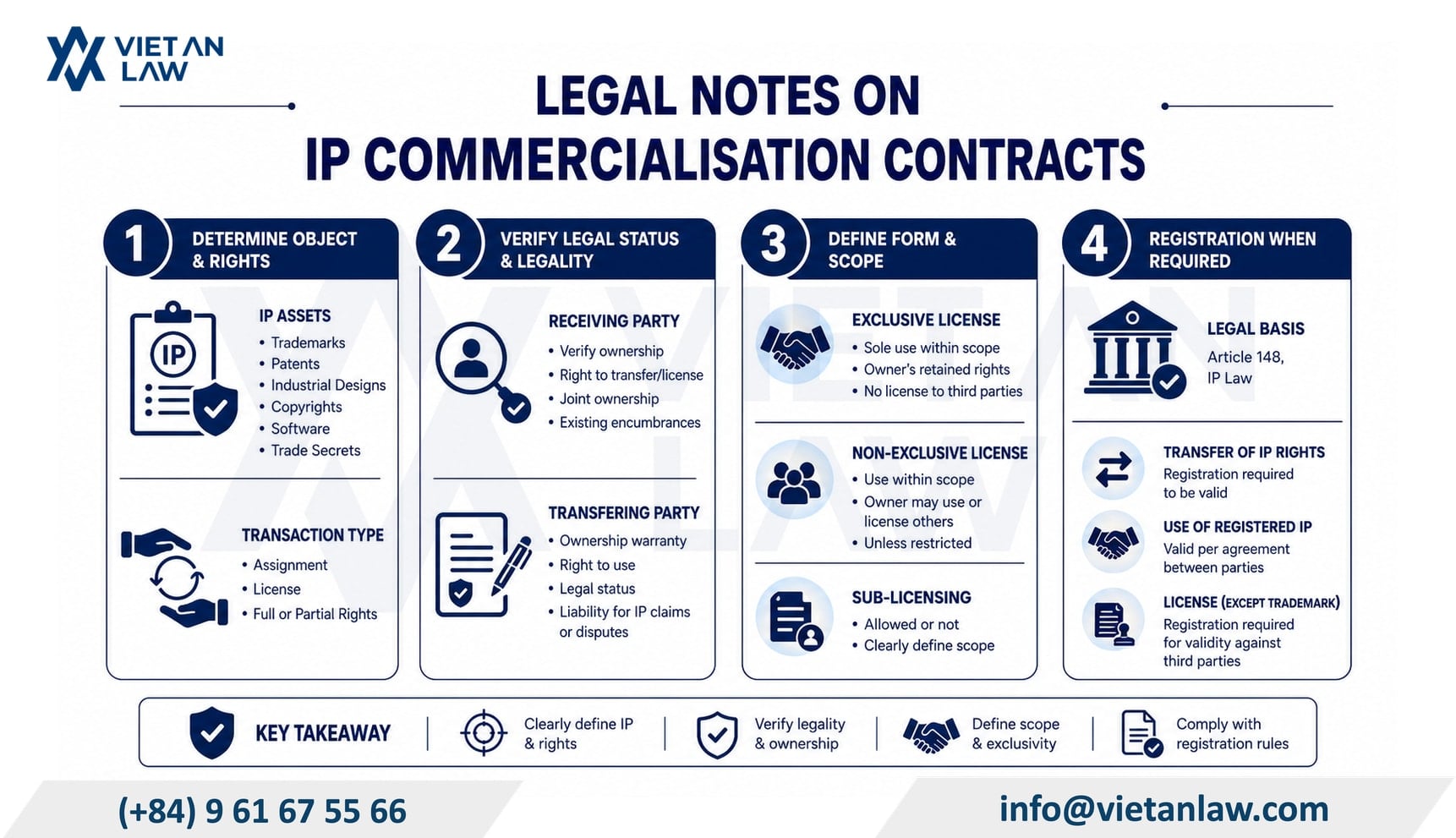
Accurately determine the object and rights to be commercialised
The contract needs to specifically determine the IP assets brought into the transaction, such as trademarks, patents, industrial designs, copyrights, software, or trade secrets. Simultaneously, it is necessary to clarify whether the transaction aims at assignment of intellectual property rights or transfer of right to use, for all or part of the rights.
Check the legal status of transacting entities and legality of assets
- Before signing the contract, the receiving party needs to check whether the signatory is the owner or has the legal right to transfer or license the exploitation of the assets. For assets under joint ownership or already transferred to another party, it is necessary to fully determine the rights of related parties.
- The transferring party needs to make appropriate commitments regarding ownership, right to use, and legal status of the assets. At the same time, the contract should stipulate the responsibilities of the parties if the asset is subject to complaints, disputes, or requests related to IP rights by a third party.
Clearly determine the form and exclusive scope of the contract
Parties need to clearly determine whether the IP commercialisation contract is implemented in an exclusive or non-exclusive form, especially for contracts on licensing IP objects. Specifically:
- Exclusive licensing: the licensee is allowed to use the object within the agreed scope, term, and territory; the owner needs to clearly determine the scope of rights they still maintain and the right to license to third parties.
- Non-exclusive licensing: the licensee has the right to exploit the assets within the contract’s scope, but the owner can still use them or license them to other entities, unless there is a restrictive agreement.
- Sub-licensing: it is necessary to clearly determine whether the licensee is allowed to sub-license to a third party and within what scope.
Perform registration procedures when required by law
After signing, the parties need to determine whether the transaction falls under cases requiring registration or recording at competent authorities.
According to Article 148 of the IP Law:
- For industrial property rights established on the basis of registration such as trademarks, patents, industrial designs: The contract on transfer of industrial property rights is only valid when it has been registered with the state management agency for industrial property rights.
- For industrial property rights established on the basis of registration: The contract on using industrial property objects is valid according to the agreement between the parties.
- Contracts on using industrial property objects, except for trademark licensing contracts: Must be registered with the competent state agency to have legal validity against third parties.
Legal risks that may arise when commercialising IP assets in Vietnam
Ownership risks
If the transferring party is not the legal right holder, the entire transaction may give rise to disputes.
Therefore, the receiving party should not only rely on information provided by the partner but must check the legal records of the assets.
Risks due to incorrect determination of transfer scope
A contract may record “right to use the trademark” without specifying territory, products, term, and exclusivity. This is a common source of disputes.
Risks of infringing third-party rights
A registered asset can still incur rights disputes or be claimed by a third party that the use of the asset infringes their rights.
Therefore, appraising the possibility of infringing third-party rights is an important step before the transaction.
Trade secret risks
If the commercialised assets contain trade secrets, the contract must have a strict confidentiality mechanism.
Disclosing secrets not only causes direct damage but can also destroy the commercial value of the assets.
Risks after contract termination
This is a frequently overlooked issue. The contract needs to clearly stipulate:
- Is it necessary to stop using the assets immediately?
- How are manufactured products handled?
- Is it allowed to sell inventory?
- Must technical data and documents be returned or destroyed?
- How long do confidentiality obligations continue?
Frequently asked questions about IP commercialisation in Vietnam
How does an intellectual property rights assignment differ from an IP license?
Assignment is basically transferring the ownership of an asset, while licensing is allowing another party to use IP objects within a certain scope but the owner still maintains ownership.
What important contents should a licensing contract stipulate?
The contract should clearly stipulate the object, scope of use, territory, term, exclusivity, licensing fees, sub-licensing rights, quality control, confidentiality, violation handling, and consequences when the contract terminates.
How to commercialise copyrights for articles, software, images, or videos?
Copyright owners can exploit the commercial value of their works through forms such as assignment of rights, licensing of copyrights, granting permission to exploit the work, or business cooperation. However, it is necessary to distinguish between the moral rights and property rights of the author, because not all rights of the author can be assigned or transferred to other entities. The contract needs to clearly determine the work, exploited rights, scope of use, term, territory, and remuneration.
Can unpatented IP assets (pending application) be commercialised?
In principle, you can entirely commercialise them (such as application assignment, trade secret licensing, exploitation cooperation agreements…). However, commercialisation without a protection title poses significant risks if the application is refused. For industrial property objects (like trademarks, patents), the assignee often requires the assignor to commit to compensate or refund costs if that asset is not granted an official protection title.
How does exclusive licensing differ from non-exclusive licensing?
- Exclusive licensing: The licensor allows only one receiving party to exploit and use the IP assets within the agreed scope and term. During this time, even the owner themselves is not allowed to exploit or license to any other third party (unless otherwise agreed).
- Non-exclusive licensing: The owner allows the receiving party to use, while retaining the right to exploit it themselves and having the right to license those IP assets to multiple other third parties at the same time.
Above is the legal advice on IP commercialisation in Vietnam: transactions & contracts. Clients who need consulting, drafting, and reviewing contracts on assignment, licensing, capital contribution, or other transactions related to IP assets, please contact Viet An Law Firm for lawyers to advise and support suitably for each specific case.
Writer: Lawyer Duong Xuan Thang
Reviewed by: Lawyer Dong Van Thuc
Hotline/ Zalo/ Whatsapp: (+84) 961 675 566
Email: info@vietanlaw.com
Hanoi Office: 3rd Floor, Hoang Ngan Plaza Building, No. 125 Hoang Ngan, Yen Hoa Ward, Hanoi City
Ho Chi Minh City Office: Room 04.68, 4th Floor, Lobby A, RiverGate Residence Building, 151-155 Ben Van Don, Khanh Hoi Ward, Ho Chi Minh City