


Assigning intellectual property rights in Vietnam is a legal transaction in which the owner transfers ownership of copyright, related rights or industrial property rights to another organization or individual. For the transaction to be valid and to limit disputes, the parties must correctly identify the subject matter to be assigned, the assignment conditions, the contents of the contract and the procedures for recording the rights after the assignment, whether the deal takes the form of a copyright assignment agreement in Vietnam or another arrangement. Below, Viet An Law Firm provides detailed advice on assignment of intellectual property rights in Vietnam: contracts and procedures.
Which intellectual property rights may be assigned in Vietnam?
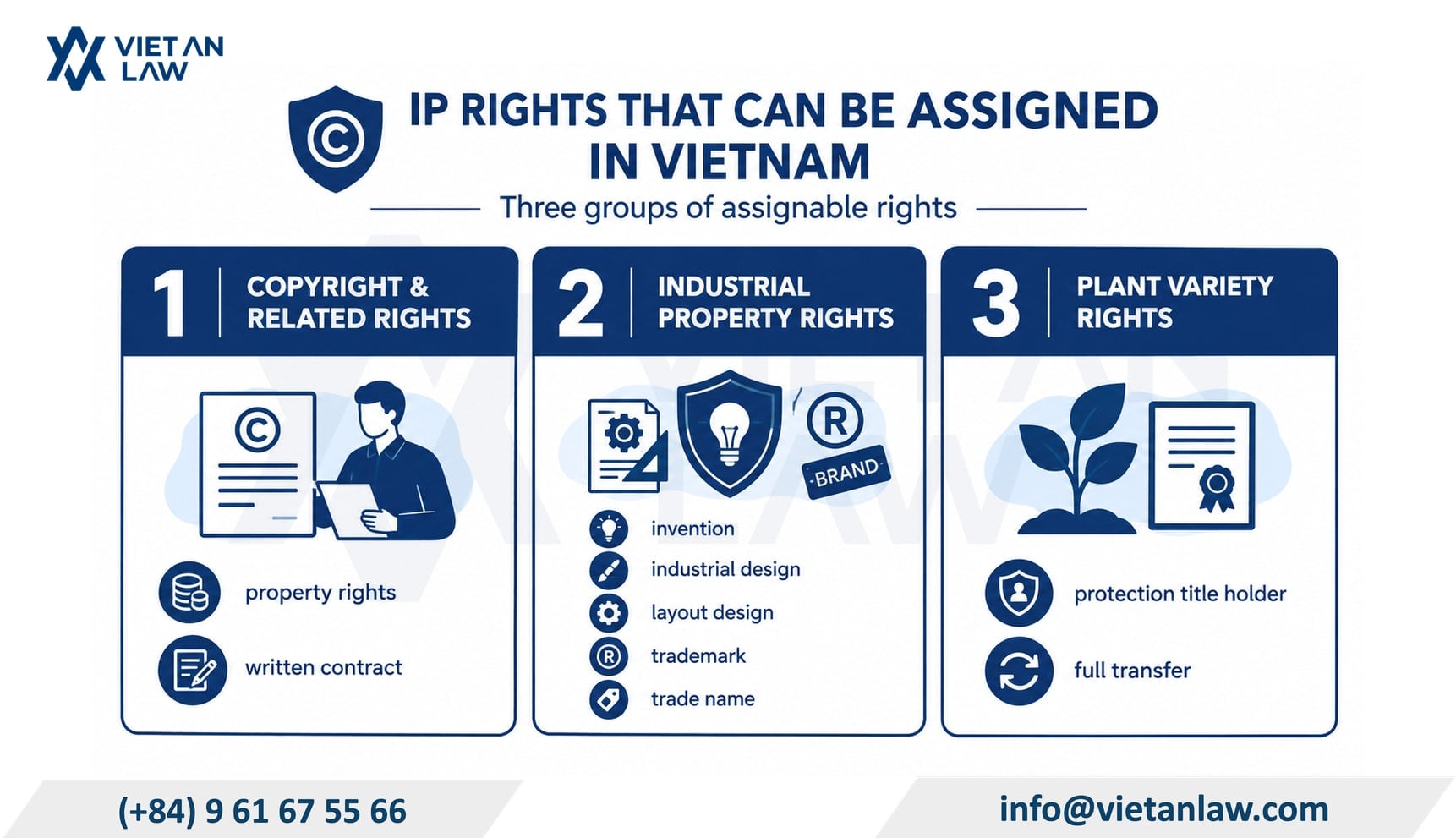
Assignment of copyright and related rights
Clause 1, Article 45 of the Law on Intellectual Property provides that assignment is the act by which the copyright owner or the related rights owner transfers ownership of the rights that the law allows to be assigned to another organization or individual under a contract or under relevant legal provisions.
Under Article 45 of the Law on Intellectual Property, the owner may assign the property rights belonging to copyright and related rights as prescribed. However, not every right may be assigned.
Assignment of industrial property rights
Clause 1, Article 138 of the Law on Intellectual Property provides that assignment of industrial property rights is the act by which the owner of industrial property rights transfers his or her ownership to another organization or individual.
The subject matters of industrial property rights that may be assigned include the rights to:
- Inventions;
- Industrial designs;
- Layout designs;
- Trademarks;
- Trade names;
- Other subject matters within the scope of rights protected by law.
However, the assignment must satisfy the conditions and restrictions set out in Article 139 of the Law on Intellectual Property.
Transfer of IP rights to plant varieties
Clause 1, Article 194 of the Law on Intellectual Property provides that assignment of rights to a plant variety is the act by which the holder of the plant variety protection title transfers all rights to that plant variety to the assignee. The assignee becomes the holder of the plant variety protection title from the date on which the assignment contract is registered with the state management agency in charge of rights to plant varieties under the procedures prescribed by law.
Therefore, when drafting the contract, the parties must first correctly identify the subject matter of the intellectual property right concerned so that they can assign IP rights in Vietnam under the correct provisions.
Restrictions on the ability to assign IP rights in Vietnam
Restrictions on assigning copyright and related rights
- The author may not assign moral rights, except for the right to publish the work;
- A performer may not assign moral rights, including: the right to be introduced by name when performing and when the sound recording, video recording or broadcast of the performance is released; the right to protect the integrity of the performance image, not allowing others to distort it or to modify or cut it in any form that harms the performer’s honor and reputation.
- Where a work, performance, sound recording, video recording or broadcast has co-owners, the assignment must be agreed by all co-owners; where there are co-owners but the work, performance, sound recording, video recording or broadcast has separate parts that can be separated for independent use, the copyright owner or the related rights owner may assign the copyright or related rights to his or her separate part to another organization or individual.
Restrictions on assigning industrial property rights
Article 139 of the Law on Intellectual Property sets out a number of important restrictions:
- The owner of industrial property rights may assign his or her rights only within the scope of protection.
- Rights to a geographical indication may not be assigned.
- Rights to a trade name may only be assigned together with the assignment of the entire business establishment and business activities under that trade name.
- The assignment of rights to a trademark must not cause confusion as to the characteristics or origin of the goods or services bearing the trademark.
- Rights to a trademark may only be assigned to an organization or individual that satisfies the conditions applicable to persons entitled to register that trademark.
- Rights to an invention, industrial design or layout design that is the result of a science and technology task funded by the state budget may only be assigned to an organization established under Vietnamese law or to an individual who is a Vietnamese citizen and permanently resides in Vietnam.
IP assignment contract in Vietnam
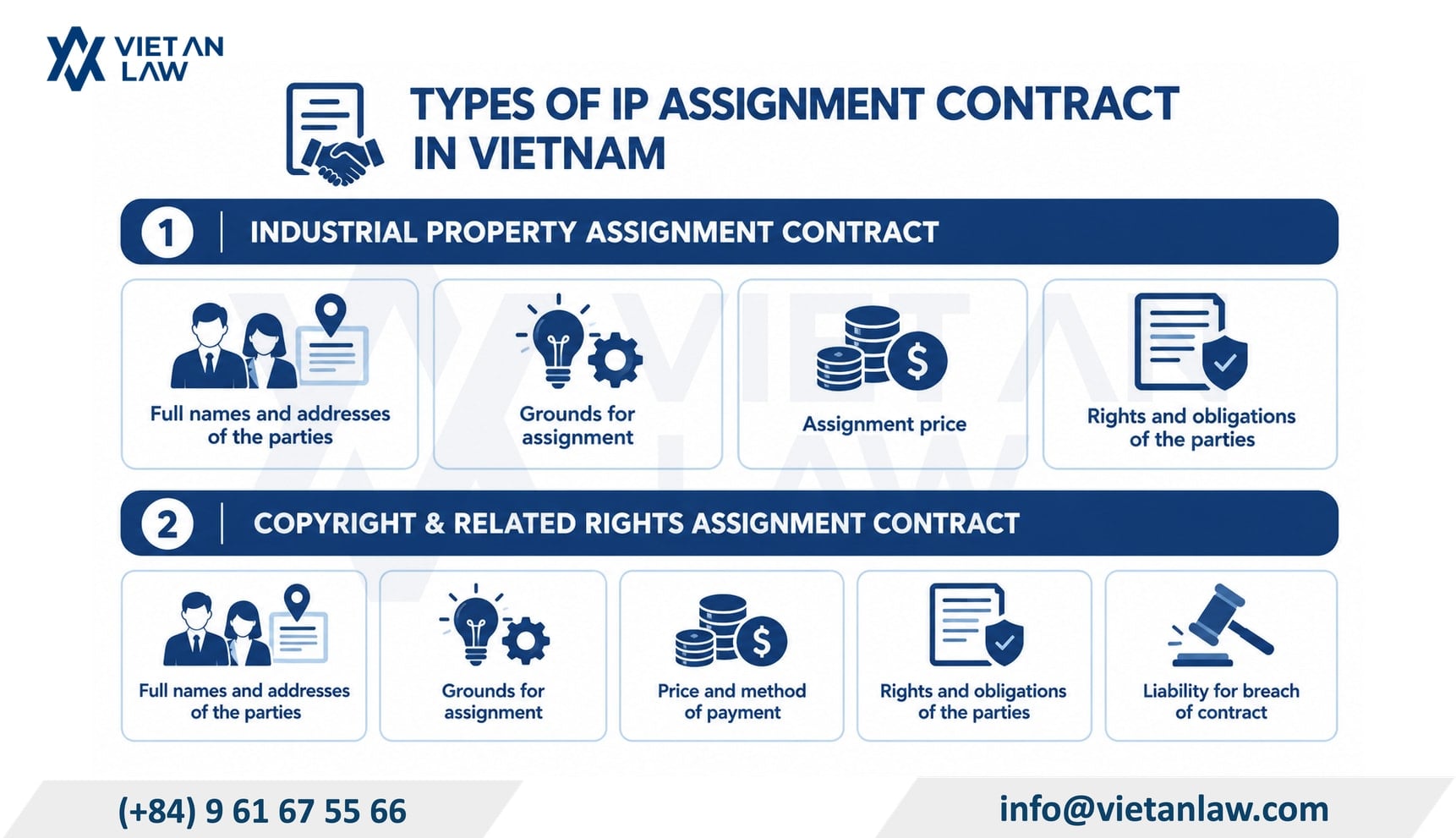
Contract for assignment of industrial property rights
Clause 2, Article 138 of the Law on Intellectual Property requires the assignment of industrial property rights to be carried out by a written contract.
Under Article 140 of the Law on Intellectual Property, an intellectual property transfer agreement for industrial property rights must contain the following principal contents:
- The full names and addresses of the assignor and the assignee;
- The grounds for the assignment;
- The assignment price;
- The rights and obligations of the assignor and the assignee;
Contract for assignment of copyright and related rights
Under Clause 1, Article 46 of the Law on Intellectual Property, a contract for the assignment of copyright and related rights must be made in writing and contain the following principal contents:
- The full names and addresses of the assignor and the assignee;
- The grounds for the assignment;
- The price and the method of payment;
- The rights and obligations of the parties;
- Liability for breach of the contract.
Comparing an intellectual property transfer agreement and a license in Vietnam
| Criteria | IP assignment | IP licensing |
| Nature | Transfer of ownership | Permission to use the rights |
| Owner after the transaction | The assignee becomes the owner | The licensor remains the owner |
| Form | Assignment contract | Use/license contract |
| Term | Tied to the scope and term of protection of the rights | According to the term of the contract |
| Ability of the former owner to continue exploitation | In principle, no longer holds the ownership that has been assigned | Still holds rights within the scope of the remaining rights |
| Example | Selling the entire ownership of a trademark | Allowing another enterprise to use the trademark for business |
Procedures for assignment of intellectual property rights in Vietnam
Copyright and related rights
Under Clause 2, Article 49 of the Law on Intellectual Property, registration of copyright and related rights is not a mandatory procedure for enjoying the rights.
Therefore, for a transaction assigning copyright and related rights, the focus is on correctly identifying the owner and the scope of the rights to be assigned, and on making a written contract that satisfies Articles 45 and 46 of the Law on Intellectual Property.
The parties should take the following steps:
- Step 1: Verify the owner and the legal status of the work or the related rights.
- Step 2: Precisely determine the rights to be assigned.
- Step 3: Draft and sign the written assignment contract.
- Step 4: Hand over the dossier and documents and perform the payment obligations.
- Step 5: Carry out the procedures for updating the owner’s information if necessary.
Industrial property rights
For industrial property rights established on the basis of registration, Clause 1, Article 148 of the Law on Intellectual Property provides that a contract for the assignment of industrial property rights takes effect only when it has been registered with the state management agency in charge of industrial property rights.
However, under Point VI, Part B, Section 2, Appendix I.3 of Resolution No. 66.18/2026/NQ-CP dated May 18, 2026, from July 1, 2026 the procedure for registering contracts under Article 148 of the Law on Intellectual Property is abolished.
Under the current mechanism, the transfer of IP rights is handled together with the procedure for amending the protection title or changing the title holder, in which the dossier may have to be accompanied by the assignment contract and documents evidencing the transfer of the rights.
Key notes on intellectual property assignment in Vietnam
Checking that the owner is correct
Before signing the contract, the assignee should check whether the person signing the contract is genuinely the owner of the rights.
For industrial property rights, it is necessary to check the information on the protection title, its validity status and the information relating to any transfer, mortgage or restriction of the rights.
Checking co-ownership
If the rights belong to co-owners, the rights of each of them must be fully determined. For copyright and related rights, Clause 3, Article 45 requires the agreement of all co-owners where jointly owned rights are assigned, except where a separate part of the rights can be separated for independent use.
Checking the term of protection
It is not enough to check only the name of the intellectual property subject matter; the term and the scope of protection must also be checked.
In particular, for an industrial design assignment in Vietnam, the contract must clearly describe the protection title number, the grant date, the title holder, the group of goods or services, or the scope of the rights to be assigned.
Trademark assignment in Vietnam requires careful checking of the assignee’s conditions
The assignment of a trademark must not cause confusion as to the characteristics or origin of the goods and services, and the assignee must satisfy the conditions applicable to persons entitled to register the trademark under Clauses 4 and 5, Article 139 of the Law on Intellectual Property.
Benefits of intellectual property assignment in Vietnam
For the assignor
- Recovering capital and generating revenue: assigning intellectual property rights allows the owner to receive a sum of money from the intellectual asset without having to continue exploiting it directly.
- Optimizing the intellectual asset portfolio: an enterprise may assign intellectual property rights that no longer suit its business direction, thereby focusing its resources on its core products, technologies or brands.
- Reducing the cost of exploiting and protecting the rights: the assignment helps the owner reduce the costs related to maintaining, managing, exploiting and protecting intellectual property rights.
- Exploiting the value of intellectual assets: inventions, designs, trademarks or other intellectual assets that have not been effectively exploited may be transferred to an entity with better commercialization capacity.
- Limiting business risks: where the owner no longer has the ability or the need to continue investing in the intellectual property subject matter, assignment may be a solution to recover part of the value of the asset and limit additional costs.
For the assignee
- Obtaining ownership of the intellectual asset: the assignee becomes the owner of the transferred rights and may therefore actively exploit and dispose of the rights within the scope permitted by law.
- Saving research and development time and costs: instead of carrying out its own research and creation or building a new intellectual asset from scratch, an enterprise may receive rights that have already been created and protected.
- Increasing competitive advantage: owning inventions, trademarks, industrial designs or other intellectual assets can help an enterprise differentiate itself and enhance its position in the market.
- Expanding business activities: the intellectual asset received through assignment may be used to develop products, expand markets or build new commercial strategies.
- Increasing enterprise value: a valuable intellectual asset portfolio can help increase the value of the assets and the brand and the enterprise’s ability to attract investment.
For society
- Promoting the commercialization of intellectual assets: assignment helps move creative results, technologies and brands from one entity to another that is able to exploit them more effectively.
- Encouraging creativity and innovation: when intellectual property rights can be valued and assigned, individuals and organizations have a further incentive to invest in research, creation and technology development.
- Using social resources effectively: intellectual assets that are not effectively exploited by their owners may be transferred to other entities with suitable capacity and resources.
- Promoting competition and market development: transactions assigning intellectual property rights contribute to the formation and development of the intellectual asset market and create conditions for enterprises to access new technologies and intellectual assets.
- Contributing to economic development: the effective exploitation of intellectual assets promotes innovation and improves productivity, product quality and the competitiveness of the economy.
Viet An Law Firm’s services for assignment of intellectual property rights in Vietnam
Assigning intellectual property rights is a transaction of significant legal and commercial value, especially for trademarks, industrial designs, inventions, copyright and intellectual assets exploited in business activities. The assignment requires not only a suitable contract but also verification of the owner, the scope of protection, the validity status and the legal conditions applicable to each type of right.
With in-depth advisory experience in the field of intellectual property, Viet An Law Firm provides advisory services and carries out the procedures for assigning intellectual property rights in Vietnam for enterprises, organizations and individuals, both domestic and foreign.
Viet An Law Firm’s services include:
- Advising on the conditions for assigning intellectual property rights under Vietnamese law;
- Checking the owner and the legal status of the intellectual property rights before the transaction;
- Searching the validity of trademarks, industrial designs, inventions and related protection titles;
- Advising on the scope of the rights that may be assigned and the restrictions on assignment;
- Advising on the transaction structure and a suitable assignment plan;
- Drafting, reviewing and negotiating contracts for the assignment of intellectual property rights;
- Drafting a copyright assignment agreement in Vietnam;
- Advising on and carrying out a trademark assignment in Vietnam;
- Advising on and carrying out an industrial design assignment in Vietnam;
- Advising on the assignment of inventions and other industrial property rights;
- Preparing the dossier for changing the owner of a protection title;
- Representing clients in carrying out procedures at the National Office of Intellectual Property and other competent state agencies;
- Monitoring the processing of the dossier and assisting in responding to notices from the competent authority;
- Advising on tax, payment and legal issues relating to transactions assigning intellectual assets;
- Advising on the assignment of intellectual property rights in M&A transactions, corporate restructuring and asset transfers;
- Supporting the resolution of disputes arising from contracts for the assignment of intellectual property rights.
Can ownership of a trademark be assigned?
Rights to a trademark may be assigned if the conditions in Article 139 of the Law on Intellectual Property are satisfied, in particular that the assignment must not cause confusion as to the characteristics or origin of the goods and services and that the assignee must satisfy the conditions applicable to persons entitled to register the trademark.
Must a contract for the assignment of industrial property rights be made in writing?
Clause 2, Article 138 of the Law on Intellectual Property provides that the assignment of industrial property rights must be carried out in the form of a written contract.
Can intellectual property rights be assigned in part?
Whether a partial assignment is possible depends on the subject matter and the scope of the rights permitted by law. For copyright and related rights, where co-owners have separate parts that can be separated for independent use, the rights to such a separate part may be assigned under Clause 3, Article 45 of the Law on Intellectual Property.
Does an IP assignment contract need to be notarized?
The Law on Intellectual Property mainly requires that a contract for the assignment of industrial property rights and a contract for the assignment of copyright and related rights be made in writing; it does not provide generally that every contract assigning intellectual property rights must be notarized.
However, in each specific transaction, the parties still need to check the formal requirements under the relevant law and their own agreement.
Clients wishing to assign trademarks, industrial designs, copyright, inventions or other intellectual property rights in Vietnam are kindly requested to contact Viet An Law Firm for advice and support from our lawyers and intellectual property specialists throughout the transaction and the legal procedures.