


Establishing a joint-stock company in 2026 requires a minimum of 3 shareholders, a valid registration application, appropriate charter capital, and a processing time of approximately 3-8 days. Understanding the correct procedures, costs, and conditions will help enterprises open a company quickly and avoid legal risks.
Quick summary of joint stock company registration in Vietnam
| Category | Requirements |
|---|---|
| Shareholders | Minimum of 03 shareholders (legal individuals/organizations) |
| Charter capital | Must suit the business line; no overstatement of capital |
| Company name | “Joint stock company + private name”; must not be duplicated |
| Headquarters | Clear address; apartment buildings are not permitted for use |
| Legal representative | At least 01 person must be a resident of Vietnam |
| Registration dossier | Application form, charter, and list of shareholders |
| Legal documents | Chip-based ID card or other valid legal documents |
| Business lines | Not included in the list of prohibited business investment sectors |
| Fees | Full payment of enterprise registration fees as prescribed |
| Capital contribution | Must be completed within 90 days |
What is a joint-stock company?
According to Article 111 of the Law on Enterprises 2020 (amended and supplemented in 2025), a joint-stock company (JSC) is a type of enterprise entity whose charter capital is divided into many equal parts (shares), with a minimum of 3 shareholders and no maximum limit. Shareholders have limited liability within the scope of their contributed capital. This is a legal entity model with a high capacity to raise capital through the issuance of shares and listing of securities.
Requirements for joint stock company formation in Vietnam
Establishing a joint-stock company requires the following five basic conditions:
Shareholder requirements
- Minimum of 3 founding shareholders
- Individuals aged 18 or older or legally registered organizations
- Not subject to any prohibitions on establishing an enterprise
- Mandatory declaration of beneficial owners (new point).
Charter capital requirements
- No minimum capital requirement (except for industries with statutory capital)
- Shareholders must subscribe to a minimum of 20% of common shares
- Capital must be fully contributed within 90 days
- Falsely declaring capital is strictly prohibited.
Name and headquarters requirements
- Name must include: “Joint stock company” + Private name
- Must not be identical to or cause confusion with other names
- Registered office must have a clear address in Vietnam
- Must not be located in an apartment building (except in commercial areas).
Legal representative
- There may be one or more legal representatives.
- At least one of them must reside in Vietnam.
Registration dossier requirements:
- Use a valid chip-embedded citizen identification card.
- Complete application: Application form, charter, list of shareholders.
- Additional information on beneficial owners (if any).
- Business lines must not be on the prohibited list.
In summary: By fulfilling just the five conditions above, enterprises can quickly establish a joint-stock company and minimize legal risks.
Timeline for establishing a joint stock company
| Stage | Timeframe |
|---|---|
| Dossier preparation | 1–3 days |
| Submission & processing | 3–5 days |
| Completion and post-establishment | 6–10 days |
Costs of establishing a joint-stock company
When using Viet An Law’ company formation services, clients will receive full support for all mandatory costs, including:
- State fees
- Business information publication fees
- Company seal engraving fees
- Company signboards
- Title seals.
The all-inclusive cost for company registration starts from: 1,990,000 VND.
Viet An Law commits to:
- No additional costs;
- Clear pricing from the outset.
Strategic benefits of using professional services to start a company in Vietnam
- Save time
- Avoid legal errors
- No need for travel
- Receive optimal tax advice and business model guidance.
Therefore, choosing a professional firm like Viet An Law is essential to ensure speed, legal compliance, and minimize risks.
Key distinguishing characteristics of joint stock companies under latest regulations
Joint-stock companies (JSCs) are considered the most flexible and efficient enterprise model for raising capital and expanding business scale. With a flexible capital structure, high transferability, and clear legal framework, JSCs are increasingly becoming the preferred choice for many investors in Vietnam.
Flexible capital raising capabilities through shares
One of the biggest advantages of a joint stock company is its strong ability to raise capital through the issuance of shares and other securities.
- Capital subdivision
- Right to issue securities
High liquidity and share transfer rights
Joint-stock companies have a flexible transfer mechanism, increasing liquidity for investors while ensuring stability in governance.
- Free transfer
- Restrictions on founding shareholders
Clear legal status and liability
Joint stock companies have independent legal status, which helps protect the rights of shareholders and enhances transparency in operations.
Why is an JSC the optimal business model?
The combination of:
- Flexible capital raising ability
- High liquidity
- Transparent legal framework
This helps joint stock companies become the fastest-growing and most effective type of business entity in attracting investment capital in the modern economy.
Common mistakes to avoid during joint stock company registration in Vietnam
Choosing the wrong shareholder structure
Differences in business vision among founding shareholders are a leading cause of business failure in its early stages.
- Risks from capital structure: An equal ownership ratio (e.g., 50/50 or 33/33/33) may seem fair, but it can easily create a deadlock in strategic decision-making, as no one has sufficient decision-making power.
- Conflicts of interest: Capital-contributing shareholders are only interested in short-term profits, while the managing shareholder (Founder) wants to reinvest for expansion. Without careful screening from the company registration stage, these disagreements can quickly escalate into legal disputes, paralyzing business operations.
Unreasonable declaration of registered capital
Registered capital is a measure of financial capacity, but declaring this figure subjectively carries certain risks:
- Declaring excessively high capital (“fictitious capital”): The law stipulates that shareholders must pay for the shares they have registered to purchase within 90 days. If capital contribution is delayed without adjustment procedures, the business will face heavy administrative penalties. Furthermore, shareholders are liable for assets equivalent to the committed “fictitious” capital if the company goes bankrupt.
- Declaring excessively low capital: This causes the enterprise to lose credibility in the eyes of partners, suppliers, and banks. A low registered capital will make it difficult for the company to bid on large projects or obtain credit limits.
Adopting overly simplified corporate charters
Many enterprises, when establishing themselves, only use Articles of Association downloaded from the internet to “complete the paperwork” for submission to the Department of Finance. This is an extremely dangerous legal loophole.
- Legal due diligence barriers: Capital gains funds or investors will greatly underestimate a poorly drafted Articles of Association. They need to see clear clauses regarding the right to purchase shares, dividend policies, and mechanisms for resolving disagreements.
- Lack of protection mechanisms: A well-structured corporate charter need to clearly define the veto power of minority shareholders and how to revalue the company. Ignoring this step makes it easy for shareholders to take each other to court when profits arise or when they want to divest.
Lack of shareholding control
Joint-stock companies are created to raise capital, but each funding round means that the founding team’s ownership stake is divided (shareholding dilution).
- Risk of hostile takeover: If founders do not understand the regulations on voting percentages (usually 51%, 65%, or 75% depending on the Articles of Association), they can easily lose their right to manage and make decisions at the General Meeting of Shareholders.
Comparison of joint stock companies, limited liability companies, and partnerships
| Criteria | Joint Stock Company (JSC) | Limited Liability Company (LLC) | Partnership |
| Number of members | Minimum of 03 shareholders; no maximum limit | – Single-member LLC: 01 individual/organization.
– Multiple-member LLC: 02–50 members. |
At least 02 general partners (individuals); may have additional contributing partners |
| Asset liability | Shareholders have limited liability | Members have limited liability | – General partners: Unlimited liability
– Contributing partners: Limited liability |
| Charter capital structure | Divided into equal shares | Divided into capital contribution portions; flexible ratios | Associated with capital contribution portions + unlimited liability of general partners |
| Capital raising | Highly flexible: Issuance of shares and bonds | Limited: No share issuance; bond issuance allowed (under strict conditions) | Highly limited; mainly from internal sources |
| Capital transfer | Freely transferable (except for founding shareholders in the first 03 years) | Controlled transfer; internal members have the right of first refusal | Must be approved by all general partners |
| Organizational Structure | Complex: General Meeting of Shareholders, Board of Directors, Director/CEO; may have a Board of Controllers | Simpler: Members’ Council, Chairperson of the Members’ Council, Director/CEO | Simple but heavily dependent on general partners |
| Management & control | Harder to control due to a large number of shareholders | Easier to control due to a small number of members | Heavily dependent on mutual trust between members |
| Information confidentiality | Lower (transparency required, especially when issuing shares) | High (internal, fewer public disclosures) | High but risky due to unlimited liability |
| Liquidity | High (easy to transfer shares) | Lower | Low |
| Suitability | Startups seeking investment, large enterprises, IPOs | SMEs, family-owned companies, tight control | Small enterprises, professions requiring individual prestige. |
Joint stock companies are suitable for raising capital – Limited liability companies are suitable for internal control – Partnerships in reputable industries with conditions for personalization.
Expert consulting and business registration services Vietnam for joint stock companies
Joint stock company registration dossiers
The required dossiers for registering a joint stock company include:
- Application for enterprise registration (Form No. 4, Appendix I attached to Circular No. 68/2025/TT-BTC)
- Company charter
- List of founding shareholders (Form No. 7, Appendix I attached to Circular No. 68/2025/TT-BTC); list of shareholders who are foreign investors (Form No. 8, Appendix I attached to Circular No. 68/2025/TT-BTC); list of beneficial owners of the enterprise (if any) according to Form No. 10, Appendix I attached to Circular No. 68/2025/TT-BTC.
- Copies of the following documents:
- Legal documents of individuals for founding shareholders and foreign investor shareholders who are individuals, and their legal representatives.
- Legal documents of organizations for organizational shareholders and the document appointing an authorized representative; legal documents of individuals for authorized representatives of founding shareholders and foreign investor shareholders who are organizations.
- For foreign organizational shareholders, a copy of the organization’s legal documents must be legalized by consular authorities.
- Investment registration certificate for foreign investors as stipulated in the Investment Law.
- In cases where the founding shareholder and foreign investor shareholder are individuals, or the legal representative or authorized representative of the founding shareholder and foreign investor shareholder is an organization, and they declare their personal identification number as prescribed in Clause 1, Article 11 of Decree 168/2025/ND-CP, then the business registration dossier does not include copies of the legal documents of these individuals.
Joint stock company establishment procedures
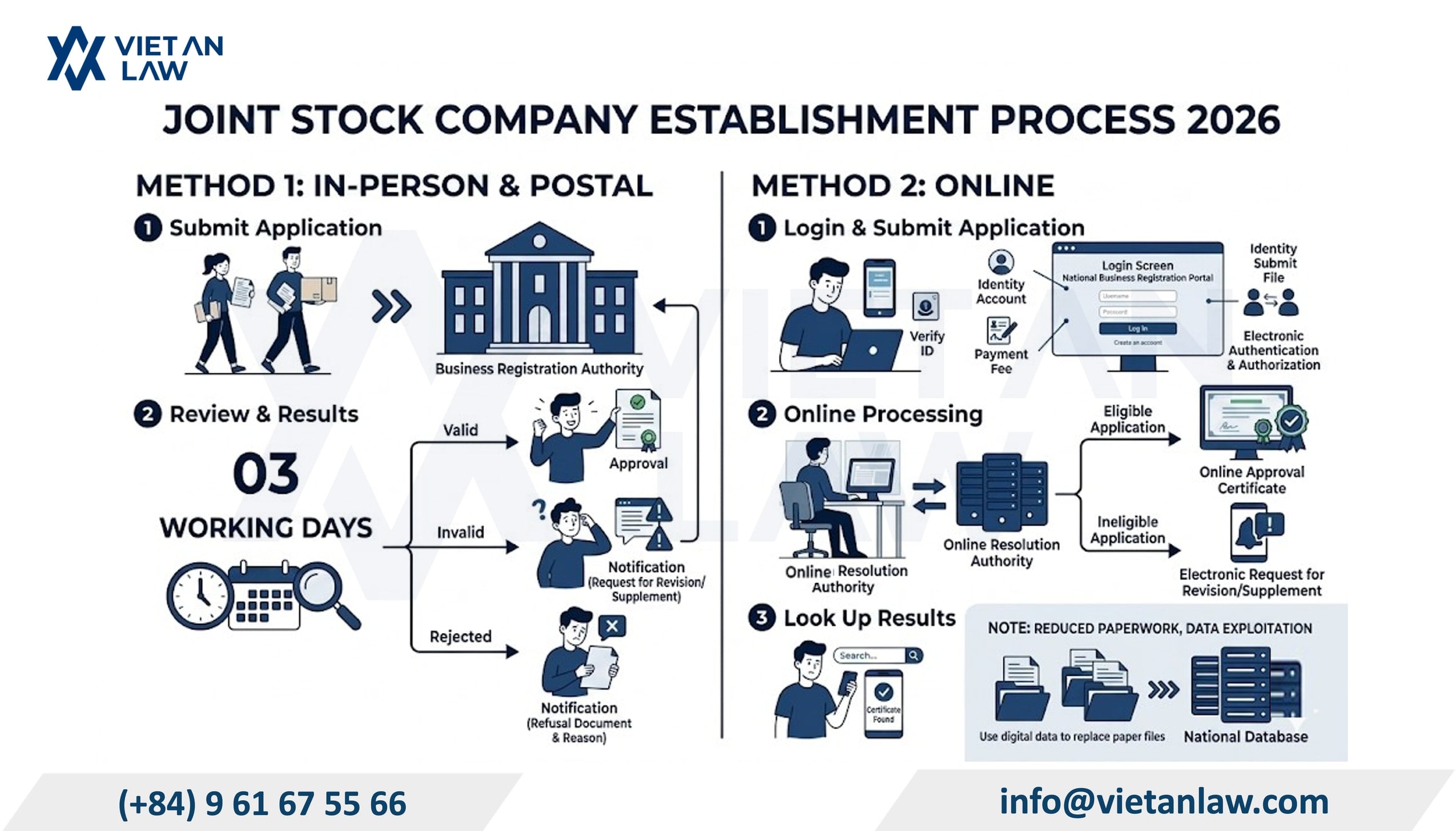
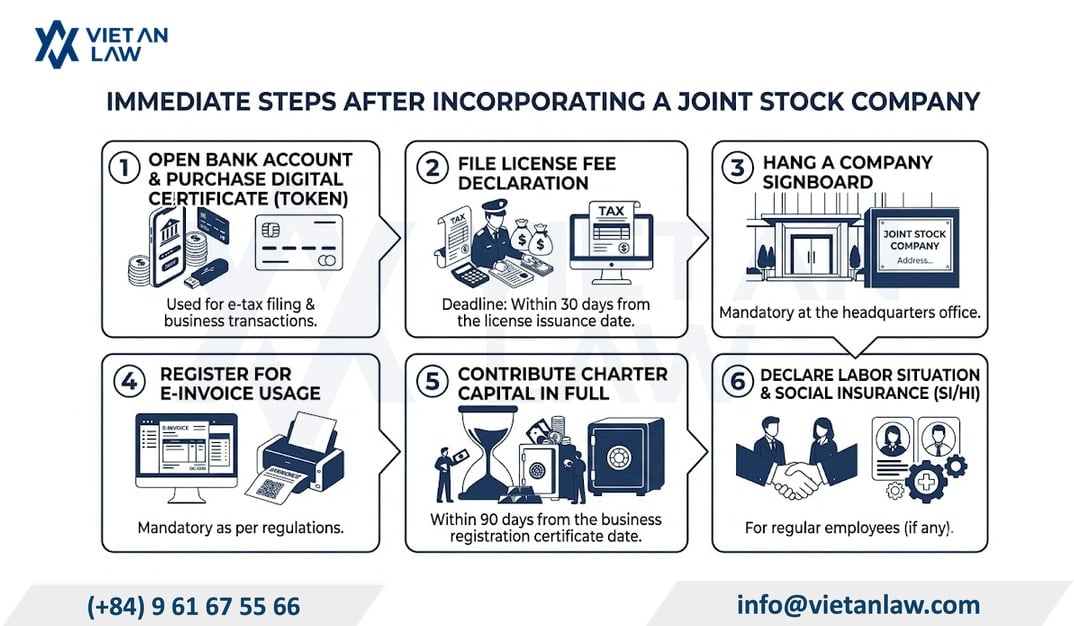
Tasks to be performed after registering a joint stock company
After receiving the business registration certificate, the following tasks need to be performed:
Strategic FDI consulting for joint stock companies by Viet An Law
Foreign investors establishing joint-stock companies as FDI enterprises in Vietnam is becoming increasingly common due to its flexible capital raising capabilities. However, foreign direct investment (FDI) requires enterprises to face significantly stricter legal hurdles compared to domestic investors. Below are some important points compiled by Viet An Law for investors to consider:
Regulations on foreign investor ownership percentages
Unlike domestic investors who can own 100% of shares in most sectors, foreign investors are subject to a maximum ownership percentage depending on the specific business lines.
- Dependent on international agreements: This percentage is clearly stipulated in Vietnam’s WTO accession commitments and new generation free trade agreements (such as CPTPP, EVFTA).
- Sectoral limitations: There are sectors where foreign investors are allowed to own 100% of capital (such as software production, management consulting). However, for conditional business lines (such as logistics, advertising, tourism…), the shareholding percentage of foreign investors may be limited to 49%, 51%, or 65%, or they may be required to form a joint venture with a Vietnamese partner.
Note regarding the joint-stock company model: Due to the inherently transferable nature of joint-stock companies, founding shareholders and the Board of Directors must closely monitor share purchase and sale transactions, ensuring that the total ownership percentage of foreign shareholders at any given time does not exceed the stipulated “room”, thus avoiding suspension of operations or revocation of the license.
Compliance with direct investment capital account (DICA)
An DICA is a payment account in foreign currency or Vietnamese Dong opened by FDI enterprises at an authorized bank in Vietnam. It is the “choke point” controlling the cash flow of all foreign-invested enterprises.
- Mandatory for all capital transactions: According to regulations of the State Bank of Vietnam, all activities involving the transfer of capital for share purchases, foreign borrowing, and especially the transfer of profits abroad must be conducted through this DICA account.
- Risk of cash flow blockage: A common and fatal mistake is that investors wanting to establish an FDI company rush to transfer capital contributions directly into the company’s regular payment account (or the personal account of the Vietnamese partner) without going through the DICA. This lack of understanding leads to “incorrect cash flow” according to foreign exchange management regulations.
Even if the company is profitable, foreign investors will face a deadlock, completely unable to legally repatriate dividends or profits because banks will refuse to process the transfer order due to the initial capital inflow not being properly recorded through the DICA account. To remedy this, the business will face very heavy administrative penalties and an extremely complex cash flow explanation process.
Questions related to joint stock companies
What is needed to establish a joint stock company?
Establishing a joint stock company requires a minimum of 3 shareholders, a valid company name, a clear registered office, charter capital appropriate to the business sector, and a complete business registration dossier in accordance with legal regulations.
How long does it take to establish a joint-stock company?
With Viet An Law, the time to establish a joint stock company is only about 6-8 working days.
How much does it cost to establish a joint stock company?
The cost of establishing a joint-stock company ranges from approximately 2-8 million VND, depending on whether you do it yourself or use a full-service package.
Can founding shareholders freely transfer their shares?
Founding shareholders are restricted from transferring their shares to outsiders for the first 3 years.
What types of shares are there in a joint stock company?
According to the latest regulations, a joint-stock company includes the following types of shares: common shares (mandatory). In addition, the company may issue other types of preferred shares, including:
- Voting preferred shares (with a higher number of voting rights than common shares).
- Dividend preferred shares (receiving higher or more stable dividends).
- Redeemable preferred shares (the company repays the contributed capital upon request or under pre-determined conditions).
- Other types of preferred shares as stipulated in the company’s charter.
This provides a foundation for joint-stock companies to be flexible in capital raising and management.
Are founding shareholders free to sell their shares?
There are restrictions in the first 3 years. According to Clause 3, Article 120 of the Law on Enterprises 2025, within 3 years from the date the company is granted its Enterprise Registration Certificate:
- Founding shareholders are free to transfer their shares to other founding shareholders.
- If they wish to transfer shares to someone who is not a founding shareholder, approval from the General Meeting of Shareholders is mandatory.
- After 3 years, all these restrictions will be lifted (unless otherwise stipulated in the company’s charter).
What departments/divisions make up the organizational structure of a joint stock company?
According to Article 137 of the Law on Enterprises 2025, a joint-stock company has the right to choose to operate according to one of two models:
- Model 1: General Meeting of Shareholders, Board of Directors, Supervisory Board, and Director/General Director. (Note: A Supervisory Board is mandatory if the company has more than 11 shareholders or if an organization owns more than 50% of the total shares).
- Model 2: General Meeting of Shareholders, Board of Directors, and Director/General Director. (Conditions apply: At least 20% of the members of the Board of Directors must be independent members, and there must be an Audit Committee reporting to the Board of Directors).
Can shareholders withdraw capital directly from the company?
No. According to Clause 2 of Article 119, shareholders are not allowed to withdraw their contributed capital in the form of common shares from the company in any form (except in cases where the company repurchases shares or the company is dissolved or goes bankrupt). To recover their capital, shareholders can only transfer (sell) their shares to others on the market.
Are you looking for advice on establishing a joint-stock company quickly, legally, and with an optimized structure? Contact us now for comprehensive support from documentation and procedures to a suitable legal strategy (Hotline / Zalo / WhatsApp): 09 61 67 55 66.