Foreign Ownership Limits (FOL) in Vietnam: Latest 2026 Updates
In an era of deep globalization and economic integration, Foreign Direct Investment (FDI) plays an increasingly vital role in the economic growth of many nations. One of the core factors attracting and regulating these capital flows is the equity ownership ratio of foreign investors within specific enterprises and economic sectors. For international investors, the permitted level of capital ownership is a decisive factor in their business operations in the Vietnamese market. In the following article, Viet An Law will provide comprehensive legal insights into foreign ownership limits (FOL) in Vietnam: Latest 2026 updates, helping you navigate the regulatory landscape with confidence.
Based on Article 26 of the Investment Law 2020, the conditions for foreign investors to contribute capital to Vietnamese enterprises are stipulated as follows:
General conditions and procedures for changing members/shareholders: When contributing capital, purchasing shares, or purchasing capital contributions in an economic organization, investors must fully meet the conditions and comply with the procedures for changing members and shareholders as prescribed by current laws applicable to that type of economic organization (Law on Enterprises, Law on Securities, etc.).
Cases where foreign investors must register capital contributions, share purchases, or capital contribution purchases before changing members/shareholders: In addition to complying with the general procedures mentioned above, foreign investors are required to register their capital contributions, share purchases, or capital contribution purchases with the competent authority before proceeding with changes to members or shareholders if they fall into one of the following cases:
Case 1: Increasing ownership stake in industries/businesses with conditional market access: Contributing capital or purchasing shares/equity stakes that result in an increase in the total ownership stake of foreign investors in an economic organization operating in industries/businesses that are legally subject to conditional market access for foreign investors.
Case 2: Holding more than 50% of charter capital or increasing ownership stake beyond 50% of charter capital:
Contributing capital or purchasing shares/equity stakes that allows a foreign investor (or economic organizations identified as foreign investors according to points a, b, and c of Clause 1, Article 23 of the Investment Law) to hold more than 50% of the charter capital of an economic organization. This includes:
Increase the percentage of charter capital owned by foreign investors from less than or equal to 50% to over 50%.
Further increase the percentage of charter capital owned by foreign investors in cases where foreign investors already own more than 50% of the charter capital of that economic organization.
Case 3: Related to land in areas sensitive to national defense and security: Foreign investors contribute capital or purchase shares/equity stakes in economic organizations that hold land use right certificates in areas considered sensitive, including:
Islands.
Border communes, wards, and towns.
Coastal communes, wards, and towns.
Other areas affecting national defense and security as prescribed by law.
According to Article 4 of the Law on Enterprises 2020, the capital contribution ratio or ownership ratio is determined as the percentage of a member’s capital contribution to the company’s charter capital. In the case of a joint-stock company, the ownership ratio is understood as the percentage of shares a shareholder owns in that company.
Limits on the percentage of foreign equity cap in Vietnam
Limits on the percentage of foreign equity cap in Vietnam
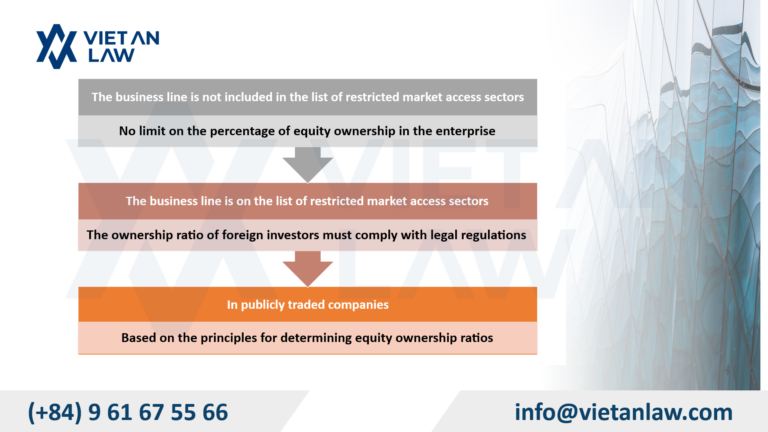
According to the Investment Law 2020, foreign investors investing in Vietnam must meet the market access conditions stipulated in Article 9 of this Law. Among these, the percentage of FOL in the enterprise is one of the important conditions that must be met.
In principle, for industries not included in the list of restricted market access, foreign investors are subject to the same market access conditions as domestic investors. This means that foreign investors will not be limited in their ownership percentage in enterprises in industries not included in the restricted market access list.
For industries included in the restricted market access list, the percentage of capital owned by foreign investors must comply with the regulations in relevant Vietnamese legal documents, the Vietnamese List of Restricted Market Access, and international investment treaties to which Vietnam is a signatory.
According to Article 139 of Decree No. 155/2020/ND-CP, the ownership ratio of foreign investors in public companies is determined as follows: Principles for determining the ownership ratio:
In cases where specific regulations apply:
If there is an international treaty to which Vietnam is a party that stipulates the ownership ratio of foreign investors, then this ratio will be applied according to that international treaty.
If there are specific regulations on the foreign equity cap Vietnam in specialized legal documents related to each industry or business sector, then the ownership ratio will comply with the provisions of those legal documents.
For example: For the banking sector (credit institutions): the percentage of charter capital ownership by foreign investors in economic organizations according to Government Decree 69/2025/ND-CP, amending and supplementing some articles of Decree 01/2014/ND-CP, is as follows:
The total shareholding of foreign investors in a Vietnamese commercial bank shall not exceed 30% of its charter capital.
The shareholding ratio of a foreign individual shall not exceed 5% of the charter capital.
The shareholding ratio of a foreign organization (excluding credit institutions) shall not exceed 15% of the charter capital.
The shareholding ratio of a foreign credit institution shall not exceed 20% of the charter capital.
Note: In some specific cases, for weak banks participating in restructuring plans approved by the State Bank of Vietnam, the foreign ownership ratio may be raised to a maximum of 49% by decision of the Prime Minister, but this is a special case and subject to conditions.
In cases where there are no specific regulations:
For industries and business sectors with market access conditions for foreign investors but without specific regulations on the percentage of charter capital ownership, foreign investors may own up to 50% of the capital.
For industries and business sectors without any restrictions stipulated in relevant legal documents or international treaties, foreign investors may own up to 100% of the capital.
Note: For sectors where there are no other specific regulations, the maximum ownership percentage for foreign investors will be 49%.
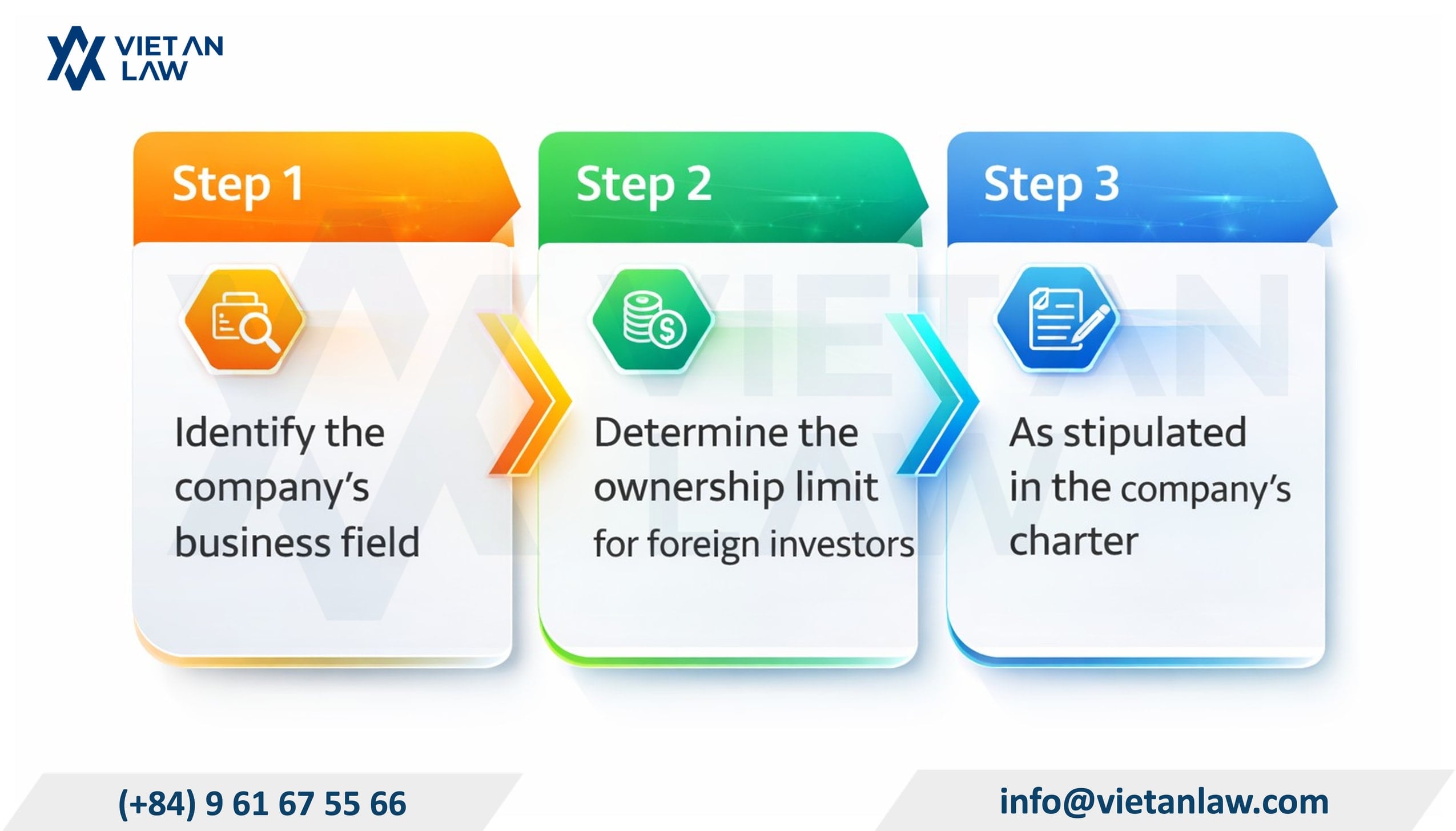
Steps to determine FOL for foreign investors
Step 1: Identify the company’s business field
Does that business sector fall under any international treaty to which Vietnam is a signatory regarding the percentage of foreign investor ownership? If such a treaty exists, its provisions must be complied with.
For example, according to the WTO Commitment Schedule, for businesses providing passenger services and inland waterway freight transport, the maximum FOL ratio is 49%.
If the business sector of the company that the foreign investor intends to invest in is not included in the WTO commitment schedule, it must be determined whether the business sector is subject to conditions.
Step 2: Determine the ownership limit for foreign investors
According to regulations of specialized laws or conditional business sectors:
Specialized legal regulations: If the law stipulates a maximum ownership percentage for foreign investors in that sector, then those regulations must be followed.
Conditional business lines: The list of conditional business lines is regularly updated on the National Portal on Foreign Investment. In this case, the regulations of each sector regarding the limit on the ownership percentage of foreign investors must be followed.
For example, in the film screening service (CPC: 96121), the percentage of charter capital owned by foreign investors in the economic organization shall not exceed 51%.
If the business line falls under the category of conditional business activities and no specific regulations have been established, the maximum ownership percentage for foreign investors is 49%.
In the case of multi-sector operations, foreign investors need to identify which sectors have regulations on foreign ownership percentages. Among those sectors, the lowest percentage should be selected.
Bước 3: As stipulated in the company’s charter
If relevant laws do not stipulate otherwise, and the business sector is not on the list of conditional business activities, then the company’s charter must be used to determine whether it specifies a limit on the ownership percentage of foreign investors. If not, the limit for foreign investors is unlimited, potentially up to 100%. In the case of state-owned enterprises undergoing equitization:
The equitization of state-owned enterprises is carried out according to the regulations in Decree No. 126/2017/ND-CP on the conversion of state-owned enterprises and one-member limited liability companies with 100% state-owned capital into joint-stock companies.
The above is an analysis of Foreign Ownership Limits (FOL) in Vietnam: Latest 2026 updates. If you have any related questions or require legal advice, please contact Viet An Law for the best support!
Fast & Reliable Legal Assistance
Fill out the form below and get connected with a lawyer quickly.
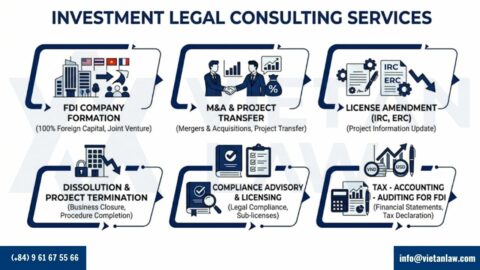
Comprehensive Solutions for Domestic and International Investors Legal investment consulting services in Vietnam encompass: establishing FDI companies, M&A, capital transfer, dissolution, tax, and outward investment. Navigating a new jurisdiction requires…
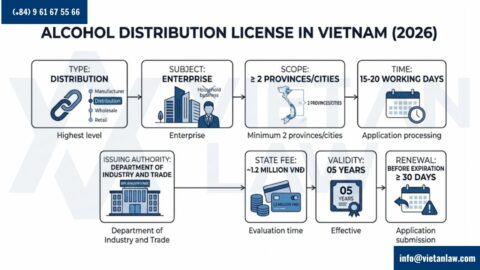
Navigating the legal framework for the Alcohol Distribution License in Vietnam (2026): Requirements, Procedures & Costs is a critical compliance step for businesses aiming to operate at the highest level…
Learn how to start a sporting goods business in Vietnam with our complete guide. Covers business registration, legal requirements, capital needs, and company formation procedures.
Discover high-growth industries for company incorporation in Singapore. Explore finance, IT, logistics, and consulting sectors with government incentives and market advantages.