Decree 307/2025: New Administrative Unit Classification Standards in Vietnam
Administrative unit is an essential structure, the backbone of the state organizational system, and their classification directly affects the mechanisms of decentralization, personnel arrangement, and public investment orientation. Recognizing that the old criteria were outdated and no longer accurately reflected the reality of development, the Government issued Decree 307/2025/ND-CP. This document establishes a new, more flexible, and accurate framework of criteria regarding population size, natural area, and level of economic development. Through the article below, Viet An Law will analyze the Decree 307/2025: new administrative unit classification standards in Vietnam.
Table of contents
Hide
Decree 307/2025: new administrative unit classification standards in Vietnam
Criteria and methods for classifying administrative units after mergers.
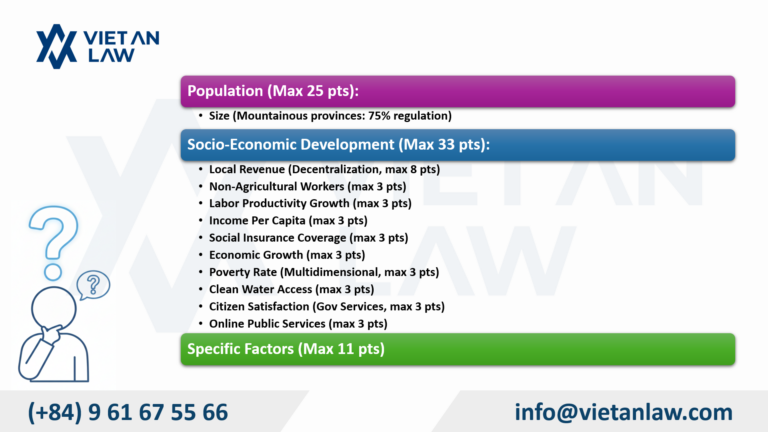
Population size:
Provinces with a population of 2,000,000 or less are awarded 10 points; for provinces with a population exceeding 2,000,000, an additional 0.5 points are awarded for every 60,000 people, but the maximum is 25 points;
Mountainous provinces apply 75% of the rate stipulated in point a, clause 1, Article 5 of Decree 307/2025/ND-CP.
Acreage
Natural land area of 8,000 km2 or less is awarded 10 points; for areas exceeding 8,000 km2, an additional 0.5 points are awarded for every 200 km2, but the maximum score is 25 points.
Socio-economic development conditions:
A revenue sharing ratio of 10% or less allocated to the central budget is awarded 8 points; for ratios above 10%, an additional 0.25 points are awarded for every additional 1%, but the maximum is 10 points.
In cases where there is no regulation on the allocation of shared revenue to the central budget, if the local budget revenue received according to the decentralization scheme is 50% or less of the total balanced local budget expenditure, 3 points will be awarded; if it is over 50%, an additional 0.5 points will be awarded for every additional 5%, but the maximum is not more than 8 points.
If the proportion of industry, construction, and services in the economic structure is 70% or less, 1 point is awarded; if it is above 70%, an additional 0.5 points are awarded for every 5% increase, but the maximum is no more than 3 points;
An economic growth rate of 7% or below is awarded 1 point; for rates above 7%, an additional 0.25 points are awarded for every 0.5% increase, but the maximum is 3 points.
A non-agricultural labor force ratio of 60% or less is awarded 1 point; for ratios above 60%, an additional 0.5 points are awarded for every 5% increase, but the maximum is 3 points.
An average labor productivity growth rate of 5% or less in the province is awarded 1 point; for every additional 0.5% above 5%, an additional 0.5 points are awarded, but the maximum is 3 points;
Per capita income below or below the national average is awarded 2 points; for every additional 5% above the national average, an additional 0.25 points are awarded, but the maximum is 3 points;
The percentage of the working-age labor force participating in social insurance that is below or below the national average is awarded 2 points; for every additional 5% above the national average, an additional 0.5 points are awarded, but not exceeding 3 points;
The poverty rate according to the multidimensional poverty standard is at or above the national average and is awarded 2 points; for every 0.5% reduction below the national average, an additional 0.25 points are awarded, but not exceeding 3 points;
The percentage of the population using clean water that meets standards in the province that is at or above the national average is awarded 2 points; for every additional 1% above the national average, an additional 0.5 points are awarded, but not exceeding 3 points;
Provinces with the highest citizen satisfaction index regarding the services of provincial-level state agencies in the year preceding the reporting year that are among the top 10 provinces and centrally-administered cities nationwide as published by the Ministry of Interior are awarded 3 points; those in the next 10 provinces and cities are awarded 2 points; and all other provinces are awarded 1 point;
The percentage of administrative procedures processed through online public services that is below or below the national average is awarded 2 points; for every additional 2% above the national average, an additional 0.25 points are awarded, but not exceeding 3 points.
Specific factors:
1 point is awarded for having 20% to 30% of the population belonging to ethnic minorities; for every additional 5% above 30%, 0.25 points are added, but the maximum is 2 points;
10% to 20% of the commune-level administrative units have a national land border; for every additional 10% above 20%, 0.5 points are added, but the maximum is 2 points;
1 point is awarded for having a special national monument or a UNESCO-recognized heritage site;
2 points are awarded for having 80 or fewer commune-level administrative units; for every additional 5 commune-level administrative units exceeding 80, 0.25 points are added, but the maximum is 5 points.
Types of administrative units after mergers
Hanoi and Ho Chi Minh City are special-type provincial-level administrative units; the remaining centrally-administered cities are Type I provincial-level administrative units.
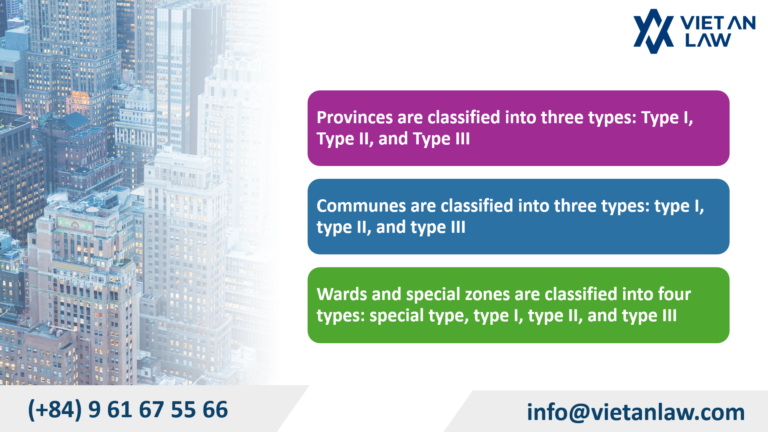
Provinces are divided into three types: Type I, Type II, and Type III.
Communes are also divided into three types: Type I, Type II, and Type III. Wards and special zones are further divided into four types: special type, Type I, Type II, and Type III.
What is the purpose of classifying administrative units after mergers?
According to Article 3 of Decree 307/2025/ND-CP, the purpose of classifying administrative units is to assess the scale and level of development of the administrative unit; the extent to which the local government apparatus meets the needs of the administrative unit, serving as a basis for formulating socio-economic development policies, building the organizational structure, determining staffing levels, and policies and regulations for local government officials and civil servants appropriate to each type of administrative unit.
Authority to classify administrative units
Regarding the authority to decide on classification, the Minister of Home Affairs decides on the recognition of the classification of provincial-level administrative units and special-class wards and special zones. The Chairman of the Provincial People’s Committee decides on the classification of commune-level administrative units, except in cases decided by the Ministry of Home Affairs.
The above is legal advice from Viet An Law regarding the Decree 307/2025: new administrative unit classification standards in Vietnam. If clients need further information on the Decree 307/2025: new administrative unit classification standards in Vietnam or have any questions, please contact Viet An Law for detailed advice and guidance.
Fast & Reliable Legal Assistance
Fill out the form below and get connected with a lawyer quickly.
In the rapidly evolving landscape of business activities and civil transactions within Vietnam, contracts have become indispensable legal instruments for establishing the rights and obligations of participating parties. However, in…
Depending on the operational status of the enterprise, its years of operation, tax records, and financial obligations, the cost to close a company in Vietnam may vary from case to…
Construction contract dispute resolution lawyer in Vietnam. Expert legal services for payment disputes, delays, quality issues. Viet An Law handles negotiation, arbitration & court proceedings.
According to Official Letter 2169/TPHCM-QLDN3 (March 2026) issued by the Ho Chi Minh City Tax Department, the regulations on tax incentives under Resolution 198/2025/QH15 and Decree 20/2026/ND-CP have been clarified:…
In the context of accelerating industrialization, modernization, and energy transition, the electrical equipment trading sector is becoming an investment choice for many individuals and organizations. Setting up an electrical equipment…