


In recent years, the fashion clothing business has been an industry of interest to young people, but to maintain market share and develop a career in this field, the first thing to consider is brand building. The brand appears associated with the process of establishing a business. Therefore, if you are an investor planning to do fashion clothing business, let’s explore with Viet An Law the current legal regulations on setting up a fashion clothing business in Vietnam.
Industry codes for fashion clothing business in Vietnam
Based on Decision No. 36/2025/QD-TTg on issuing the Vietnam Standard Industrial Classification, you can choose the fashion clothing business lines as follows:
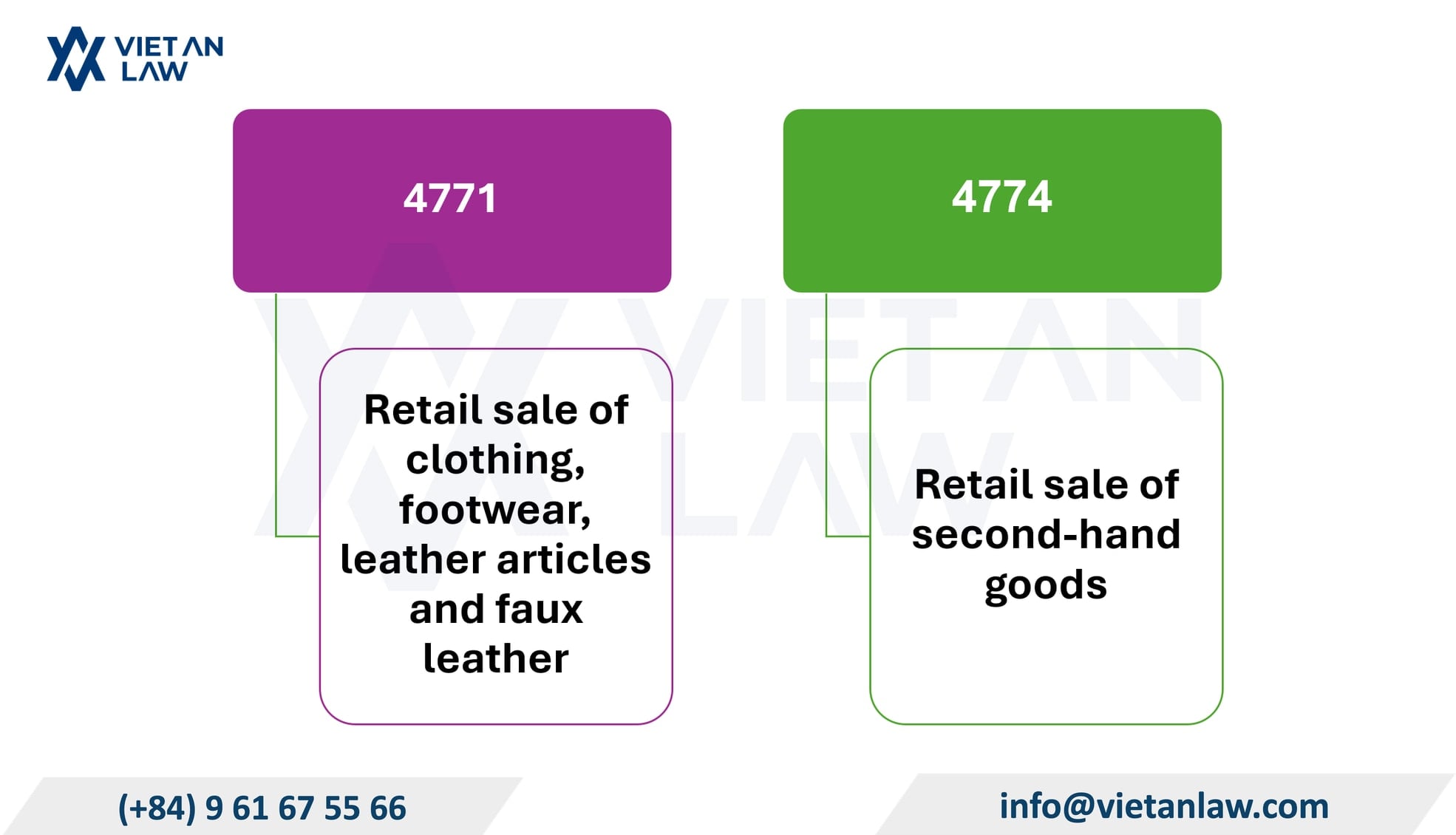
Industry codes for fashion clothing business in Vietnam
4771: Retail sale of clothing, footwear, leather articles and faux leather
This group includes: Specialized retail sale of the following items:
- Retail sale of clothing;
- Retail sale of fur articles;
- Retail sale of other clothing accessories such as gloves, scarves, socks, ties, suspenders…;
- Retail sale of footwear;
- Retail sale of leather and faux leather articles;
- Retail sale of travel goods made of leather and faux leather.
4774: Retail sale of second-hand goods
- 47741: Retail sale of second-hand clothing. This group includes:
- Retail sale of second-hand clothing (including sportswear);
- Retail sale of second-hand clothing accessories: Scarves, gloves,…
- 47749: Retail sale of other second-hand goods. This group includes:
- Retail sale of old books, comics, magazines, including rentals;
- Retail sale of second-hand furniture;
- Retail sale of second-hand household appliances;
- Retail sale of other second-hand goods;
- Retail sale of antiques.
Forms of setting up a fashion clothing business
Currently, the law does not specify the type of enterprise when setting up a company in the field of fashion clothing business. Depending on your needs and conditions, you can choose one of the following business forms:
- Private enterprise
- Partnership
- Limited Liability Company (single-member or two or more members)
- Joint stock company
Market access conditions for foreign investors
Based on Vietnam’s Specific Commitments in the WTO, the fashion clothing business service has CPC codes 631+632 for retail services, CPC 622 for wholesale services, and CPC 621 for commission agent services and is regulated as follows:
Capital contribution ratio
Foreign investors must establish a joint venture with a Vietnamese partner, and the foreign capital contribution ratio must not exceed 49%. From January 1, 2008, the 49% capital contribution restriction will be abolished. From January 1, 2009, there are no restrictions.
Form of service provision
Within 03 years from the date of accession, foreign-invested companies in the fashion clothing business will be allowed to provide commission agent services, wholesale and retail of all clothing products manufactured in Vietnam and legally imported clothing products into Vietnam. The establishment of retail outlets (beyond the first outlet) will be considered based on an Economic Needs Test (ENT). The main criteria for checking economic needs are the number of service providers present in a geographical area, market stability, and geographic scale. Thus, currently, foreign investors investing in the fashion clothing business will not be restricted from market access.
Process of setting up a fashion clothing business
Step 1: Apply for an Investment Registration Certificate
- For establishing a foreign-invested transport enterprise under Article 37 of the Law on Investment 2020, an investment registration certificate must be applied for.
- The investment registration dossier follows Clause 1, Article 36 of Decree 31/2021/ND-CP, amended by Point a, Clause 12, Article 1 of Decree 239/2025/ND-CP, and is sent to the provincial-level investment registration agency.
- According to Clause 3, Article 36 of Decree 31/2021/ND-CP, amended by Point b, Clause 12, Article 1 of Decree 239/2025/ND-CP, the investment registration agency grants the Investment Registration Certificate to the investor within 10 days from the date of receiving a valid dossier when the project meets the conditions.
Step 2: Apply for an Enterprise Registration Certificate
- After the investment project is granted the Investment Registration Certificate, proceed with the procedures to be granted the Enterprise Registration Certificate.
- The dossier is specified in Articles 19 to 22 of the Law on Enterprises 2020 (amended in 2025) and guided in Chapter III of Decree 168/2025/ND-CP and sent to the provincial-level business registration agency.
- The provincial business registration agency examines the validity of the dossier and issues the Enterprise Registration Certificate to the enterprise within 3 working days from the date of receiving the complete dossier.
Step 3: Proceed with post-establishment procedures
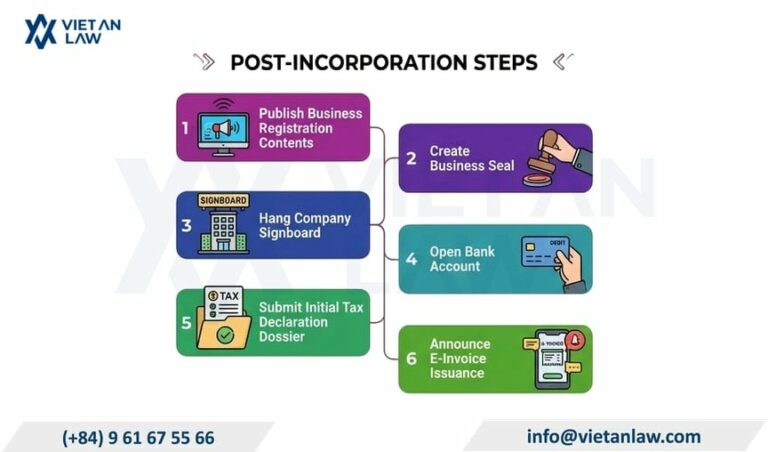
Proceed with post-establishment procedures
Publicize enterprise registration contents
After being granted the Enterprise Registration Certificate, the enterprise must publicly announce it on the National Business Registration Portal, pay the prescribed fee, and publicize the enterprise registration within 30 days from the date of publication. Based on Article 45 of Decree 122/2021/ND-CP, failure to publicly announce the enterprise registration contents on the National Portal will result in an administrative fine of 10,000,000 to 15,000,000 VND and a mandate to publicize the enterprise registration contents.
Engrave the enterprise seal
The enterprise decides on the type, quantity, form, and content of the seal of the enterprise, branches, representative offices, and other units of the enterprise. According to current legal regulations, a fashion clothing business does not need to notify the competent authority of the seal sample.
Hang the company signboard
The enterprise must make a company signboard and hang it in front of the head office, branches, representative offices, and business locations (if any). If not hung, the enterprise may have its tax code closed by the tax authority and be fined 30 – 50 million VND according to Clause 2, Article 52 of Decree 122/2021/ND-CP.
Open a bank account
The enterprise needs a bank account to facilitate the payment of costs for purchasing goods, services, employee salaries, and office rental costs. For amounts of 20 million VND or more, the enterprise must make payments from the company account to be eligible for input VAT deduction and Corporate Income Tax (CIT) deduction.
Submit the initial tax declaration dossier
This is the first step in establishing the operational method for the enterprise’s accounting apparatus. In this step, the enterprise needs to register for electronic tax declaration – payment, register the method of fixed asset depreciation, register the accounting form, and use invoices with the enterprise’s tax management agency.
Notice of issuance of electronic invoices
When there is a need to issue invoices to customers, the enterprise must purchase electronic invoices and complete the invoice issuance procedures before using them.
Fully contribute the registered charter capital
According to the provisions of the Law on Enterprises 2020, the company owners/members/shareholders must fully contribute the registered capital within 90 days from the date of being granted the Enterprise Registration Certificate.
Note on new regulations regarding tax and invoice obligations for fashion clothing companies
From July 1, 2025, enterprises can only deduct input VAT when paying via bank transfer
- Based on Clause 2, Article 14 of the Law on Value Added Tax 2024 specifying conditions for input VAT deduction, one of the conditions is “Having non-cash payment documents for purchased goods and services”.
- Thus, while the Law on Value Added Tax 2008 allowed tax deductions for transactions under 20 million VND even if paid in cash, the new regulation from July 1, 2025, under the Law on Value Added Tax 2024 requires “non-cash payment documents” to deduct input VAT.
- According to Decree 181/2025/ND-CP guiding the Law on Value Added Tax 2024, this regulation applies to payments of 5 million VND or more.
Officially abolishing the business license fee from January 1, 2026
Resolution 198/2025/QH15 materializes the policy of abolishing the business license fee at Clause 7, Article 10 of Resolution 198/2025/QH15; the Resolution stipulates that the collection and payment of the business license fee will be terminated from January 1, 2026.
Policies supporting taxes, fees, and charges under Resolution 198/2025/QH15
Based on Article 10 of Resolution 198/2025/QH15, in addition to officially abolishing the business license fee, the State has established other policies to help develop the private economy such as:
- Exemption from CIT for a period of 02 years and a 50% reduction of payable tax for the next 04 years for income from innovative startup activities of innovative startup enterprises, innovative startup investment fund management companies, and intermediary organizations supporting innovative startups.
- Exemption from CIT for small and medium-sized enterprises for 03 years from the date of being granted the Enterprise Registration Certificate for the first time.
- Exemption from Personal Income Tax (PIT) and CIT for income from transferring shares, capital contributions, rights to contribute capital, rights to buy shares, and rights to buy capital contributions to innovative startup enterprises….
From June 1, 2025, must use electronic invoices generated from cash registers According to the provisions of Article 11 of Decree 123/2020/ND-CP amended by Clause 8, Article 1 of Decree 70/2025/ND-CP (effective from June 1, 2025) regarding cases requiring the use of electronic invoices generated from cash registers connected to transfer data to tax authorities, enterprises with activities of selling goods and providing services, including selling goods and providing services directly to consumers (commercial centers; supermarkets; retail (except automobiles, motorcycles, motorbikes and other motor vehicles)) must use electronic invoices generated from cash registers and connect data with tax authorities.
Some popular fashion companies currently in Vietnam
Elise Fashion Company Limited
From a startup company with the aspiration to bring an international-class fashion brand positioning closer to Vietnamese customers. Up to now, with persistence and sustainability, Elise has built a pioneering fashion empire and continuously upgraded it with the brand positioning of a multinational company. Currently, ELISE is a leading fashion brand in Vietnam with 121 stores in 63 provinces and cities nationwide, maintaining its leading position in the fashion market in terms of scale and growth rate. ELISE’s products are manufactured in Vietnam at 3 main factories and 200 business partners, creating more than 2,000 direct jobs and over 1,000 indirect jobs. ELISE owns a synchronous operation and unified development system from design, production, and distribution to customer service in Vietnam.
Au Chau Fashion and Cosmetics Company Limited
Au Chau Fashion and Cosmetics Co., Ltd (ACFC), established in 2009 under Imex Pan Pacific Group (IPP Group), is a leading distributor and manager of international fashion brands in Vietnam. With a network of over 200 stores in major city centers nationwide, ACFC carries the mission of bringing Vietnamese people closer to the capital of branded fashion. ACFC exclusively distributes brands in the Vietnamese market such as Nike, Mango, Levi’s, Gap, Old Navy, Calvin Klein, Tommy Hilfiger, Mothercare, OVS, Banana Republic, Owndays, French Connection, Parfois, Sisley, Cotton:On, Typo, Polo, Sunnies Studios, Swarovski….
Yody Fashion Joint Stock Company
Starting from the fashion brand Hi5 born in 2009, going through a difficult development path, Hi5 was renamed Yody in 2014 with the dream of building a world-leading fashion brand. Yody has painstakingly researched product materials and launched product lines optimized in both price and quality for customers. To date, Yody has reached the milestone of more than 260 stores after 9 years of establishment and development, present in 55 provinces stretching from North to South. Yody has the honor of serving more than 5 million Vietnamese customers.
If you have any other legal obstacles related to setting up a fashion clothing business, please contact Viet An Law for more specific and detailed advice. Thank you very much!