


Vietnam has increasingly become a safe and attractive destination for international tourists. The rapid expansion of foreign-invested service sectors, particularly tourism, has significantly contributed to the growth of the food and beverage (F&B) industry. As a result, the restaurant business in Vietnam has seen substantial foreign investment in recent years. In the following article, Viet An Law provides a detailed overview of the legal conditions for FDI requirements for opening a restaurant business in Vietnam, ensuring compliance with Vietnamese law and aligning with international investment standards.
Legal Basis
The requirements are governed by the following legal instruments:
- WTO Commitments and international investment treaties to which Vietnam is a party;
- Law on Investment 2020;
- Law on Enterprises 2020 (amended in 2025);
- Decree No. 31/2021/ND-CP guiding the Law on Investment;
- Law on Food Safety 2010 (amended in 2018);
- Decree No. 15/2018/ND-CP detailing the implementation of certain provisions of the Law on Food Safety;
- Decree No. 155/2018/ND-CP amending regulations on business conditions under the Ministry of Health.
Conditions for opening a FDI restaurant business in Vietnam
Following administrative restructuring, certain aspects relating to enterprise management and licensing authorities may be adjusted. However, the fundamental conditions for foreign investment in the restaurant sector in Vietnam continue to be governed primarily by the Law on Investment 2020 and its guiding documents.
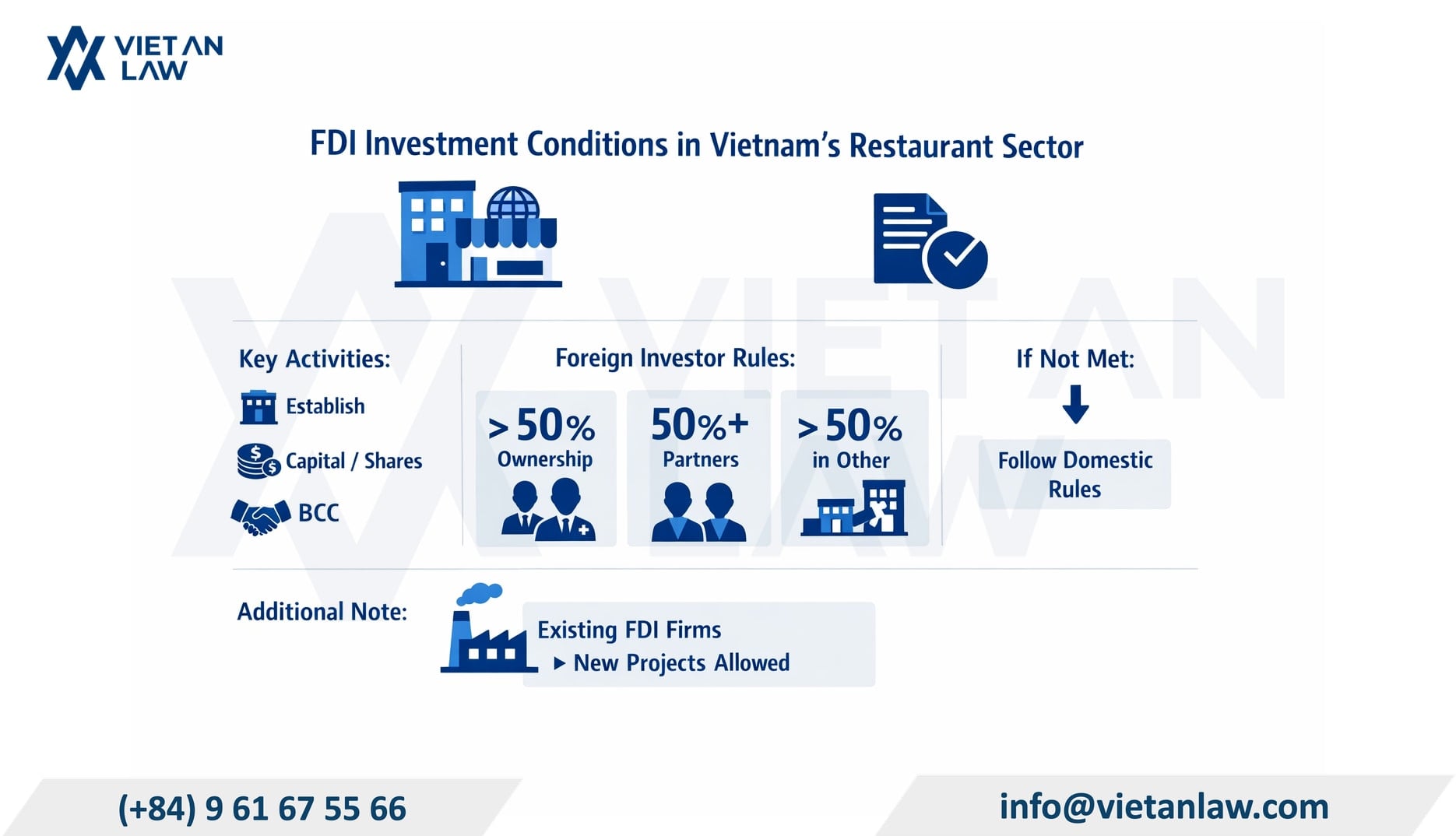
FDI requirements for opening a restaurant business in Vietnam
In order to conduct investment activities in the restaurant sector, a foreign-invested company must comply with the conditions and procedures applicable to foreign investors when engaging in the following activities:
- Establishing an economic organization;
- Contributing capital, purchasing shares, or acquiring capital contributions in an economic organization;
- Investing under a Business Cooperation Contract (BCC).
These conditions apply where the economic organization falls into one of the following cases:
- Foreign investors hold more than 50% of the charter capital or, in the case of partnerships, the majority of general partners are foreign individuals;
- An economic organization with foreign ownership exceeding 50% holds more than 50% of another entity’s charter capital;
- Both foreign investors and such economic organizations jointly hold more than 50% of the charter capital.
If the economic organization does not fall into the above categories, it shall follow the same investment conditions and procedures as domestic investors.
Additionally, foreign-invested enterprises already established in Vietnam may implement new investment projects without the need to establish a new legal entity.
Changes after administrative restructuring
Changes in competent state authorities
Prior to administrative restructuring, licensing procedures for restaurant businesses were handled by specialized agencies such as the Department of Industry and Trade or the Department of Health.
From 2025 onwards, such responsibilities may be reassigned to:
- Provincial-level People’s Committees; or
- Central authorities such as the Ministry of Industry and Trade (depending on the nature of the business).
Foreign investors must therefore carefully identify the competent authority based on the project location and sector.
Changes in registration and licensing procedures
On registration and licensing procedures
Following the administrative restructuring, these procedures may be streamlined or adjusted to align with the new organizational framework. After successfully obtaining the initial investment approvals, foreign investors are required to prepare a dossier comprising: the application for enterprise registration, the investment project proposal, the certificate of eligibility for restaurant business operations (if applicable), and other relevant legal documents.
It should be noted that regulations on enterprise registration have been updated and take effect from July 1, 2025, as guided in detail by Decree No. 168/2025/ND-CP and Circular No. 68/2025/TT-BTC. To ensure the accuracy and compliance of the enterprise registration dossier, investors are strongly advised to engage qualified legal consultants with relevant expertise.
The application dossier shall be submitted to the Department of Finance where the enterprise’s head office is intended to be located, which, following the administrative restructuring, assumes the functions previously performed by the Department of Planning and Investment, for the issuance of the Enterprise Registration Certificate.
On licensing timeline
The processing time for licensing applications may be shortened or otherwise adjusted in accordance with the new administrative procedures, with a view to facilitating investors and improving administrative efficiency.
In addition, the substantive conditions for establishing a foreign-invested company engaged in restaurant services – including requirements on capital, food safety and hygiene standards, fire prevention and fighting, as well as other relevant regulatory standards – remain applicable or may be updated in accordance with current laws on food safety, fire safety, public security, and state management in the food and beverage service sector.
Primary conditions for opening a restaurant business in Vietnam with FDI
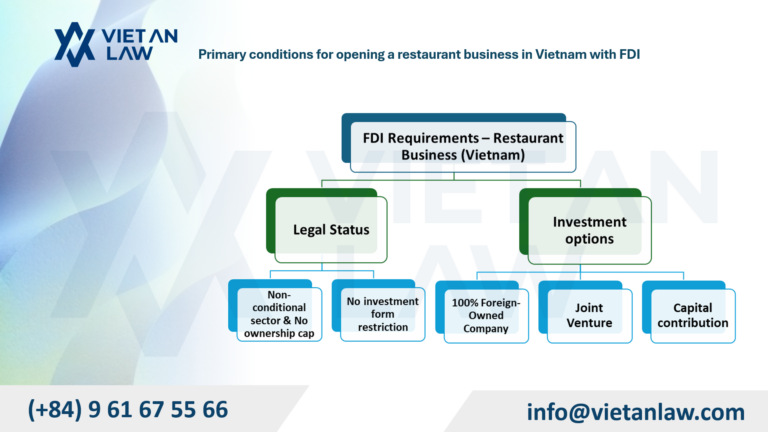
Primary conditions for opening a restaurant business in Vietnam with FDI
Restaurant business and food service activities are not classified as conditional business lines under the List set out in Appendix IV of the Law on Investment 2020. Accordingly, under the current legal framework, foreign investors investing in this sector are not subject to restrictions on foreign ownership ratio or specific conditions regarding investment forms. Specifically:
- Foreign investors are permitted to establish a wholly foreign-owned enterprise, enter into a joint venture with Vietnamese investors, or contribute capital to or acquire shares in a Vietnamese enterprise to conduct restaurant business activities;
- The maximum foreign ownership ratio may reach up to 100%;
- Investors are entitled to carry out the full scope of restaurant business activities.
However, in order to legally operate a restaurant business in Vietnam, foreign investors must comply with certain essential requirements, including:
- Obtaining the relevant business eligibility license, in particular, the Certificate of Food Safety and Hygiene Eligibility for restaurant operations.
Cases exempt from the certificate of food safety and hygiene eligibility
Pursuant to Article 12 of Decree No. 15/2018/ND-CP, the following cases are exempt from obtaining such certificate:
- Restaurants located within hotels;
- Collective kitchens without food business registration;
- Street food vendors;
- Establishments holding valid certifications such as Good Manufacturing Practice (GMP), Hazard Analysis and Critical Control Points (HACCP), ISO 22000 Food Safety Management System, International Featured Standards (IFS), British Retail Consortium (BRC), Food Safety System Certification (FSSC 22000), or equivalent certifications.
Note: The above establishments must still comply with applicable food safety requirements.
For restaurant businesses providing food and beverage services, investors are required to obtain the Certificate of Food Safety and Hygiene Eligibility in accordance with Decree No. 155/2018/ND-CP, which amends regulations on conditional business sectors under the management of the Ministry of Health. This constitutes a core component.
Investors may refer to guidance on obtaining the Food Safety Certificate for restaurants at the following link: https://luatvietan.vn/giay-chung-nhan-ve-sinh-an-toan-thuc-pham.html
In addition to the above conditions, foreign investors must carefully consider the project location. Due to the nature of restaurant operations, which require compliance with food safety, fire prevention and fighting, environmental protection, and public security regulations, the selected business premises must satisfy all relevant legal conditions. Prior to entering into any lease agreement, investors should verify whether the premises are eligible for obtaining the necessary licenses, particularly those relating to food safety, fire safety, and environmental compliance – key aspects of FDI requirements for opening a restaurant business in Vietnam.
FDI company incorporation services by Viet An Law
Viet An Law provides comprehensive consultancy services for establishing foreign-invested companies in the restaurant sector, including:
- Advising on foreign capital contribution ratios in Vietnam;
- Advising on the appropriate company structure (Limited Liability Company or Joint Stock Company), head office location, charter capital, business lines, capital account opening, and capital contribution schedule;
- Advising on legal conditions and guiding investors in preparing necessary documentation for company incorporation;
- Drafting and preparing incorporation dossiers;
- Representing investors before competent Vietnamese authorities during the incorporation process, including obtaining the Investment Registration Certificate (IRC), Enterprise Registration Certificate (ERC), company seal registration, post-licensing procedures, tax and accounting advisory, profit remittance abroad, labor and insurance compliance, and intellectual property matters;
- Providing ongoing legal advisory services throughout the business operation in Vietnam.
Compliance with FDI requirements for opening a restaurant business in Vietnam not only facilitates market entry but also enhances corporate credibility and strengthens competitive positioning within the industry. Should you require further assistance, please contact Viet An Law for detailed guidance.