


Company registration (FDI) in Vietnam for foreign investors is an important step to establish a commercial presence and conduct investment activities legally. Under the Vietnamese investment law applicable in 2026, the establishment of an FDI company remains subject to rules governing market access and the management of foreign investment capital.
The process generally consists of two main stages:
- Issuance of the Investment Registration Certificate (IRC)
- Issuance of the Enterprise Registration Certificate (ERC)
After establishment, several additional procedures must be completed, including:
- Opening a Direct Investment Capital Account (DICA)
- Contributing capital within the prescribed timeline
- Obtaining sub-licenses (if applicable)
- Submitting periodic investment project reports
Viet An Law Firm provides an overview of procedures, required documents, conditions, and practical guidance. It highlights key points to help foreign investors minimise common risks when doing business in Vietnam.
Common mistakes when setting up a foreign-invested company in Vietnam
Typical issues include:
- Selecting an incorrect business sector, leading to rejection of the IRC
- Failure to provide proper financial capacity documents
- Invalid office address
- Contributing capital through the wrong bank account
- Failure to obtain required sub-licenses
- Failure to submit periodic investment reports
Conditions for Company registration in Vietnam
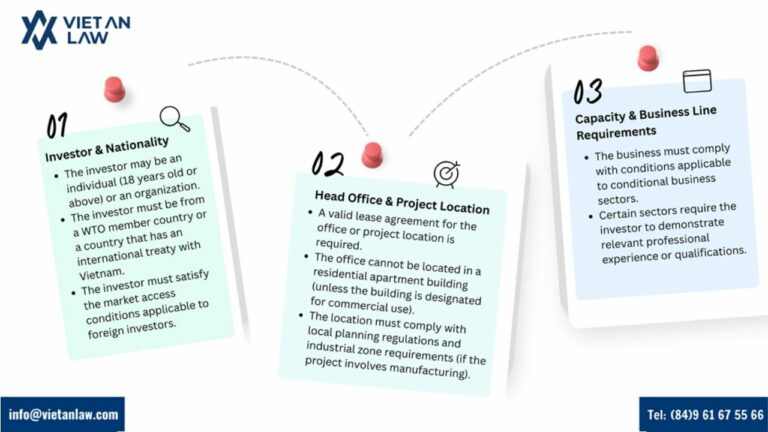
Forms of establishment
Investors may choose one of the following forms:
- Company registration in Vietnam, with foreign ownership ranging from 1% to 100%, depending on the sector
- Capital contribution or acquisition of shares in an existing Vietnamese company
- An FDI company investing in a new subsidiary in Vietnam
- Business Cooperation Contract (BCC) (suitable for certain models that do not require a new legal entity)
In practice, if investors wish to simplify procedures, especially when working with a Vietnamese partner, capital contribution or share acquisition in an existing Vietnamese company may offer greater flexibility and reduced documentation requirements in the initial stage (depending on the specific case).
Procedures for company registration in Vietnam
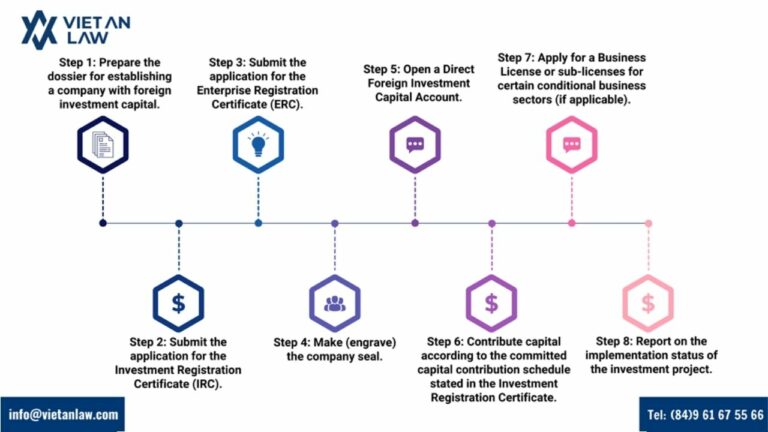
Step 1: Preparation of application documents
In addition to legal documents of individuals/organisations and representatives, investors must prepare the following capability documentation:
Financial capacity documents
(one or a combination, depending on project requirements)
- Financial statements for the two most recent years, or
- Financial support commitment from a parent company or financial institution, or
- Financial guarantee, or
- Bank balance confirmation equivalent to the intended investment capital in Vietnam.
Project location documents
- Lease agreement for the head office or project site
- Documents proving the lessor’s legal right to lease the property (land ownership documents, construction permits, business licenses for real estate activities, etc.)
Technology documents (if applicable)
- Technology explanation report including:
- Technology name
- Origin
- Process
- Technical specifications
- Condition of equipment or production lines
Note: All foreign-language documents must be translated into Vietnamese and notarised. Copies must be certified and legalised by the Vietnamese diplomatic mission abroad.
Step 2: Application for the Investment Registration Certificate (IRC)
Based on the provided documents, Viet An Law Firm will prepare the application dossier, including:
- Application for the implementation of the investment project
- Investment project proposal
- Power of Attorney
Submission Authority
Depending on the project location and local administrative structure, applications are submitted to:
- The Investment Registration Authority (Department of Finance), or
- The Management Board of Industrial or Export Processing Zones (if the project is located within such zones)
Processing Time
Approximately 15 days from the date of receipt of a valid dossier.
Step 3: Application for the Enterprise Registration Certificate (ERC)
After obtaining the IRC, the company must apply for enterprise registration at the Business Registration Office where the head office is located. The application procedure is similar to that for domestic companies but must include the IRC (if applicable).
Estimated processing time: 3-5 working days after submission of a complete application.
Step 4: Company seal
- The company determines its own seal design and is responsible for its management and use.
- Estimated time: approximately 1 day
- Additional title seals for key positions may also be created for operational convenience.
Step 5: Opening a Direct Investment Capital Account (DICA)
After obtaining the IRC and ERC, the FDI company must open a direct investment capital account at a licensed bank to:
- Receive capital contributions
- Transfer investment capital
- Repatriate lawful profits.
Step 6: Capital contribution
- Capital contributions must be transferred through the direct investment capital account.
- Maximum capital contribution period: 90 days from the date of ERC issuance, unless another timeline is specified in the investment certificate.
Step 7: Obtaining sub-licenses (If applicable)
Certain business sectors require additional permits. Examples include:
- Retail businesses: business license and retail outlet establishment license
- International travel services (inbound tourism): foreign investors may only operate inbound services bringing foreign tourists into Vietnam
- Foreign language education services: approval from the Department of Education and Training, followed by an operating license for the language training centre.
Step 8: Investment project reporting
During operations, the FDI company must submit periodic reports on the implementation of the investment project, typically via the relevant authorities’ electronic reporting system.
There is no fixed cost for company registration in Vietnam. Total costs depend on:
- Business sector (conditional or non-conditional)
- Investment form (new company or capital acquisition)
- Project scale and location
- Number of documents requiring legalisation or translation
- Need for additional licenses after establishment
Typical cost categories
Government fees (IRC, ERC, information announcement)
Example:
| Item | Description | Fee |
| Publication of enterprise registration information | Required upon registration | approx. 100,000 VND |
| Enterprise registration fee | Depends on submission method/local authority | often 0 VND |
Government fees are relatively small; the main costs usually arise from legalisation, translation, and post-establishment compliance.
Translation and legalisation costs
Often, the largest cost component is when investors are organisations with multiple foreign documents. Typical expenses include:
- Translation into Vietnamese and notarization
- Consular legalisation of foreign documents
- Certified copies required by local authorities
Office/Project location costs
Depending on the location and project model:
- Rental and deposit
- Building management fees
- Legal documentation of the landlord
Initial operational costs
After obtaining the ERC, there are unexpected additional fees :
- Company seal
- Digital signature
- Electronic invoice registration
- Accounting and tax system setup
Bank account costs (DICA)
Depends on the bank and transaction purposes:
- Opening a direct investment capital account
- International transfer and bank transaction fees
Sub-license Costs
If an FDI enterprise operates in a conditional business sector, the cost and processing time may increase due to additional requirements, including:
- Documentation proving compliance with sector-specific conditions;
- Business licenses or retail licenses, including permits to establish retail outlets;
- Additional sector-specific licenses, such as for international travel services (inbound tourism), education and training, logistics, e-commerce, etc. (depending on the specific case).
Ongoing compliance costs
FDI companies typically incur:
- Accounting and tax services
- Periodic investment reports
- Labour and social insurance compliance
Typical Estimated Costs for Establishing an FDI Company
- Simple services – minimal documentation – no additional sub-licenses
Main costs typically include: translation and notarization, business registration publication fees, initial operational setup, and legal service fees.
- Conditional retail/trading sectors or businesses requiring a business license
Costs may increase due to additional sub-licenses and more complex compliance documentation.
- Manufacturing projects in industrial zones (IZs)
Costs are generally higher due to project location requirements, technology/equipment documentation (if applicable), and additional regulatory compliance obligations.
Cost of Company Registration in Vietnam
The cost of setting up a company in Vietnam depends on several factors, including:
- Business sector
- Investment capital
- Licensing requirements
Typical legal service fees for company registration in Vietnam range from: USD 2,000 – USD 15,000.
Additional services may include:
- Accounting and tax registration
- Work permits
- Business licenses
- Intellectual property registration.
Notes when estblishing a foreign-invested company (FDI) in Vietnam
Notes on foreign ownership ratio
The ownership ratio of foreign investors in a Vietnamese company varies by business sector. Foreign ownership may range from 0% to 100%, depending on the applicable regulations. For example:
- Management consulting services: Foreign investors may own up to 100% of the company.
- Advertising services: Foreign investors must form a joint venture with a Vietnamese company already licensed in this sector; however, the foreign ownership ratio is not restricted within the joint venture.
- Road freight transport services: Foreign investors may hold up to 51% of the ownership.
- Services sending Vietnamese workers abroad: Foreign capital participation is not permitted.
Notes on investment sectors
- Depending on the chosen investment sector, investors must determine their permitted ownership ratio in the Vietnamese company. Each sector may have specific regulatory conditions, and investors must also determine an appropriate investment capital amount to demonstrate sufficient financial capacity for project approval and ensure capital contributions are made in accordance with the committed schedule.
- For investment sectors not covered by Vietnam’s WTO commitments, investors must obtain approval and consultation from the Ministry of Industry and Trade. As a result, the likelihood of successfully registering these sectors may be lower, and approval largely depends on the investor’s explanation, experience, and financial capacity.
Notes on investment capital and capital contribution schedule
- Investment capital serves not only as proof of financial capacity but also relates to the investor’s legal obligations, including eligibility for certain administrative exemptions, residence duration, and other compliance requirements.
- Investment capital may also determine whether the investor must obtain a work permit in Vietnam. For example, if an investor contributes less than VND 3 billion, they are not exempt from the work permit requirement.
- After obtaining a work permit, the investor may only receive a temporary residence card valid for up to two years.
- Investors must also ensure that capital contributions are made within the timeline specified in the Investment Registration Certificate (IRC). If the investor fails to contribute the full capital within the committed timeframe, they must apply for an extension (if there is a legitimate reason). Late contributions without proper approval may result in administrative penalties.
Notes on investment capital accounts
Capital contributions must be made through a Direct Investment Capital Account (DICA).
If the capital is transferred through the wrong type of account, it may create difficulties in proving completion of capital contribution when the company later needs to amend the project, dissolve the company, or transfer ownership.
Notes on choosing the method of setting up a foreign-invested company in Vietnam
| Criteria | Setting up a new FDI company | Capital contribution / share acquisition |
| Initial procedures | Usually involves more steps | Generally simpler procedures |
| Location documentation requirements | Usually stricter | More flexible in some cases |
| Suitable when | A new project requires a clear Investment Registration Certificate (IRC) | Faster entry, especially when cooperating with a Vietnamese partner |
| Estimated processing time | Around 30 days | Approximately 10–17 days |
Timeline to Set Up a Company in Vietnam
The average timeline for foreign company formation in Vietnam is:
| Process | Estimated Time |
| Investment Registration Certificate | 15 – 25 working days |
| Enterprise Registration Certificate | 5 – 7 working days |
Total estimated time: 3 – 5 weeks.
Taxes payable by foreign-invested companies after establishment
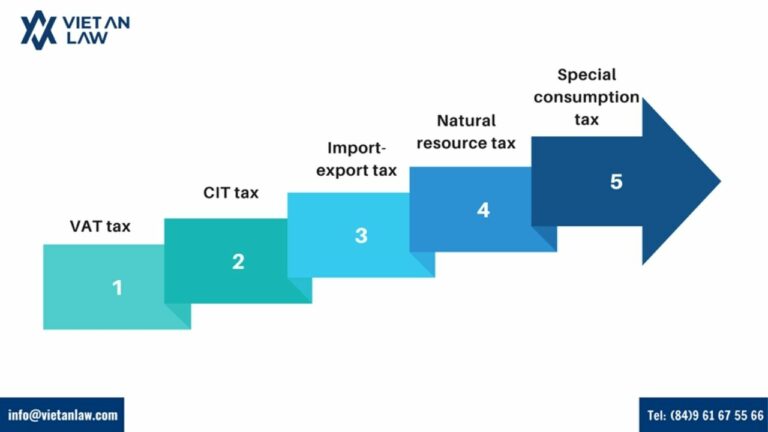
Similar to Vietnamese domestic companies, foreign-invested companies (FDI companies) must pay several basic types of taxes, including:
- Value Added Tax (VAT): Calculated based on the company’s output and input VAT balance.
- Corporate Income Tax (CIT): Only payable when the company generates taxable profit. Under the Corporate Income Tax Law 2025, effective from 1 October 2025 and applicable to the 2025 tax period, the tax rates are as follows:
- 20% standard CIT rate for most enterprises;
- 15% rate for enterprises with annual revenue below VND 3 billion;
- 17% rate for enterprises with annual revenue from VND 3 billion to VND 50 billion.
- In addition, newly established FDI enterprises may benefit from a CIT exemption for the first three years of operation, subject to applicable incentives.
- Import and export tax: Applicable if the company conducts import–export activities.
- Special consumption tax and natural resource tax: Applicable depending on the nature of the business activities.
Why Choose Viet An Law for Company Registration in Vietnam
With nearly 20 years of experience in legal consulting, Viet An Law is one of the leading law firms supporting foreign investors in Vietnam.
Our services include:
- Investment consulting;
- Company registration for foreign investors;
- Investment license applications;
- Tax and accounting services;
- Intellectual property protection;
Our legal experts provide efficient, transparent, and reliable services to help international clients establish businesses in Vietnam successfully.
Comprehensive foreign-invested company establishment services by Viet An Law Firm
Viet An Law Firm provides full-service support for establishing foreign-invested companies, including:
- Advising on market access conditions, foreign ownership ratios, and conditional business sectors;
- Advising on the appropriate company structure (Limited Liability Company or Joint Stock Company) and capital contribution arrangements;
- Preparing and submitting applications for the Investment Registration Certificate (IRC) and Enterprise Registration Certificate (ERC);
- Representing investors in communications and procedures with competent government authorities;
- Assisting with opening investment capital accounts and ensuring capital contributions are made on time;
- Advising on sub-licenses, as well as post-establishment accounting, tax, and compliance requirements.
Frequently Asked Questions (FAQ)
Are there any restrictions on the business sectors of FDI companies?
Yes. Under WTO commitments and relevant international agreements, foreign investors establishing FDI companies must determine the permitted business sectors, including the scope of business operations and foreign ownership ratios applicable to those sectors.
How long does it take to register a company in Vietnam?
The timeline depends on the project. However, typically:
- Investment Registration Certificate (IRC): around 15 days after submitting a complete and valid application.
- Enterprise Registration Certificate (ERC): around 3–5 working days after IRC approval.
Does every FDI project require an Investment Registration Certificate (IRC)?
Not necessarily. The requirement depends on the type of investment and specific circumstances. Many newly established projects will require an IRC before applying for an ERC.
Is a registered office required when submitting the application?
Yes. Investors usually need to provide proof of the project location or office address, along with legal documents from the landlord confirming the legitimacy of the leased premises.
What happens if capital is contributed later than the 90-day deadline?
Late capital contributions may result in legal risks and administrative penalties, depending on the situation. Investors often need to seek legal advice on possible extensions or adjustments to the capital contribution schedule.
Is it mandatory to open a Direct Investment Capital Account?
Yes. For FDI companies, a Direct Investment Capital Account (DICA) is generally required to receive capital contributions and conduct lawful capital transactions.
Where should applications be submitted if the project is located in an industrial zone?
Applications are typically submitted to the Industrial Zone Management Authority or the local investment registration authority, depending on the locality’s administrative structure.
Request a cost estimate
To receive a detailed quotation within 24 hours, please provide the following information:
- Investor nationalit
- Whether the investor is an individual or an organisatio
- Intended business secto
- Project location in Vietna
- Estimated investment capital,
Based on this information, Viet An Law Firm will provide tailored advice and a specific service quotation.