


The company charter capital change is a procedure executed by an enterprise when increasing or decreasing the contributed capital registered with the business registration authority in accordance with the Vietnamese Law on Enterprises. Enterprises must register this change within the statutory timeframe to avoid administrative penalties. From July 1, 2025, according to new regulations in Decree 168/2025/ND-CP and Circular 68/2025/TT-BTC, business registration amendment procedures, specifically the company capital increase procedure and company capital reduction procedure, have undergone significant adjustments regarding the required dossiers and execution processes. Registering a charter capital change in Vietnam properly not only helps enterprises ensure legal compliance and enhance credibility with partners, banks, and investors, but also minimizes the risks of administrative penalties during operations. In the article below, Viet An Law will provide a detailed update on the dossiers, processes, timelines, and costs to execute the company charter capital change procedures in Vietnam 2026 under current regulations.
Summary table of company capital increase and reduction procedures
| Content | Timeframe |
| Processing time | 3–5 days |
| Publication fee | 100,000 VND |
| Registration deadline | 10 days |
| Execution period | Within 10 days from the completion of the capital increase or decrease |
| Processing authority | Department of Finance |
When must an enterprise change its charter capital?
An enterprise must perform a charter capital change in Vietnam whenever there is an adjustment to the registered capital amount recorded on the Enterprise Registration Certificate. There are two primary scenarios for adjusting corporate capital:
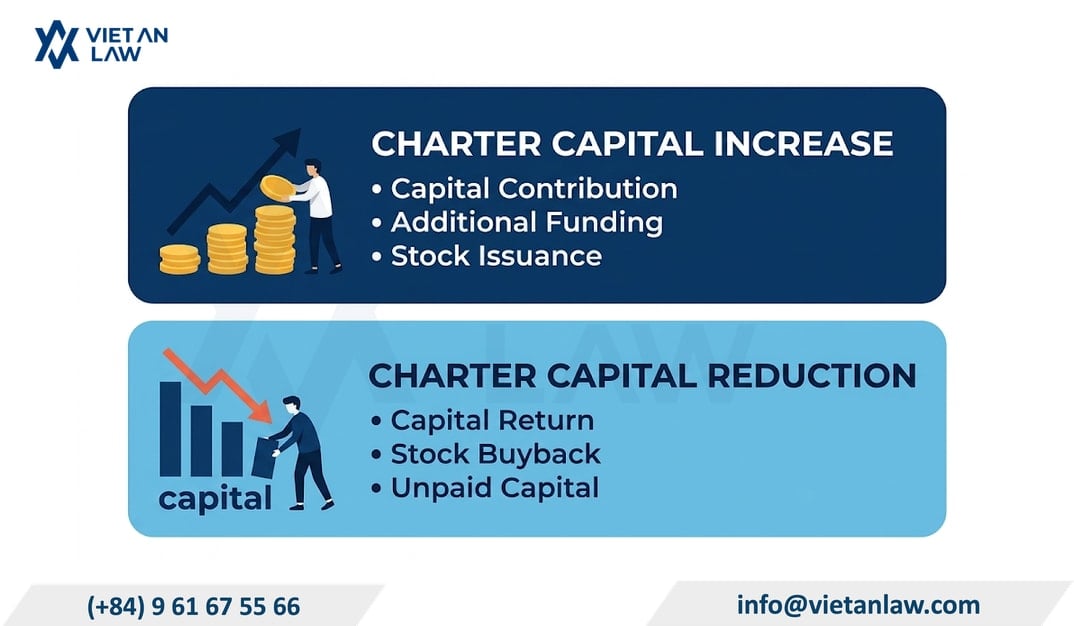
Increase charter capital
A multi-member limited liability company may adjust its capital upward in the following cases:
- Increasing the capital contribution of existing members;
- Accepting additional capital contributions from new members.
A single-member limited liability company executes a capital increase when the company owner injects additional funds or mobilizes additional capital from other individuals or organizations.
A joint-stock company changes its charter capital through the following methods:
- Offering shares, which includes: offering shares to existing shareholders, private placement of shares, and public offering of shares;
- Paying dividends in shares.
Decrease charter capital
A multi-member limited liability company may reduce its capital in the following circumstances:
- The company returns a portion of the contributed capital to members in proportion to their ownership stakes, provided the company has operated continuously for at least 02 years from the date of enterprise registration and guarantees the full payment of debts and other property obligations after the return;
- The company repurchases the capital contributions of its members;
- Members fail to fully pay their registered charter capital within 90 days from the issuance date of the Enterprise Registration Certificate.
A single-member limited liability company may reduce its capital in the following circumstances:
- The company returns a portion of the contributed capital to the owner, provided the company has operated continuously for at least 02 years from the date of enterprise registration and guarantees the full payment of debts and other property obligations after the return;
- The company owner fails to fully pay the registered capital within 90 days from the issuance date of the Enterprise Registration Certificate.
A joint-stock company executes a capital reduction when:
- The General Meeting of Shareholders decides to return a portion of the contributed capital to shareholders in proportion to their share ownership, provided the company has operated continuously for at least 02 years from the date of establishment and guarantees the full payment of debts and other property obligations after the return;
- The company repurchases previously sold shares;
- Shareholders fail to fully pay their registered capital within 90 days from the issuance date of the Enterprise Registration Certificate;
- The company returns capital contributions upon request for shareholders holding redeemable preference shares under the conditions stipulated on the share certificates.
When must an enterprise change its charter capital?
Pursuant to the Law on Enterprises, an enterprise bears the responsibility to register any increase or decrease in its capital with the business registration authority within 10 days from the date the capital adjustment is completed.
Accordingly, the enterprise must fully complete the capital payment (contribute the additional funds) before executing the charter capital amendment procedures as outlined below.
Dossier for company charter capital change in 2026
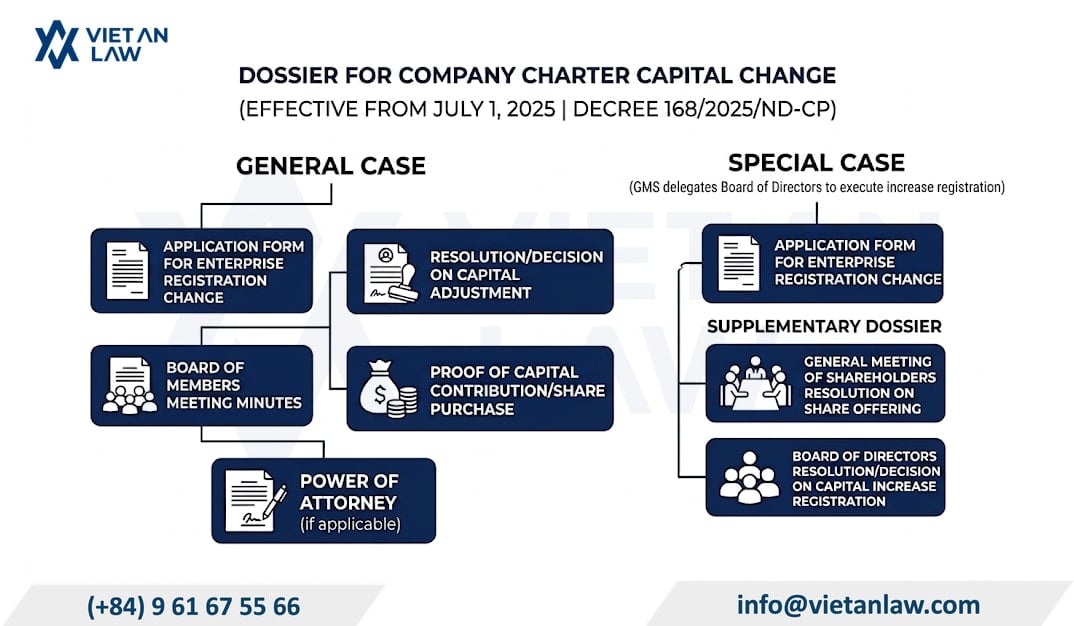
Pursuant to Article 44 of Decree 168/2025/ND-CP, effective from July 1, 2025, the components of the dossier for a company charter capital change have been updated. Specifically, the general dossier includes:
- An application form for enterprise registration change;
- A copy or original resolution/decision regarding the capital adjustment from the company owner, the Board of Members, or the General Meeting of Shareholders;
- A copy or original meeting minutes of the Board of Members;
- Documents proving the capital contribution or share purchase has been fully paid if executing a company capital increase procedure;
- A power of attorney authorizing Viet An Law to submit the dossier (if applicable).
Additionally, in special cases where the General Meeting of Shareholders decides to offer shares to increase capital and delegates the Board of Directors to execute the registration, the dossier must supplement the application form with:
- A resolution of the General Meeting of Shareholders regarding the share offering to increase capital;
- A resolution or decision of the Board of Directors regarding the registration of the capital increase.
Company capital increase procedure and reduction procedure steps
The standard procedural flow for amending corporate capital consists of three basic steps:
| Step | Execution detail | Result |
| Step 1 | Prepare and submit the dossier to the business registration authority under the Department of Finance where the enterprise is headquartered. | Receive a dossier submission receipt. |
| Step 2 | The competent authority reviews the dossier and issues a notice requiring amendments or supplements (if any). | Receive a notice for amendments or supplements (if any). |
| Step 3 | Receive the results of the enterprise registration change. | Receive the new Enterprise Registration Certificate. |
Application forms for ERC amendment services
Under Circular 68/2025/TT-BTC, starting from July 1, 2025, enterprises preparing a dossier to change registered capital in Vietnam must declare information using Form No. 12 issued alongside this Circular.
How long do charter capital amendment procedures take?
The processing time for a company charter capital change is typically 03 to 05 working days from the date of receiving a valid dossier (excluding the time required to amend or supplement the dossier if errors exist).
However, in practice, the timeline may be extended if:
- The dossier lacks required information;
- Incorrect forms are used;
- The enterprise has not updated new administrative boundary information following mergers effective from July 1, 2025.
To avoid errors that prolong the procedural timeline, clients can contact Viet An Law for consultation and support.
What is the fee to change registered capital in Vietnam?
According to regulations in Circular 64/2025/TT-BTC and Circular 47/2019/TT-BTC, from July 1, 2025, to the end of December 31, 2026, the enterprise registration fee is reduced by 50%.
Specifically, when performing registration procedures related to adjusting corporate capital, the enterprise must pay:
- The fee for publishing enterprise registration contents: 100,000 VND per occurrence.
Important notes:
- The standard enterprise registration fee is entirely exempted due to the mandatory 100% online submission policy starting July 1, 2025.
- The publication fee remains fixed at 100,000 VND per occurrence.
- If an enterprise utilizes a professional legal service for the capital change or requires a digital signature, separate service fees will apply depending on the specific law firm’s fee schedule.
Common errors during the company capital increase procedure and reduction procedure
During the execution of a company capital increase procedure, enterprises frequently encounter the following errors:
- Failing to fully contribute the capital before registering the change;
- Incorrectly declaring the capital contribution ratios of members;
- Failing to update the new administrative address following geographic mergers;
- Missing valid meeting minutes or resolutions;
- Using the wrong enterprise registration application form under Circular 68/2025/TT-BTC;
- Delaying the registration beyond the 10-day statutory deadline;
- Failing to declare beneficial owner information according to new regulations.
Important notes for enterprises conducting a company charter capital change
- From July 1, 2025, when registering a capital change, an enterprise must simultaneously supplement and update the address of its head office, as well as the contact addresses of the owner, members, and the legal representative. Furthermore, if the enterprise possesses information regarding beneficial owners, it must declare this data (using Form No. 10, Appendix I issued alongside Circular 68/2025/TT-BTC).
- For multi-member limited liability companies registering a capital adjustment, the enterprise must concurrently register the change in the capital contribution amounts and ownership ratios of the company members.
- An enterprise is obligated to register the capital change with the business registration authority within 10 days from the date the change decision is made. Exceeding this deadline may result in administrative penalties depending on the severity of the delay.
Case studies on capital registration changes supported by Viet An Law
Case 1: Penalized for delayed registration of an increased charter capital
ABC Construction LLC completed the capital contribution increase from its members in January 2026 but waited more than 30 days before executing the registration change with the competent authority.
Because it violated the statutory deadline for updating enterprise registration contents under the Law on Enterprises, the company faced administrative fines and was compelled to finalize the information adjustment procedure according to the law.
Practical experience:
- Enterprises must register capital changes within the statutory timeframe;
- Do not delay the declaration after the capital contribution is fully finalized;
- Utilizing professional legal services helps minimize dossier errors and prevents administrative penalties.
Case 2: Capital reduction flagged by tax authorities
ZY Joint Stock Company in Ho Chi Minh City registered to decrease its capital from 20 billion VND to 5 billion VND due to business restructuring. However, during the company capital reduction procedure, the enterprise had not yet fulfilled several outstanding debt obligations to suppliers.
Upon reviewing the dossier, the business registration authority coordinated with the tax authority to demand an explanation regarding the financial statement status and the enterprise’s capacity to clear outstanding liabilities before approving the reduction.
Only after submitting supplemental documents proving the full payment of debts and verifying the actual figures on the financial statements was the enterprise granted approval for the capital change.
Important note:
- Enterprises are only permitted to decrease capital when they can guarantee the full payment of debts and other property obligations;
- Dossiers for a capital reduction are generally scrutinized much more strictly than those for an increase;
- Enterprises should proactively audit their tax obligations, outstanding debts, and financial statements before initiating the procedure.
Frequently asked questions about charter capital change in Vietnam
How long does a company charter capital change take?
Generally, the timeframe to complete a company charter capital change takes between 3 to 5 working days from the moment a valid dossier is submitted to the Business Registration Office. For foreign direct investment (FDI) enterprises or complex cases, processing times may be extended.
What does a dossier for changing corporate charter capital include?
A standard dossier typically requires:
- A notice of changes to enterprise registration information;
- Meeting minutes;
- The company’s official decision on the capital increase or decrease;
- An updated list of members/shareholders (if applicable);
- A power of attorney for the representative submitting the dossier.
Depending on the corporate structure and the specific method of capital adjustment, the required documents may vary.
Does increasing capital require financial proof similar to company registration in Vietnam?
Usually, no. For standard domestic companies, current laws do not demand financial proof when increasing capital, much like standard company registration in Vietnam. However, the enterprise must ensure the capital is contributed fully and on time as committed. FDI enterprises or companies operating in conditional business sectors may be required to prove their financial capacity.
Will decreasing capital trigger inspections related to tax and accounting services?
No. A company capital reduction procedure may be closely reviewed by the business registration or tax authorities to ensure the enterprise has settled its financial obligations and debts before the reduction, but it does not automatically trigger a comprehensive tax inspection affecting your tax and accounting services.
Is it required to fully contribute funds before a company capital increase procedure?
Yes. Unlike the initial establishment phase, when executing a company capital increase procedure, shareholders and members must fully contribute the additional funds before submitting the registration dossier to the competent state authority.
Must bank information be updated after a company charter capital change?
Yes. After completing the company charter capital change procedures in Vietnam 2026, the enterprise should update its information with partner banks, suppliers, and internal records to ensure legal consistency and facilitate smooth business transactions.
Can a company simultaneously change its charter capital and business lines?
Yes. An enterprise can legally execute multiple corporate amendments simultaneously, such as:
- Changing registered capital;
- Changing the legal representative;
- Adding new business lines;
- Changing the headquarters address;
- Changing contributing members/shareholders.
Processing these simultaneously saves the enterprise significant time and administrative costs.
How much does a company capital reduction procedure or increase cost?
The costs associated with a charter capital change in Vietnam depend on:
- The enterprise type;
- The complexity of the dossier changes;
- Whether changes to members/shareholders are occurring simultaneously;
- Notably, a reduction dossier is inherently more complex than an increase dossier, typically incurring higher professional costs;
- Whether the entity is a domestic or FDI enterprise.
Should enterprises use foreign investment consulting for a charter capital change?
Yes. Utilizing professional counsel such as foreign investment consulting or specialized corporate lawyers is highly recommended if the enterprise:
- Is processing the dossier for the first time;
- Has a complex structure with multiple contributing members;
- Is executing multiple registration changes simultaneously;
- Wants to save time and eliminate the risk of dossier rejection.
What do ERC amendment services for capital changes include?
Comprehensive ERC amendment services for capital adjustments typically provide:
- Strategic consultation on the most appropriate method to increase or decrease capital;
- Complete drafting of the amendment dossier;
- Authorized representation to submit documents and liaise with state authorities;
- Tracking the application and retrieving the final results;
- Post-change legal advisory support.
Why choose Viet An Law for foreign investment consulting and capital changes?
- Nearly 20 years of dedicated legal experience;
- Successfully supported over 10,000 enterprises;
- Our lawyers are highly specialized and experienced professionals;
- Viet An Law provides comprehensive corporate support nationwide;
- We guarantee the most up-to-date, compliant dossiers for 2026, ensuring the highest protection of our clients’ rights and interests.
If you have any further questions regarding the company charter capital change procedures in Vietnam 2026, please contact Viet An Law for detailed nationwide consultation on corporate registration amendments and related legal matters!