


For foreign-invested enterprises in Vietnam, obtaining an investment registration certificate (IRC) and an enterprise registration certificate (ERC) does not mean that the enterprise is automatically permitted to carry out all goods trading activities and activities directly related to goods trading. In certain sectors such as retail distribution, certain import and distribution activities, logistics, commercial intermediary services or the operation of e-commerce platforms, FDI companies must additionally apply for a business license and, in certain cases, a retail outlet establishment license for FDI companies in Vietnam in accordance with the law.
On September 3, 2026, the Government issued Decree No. 342/2026/ND-CP detailing the Law on Commerce and the Law on Foreign Trade Management regarding goods trading activities and activities directly related to goods trading of foreign investors and foreign-invested economic organizations in Vietnam. The decree takes effect from October 18, 2026 and replaces Decree 09/2018/ND-CP. In the article below, Viet An Law Firm summarizes the cases requiring a business license for FDI companies in Vietnam under Decree 342/2026/ND-CP, together with the conditions, the dossier and the procedure under the new regulations.
What is a business license for FDI companies in Vietnam under Decree 342/2026/ND-CP?
A business license is a license granted to a foreign-invested economic organization to carry out certain goods trading activities and activities directly related to goods trading that are subject to licensing under Decree 342/2026/ND-CP.
Therefore, before commencing commercial activities in Vietnam, foreign investors need to determine at the same time:
- Whether the intended business activity falls within the sectors and trades with restricted market access;
- Whether Vietnam has made market opening commitments for that activity under the international treaty applicable to the investor;
- Whether the activity is subject to a business license;
- Whether a retail outlet establishment license or other specialized licenses must also be obtained.
Making the correct determination from the outset is important for building the investment structure, registering business lines and limiting dossier adjustments after the enterprise has been established.
Do FDI companies need a business license?
Not every foreign-invested company carrying out goods trading activities in Vietnam must apply for a business license. Whether this procedure is required depends on the type of activity, the type of goods, the scope of business rights, the nationality of the investor and Vietnam’s market opening commitments. Clients may refer to the preliminary overview in the table below:
| Intended activity of the FDI company | Business license required? | Notes |
| Exercising export rights | Usually not | Check the type of goods and the permitted scope of export rights |
| Exercising import rights | Depending on the case | Certain goods or activities must satisfy separate conditions |
| Wholesale distribution of goods | Depending on the case | Check market access commitments and the type of goods |
| Retail distribution of goods | Yes, in cases under Decree 342/2026/ND-CP | Opening a retail location may also require a retail outlet establishment license |
| Provision of logistics services | Depending on the service sub-sector | Identify each logistics sub-sector and the applicable international commitments |
| Leasing of goods | Yes, with certain exceptions | Excluding financial leasing and leasing of construction equipment with operators |
| Trade promotion services | Yes | Excluding advertising services |
| Commercial intermediary services | Yes | Review the specific scope of activities |
| Management and operation of e-commerce platforms | Yes, in cases subject to licensing | May also be governed by e-commerce laws and specialized regulations |
| Services of organizing bidding for goods and services | Yes | Follow the corresponding licensing conditions and procedure |
The table above is for initial guidance only. In practice, enterprises need to specifically review the investor structure, the investor’s nationality, the type of goods, the business method and the intended scope of activities before concluding whether a business license is required.
In particular, enterprises need to clearly distinguish between import rights, export rights, wholesale distribution rights and retail distribution rights, as each activity has a different scope and different legal conditions.
Activities for which FDI companies in Vietnam must obtain a business license
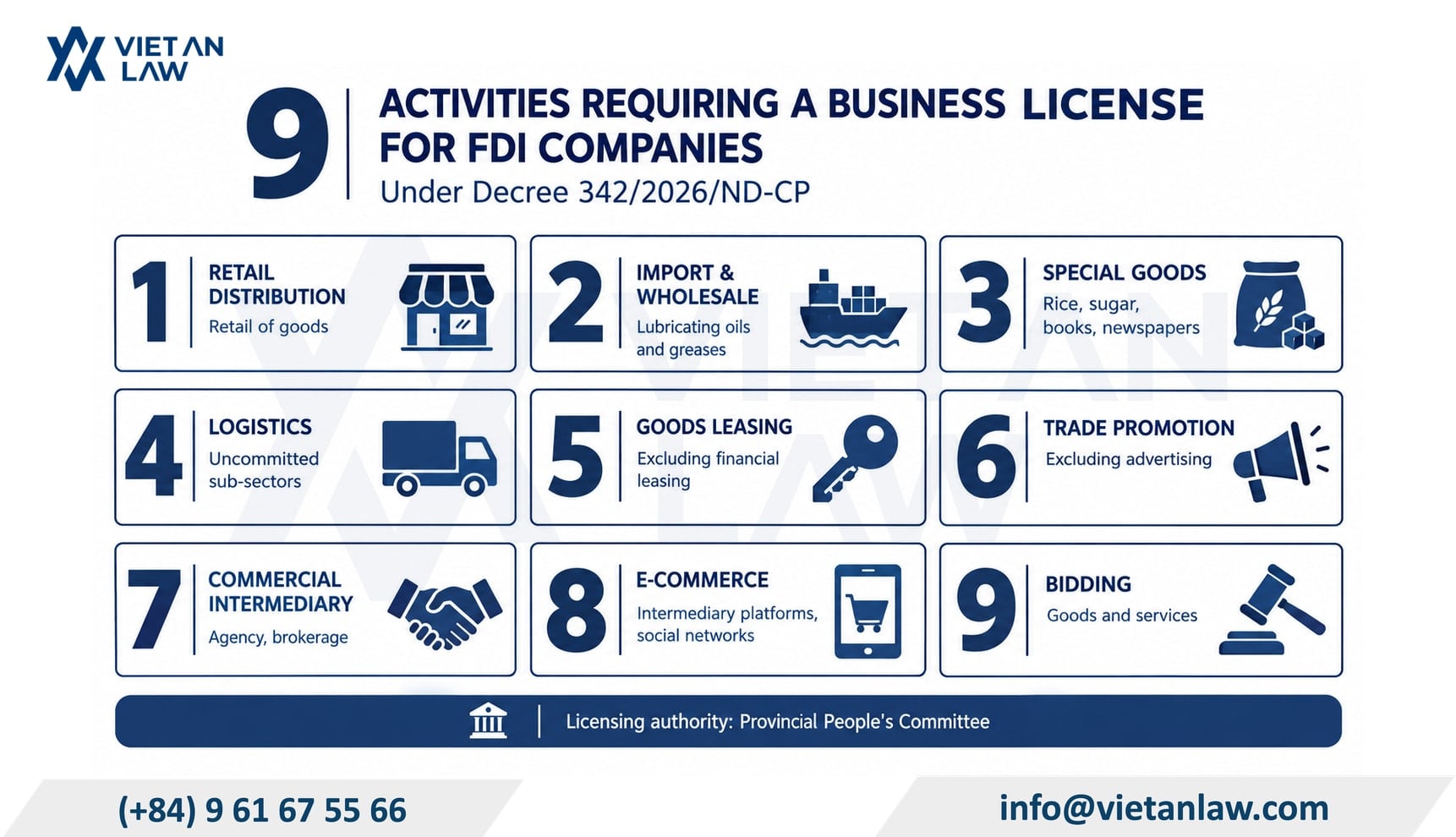
According to Article 5 of Decree 342/2026/ND-CP, a business license is granted to a foreign-invested economic organization to carry out the following main activities:
Exercising the right to retail distribution of goods
FDI companies exercising the right to retail distribution of goods in the cases specified in Decree 342/2026/ND-CP must be granted a business license before commencing operations.
Where the enterprise directly sets up a retail location, in addition to the business license, it may also have to apply for a retail outlet establishment license.
Import and wholesale distribution of certain goods
For certain groups of goods for which Vietnam has not fully committed to opening its market, FDI companies exercising import rights or wholesale distribution rights must satisfy the conditions and be licensed in accordance with regulations.
Under Decree 342/2026/ND-CP, one of the groups of goods subject to separate regulation is petroleum-based lubricating oils and greases.
Retail distribution of certain special goods
For the following goods:
- Rice;
- Sugar;
- Recorded articles;
- Books, newspapers and magazines,
retail distribution by FDI companies is considered under the separate conditions of Decree 342/2026/ND-CP.
Provision of logistics services
FDI companies providing logistics services must apply for a business license, except for logistics service sub-sectors for which Vietnam has made market opening commitments under international treaties to which Vietnam is a member.
Therefore, when establishing an FDI logistics company, it is necessary to accurately check each service sub-sector the enterprise intends to provide instead of only registering the general “logistics” business line.
Leasing of goods
Leasing of goods is subject to a business license, except for:
- Financial leasing;
- Leasing of construction equipment with operators.
Trade promotion services
FDI companies providing trade promotion services are subject to a business license, excluding advertising services.
Commercial intermediary services
FDI companies providing commercial intermediary services within the scope of Decree 342/2026/ND-CP need to carry out the business license procedure before commencing operations.
Management and operation of e-commerce platforms
A notable point of Decree 342/2026/ND-CP is the more specific regulation of the following activities:
- Management and operation of intermediary e-commerce platforms;
- Social networks with e-commerce activities;
- Integrated commerce platforms.
Foreign investors planning to build an e-commerce exchange, marketplace or intermediary platform in Vietnam need to simultaneously check the regulations on investment, commerce, e-commerce, consumer protection, data and related licenses.
Services of organizing bidding for goods and services
The provision of services of organizing bidding for goods and services by FDI companies is also subject to a business license.
Cases where FDI companies in Vietnam are not required to obtain a business license
Not all goods trading activities of FDI companies require a business license.
Apart from the activities subject to a business license mentioned above, foreign-invested economic organizations may carry out goods trading activities within the scope permitted by law after registering the corresponding activities on their investment and enterprise registration documents.
For example, depending on the investor’s nationality, international commitments and the type of goods, an FDI company may exercise export rights, import rights or wholesale distribution rights without having to apply for a separate business license.
However, it is necessary to distinguish between:
- Export rights;
- Import rights;
- Distribution rights;
- Wholesale activities (including wholesale agency of goods);
- Retail activities (including retail agency of goods);
- Logistics activities;
- E-commerce activities;
- Trading in conditional goods.
In practice, this is an issue that foreign investors often confuse when carrying out company registration in Vietnam for an FDI company engaged in commercial activities.
Notable new points of Decree No. 342/2026/ND-CP in Vietnam
Compared with Decree 09/2018/ND-CP, Decree 342/2026/ND-CP contains many new provisions that FDI companies should note when carrying out goods trading activities and activities directly related to goods trading in Vietnam.
Change in the authority competent to grant business licenses
Under the new regulations, the provincial People’s Committee where the foreign-invested economic organization is headquartered grants, re-grants, adjusts and revokes business licenses.
For the retail outlet establishment license, the competent authority is the provincial People’s Committee where the enterprise locates its retail outlet.
Business plan prepared for a 5-year period
The application dossier for a business license must include an explanation of the business plan for 5 years from the year of dossier submission, including the method of implementing activities, market development, labor demand and assessment of socio-economic efficiency.
This is one of the contents that enterprises need to prepare carefully, especially for activities for which Vietnam has not fully committed to opening its market.
Enhanced use of electronic data in dossier processing
Decree 342/2026/ND-CP allows competent authorities to retrieve information from national databases and specialized databases.
Accordingly, for certain documents already available on the system, enterprises may not have to resubmit them if the licensing authority can retrieve the necessary information fully and accurately.
Clearer regulations on e-commerce activities
The new decree further clarifies the licensing scope for activities such as:
- Management and operation of intermediary e-commerce platforms;
- Social networks with e-commerce activities;
- Integrated commerce platforms.
Therefore, foreign investors planning to launch marketplaces, platforms connecting sellers and buyers or other e-commerce models in Vietnam need to simultaneously assess the regulations on investment, commerce and e-commerce.
More specific regulations on the business term
The term of licensed activities does not apply uniformly to all cases.
For certain cases meeting market access conditions under international treaties, the business term may be linked to the term of the enterprise in accordance with the law.
For certain other cases under Decree 342/2026/ND-CP, the business term is 5 years.
Additional mechanism for simultaneous handling of procedures related to retail activities
The new decree provides regulations and forms for cases where an enterprise applies for a business license simultaneously with a retail outlet establishment license.
This gives enterprises a basis to prepare their dossier under a consistent plan from the outset when they intend to both register retail rights and open retail outlets in Vietnam.
Transitional provisions for licenses already granted
Enterprises granted a business license before Decree 342/2026/ND-CP takes effect are not required to re-apply for a new license merely because of the change of decree.
However, when there is a need to adjust the license after the new decree takes effect, enterprises shall follow the procedure under the new regulations.
Narrower scope of the economic needs test (ENT)
Decree 342/2026/ND-CP significantly changes the application of the ENT to retail outlets other than the first retail outlet. Whether an ENT is required must be determined based on the investor’s nationality, the applicable international treaty and the type of retail outlet. Therefore, FDI companies should not assume that every second retail outlet must undergo an ENT or that every case is exempt from the ENT.
Conditions for granting a business license to FDI companies in Vietnam
The conditions for granting a business license are determined based on the investor’s nationality, the applicable international treaty, the type of goods and the business sector.
Investors from countries or territories having international treaties with Vietnam
For foreign investors from countries or territories that are parties to international treaties to which Vietnam is a member and that contain market opening commitments for the relevant activity, the investor needs to:
- Satisfy the market access conditions under the international treaty selected for application;
- Maintain compliance with the market access conditions throughout the course of operation;
- Have no overdue tax debts if the economic organization has been established in Vietnam for 1 year or more as of the date of dossier submission.
Compared with the previous regulations, Decree 342/2026/ND-CP no longer provides for “having a financial plan” as an independent condition in this group of conditions, although the dossier must still include a 5-year business plan.
Investors from countries or territories without market opening commitments
In addition to the condition of having no overdue tax debts where applicable, the licensing authority also considers criteria such as:
- Compliance with specialized laws;
- The level of competition of domestic enterprises in the same field of activity;
- Consistency with the development strategy of the sector and field at local, regional and national levels;
- Vietnam’s negotiation and market opening process;
- Diplomatic relations;
- National security, social order and safety.
Services for which Vietnam has not committed to opening its market
For services not covered by market opening commitments under international treaties, the dossier will be further considered based on criteria related to the market, competition and the sector’s development orientation.
Goods for which Vietnam has not committed to opening its market
For certain goods such as petroleum-based lubricating oils and greases, rice, sugar, recorded articles, books, newspapers and magazines, Decree 342/2026/ND-CP sets out separate conditions corresponding to each type of goods.
Enterprises need to specifically check the type of goods, the intended business rights and the distribution model before licensing to ensure proper compliance with the law.
Dossier for a business license application in Vietnam
According to Article 11 of Decree 342/2026/ND-CP, the dossier that enterprises need to prepare includes:
Application for a business license
The application is made using Form No. 01 issued together with Decree 342/2026/ND-CP.
Explanatory report
The explanatory report includes the following main contents:
- Satisfaction of the conditions for granting a business license;
- Business plan for 5 years from the year of dossier submission;
- Contents and methods of implementing business activities;
- Business and market development plan;
- Labor demand;
- Assessment of the socio-economic impact and efficiency of the business plan.
In certain cases where the enterprise is already operating, the dossier must also present the status of its goods trading activities and activities directly related to goods trading up to the time of applying for the license.
Documents proving no overdue tax debts
Where required, the confirmation document of the tax authority must be issued no more than 6 months before the date of sending the dossier to the licensing authority.
Legal documents of the enterprise
These may include:
- Enterprise registration certificate;
- Investment registration certificate;
- Or documents of equivalent validity in accordance with the law on investment and enterprises.
In certain cases, enterprises must additionally submit documents proving satisfaction of the separate conditions applicable to the relevant goods or business activities.
A notable new point is that Decree 342/2026/ND-CP allows the licensing authority to retrieve data from national databases and specialized databases. Enterprises only have to provide certain documents already in the system when the licensing authority cannot retrieve them or the retrieved information is incomplete.
Which authority grants business licenses to FDI companies in Vietnam?
Under Decree 342/2026/ND-CP, the provincial People’s Committee where the foreign-invested economic organization is headquartered is responsible for:
- Granting business licenses;
- Re-granting business licenses;
- Adjusting business licenses;
- Revoking business licenses.
This is a point that enterprises should pay special attention to when updating procedures under the new regulations.
For the retail outlet establishment license, the competent authority is the provincial People’s Committee where the enterprise locates its retail outlet.
In certain cases related to national security, the licensing authority must consult the Ministry of Public Security and the Ministry of National Defense before deciding on licensing.
Procedure for obtaining a business license in Vietnam
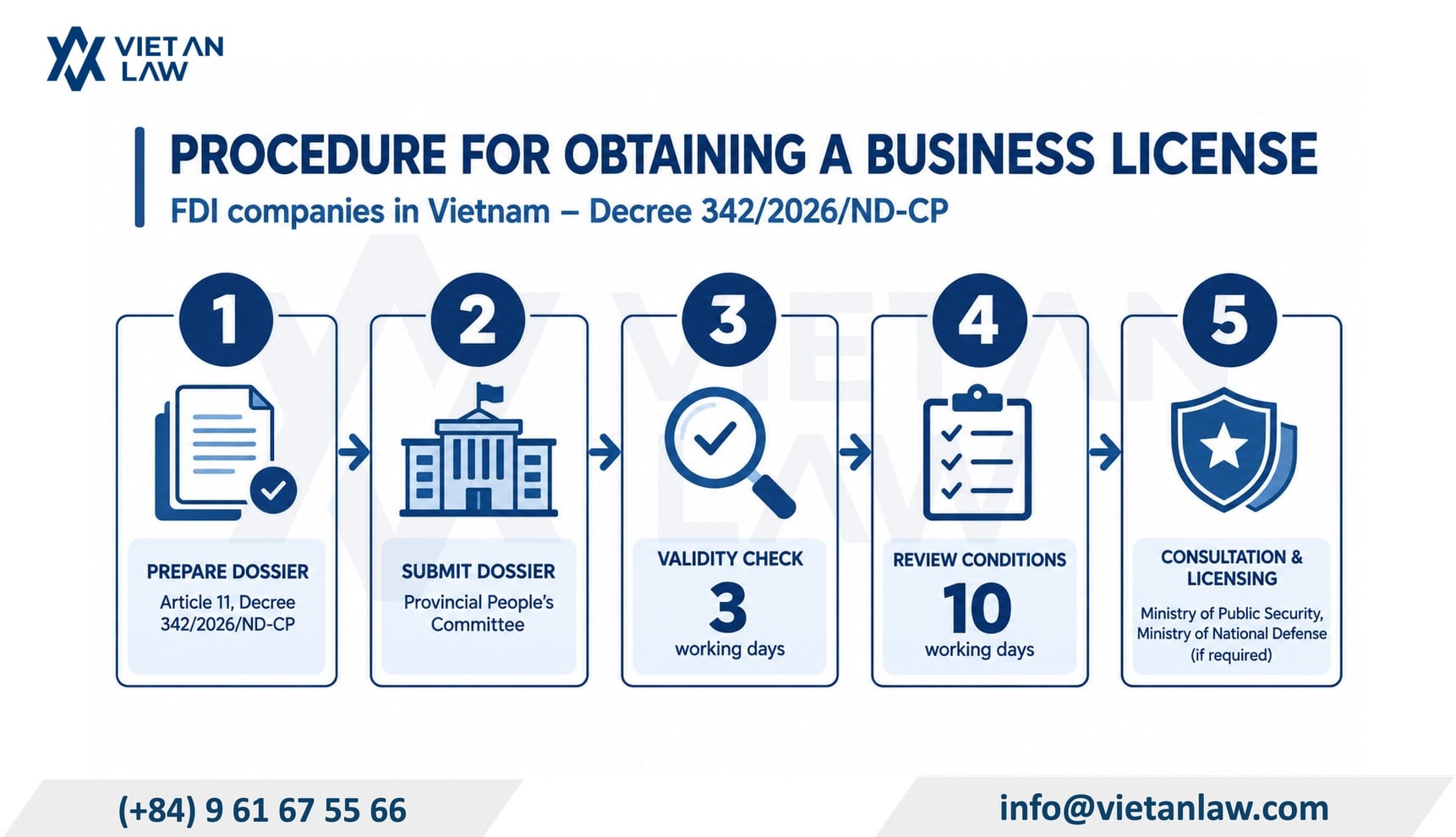
Step 1: Prepare the dossier
The enterprise identifies the activities to be licensed, checks the market access conditions and prepares the dossier under Article 11 of Decree 342/2026/ND-CP.
This is the most important step, especially the explanatory report on market access conditions and the 5-year business plan.
Step 2: Submit the dossier
The enterprise submits 1 set of dossier by one of the following methods:
- Directly at the one-stop shop division;
- Via public postal services;
- Through organizations or individuals hired or authorized to carry out the procedure;
- Online via the National Public Service Portal, if eligible.
Step 3: Check the validity of the dossier
Within 3 working days from the date of receiving the dossier, the licensing authority checks the dossier.
If the dossier is incomplete or invalid, the licensing authority issues a written request for amendment and supplementation.
Step 4: Review the licensing conditions
Within 10 working days from the date of receiving a complete and valid dossier, the licensing authority reviews the satisfaction of the conditions, criteria and grounds for granting the business license.
If the conditions are not satisfied, the licensing authority responds in writing, clearly stating the reasons.
Step 5: Consult the Ministry of Public Security and the Ministry of National Defense if required
For cases requiring consultation on national security issues, the Ministry of Public Security and the Ministry of National Defense have 14 working days from the date of receiving the dossier to give their opinions.
After receiving all approving opinions, the licensing authority grants the business license in accordance with regulations.
Validity period of a business license in Vietnam
The business term under Decree 342/2026/ND-CP does not apply uniformly in all cases.
Cases within the scope of market opening commitments
Where the investor satisfies the conditions under Clause 1, Article 9 of Decree 342/2026/ND-CP, the business term corresponds to the term stated in the enterprise registration certificate, if any, in accordance with the law on enterprises.
Certain other cases
For cases under Clauses 2, 3 and 4, Article 9 of Decree 342/2026/ND-CP, the business term is 5 years.
Therefore, upon receiving a business license, enterprises need to check the term stated on the license so as to proactively carry out related procedures upon its expiry.
When must an FDI company in Vietnam adjust its business license?
During operation, if there are changes related to the contents recorded on the business license or the licensed scope of activities, FDI companies need to consider carrying out the procedure to adjust the business license under Decree 342/2026/ND-CP.
Common cases include:
- Changes in enterprise information related to the contents of the business license;
- Changes to or additions of business activities subject to licensing;
- Changes in groups of goods or in the scope of import rights, wholesale or retail distribution rights;
- Changes related to licensed e-commerce, logistics or other service activities;
- Changes in the investment structure or investor information requiring a re-examination of market access conditions;
- Other cases that change the contents recorded by the competent authority on the business license.
Before carrying out the adjustment procedure, enterprises should simultaneously review the investment registration certificate (IRC), the enterprise registration certificate (ERC) and related specialized licenses to ensure consistent legal information.
Where the enterprise only changes internal information without changing the contents of the business license, it should be checked specifically whether an adjustment obligation arises, so as to avoid unnecessary procedures or missing an update obligation.
Do FDI companies in Vietnam holding a business license before October 18, 2026 need to reapply?
No.
Foreign-invested economic organizations granted a business license before Decree 342/2026/ND-CP takes effect may continue carrying out the licensed business activities.
When an enterprise needs to adjust its business license after the new decree takes effect, the adjustment procedure is carried out under Decree 342/2026/ND-CP.
For dossiers for granting, re-granting, adjusting or revoking licenses received by the competent authority before October 18, 2026, they are processed under the transitional provisions of Decree 342/2026/ND-CP.
Notes on obtaining a business license for an FDI company in Vietnam
Define the scope of activities before company registration in Vietnam
Investors should determine from the outset whether the enterprise intends to carry out:
- Import;
- Export;
- Wholesale;
- Retail;
- Logistics;
- E-commerce;
- Commercial intermediary services;
- Or other commercial activities.
This helps select the appropriate business lines, investment project scope and licenses right from the establishment stage.
Do not equate a business license with business line registration
The fact that a business line has been recorded on the enterprise registration certificate or investment registration certificate does not always mean that the enterprise is eligible to commence the activity.
If the activity is subject to a business license, the enterprise should only commence it after being licensed by the competent authority.
Retail activities may require a retail outlet establishment license for FDI companies in Vietnam
The business license and the retail outlet establishment license are two different procedures.
An FDI company holding a business license for retail distribution rights, when setting up a retail outlet in Vietnam, needs to further determine whether it must apply for a retail outlet establishment license and undergo an economic needs test (ENT).
Check international treaties based on the investor’s nationality
Licensing conditions depend significantly on whether Vietnam has market opening commitments with the investor’s country or territory.
Therefore, for the same business activity, investors from different countries may have to satisfy different legal conditions.
Viet An Law Firm’s business license services for FDI companies in Vietnam
Viet An Law Firm supports foreign investors and FDI companies throughout the process of applying for a business license in Vietnam, including:
- Advising on whether an activity is subject to a business license;
- Reviewing market access conditions based on the investor’s nationality;
- Advising on import rights, export rights, wholesale and retail distribution;
- Advising on conditions for specific goods and services;
- Reviewing the investment registration certificate and enterprise registration certificate;
- Drafting the dossier and explanatory report;
- Preparing the 5-year business plan;
- Representing the enterprise in submitting the dossier and working with competent authorities;
- Carrying out dossier amendment and supplementation procedures;
- Receiving and handing over the business license;
- Advising on the retail outlet establishment license and the economic needs test (ENT);
- Advising on specialized licenses after the enterprise commences operation.
For investors preparing to enter Vietnam, Viet An Law Firm recommends conducting a legal feasibility assessment before making the investment, especially for commercial, distribution, logistics and e-commerce models with foreign elements.
Practical experience in preparing business license dossiers for FDI companies in Vietnam
Through advising and supporting FDI companies, Viet An Law Firm has found that difficulties in business license dossiers usually do not lie in missing forms, but mainly arise from legal information, the scope of activities and explanatory contents that are not consistent with the actual business model.
Enterprises should pay special attention to the following issues:
Ensure consistency between the IRC, the ERC and the licensing application
The investment project objectives on the investment registration certificate (IRC), the business lines registered on the enterprise registration certificate (ERC) and the scope of activities in the business license application need to be consistent.
Where the project objectives, business lines or business scope do not match the intended activities, the enterprise may have to adjust its investment certificate before or simultaneously with the business license application.
Clearly identify the goods and each business right
Enterprises should not merely describe their activity generally as “trading in goods” but need to specify:
- Groups of goods intended for export and import;
- Goods intended for wholesale distribution;
- Goods intended for retail distribution;
- Goods in conditional business lines or in groups for which Vietnam has not fully committed to opening its market.
Clear classification from the outset helps accurately determine the scope of business rights and limits requests for explanation, amendment or supplementation of the dossier.
Do not confuse import rights with distribution rights
Import rights and distribution rights are two different scopes of activity.
The fact that an enterprise may exercise import rights does not automatically mean that it is permitted to wholesale or retail the imported goods in Vietnam. Therefore, the business model needs to be analyzed by each specific right to correctly identify the applicable conditions and licenses.
The 5-year business plan should accurately reflect actual operations
The business plan should not only present projected revenue figures but should clearly show:
- Sources of goods;
- Clients and target markets;
- Import and distribution methods;
- Sales channels;
- Market development plan;
- Labor demand;
- Socio-economic efficiency of the intended activities.
The more consistent the explanation is with the actual business model, the stronger the basis for the competent authority to consider the dossier.
Anticipate subsequent licenses and procedures
The business license is not always the final procedure.
Depending on the business model, the enterprise may further have to apply for a retail outlet establishment license, undergo an economic needs test (ENT), complete e-commerce procedures or obtain other specialized licenses.
Therefore, Viet An Law Firm recommends that enterprises build an overall legal roadmap right from the dossier preparation stage, instead of handling each license separately.
Review legal status and tax obligations before submitting the dossier
Before submitting the dossier, enterprises should check:
- Investment registration and enterprise registration information;
- Changes of the enterprise that have not been updated;
- Status of tax obligations;
- Consistency of legal information in the dossier.
Prior review helps limit cases where the dossier is required to be supplemented or the enterprise has to carry out additional adjustment procedures during the licensing process.
Common dossier errors Viet An Law Firm encounters in practice
Some errors that may prolong dossier processing include:
- The IRC and ERC record an overly broad scope of activities or one inconsistent with the business license application;
- The list of goods does not clearly separate export, import, wholesale and retail goods;
- The dossier does not clarify the difference between import rights and distribution rights;
- The 5-year business plan focuses only on revenue without explaining sources of goods, clients, distribution methods and labor demand;
- Subsequent procedures such as the retail outlet establishment license, ENT or specialized licenses have not been anticipated;
- Information on the IRC, ERC, tax records and license application is inconsistent.
From practical experience, preparing the dossier in line with the business model, accurately determining the scope of business rights and building the license roadmap in advance is usually more effective than focusing only on completing administrative forms.
Frequently asked questions about business licenses for FDI companies
Does a 100% foreign-owned company that imports goods and sells them to Vietnamese enterprises need a business license?
Not every case requires a business license. The enterprise needs to determine the type of goods, the scope of import rights and wholesale distribution rights, and the market access conditions applicable to the investor. Import rights do not automatically include the right to distribute goods in Vietnam.
Does a retail FDI company need to additionally apply for a retail outlet establishment license?
Possibly. The business license and the retail outlet establishment license are two different procedures. When the enterprise opens a store or retail location, it needs to further determine whether it must apply for a retail outlet establishment license and undergo an economic needs test (ENT).
Does a foreign investor acquiring a Vietnamese company with existing retail activities need to apply for a business license?
Whether a business license obligation arises depends on the foreign ownership ratio after the transaction, the activities being carried out, the type of goods and the applicable market access conditions. The enterprise should review the requirements on capital contribution registration, investment adjustment and business license before completing the transaction.
Does an FDI company selling goods via a website or e-commerce platform need a business license?
It depends on the business model. An enterprise selling goods via its own website and the management and operation of an intermediary e-commerce platform are two different legal models. In addition to the business license, the enterprise may also have to carry out e-commerce procedures and obtain related specialized licenses.
Can a business license and a retail outlet establishment license be applied for simultaneously?
Yes. Decree 342/2026/ND-CP provides regulations and forms for cases where an enterprise applies for a business license simultaneously with a retail outlet establishment license. The enterprise needs to prepare a dossier satisfying the conditions of both procedures.
Above are some key points on the business license for FDI companies in Vietnam under Decree 342/2026/ND-CP. The actual licensing process depends on the investor’s nationality, the type of activity, the goods traded, Vietnam’s international commitments and related specialized licenses.
Clients wishing to set up an FDI company, apply for a business license, exercise import, export, wholesale or retail distribution rights, or establish a retail outlet in Vietnam, please contact Viet An Law Firm for support from our lawyers and consultants.
Viet An Law Firm accompanies investors from the legal feasibility assessment stage until the enterprise officially commences business operations in Vietnam.
Author: Lawyer Trung Thi Lieu
Reviewed by: Lawyer Dong Van Thuc
Hotline/Zalo/WhatsApp: (+84) 961 675 566
Email: info@vietanlaw.com
Hanoi office: 3rd Floor, Hoang Ngan Plaza Building, No. 125 Hoang Ngan Street,
Yen Hoa Ward, Hanoi
Ho Chi Minh City office: Room 2.26 – 2.27, Charmington La Pointe Building, 181 Cao Thang Street, Hoa Hung Ward, Ho Chi Minh City