From July 1, 2025, after the merger, the new Bac Ninh province will consist of 66 communes and 33 wards, with its headquarters located in Bac Giang City (formerly Bac Giang province). Taking advantage of the strengths of both key industrial investment hubs in Vietnam, Bac Ninh has become an attractive destination for foreign investors, especially Chinese-owned manufacturing companies seeking to establish operations in Vietnam. With its strategic location, modern industrial infrastructure, and favorable investment policies, Bac Ninh offers tremendous opportunities for Chinese manufacturing enterprises to expand their production in Vietnam. The following article by Viet An Law Firm provides a detailed guide on the procedure, conditions, and important notes for Chinese investors looking to establish a manufacturing company in Bac Ninh, Vietnam.
Located in the Northern Key Economic Zone of Vietnam, close to major seaports and international airports, making logistics and import-export highly convenient, Bac Ninh is among the leading provinces in attracting foreign direct investment (FDI), especially in the high-tech manufacturing sector.
While Chinese capital is not the largest source compared to South Korea or Japan, it still represents a significant and rapidly growing portion of Bac Ninh’s FDI, particularly in the manufacturing industry.
In recent years, Chinese investment in Bac Ninh — especially in manufacturing — has grown substantially. Although it does not top the list in total FDI value compared to giants like Samsung (Korea), Canon (Japan), or Singaporean investors, China has led in the number of new projects during certain periods. Chinese firms are especially active in supporting industries, electronic components, and consumer goods manufacturing.
Many Chinese companies are relocating production facilities to Vietnam, and Bac Ninh stands out as a prime destination thanks to its strategic location, well-developed infrastructure, and improving investment environment.
Chinese-invested projects in Bac Ninh span a wide range of industries, including:
Chinese enterprises in Bac Ninh vary in scale, from small and medium-sized factories in supporting industries to large-scale production facilities. Some notable examples include:
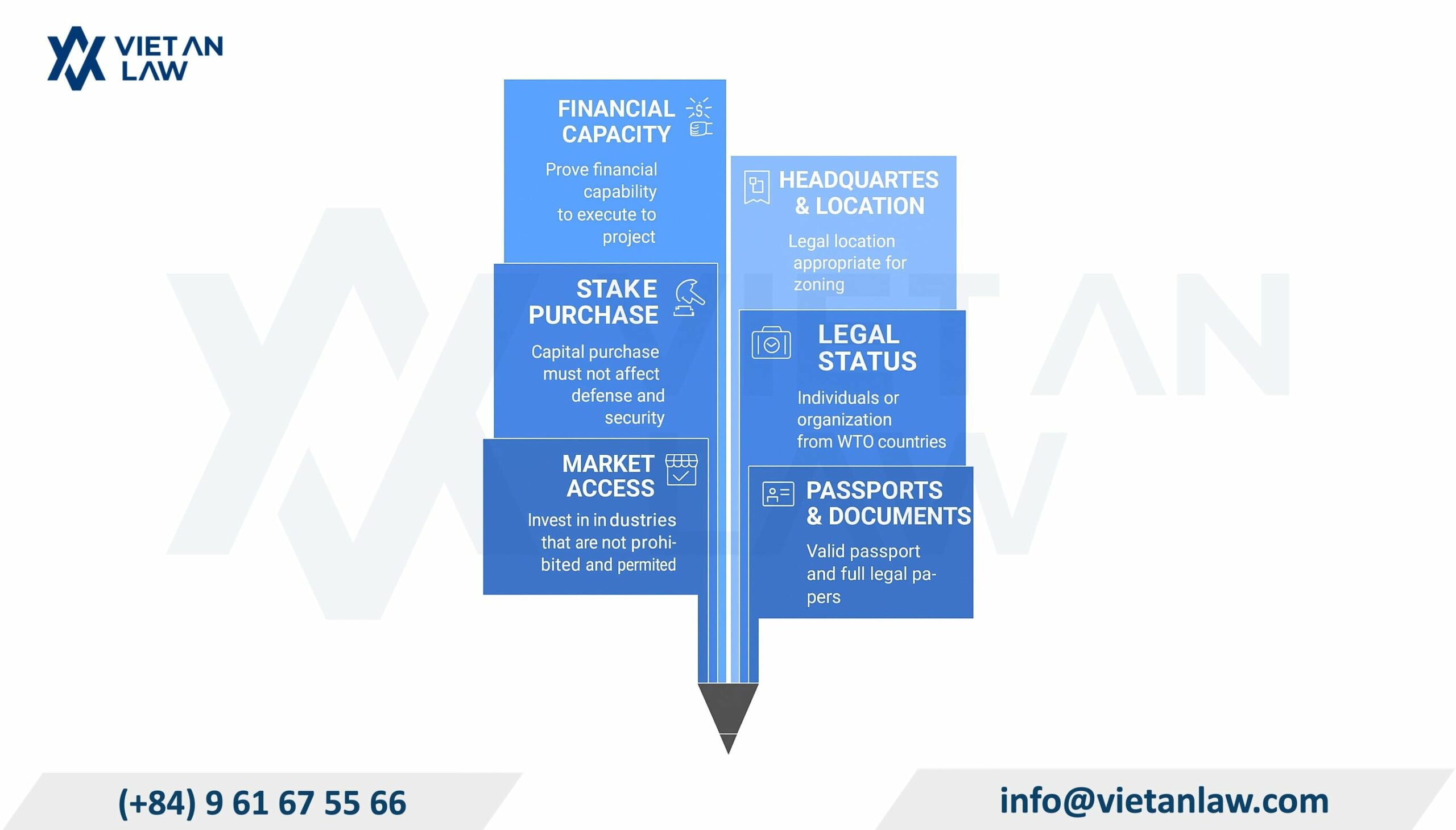
According to Article 22 of the Law on Investment 2020, when establishing a company in Vietnam, foreign investors must comply with the market access conditions stated in Article 9 of the same law. Accordingly, investors are only permitted to invest in sectors that are not prohibited and are included in the list of permitted business lines.
Before establishing an enterprise, investors must have a specific project and complete the procedures for obtaining or adjusting the Investment Registration Certificate in accordance with Vietnamese law.
According to Clause 4, Article 21 of the Law on Enterprises 2020, as amended and supplemented by the Law on Enterprises 2025, the application dossier for enterprise registration of a foreign investor must include a valid copy of the investor’s passport or an equivalent identification document.
A valid dossier must also include:
“(b) Legal documents of the organization for members being organizations, and a written authorization of the representative; legal documents of the individual acting as the authorized representative of an organizational member.
…For members being foreign organizations, the legal documents of the organization must be consularly legalized.”
Pursuant to Article 33 of the Law on Investment 2020, the application dossier for establishing a foreign-invested company must contain a valid copy of the foreign investor’s passport. A “valid copy” means a notarized or certified copy in Vietnam, or a consularly legalized copy if it was notarized abroad.
Therefore, a Chinese E-code passport that has not been notarized or consularly legalized will not meet the legal requirements for company establishment in Vietnam. Investors must complete consular legalization procedures or provide a certificate of personal identification as a substitute.
According to Article 24 of the Law on Investment 2020, foreign investors — including Chinese investors who wish to purchase shares or capital contributions in a Vietnamese company must comply with the market access conditions prescribed in Clause 3, Article 9 of the Law on Investment and Decree No. 31/2021/ND-CP.
In addition, such investments must not affect national defense or security and must comply with regulations on land use, especially in sensitive areas such as border zones or coastal regions.
Foreign investors establishing or investing in a company in Vietnam, including Chinese-owned manufacturing companies, may be individuals (aged 18 or above) or organizations with nationality from WTO member states or countries having bilateral investment treaties with Vietnam. Certain business sectors may specifically require investors to be legal entities rather than individuals.
It is important to note that individual Chinese investors holding passports that contain the “nine-dash line” will not be accepted to invest in or participate in the capital management of any enterprise in Vietnam. Although there are no nationality restrictions in general, all investors must comply with Vietnamese law and the international treaties to which Vietnam is a party.
Under Decree No. 104/2025/ND-CP, authorities performing notarization and certification are required to refuse to notarize or certify any documents or transactions containing content that violates Vietnam’s sovereignty or national laws.
Foreign investors, including Chinese investors establishing manufacturing companies in Bac Ninh, must demonstrate sufficient financial capability to implement their investment projects in Vietnam. The specific financial requirements vary depending on the industry and the regulatory orientation of competent authorities. Conducting due diligence and ensuring full compliance with financial capacity conditions is an essential step before proceeding with the investment.
Having a legal business address or project location is a mandatory condition for setting up a Chinese-owned manufacturing company in Bac Ninh. Investors must provide documents proving their lawful right to use the premises, such as land lease agreements, factory lease contracts, or land use right certificates.
For manufacturing projects, it is crucial that the factory location complies with local zoning and industrial planning and meets all conditions necessary for operational readiness.
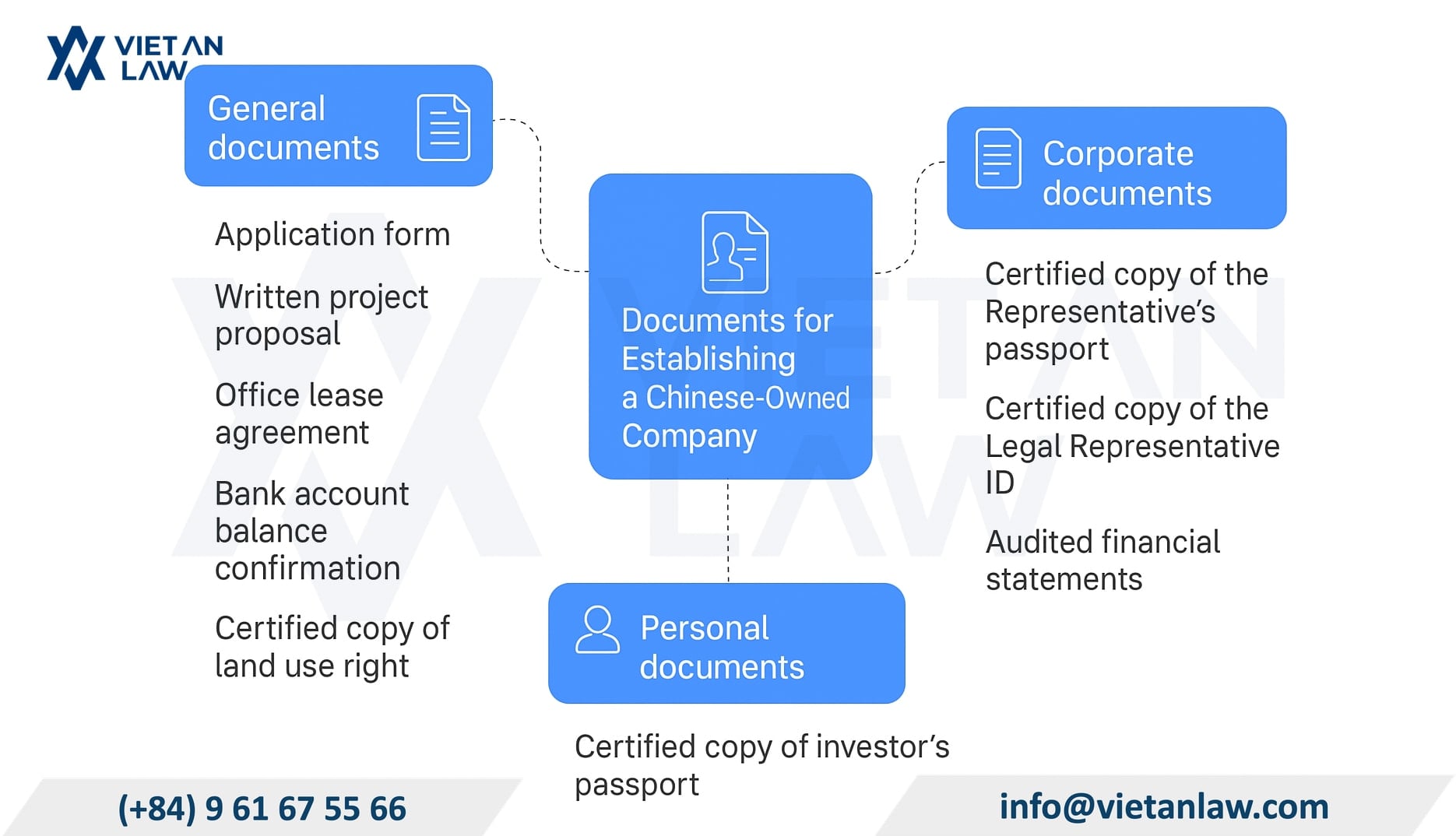
To implement a foreign-invested manufacturing project in Bac Ninh, the investor must prepare the following application documents for the Investment Registration Certificate:
Note: All documents issued abroad must be translated into Vietnamese, notarized, and legalized according to current regulations.
After completing the dossier, the investor shall submit it to the Investment Registration Division of Bac Ninh Province. Within 15 working days from the date of receiving a complete and valid application, the Bac Ninh Department of Finance will appraise and issue the Investment Registration Certificate. If the application is refused, the authority must issue a written notice stating the reasons for rejection.
To register a foreign-invested enterprise (FDI company) in Bac Ninh, the investor needs to prepare the following documents:
Submission authority: Business Registration Division – Bac Ninh Department of Finance.
Upon receipt of a complete enterprise registration dossier, the authority will issue a receipt to the applicant. Within 03 working days from the date of receiving valid documents, the Business Registration Division will review and issue the Enterprise Registration Certificate. If the dossier is rejected, the authority must provide a written notice clearly stating the reasons for refusal.
The above is the complete content related to the Chinese-owned manufacturing company setup in Bac Ninh, provided by Viet An Law. If you require legal consultation or assistance, please feel free to contact us for timely support!