Decree 22/2026/ND-CP: Product Conformity by Standards and Technical Regulations in Vietnam
On January 16, 2026, the Government officially issued Decree 22/2026/ND-CP, providing detailed regulations and measures for the implementation of the Law on Standards and Technical Regulations. This decree applies to both domestic and foreign organizations and individuals, as well as overseas Vietnamese engaged in activities related to standards, technical regulations, and conformity assessment within the country. In this article, Viet An Law will provide a comprehensive update on Decree 22/2026/ND-CP: Product conformity by standards and technical regulations in Vietnam. We will guide you through the latest procedures for Declaration of Conformity Vietnam, technical regulation conformity, and TCCS standard Vietnam, helping you transform legal compliance into a powerful competitive advantage for your products.
Distinguishing between standard conformity, technical regulation conformity, and TCCS standard Vietnam declarations
Mandatory
Mandatory of between standard conformity, technical regulation conformity, and TCCS standard Vietnam declarations
According to Article 37 of Decree 22/2026/ND-CP, the following is stipulated:
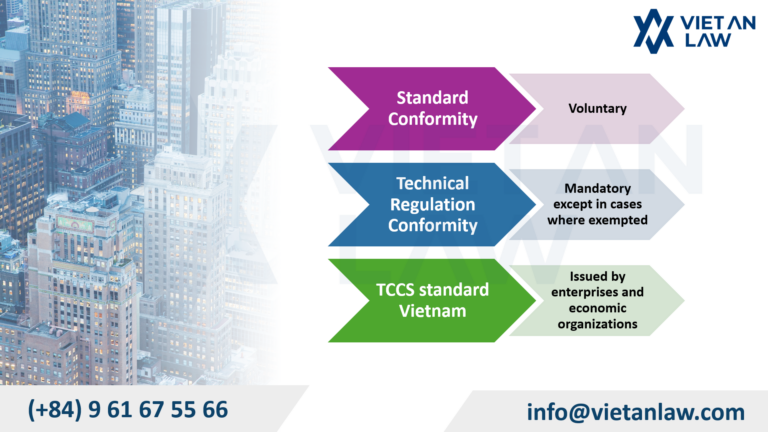
Declaration of standard conformity is a voluntary activity;
Declaration of technical regulation conformity is a mandatory activity, except in cases where exemption from conformity declaration is granted as stipulated in Clause 2, Article 48 of the Law;
TCCS standard Vietnam are standards issued by economic organizations, socio-professional organizations, state agencies, or public service units for application to activities within the scope of those organizations.
Basis for implementation
Based on Clause 1, Article 38 of Decree 22/2026/ND-CP regulating standard conformity marks, CR marks registration, and certification with TCCS standards, the following applies:
The standard conformity mark is issued by a conformity assessment body to the certified entity. The shape, structure, and presentation of the conformity mark are prescribed by the conformity assessment body in accordance with the guidelines of the Ministry of Science and Technology.
The CR mark is issued by a compliance assessment body to the certified product or goods, or is affixed by the organization or individual declaring conformity to the declared product or goods after registration. The shape, structure, and presentation of the CR mark are prescribed by the Ministry of Science and Technology.
Organizations and individuals producing and trading goods, after being certified as standard conformity, shall display the conformity mark themselves on the certified products, goods, product packaging, product documentation, processes, and environments that have been certified as technical regulation conformity.
The TCCS standards of the association or organization used for certification must meet the following requirements according to Clause 2, Article 39 of Decree 22:
Priority should be given to referencing and referencing national technical regulations and standards;
In cases where there are no national technical regulations or standards as stipulated in point a, it is permissible to referencing and referencing international standards, regional standards, and foreign standards;
There must be written opinions from the relevant industry/sector management ministry and the National Standards Authority;
Conformity with the principles stipulated in the national standard TCVN ISO/IEC 17007 “Conformity assessment – Guidance on the preparation of regulatory documents for use in conformity assessment”.
Key updates and new provisions in Decree 22/2026/ND-CP
Simplification of administrative procedures for declaration dossiers
Decree 22/2026/ND-CP identifies the National Database on standards, measurement, and quality as the main and primary channel for receiving applications. However, the decree also clearly stipulates flexible handling methods to ensure that enterprises’ operations are not interrupted due to technical errors.
Enterprises must notify the declaration of standard conformity, technical regulation conformity through the National Database on standards, measurement, and quality. This is a mandatory method to synchronize data and minimize paperwork.
However, according to Article 48 on the method of submitting dossiers, in cases where the National Database on standards, measurement, and quality is faulty or its infrastructure is incomplete, organizations and individuals must notify the declaration of standard conformity by submitting it directly or via postal service.
Changes in conformity assessment methods
According to Clause 1, Article 57 of the Law, the recognition of conformity assessment results of foreign conformity assessment organizations will include 02 cases: (1) Mutual recognition; or (2) Unilateral recognition.
Agreement on mutual recognition of conformity assessment results
Clause 1, Article 40 of the Decree stipulates the mutual recognition of conformity assessment results between countries and territories, including: conformity certification results; test results; and inspection results.
National level: Led by the relevant Ministry/sector, implemented in accordance with the law on international treaties.
Organizational level: Conducted by conformity assessment organizations under the guidance of the Ministry of Science and Technology in coordination with the Ministry of Foreign Affairs.
Unilateral recognition of conformity assessment results
Clause 1, Article 41 of the Decree stipulates: The unilateral recognition of conformity assessment results from foreign conformity assessment organizations shall be carried out on the principles of ensuring objectivity, transparency, non-discrimination, and avoiding unnecessary technical barriers to international trade, in accordance with international treaties to which Vietnam is a party.
Principles & Scope: Ensuring objectivity and transparency; prioritizing application in areas where domestic testing capacity is limited.
Recognition Criteria: Prioritizing results from reputable international organizations under mutual recognition agreements (MRA/MLA) such as ILAC, IAF, and APAC.
Implementation Authority: The relevant Ministry reviews and decides based on the applicant’s qualifications and conformity with the national standards conformity (QCVN).
Control Mechanism: The relevant Ministry is responsible for monitoring (periodically/ad hoc) to maintain compliance and the quality of results.
The process for standard and technical regulation conformity declaration
To obtain a certificate of standard and technical regulation conformity and complete the declaration procedures, enterprises need to follow these steps:
Step 1: Conformity assessment: Enterprises can conduct self-assessment or hire a qualified certification body (third party) to perform sample testing and evaluate the production process. The results must conform to the relevant standards or technical regulations.
Step 2: Prepare the declaration dossier. The dossier includes:
Declaration of standard/technical regulation conformity according to the prescribed form.
Copy of enterprise registration certificate.
Sample test results within the last 12 months.
Certificate of conformity (if any).
Step 3: Submit the dossier application to the relevant authorities: Enterprises submit their applications to the relevant government agencies.
Step 4: Receipt and processing: Within the specified timeframe, if the application is valid, the competent authority will issue a notice of receipt of the application for conformity/compliance declaration. At that point, the enterprise is officially permitted to affix the standard conformity mark or CR mark to the product packaging.
Guidelines for developing and declaring TCCS standard at enterprises
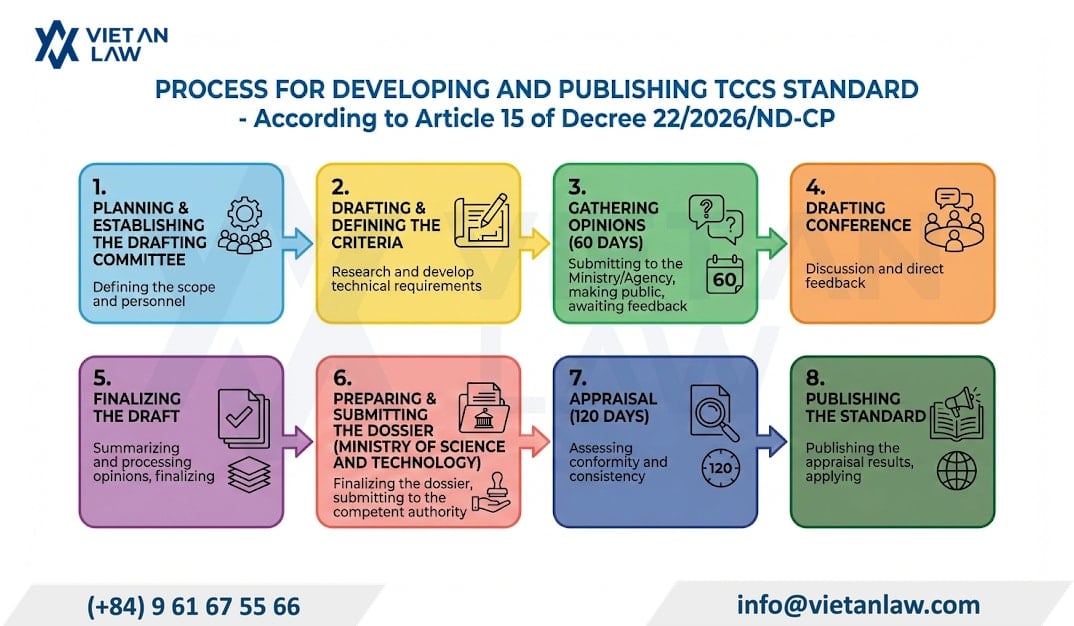
According to Article 15 of Decree 22/2026/ND-CP, the process for developing and publishing TCCS standards is as follows:
Step 1: Planning the drafting of the TCCS standard
Based on relevant information and legal issues, a drafting committee or team will be established to develop a draft of the TCCS standard.
Step 2: Drafting the standard
The drafting team conducted a situational assessment and researched technical documents to determine the indicators and technical requirements of the draft standard.
Step 3: Gathering opinions from stakeholders on the draft standard
After the draft is completed, the drafting team will report to the ministry or equivalent agencies. Next, the drafting team will conduct a broad consultation process with relevant agencies, organizations, individuals, and members of the corresponding national standards technical committee.
The minimum time for soliciting feedback on a draft is 60 days, calculated from the date the draft is received. In cases involving urgent issues such as health, safety, or the environment, the time may be shortened, but not less than 30 days.
Step 4: Organizing a conference to draft the TCCS standards
The drafting conference was organized with the participation of stakeholders to discuss and provide feedback on the draft procedure for publishing TCCS standards.
Step 5: Processing feedback and finalizing the draft standard
The drafting committee is responsible for compiling and processing feedback to finalize the draft.
Step 6: Establishing the draft standard dossier
The process of drafting a standard begins with compliance with relevant regulations. Once completed, the documents and draft standard files are submitted to the ministry or equivalent agencies for review. Files that fully meet the requirements are then sent directly to the Ministry of Science and Technology for assessment and formal approval.
Step 7: Appraising the draft TCCS standard
The draft standard review must include the following points:
The suitability of the standard to the progress of science and technology, and the conditions and needs of socio-economic development.
The compatibility between the standards and technical regulations, legal provisions, relevant international commitments, and the requirement for harmonization with international standards.
Consistency within the national standards system, adherence to principles, and the interests of stakeholders.
Ensuring compliance with professional requirements, procedures, and processes for developing basic standards.
From the date of notification of assessment, organizations responsible for developing TCCS standards are required to complete the draft standard and related documents based on the assessment comments. They must then submit them directly to the Ministry of Science and Technology within 120 days. If the deadline is exceeded, the draft standard will be re-assessed.
Step 8: The TCCS standard is published
The Ministry of Science and Technology will announce the results based on the assessment and the finalization of the draft standard and related dossiers after the assessment.
Penalties for violations of quality declaration regulations 2026
Main legal basis: Decree 119/2017/ND-CP, amended and supplemented by Decree 126/2021/ND-CP.
Regarding the TCCS Standard
Violation: Failure to disclose the applicable standards for the product (in production or import).
Penalty: From 10,000,000 VND to 20,000,000 VND.
Violation: The product’s quality does not conform to the disclosed standards.
Penalty: From 20,000,000 VND to 40,000,000 VND.
For Technical regulation conformity (QCVN) – Mandatory compliance with national standards
Violation: Failure to declare technical regulation conformity for products and goods subject to mandatory regulations (Group 2).
Penalty: From 30,000,000 VND to 40,000,000 VND.
Violation: Failure to register the declaration of technical regulation conformity with the relevant specialized agency.
Penalty: From 30,000,000 VND to 40,000,000 VND.
Remedial measures
In addition to fines, enterprises are required to take the following measures:
Recall and recycle or repurpose the infringing goods.
Destroy the goods if they are not recyclable or are harmful.
Make the necessary declarations before continuing to circulate the goods.
Note: From January 1, 2026, the Law amending and supplementing certain articles of the Law on Standards and Technical Regulations will come into effect. Accordingly, enterprises may be exempt from declaring conformity if their products have already met the quality management requirements as stipulated in other relevant specialized laws (helping to minimize overlapping procedures).
The above is content about Decree 22/2026/ND-CP: Product conformity by standards and technical regulations in Vietnam. For any related questions, please contact Viet An Law – Tax Agency for the best advice and support.
Fast & Reliable Legal Assistance
Fill out the form below and get connected with a lawyer quickly.
Complete guide to company branch registration in Hanoi 2026: requirements, procedures, costs, and address selection. Expert legal support for Vietnamese and foreign enterprises establishing branches in Vietnam.
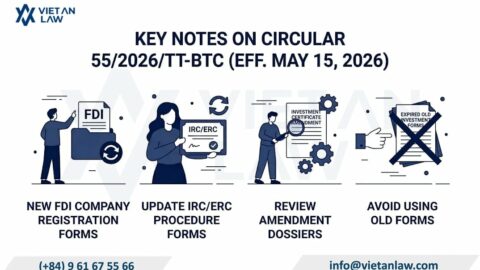
On May 15, 2026, the Ministry of Finance promulgated Circular 55/2026/TT-BTC prescribing the forms of documents and reports related to investment activities in Vietnam and investment promotion. This represents a…
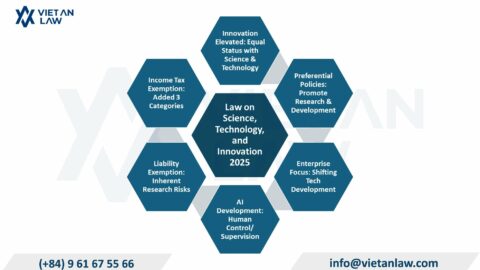
Law on Science, Technology and Innovation 2025 brings breakthrough changes for Vietnam. Discover new policies on innovation, AI control, tax exemptions, and business incentives.
Decree 134/2026/ND-CP on AI copyright in Vietnam: New regulations for AI-generated works, ownership requirements, and data usage for training AI systems. Legal guide for compliance.
Company formation in Vietnam 2026 takes 3-5 days for domestic enterprises and 18-35 days for FDI companies. Complete guide to registration timelines and requirements.