On January 19, 2026, the Government officially enacted Decree No. 29/2026/ND-CP regarding the domestic carbon trade exchange. This marks a pivotal milestone in the formation and operation of Vietnam’s carbon market, accelerating the nation’s progress toward the globally committed Net Zero 2050 goal. To ensure full legal compliance and mitigate risks under these new regulations, join Viet An Law as we provide an in-depth analysis of the Vietnam Carbon Credit Exchange (VCCE): Trading procedures under Decree 29/2026/ND-CP.
Vietnam Carbon Credit Exchange (VCCE): Trading procedures under Decree 29/2026/ND-CP
Decree 29/2026/ND-CP regulates activities related to domestic carbon credit exchange, including registration, issuance of domestic codes, transfer of ownership, custody, trading, and settlement of greenhouse gas emission quotas and carbon credits eligible for trading under the law.
Decree 29/2026/ND-CP applies to:
- Vietnam securities depository and clearing corporation.
- Vietnam Stock Exchange.
- Hanoi Stock Exchange.
- Agencies and organizations participating in trading on domestic carbon exchanges in accordance with the law on environmental protection.
- Agencies, organizations, and individuals involved in the operation of domestic carbon exchanges, registration, issuance of domestic codes, transfer of ownership, custody, trading, and settlement of greenhouse gas emission quotas and carbon credits.
Eligibility for joining the Vietnam Carbon Credit Exchange from 2026: What must Enterprises prepare?
Based on Article 18 of Decree 29/2026/ND-CP, the conditions for participating in the VCCE from 2026 onwards must meet the following requirements:
- Trading members must be securities companies operating under the Law on Securities, approved to participate in the carbon transaction custody and settlement system;
- Not subject to warnings or controls;
- Meeting the requirements for information technology infrastructure and business processes according to the regulations of the Vietnam Stock Exchange.
- Entities eligible to participate in trading on the domestic carbon exchange are those subject to the exchange of greenhouse gas emission quotas and carbon credits as stipulated in Decree 06/2022/ND-CP, amended and supplemented by Decree 119/2025/ND-CP (Article 7).
Enterprises need to prepare and complete the following procedures before participating in trading on the exchange:
- Measurement: Measurement-Reporting-Appraisal (MRV) system certified by an independent appraisal unit is mandatory.
- Registration: Register an account on the national registration system.
- Strategy: Decide whether to sell immediately to generate cash flow or hold and wait for prices to rise.
How to register an account and emission trading according to Decree 29/2026/ND-CP
According to the Decree, greenhouse gas emission quotas and carbon credits that are traded are those permitted to be exchanged as stipulated in Government Decree No. 06 dated January 7, 2022, regulating greenhouse gas emission reduction and ozone layer protection, as amended and supplemented by Decree No. 119/2025/ND-CP.
Regarding registration and domestic code issuance according to Article 11:
- Greenhouse gas emission quotas and carbon credits must be centrally registered on the National Registration System managed by the Ministry of Agriculture and Environment before being deposited or traded.
- The Ministry of Agriculture and Environment registers information on quotas, credits, and owning organizations; simultaneously issues unified domestic codes and sends the list to the Vietnam Securities Depository and Clearing Corporation and the Hanoi Stock Exchange.
Based on the regulations on the organization and operation of the domestic carbon market in Decree 29/2026/ND-CP, enterprises wishing to participate in the trading of greenhouse gas emission quotas must follow the following four-step process:
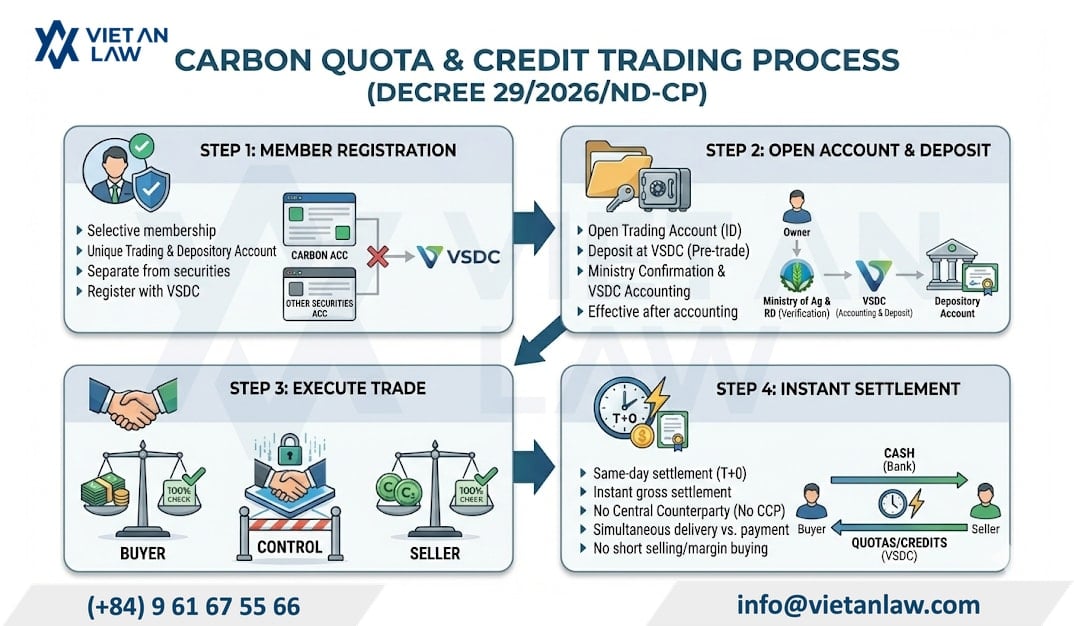
Step 1: Register as a market participant
Before opening a trading account, an enterprise must be recognized as a member. The exchange does not open its doors freely to all entities but selects them based on their capabilities and obligations.
According to Clause 4, Article 13 and Clause 1, Article 14 of Decree 29/2026/ND-CP, participating entities are only allowed to use one custody account and one trading account at a carbon custody/trading member (usually licensed securities companies).
- Exception: An additional temporary account may only be used when making transfers to another custodian member, and must be canceled immediately afterward.
This account must be completely separate from other securities trading activities. The system must display the carbon trading component separately from the moment of login. Cross-offsetting or borrowing of assets with other sub-accounts is not permitted.
- Information registration (Point b, Clause 4, Article 13 of the Decree): Before conducting transactions, organizations must register their account information with the Depository Member to update it in the system of the Vietnam Securities Depository and Clearing Corporation (VSDC).
- Required documents: Businesses submit documents to the Exchange operating unit, including:
- Market membership registration form.
- Copy of the Enterprise Registration Certificate.
- Confirmation document from the specialized management agency regarding emission reduction results or decision on the allocation of greenhouse gas emission quotas (this is a prerequisite to prove that the enterprise has “goods” or a genuine “demand”).
Step 2: Open a trading account and deposit quotas
After becoming a member, the enterprise opens an account to manage its assets (quotas/credits) and funds.
- Conditions: Quotas and credits must be deposited with the Vietnam securities depository and clearing corporation before trading can be executed.
- Opening a trading account: Enterprises sign a contract with a trading member (brokerage firm) or open an account directly at the Exchange (if eligible) to obtain a Trading code.
- Deposit Procedure:
- The owner submits a notification to the National Registration System regarding the quantity they wish to deposit.
- The Ministry of Agriculture and Environment checks and sends an approval list to the Vietnam Securities Depository and Clearing Corporation, clearly stating the identifying information of the agency, organization, deposit account for greenhouse gas emission quotas and carbon credits, and the quantity of greenhouse gas emission quotas and carbon credits deposited corresponding to each deposit account.
- The Vietnam Securities Depository and Clearing Corporation deposits the greenhouse gas emission quotas and carbon credits based on the prescribed list.
- Assets are only considered successfully deposited when VSDC completes the accounting process on the system.
Step 3: Execute the Transaction on the Exchange
Decree 29/2026/ND-CP stipulates an absolutely secure transaction mechanism, prohibiting short selling or debt purchases.
Order placement regulations are stipulated in Clause 2, Article 14 of Decree 29/2026/ND-CP:
-
- Buyer: Must have 100% of the funds in their account when placing an order.
- Seller: Must have 100% of the quota/credits in their account when placing an order.
Control responsibility (Clause 3, Article 14): Trading members (Brokers) are responsible for checking their cash and inventory balances before placing orders into the system. If the balance is insufficient, the order will be rejected immediately.
-
- The purchasing enterprise can immediately use the purchased quota to fulfill its surrender obligation to the State.
Step 4: Immediate payment on the same day (Based on Article 15)
The key advantage of a carbon exchange over the stock market is its extremely fast settlement speed.
The settlement method stipulated in Clause 1, Article 15 of the Decree is as follows:
-
- Settlement within the same trading day.
- Immediate settlement method for each transaction (Gross Settlement).
- Note: The central counterparty clearing mechanism (CCP) as with derivative securities is not applicable.
Cash and Asset Flow Procedure (Clause 4, Article 15):
-
- Simultaneous transfer principle: As soon as funds are transferred from the Buyer to the Seller at the settlement bank, the quota/credits are also transferred ownership on the VSDC system.
Impact of Decree 29/2026/ND-CP: Greenhouse gas inventory system increases enterprise production costs
The implementation of Decree 29/2026/ND-CP mandates that enterprises establish a greenhouse gas inventory system and report emission reductions. This leads to increased compliance costs in the product cost structure, including:
- Costs of dedicated personnel,
- Costs of hiring independent assessment units and costs of investing in technology conversion to meet emission quotas.
This is a short-term financial challenge that enterprises must address to maintain the legality of their production operations. Full compliance with regulations on information disclosure and emission quotas helps to transparently demonstrate the company’s capabilities, eliminating legal risks that banks may face when providing funding (such as the risk of project suspension due to violations of environmental laws).
Furthermore, meeting the standards of Decree 29/2026/ND-CP is the first screening criterion for enterprises to be considered for Green Credit packages. When environmental legal documentation is ensured, enterprises are eligible to access loan capital with preferential interest rates (lower than normal commercial interest rates) and longer grace periods. This mechanism helps enterprises offset compliance costs incurred in the initial stages, creating a sustainable financial cycle.
Forecast of price trends after Decree 29/2026/ND-CP
Carbon credit pricing in Vietnam
Based on the law of supply and demand and the pilot phase (2026-2028) transitioning to official status (after 2029), the price of carbon credits in Vietnam (V-EUA) is expected to go through 3 stages:
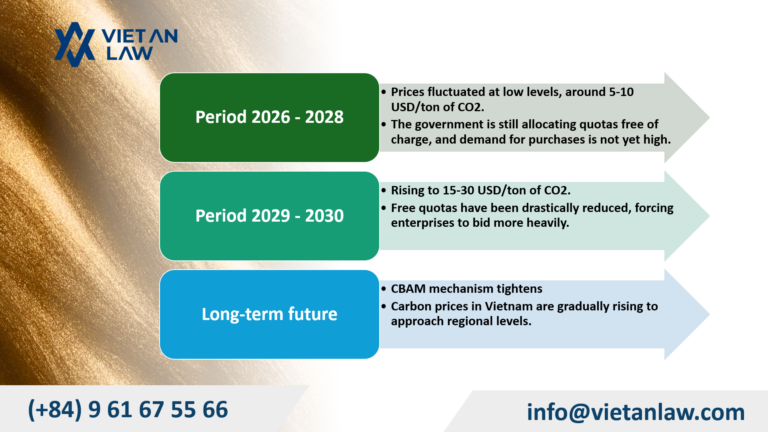
- Period 2026 – 2028 (Pilot – Low prices for getting started):
- Price Forecast: Fluctuating at a low level, around 5 – 10 USD/ton of CO2.
- Reason: The government will still mainly allocate quotas free of charge (to avoid cost shocks for enterprises). Demand is not yet high, mainly from units wanting to pilot or build green brands (CSR).
- Period 2029 – 2030 (Official Operation – Price Acceleration):
- Price forecast: Increase to 15 – 30 USD/ton of CO2.
- Reason: Free quotas are drastically reduced, forcing enterprises to bid more frequently. Simultaneously, pressure to meet national emission reduction commitments (NDCs) is causing demand to exceed supply.
- Long-term future (Approaching world prices): As the CBAM mechanism tightens, carbon prices in Vietnam will have to gradually increase to approach regional levels (such as China ~12 USD or Singapore ~25 USD) to avoid additional taxes on exports.
The difference between the Vietnam Carbon Credit Exchange (according to Decree 29/2026) and other well-known exchanges
The stock exchange under Decree 29 shares many similarities but also has unique characteristics compared to “big players” like the EU or China to suit the realities of a developing economy.
- Regarding the quota allocation mechanism: Vietnam applies a hybrid model (free allocation in the initial phase to allow enterprises to familiarize themselves with the process, then gradually increasing the auction rate). This approach is more flexible than the EU ETS (where auction is the primary method) and differs from China (allocation based on actual production quotas).
- Regarding trading methods: Vietnamese exchanges flexibly combine continuous order matching (for small lots) and negotiated transactions (for large lots). Meanwhile, the EU ETS market has developed to a high level with derivative instruments (Futures/Options), while China currently still relies mainly on negotiated transactions.
- Regarding participating entities: While China currently focuses on controlling the Energy sector (thermal power), and the EU ETS covers a wide range of sectors (Industry, Aviation, Maritime), Vietnam has defined a roadmap focusing on large-scale emission sources (Steel, Cement, Thermal Power) and expanding to include credit sellers (Forestry, Renewable Energy).
- Regarding traded commodities: The Vietnamese exchange allows parallel trading of quotas (V-EUA) and carbon credits for offset trading. This mechanism is similar to China’s (CEA & CCER) but much more open than the EU ETS, where the use of external offset credits is very strictly restricted.
Credit transferability
Certificates purchased in Vietnam will be recognized for offsetting exports to the EU (avoiding CBAM tax) if they meet the following criteria:
- CBAM principle: The EU stipulates that importing enterprises must purchase CBAM certificates corresponding to their emissions. However, if the enterprise has already paid the “Carbon Price” in the country of origin (Vietnam), this amount will be deductible.
- Conditions for deduction:
- Must be a mandatory payment: The enterprise must prove that the purchase of quotas (according to Decree 29) is a legal obligation, not a voluntary purchase for image purposes.
- Equivalent value: The EU will deduct the actual amount paid by the enterprise.
Participating in the Vietnamese exchange helps reduce the burden of CBAM tax (a $10 deduction) but does not provide a complete exemption (the difference still has to be paid) until Vietnam’s carbon price rises to match the global price.
The above is Vietnam Carbon Credit Exchange (VCCE): Trading Procedures under Decree 29/2026/ND-CP. For any related questions, please contact Viet An Law – Tax Agent for the best advice and support.