Vietnam is strategically positioning itself at the forefront of the digital industrial revolution. The digital technology industry is no longer just a socio-economic goal but the fundamental bedrock for advanced sectors like Artificial Intelligence (AI) and semiconductors. In this context, Decree 353/2025/ND-CP, guiding the implementation of the Law on Digital Technology Industry, was enacted to establish a synchronized legal framework and specify preferential policies for sector growth, effective from January 1, 2026. Below, Viet An Law will provide an in-depth analysis of Vietnam’s AI & Semiconductor strategy: The impact of Decree 353/2025.
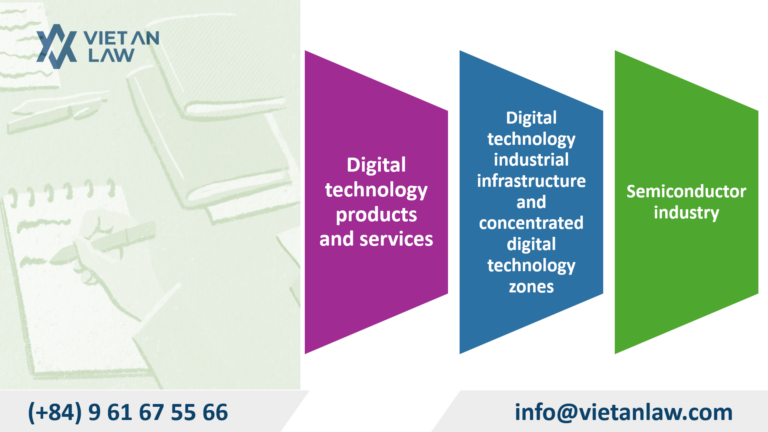
The entities eligible for preferential support for digital technology industry activities under Article 3 of Decree 353/2025/ND-CP include:
According to Clause 1, Article 3 of Decree 353/2025/ND-CP, activities related to digital technology products and services are entitled to the following support and preferential policies:
The production of digital technology products and the provision of digital technology services are entitled to investment support and incentives as stipulated in Article 28 of the Law on Digital Technology Industry 2025:
The production and provision of digital technology services are identified as investment-incentive sectors, enjoying full incentives in the following areas:
In particular, the following sectors are classified as business lines that receive special investment incentives:
For large-scale AI and semiconductor projects, enterprises also benefit from special investment incentives, including significant reductions in corporate income tax, land rent, and customs procedures.
Incentives for leasing and purchasing digital technology products and services using state budget funds are applied under the preferential policies stipulated in Article 31 of the Law on Digital Technology Industry 2025, aiming to promote the use of digital technology products in the public sector.
Specifically:
Research and development (R&D) activities for digital technology products and services are entitled to incentives and support under Articles 16 and 17 of the Law on Digital Technology Industry 2025.
Accordingly, R&D activities in the field of digital technology enjoy the highest level of incentives under the law on science, technology, and innovation.
In addition, the State will:
This helps enterprises drastically reduce initial research costs – the biggest barrier to entry in the high-tech industry.
According to Clause 2, Article 3 of Decree 353/2025/ND-CP, investment projects for the construction of digital technology industrial infrastructure and investment in concentrated digital technology zones are entitled to priority, incentives, and investment support as stipulated in Articles 21 and 24 of the Law on Digital Technology Industry 2025:
Investing in digital technology industrial infrastructure and concentrated digital technology zones is identified as a sector with special investment incentives.
The State prioritizes budget allocation for the development of:
Projects in the concentrated digital technology zone are entitled to:
The semiconductor industry is identified as a key sector and is subject to special incentive mechanisms. The development of the semiconductor industry and businesses participating in the semiconductor supply chain benefit from specific mechanisms and policies as stipulated in Articles 39 and 40 of the Law on Industry and Technology 2025.
Accordingly, semiconductor businesses will benefit from:
According to Clause 4, Article 3 of Decree 353/2025/ND-CP, innovative startup projects in the digital technology industry are entitled to incentives and support as stipulated in Article 29 of the Law on Digital Technology Industry 2025.
Accordingly, innovative startup projects in the digital technology industry are sectors and professions that receive special investment incentives and support as prescribed by laws on investment, taxation, land, and other relevant laws.
Innovative startup projects in the digital technology industry receive direct funding from local budgets as stipulated by the State Budget Law or from the Digital Technology Industry Development Program for activities including:
Enterprises operating in the digital technology industry enjoy many corporate income tax incentives under the Law on Digital Technology Industry 2025, such as:
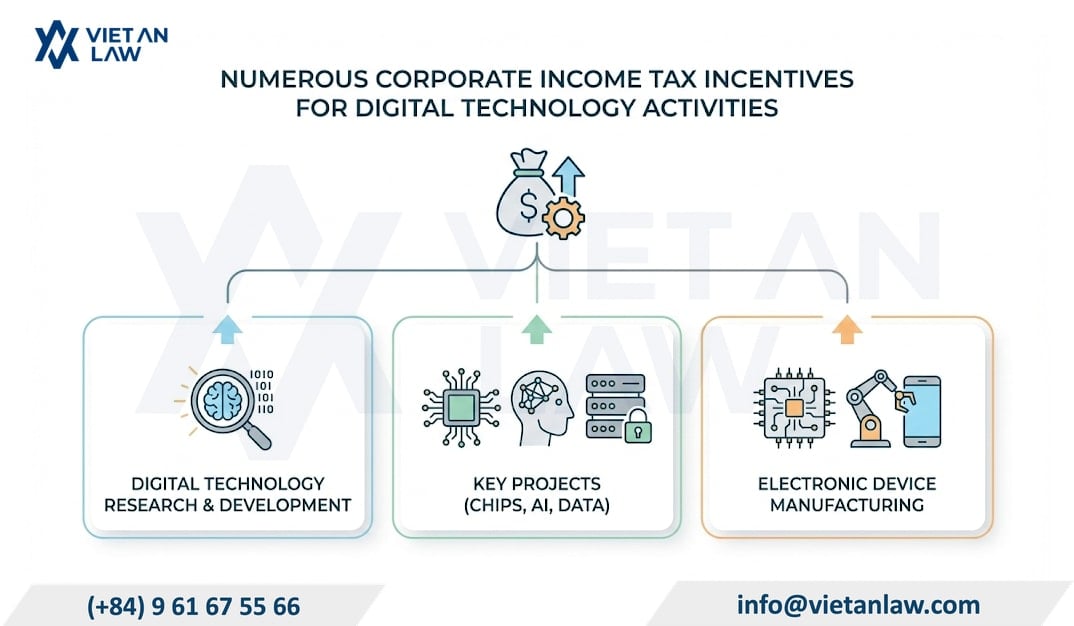
Numerous corporate tax incentives for digital technology industry activities
Expenditures by enterprises on research and development of digital technology are subject to an additional expenditure level when determining taxable income for corporate income tax purposes, as stipulated by corporate income tax laws.
Projects producing key digital technology products; research and development, design, manufacturing, packaging, and testing projects for semiconductor chips; and large-scale artificial intelligence (AI) data center construction projects that are eligible for special investment incentives and support are entitled to incentives as prescribed by the law on corporate income tax, land, and other relevant laws.
If the criteria in Circular 33/2025/TT-BKHCN are met, the company will be eligible for support and incentives regarding corporate income tax under the Corporate Income Tax Law 2025.
Decree 353/2025/ND-CP is not only a guiding document for the implementation of the Law on Digital Technology Industry, but also one of the important policy tools shaping the development strategy for AI (artificial intelligence) and the semiconductor industry in Vietnam. With its comprehensive incentive system, the Decree creates far-reaching impacts on participating entities, from technology startups to large corporations, from investors to policymakers.
Decree 353/2025/ND-CP designs investment incentives, tax policies, and land policies specifically for digital technology products and services and key industries, with AI and semiconductors being top priority sectors. Specifically:
As a result, Vietnam is increasingly becoming an attractive investment environment for domestic and foreign investors looking to deploy AI and semiconductor projects with lower input costs and better controlled legal risks.
Decree 353/2025/ND-CP strongly encourages research and development (R&D) activities by:
This helps create a favorable legal environment for enterprises, including AI startups, to develop new products, test innovative services, and bring AI solutions to a wider application in the economy.
Besides financial and tax support, Decree 353/2025/ND-CP also clearly defines criteria for identifying high-quality digital technology human resources, with a focus on experts, researchers, lecturers, and highly qualified personnel in the field of digital technology. This:
A high-quality workforce is a crucial foundation for AI and semiconductor enterprises to accelerate innovation, enhance competitiveness, and integrate into global value chains.
Thanks to the preferential policies under the Decree, AI products, digital services, and semiconductor-related products have the opportunity to:
The public adoption and prioritization of digital technology products in digital technology tenders helps AI and semiconductor enterprises develop sustainably and expand their market share both domestically and internationally.
Decree 353/2025/ND-CP facilitates close collaboration among various entities in the digital technology ecosystem (the state, large enterprises, startups, research institutes):
This collaboration helps create a collaborative environment where AI and semiconductor projects can develop more rapidly and align with national interests.
The above is an analysis of the Vietnam’s AI & Semiconductor strategy: The impact of Decree 353/2025. In the context of AI and semiconductors becoming new pillars of economic growth, correctly understanding and promptly implementing preferential policies according to Decree 353/2025/ND-CP will be a crucial advantage for enterprises and investors to achieve sustainable development; Viet An Law is ready to provide comprehensive legal advice and support throughout the implementation of AI and semiconductor projects in Vietnam.