In 2025, the Law on Digital Technology Industry was enacted, marking Vietnam as the first country in the world to promulgate a separate law on the digital technology industry sector. To implement and guide this regulation, the Government issued Decree 353/2025/ND-CP: Guiding Vietnam’s Law on Digital Technology Industry. The Decree consists of 5 Chapters and 36 Articles, effective from January 1, 2026, focusing on clarifying key contents related to preferential policy activities for the digital technology industry, development of high-quality human resources, and the controlled testing mechanism for digital technology application products and services.
According to Article 3 of Decree 353/2025/ND-CP, the State establishes a comprehensive support and incentive mechanism system to promote the development of the digital technology industry, covering products, services, and infrastructure to key sectors and innovative startups. Specifically:
For digital technology products and services, production and supply activities enjoy investment incentives according to the regulations of the Law on Digital Technology Industry.
Besides, digital technology products and services using state budget capital are prioritized in public hiring and procurement, contributing to expanding the consumption market. Research and Development (R&D) activities in this field are also subject to many support and preferential policies to encourage innovation and technology mastery.
For investment in the construction of digital technology industry infrastructure, including concentrated digital technology zones, the State applies priority mechanisms, incentives, and special support, creating a synchronous infrastructure foundation to attract technology enterprises and form large-scale innovation centers.
For the semiconductor industry – a key field of digital technology, the Decree records specific mechanisms and policies for the development of the semiconductor sector. Simultaneously, enterprises participating in the semiconductor supply chain enjoy many incentives and support, thereby strengthening domestic capacity and gradually participating deeply in the global value chain.
For innovative startup projects in the digital technology industry, the law reserves a separate preferential mechanism, creating a favorable environment for technology start-ups to develop, commercialize products, and expand operational scale.
It can be seen that Decree 353/2025/ND-CP has concretized the major orientation of the State in taking the digital technology industry as a new growth driver, while creating a legal corridor and policies strong enough to attract investment, promote innovation, and improve the competitiveness of Vietnam’s digital economy.
Based on Article 5 of Decree 353/2025/ND-CP, high-quality digital technology industry human resources are identified through 05 key groups of criteria, focusing on practical capacity, professional qualifications, and the level of contribution to the digital technology field. This can be generalized as follows:
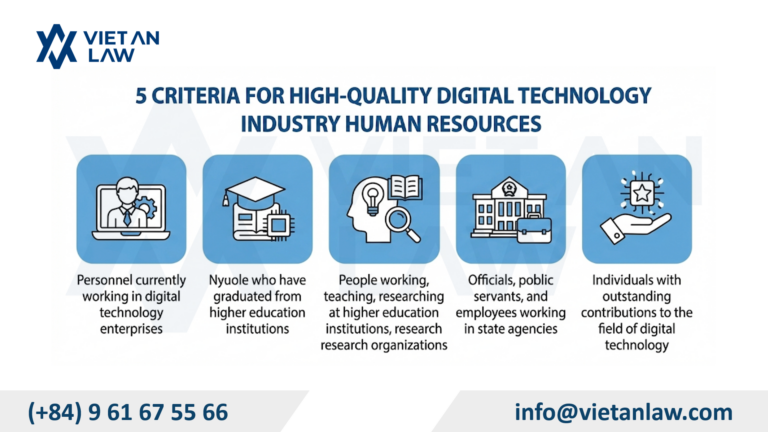
This group includes senior management positions or personnel directly participating in digital technology activities at the enterprise.
Evaluation criteria are based on the scale and operational efficiency of the enterprise (large revenue in recent years) or income levels significantly exceeding GDP per capita, applicable to both Vietnamese and foreign workers.
Recent graduates within 03 years from higher education institutions are high-quality digital technology industry human resources when meeting one of the following criteria:
Meeting one of the following criteria:
Meeting one of the following criteria:
Determining the 5 criteria for high-quality digital technology industry human resources clearly not only creates a unified legal basis for policies on attracting, treating, and utilizing talent but also demonstrates the State’s long-term orientation in building a core human resource team for the digital economy.
One of the important highlights of Decree 353/2025/ND-CP: Guiding Vietnam’s Law on Digital Technology Industry is the establishment of a controlled testing mechanism (sandbox) for digital technology application products and services, specifically regulated in Chapter IV.
This is considered a new legal corridor to promote innovation while ensuring risk management requirements. The goal of the testing mechanism is clearly defined, including allowing organizations and enterprises to be exempt from complying with certain legal regulations within a limited scope and time; encouraging innovation; creating an environment to assess risks, costs, and benefits of new products and services; and simultaneously controlling and limiting potential risks.
According to Article 15 of Decree 353/2025/ND-CP, the 4 specific conditions and criteria for testing products and services are as follows:
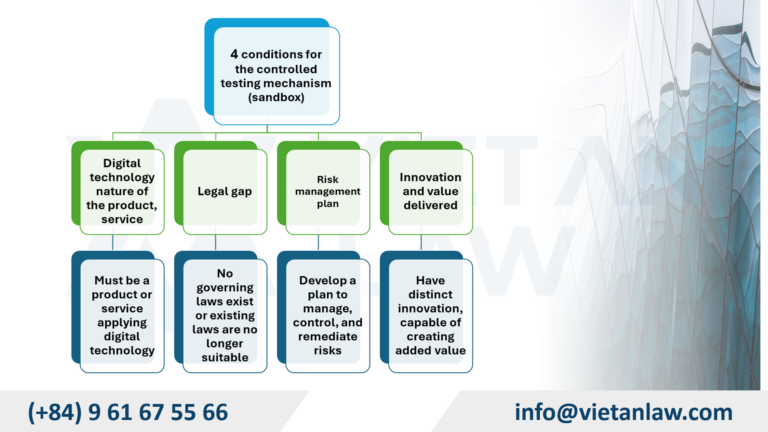
Products and services must be products and services applying digital technology, formed from the process of convergence, integration, or combination of multiple digital technologies, or between digital technology and products/services of other industries and fields.
The deployment of products and services currently has no governing legal regulations or has regulations that are no longer suitable for practice, leading to the inability to deploy under the current legal framework.
Organizations and enterprises proposing testing must build plans to manage, control, and remedy risks, and have measures to protect the legitimate rights and interests of testing participants and related organizations and individuals.
Products and services must have distinct innovation, be capable of creating added value, and contribute positively to the development of science, technology, and the digital economy.
On that basis, organizations and enterprises wishing to participate in the testing mechanism submit 01 application dossier for testing to the competent licensing authority, including the Provincial People’s Committee, Ministry, Ministerial-level agency, or the Minister of National Defense, depending on the field and scope of testing.
The maximum testing period is 03 years and can only be extended once, with the extension period not exceeding 03 years.
Besides, Decree 353/2025/ND-CP also details cases of suspension and termination of testing; rights and obligations of licensing agencies and participating organizations/enterprises, along with the process for dossiers, approval, extension, and completion of testing with unified forms, facilitating practical application.
The issuance of Decree 353/2025/ND-CP not only signifies the completion of the legal framework for the Law on Digital Technology Industry but also creates a distinct two-way impact on both technology startups and large technology corporations, thereby reshaping the structure and development momentum of the entire industry in the period from 2026 onwards.
For technology startups, Decree 353/2025/ND-CP is considered a breakthrough policy boost.
For large technology corporations like FPT, Viettel, VNPT, CMC…, Decree 353/2025/ND-CP plays the role of a strategic legal corridor to implement large-scale, long-term projects in the field of digital technology and semiconductors.
Another important impact of Decree 353/2025/ND-CP is promoting the linkage model of the digital technology industry ecosystem.
In which, startups play the central role of innovation; large corporations play the role of leading the market, transferring technology, and expanding scale; and the State plays the role of creating, supporting, and controlling risks.
This connection not only helps increase value for each subject but also contributes to forming a sustainable digital technology ecosystem, capable of competing regionally and internationally.
It can be seen that Decree 353/2025/ND-CP: Guiding Vietnam’s Law on Digital Technology Industryhas fully concretized the major orientations of the Law on Digital Technology Industry, from preferential policies and high-quality human resource development to controlled testing mechanisms, thereby creating a solid legal foundation for Vietnam’s digital technology industry to enter a new development stage from 2026.
In the context of constantly evolving policies and increasingly stringent compliance requirements, proactively understanding regulations and implementing them correctly from the outset is a key factor for enterprises and technology startups. Viet An Law is ready to accompany, advise, and provide comprehensive legal support for enterprises to effectively utilize opportunities from the new legal framework, minimize risks, and develop sustainably in the digital technology field.