On December 10, 2025, during the 10th Session of the 15th National Assembly, the announcement became official: Vietnam launches first AI Law 2025 (No. 134/2025), marking a historic milestone in the country’s legislative history. This is the first time Vietnam has developed and promulgated a dedicated Law on Artificial Intelligence, establishing a pioneering legal framework to align with global AI development trends and bolster national competitiveness in the digital era. In the following article, Viet An Law provides a comprehensive update on the most notable new provisions within the Law on Artificial Intelligence 2025 (No. 134/2025/QH15).
The Law on Artificial Intelligence comprises 35 articles and 8 chapters regulating the research, development, provision, deployment, and use of artificial intelligence systems (AI activities); the rights and obligations of relevant organizations and individuals; and state management of AI activities in Vietnam. Specifically:
These regulations are clearly designed with a “management for development” approach, ensuring a balance between risk control and innovation promotion, in line with international practices and supporting Vietnam’s proactive integration with new technological standards.
The AI Law takes effect on March 1, 2026, except for the following provisions:
For AI systems that were put into operation before the effective date of the AI Law, the provider and implementer are responsible for fulfilling their compliance obligations under the AI Law within the following timeframe:
During the specified period, the artificial intelligence system may continue to operate, except in cases where the state management agency for artificial intelligence determines that the system poses a serious risk of causing damage, in which case it has the right to request a temporary suspension or termination of operation.
Article 4 of the AI Law 2025 stipulates the basic principles in artificial intelligence activities as follows:
One of the core tenets behind the enactment of Vietnam’s first AI Law (Law No. 134/2025/QH15) is placing humans at the center, with the principle that AI serves humans, does not replace humans, and humans retain the right to oversight in important decisions. AI does not replace human authority and responsibility.
Article 7 of the AI Law 2025 stipulates the following prohibited acts:
One of the key aspects of the first AI Law in Vietnam, No. 134/2025/QH15, is the risk-based management approach, which categorizes AI systems into different levels to ensure flexibility, encourage development, and promote technological self-reliance in AI.
Accordingly, Article 9 of the 2025 AI Law classifies the risk level of artificial intelligence systems into three levels: high, medium, and low.
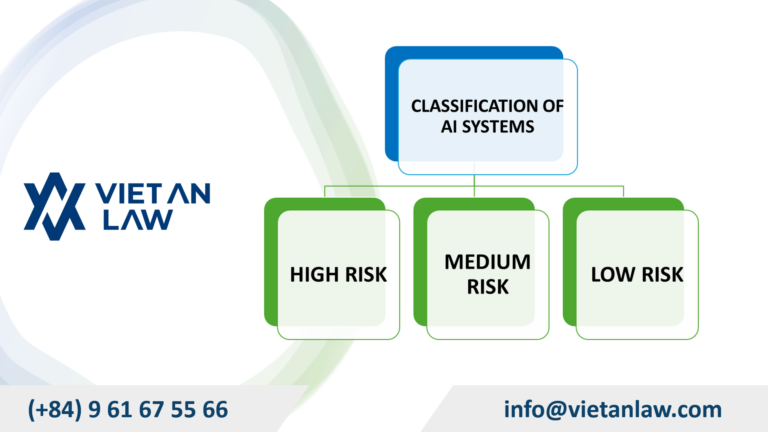
Accordingly, the vendor must classify the artificial intelligence system before putting it into use. Systems classified as medium risk or high risk must have a classification document attached.
However, the AI Law 2025 currently lacks clear quantitative or qualitative criteria, regulations on management measures, and assessment tools, leading to confusion for enterprises in self-classifying risks and concerns about legal liability. These issues will be addressed in a Government Decree in the near future.
According to Clause 1, Article 13, high-risk AI systems must undergo conformity assessment before being put into use or when significant changes occur during use. If there are standards or technical regulations for artificial intelligence systems, then conformity assessment must also be carried out in accordance with the law on standards and technical regulations.
Accordingly, the assessment is carried out by a conformity assessment body that is registered or recognized in accordance with the law. The Prime Minister stipulates the List of high-risk AI systems, including the list of artificial intelligence systems that must be certified for conformity before being put into use.
Many policies support enterprises operating in the field of artificial intelligence
According to Clause 1, Article 20 of the AI Law 2025, organizations and individuals operating in the field of artificial intelligence are entitled to the highest incentives and support as prescribed by the law on science and technology, investment, digital technology industry, high technology, digital transformation, and related laws; they are provided with conditions to access infrastructure, data, and testing environments serving research, production, and commercialization of artificial intelligence products and services.
In addition, small and medium-sized enterprises and innovative startups in AI also benefit from various support policies:
This regulation creates a comprehensive legal framework and support mechanism to encourage organizations and individuals, especially small and medium-sized enterprises and innovative startups, to promote research, development, and commercialization of AI products and services, contributing to the promotion of national innovation and digital transformation.
According to Article 21 of the AI Law 2025, the controlled testing mechanism for artificial intelligence shall be implemented in accordance with the law on science, technology, and innovation. The results of controlled testing shall serve as the basis for consideration by competent state agencies.
The primary purpose of a controlled testing mechanism for AI is to remove legal barriers hindering AI models, allowing for limited-scale testing to gather data demonstrating effectiveness, thereby fostering long-term regulatory reform.
According to Clause 2, Article 29 of the AI Law 2025, if a high-risk AI system is managed, operated, and used in accordance with regulations but still results in damage, the implementing party shall be responsible for compensating the injured party. After compensation, the implementing party may request the supplier, developer, or related parties to reimburse the compensation amount if there is an agreement between the parties.

This liability for damages is exempted in the following cases:
Thus, to enhance the protection of citizens, the Law has stipulated a strict mechanism for compensation for damages, specifying the responsibility of relevant parties to compensate for damages even if they are not at fault.
It can be affirmed that the enactment of the AI Law 2025 No. 134/2025/QH15, the first of its kind in Vietnam, is a turning point, creating a pioneering legal framework to help Vietnam catch up with the global AI development trend and enhance national competitiveness in the digital age.
It can be affirmed that the milestone, “Official: Vietnam launches first AI Law 2025 (No. 134/2025)”, represents a landmark achievement, establishing a pioneering legal corridor for Vietnam to align with global AI development trends and enhance national competitiveness in the digital era.
If you have any questions or require legal advice regarding AI regulations, please contact Viet An Law for the best consultation and support!