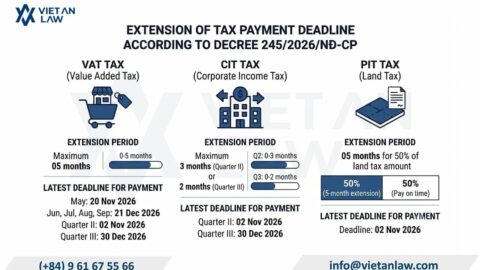
On November 26, 2024, the National Assembly officially passed the 2024 Law on Value-Added Tax (VAT), effective from July 1, 2025. The 2024 VAT Law was subsequently amended and supplemented twice: first by Law No. 90/2025/QH15, effective July 1, 2025, and second by the Law amending and supplementing several articles of the Law on VAT, effective January 1, 2026. Below, Viet An Law provides the new highlights of the Compliance with VAT Law Amendments 2025 in Vietnam.
Law No. 90/2025/QH15 supplemented Point a, Clause 1, Article 9 of the 2024 VAT Law regarding the subjects entitled to the 0% tax rate for exported goods, including:
This regulation reflects the destination principle of taxation, whereby goods consumed outside Vietnamese territory or within non-tariff zones for export purposes do not bear the VAT burden in Vietnam. This ensures consistency in tax policy and encourages export activities amidst international economic integration.
Previously, Clause 25, Article 5 of the 2024 Law on VAT stipulated:
“Article 5. Non-taxable subjects
25. Goods and services of household and individual businesses with an annual revenue of 200 million VND or less.”
Simultaneously, Clause 2, Article 18 of the 2024 Law on VAT provided: “Regulations on the revenue threshold of household and individual businesses as non-taxable subjects under Clause 25, Article 5, and Article 17 of this Law shall take effect from January 1, 2026.”
Under this provision, household and individual businesses with an annual revenue of 200 million VND or less were exempt from VAT.
However, on December 10, 2025, the National Assembly passed the 2025 Amended Law on Personal Income Tax. Accordingly, from January 1, 2026, the tax-exempt revenue threshold for household and individual businesses was adjusted from 200 million VND/year to 500 million VND/year, allowing this amount to be deducted before calculating tax based on a percentage of revenue. Simultaneously, the VAT-exempt revenue threshold was adjusted correspondingly to 500 million VND.
Thus, under this new regulation, from January 1, 2026, household and individual businesses must have a revenue exceeding 500 million VND/year (averaging 41.6 million VND/month) to be liable for VAT.
Nevertheless, household and individual businesses with revenue below 500 million VND/year, while exempt from tax, are still required to perform revenue declarations for the year 2026 no later than January 31, 2027.
One of the key highlights of the VAT Law Amendments 2025 is the amendment and supplementation of regulations regarding crop, forest, livestock, and farmed or caught aquatic products categorized as non-taxable subjects under Clause 1, Article 5 of the 2024 Law on Value-Added Tax, as follows:
“Article 1. Amending and supplementing several articles of the Law on Value-Added Tax
1. To amend and supplement Clause 1, Article 5 as follows:
“1. Crop, forest, livestock, and farmed or caught aquatic products that have not been processed into other products or have only undergone ordinary primary processing, sold by the producing or catching organizations/individuals themselves, and at the import stage.
Enterprises and cooperatives purchasing crop, forest, livestock, or farmed/caught aquatic products that have not been processed into other products or have only undergone ordinary primary processing for resale to other enterprises or cooperatives shall not be required to declare or pay Value-Added Tax, but shall be entitled to input Value-Added Tax deductions.”
Accordingly, the scope of non-taxable subjects continues to include products that are:
The critical new point is the supplementation of specific regulations for cases where enterprises or cooperatives purchase the aforementioned products for resale to other enterprises or cooperatives, whereby:
Previously, the application of VAT exemption for agricultural products was primarily linked to the direct production stage. When intermediary enterprises engaged in trading, complications arose: some localities required output VAT declaration, while others treated the entire chain as non-taxable, leading to the loss of input tax deductions and increased costs for businesses.
The new regulation clearly distinguishes that while the goods remain essentially non-taxable, a mechanism of no declaration or payment applies to transactions between enterprises and cooperatives, while simultaneously allowing for input tax deductions.
This approach prevents “disruption” in the deduction chain within the production and distribution cycle, creating a specialized tax mechanism for the agricultural, forestry, and fishery supply chains.
The VAT Law Amendments 2025 has amended and supplemented Clause 5, Article 9 as follows:
“5. Scraps, byproducts, and waste recovered for recycling and reuse, when sold, shall be subject to the tax rate applicable to the specific type of scraps, byproducts, or waste being sold.”
Accordingly, the new regulation has removed the provision stating that crop, forest, livestock, and farmed or caught aquatic products that have not been processed into other products or have only undergone ordinary primary processing and are used as animal feed or medicinal ingredients shall be subject to the VAT rate prescribed for the original crop, forest, livestock, or aquatic products.
Thus, the new regulation ensures policy transparency, encouraging the recovery and reuse of scraps, byproducts from agricultural products. This creates momentum for the development of a circular economy in the agricultural sector, thereby contributing to the reduction of negative environmental impacts.
Previously, Clause 9, Article 15 of the 2024 Law on VAT stipulated that business establishments eligible for tax refunds must satisfy the following conditions:
However, the new provision in the VAT Law Amendments 2025 has abolished the condition regarding “The seller must have declared and paid VAT as regulated for the invoices issued to the business establishment requesting the refund.” Consequently, VAT refunds are no longer contingent upon whether the seller has declared or paid VAT on the input invoices of the business establishment seeking the refund.
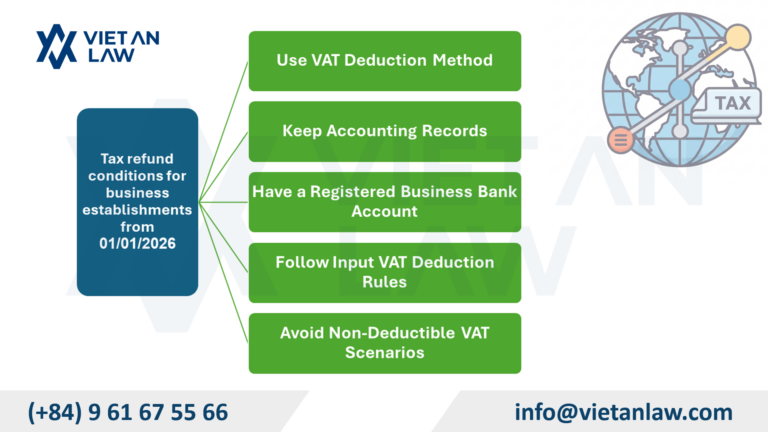
Tax refund conditions for business establishments from January 1, 2026
The abolition of this regulation contributes to shortening the tax refund processing time for businesses, ensuring that the respective responsibilities and rights of buyers and sellers are treated separately. Tax refunds will be implemented consistently in accordance with the Law on Tax Administration, ensuring efficiency and rigor.
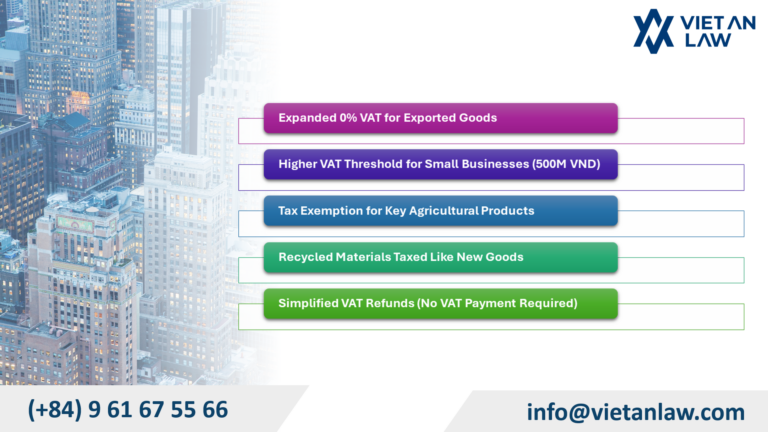
Based on the aforementioned analysis, the key highlights of the VAT Law Amendments 2025 are as follows:
It is evident that the 2025 amendment to the Law on Value-Added Tax represents a significant step in VAT reform, adopting a taxpayer-centric approach while enhancing the efficiency of state tax management.
The above is an update on the new highlights of the Compliance with VAT Law Amendments 2025 in Vietnam. Should you have any related inquiries or require tax and accounting consultancy, please contact our Tax Agent – Viet An Law Firm for the best advice and support!