Decree No. 167/2025/ND-CP was promulgated to amend and supplement regulations concerning customs procedures; customs inspection, supervision, and control, in the context where state management requirements in the customs sector increasingly demand higher levels of transparency, efficiency, and alignment with international practices. The issuance of the Decree not only aims to address shortcomings and difficulties arising during the implementation of the existing regulations but also contributes to improving the legal framework, facilitating import and export activities, and enhancing the effectiveness and efficiency of customs authorities’ management. In the article below, Viet An Law Firm provides information on Customs Reform: Decree 167/2025 Amends Inspection Rules in Vietnam, as well as the key new points of this Decree compared to the previous Decree.
On 30 June 2025, the Government promulgated Decree 167/2025/ND-CP amending regulations on customs procedures; customs inspection, supervision, and control. The Decree consists of four articles and takes effect from 15/08/2025. This is an important legal instrument that contributes to further completing the legal framework in the field of customs. At the same time, the Decree is expected to provide stronger support for import and export activities and bring about significant improvements in customs administration.
Pursuant to Decree No. 167/2025/ND-CP, as of 15/08/2025, on-the-spot exported and imported goods are those prescribed in Clause 1, Article 47a of the Law on Customs, which was supplemented by Clause 3, Article 3 of the Law amending and supplementing several articles of the Law on Bidding; the Law on Investment under the public–private partnership (PPP) model; the Law on Customs; the Law on Value-Added Tax; the Law on Export and Import Duties; the Law on Investment; the Law on Public Investment; and the Law on Management and Use of Public Property, including:
Accordingly, compared with Decree No. 08/2015/ND-CP, Decree No. 167/2025/ND-CP abolishes the condition that foreign traders must have “no presence in Vietnam” in transactions involving the purchase and sale of goods between Vietnamese enterprises and foreign organizations or individuals. In addition, this Decree repeals the regulations governing goods traded between domestic enterprises and export processing enterprises or enterprises located in non-tariff zones.
These new provisions provide greater clarity and convenience for enterprises in the application of regulations on on-the-spot exports and imports.
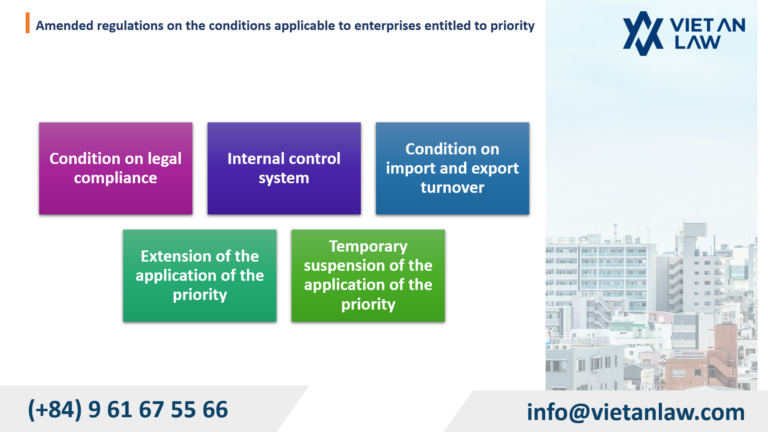
Condition on legal compliance
The Decree provides that an enterprise must not violate tax and customs laws to the extent of being subject to penalties for the following acts:
In addition, the Decree clarifies the provisions applicable where an enterprise applies for the priority. Specifically, the period for assessing compliance with laws is 24 consecutive months up to the date of submission of the application dossier.
Internal control system
While Decree No. 08/2015/ND-CP only required enterprises to implement and maintain systems and procedures for management, supervision and operational control throughout their entire export and import supply chains, Decree No. 167/2025/ND-CP supplements detailed provisions on the internal control system, specifically:
This represents a significant change compared to the previous regulations, as it establishes a clear and specific legal basis for the requirements on internal control systems. These provisions not only remedy the previous ambiguity in the legal framework but also enable enterprises to properly prepare, organize and operate internal control systems to fully satisfy statutory requirements, thereby enhancing compliance and transparency in management activities.
Condition on import and export turnover
In principle, the conditions on import and export turnover applicable to exporting and importing enterprises, enterprises exporting goods manufactured in Vietnam, and enterprises exporting agricultural and aquatic products produced or cultivated in Vietnam remain unchanged from Decree No. 08/2015/ND-CP. However, the conditions on import and export turnover applicable to customs brokerage agents have been abolished.
Extension of the application of the priority
Instead of automatic extension as previously applied, the new Decree provides that the Customs Department shall, based on collected information and management results, conduct an assessment to decide on the extension of the application of the priority regime for an enterprise. Where there is insufficient information to independently assess whether the enterprise continues to satisfy the conditions for the application of the priority regime, the Customs Department shall carry out an on-site appraisal or a post-clearance audit at the premises of the customs declarant.
Temporary suspension of the application of the priority
Where an enterprise fails to fulfill its obligations as prescribed in Article 45 of the Law on Customs after being notified by the customs, the Director of the Customs Department shall issue a decision to temporarily suspend the application of the priority regime for a period of 90 days from the date of issuance of such decision. Accordingly, the period of temporary suspension of the priority regime has been extended to 90 days, instead of 60 days as provided under the previous regulations.
Customs valuation is one of the most important factors in determining tax obligations for exported and imported goods. Decree No. 167/2025/ND-CP provides clearer and more detailed regulations on methods for determining customs value. Specifically, the Decree amends and supplements Clause 1 and Clause 2 of Article 20 as follows:
Decree No. 167/2025/ND-CP also supplements regulations on customs value used for statistical purposes for exported and imported goods.
The above constitutes the basic legal information on Customs Reform: Decree 167/2025 Amends Inspection Rules in Vietnam. Should you require further consultation or assistance, please contact Viet An Law Firm for the best possible support.