(+84) 9 61 67 55 66
info@vietanlaw.vn

Calculating Business Household Tax in Vietnam 2026

(Declaration vs. Lump-Sum)

As of January 1, 2026, Business Households will officially transition from the presumptive tax method to the declaration and self-payment method. This is considered an important step in tax administration, aimed at clarifying financial obligations, increasing autonomy for Business Households, and aligning with the modernization trend of the tax sector. Thus, how is the Calculating Business Household Tax in Vietnam 2026 implemented? Below, Viet An Law will provide detailed consultation and guidance on this issue.

Table of contents

Hide

    Abolishing the presumptive tax regime for Business Households from January 1, 2026

    On May 4, 2025, the Politburo issued Resolution 68-NQ/TW on private economic development, in which one of the proposed solutions is “Abolishing the presumptive tax form for Business Households by 2026 at the latest“.

    To implement Resolution 68-NQ/TW, the National Assembly issued Resolution 198/2025/QH15 on May 17, 2025, regarding several special mechanisms and policies to develop the private economy. This Resolution applies to enterprises, Business Households, business individuals, and other relevant organizations and individuals. Specifically, Clause 6, Article 10 of Resolution 198/2025/QH15 stipulates as follows: “…6. Business Households and business individuals shall not apply the tax presumption method from January 1, 2026. Business Households and business individuals shall pay tax in accordance with the law on tax administration.”

    Previously, Business Households could pay tax under the declaration method and the presumptive method. However, the presumptive method revealed many drawbacks such as:

    • Not encouraging revenue transparency: Business Households may declare lower than actual revenue to reduce the presumptive tax rate;
    • Causing difficulties for Tax Authorities in controlling revenue, easily leading to budget revenue loss;
    • Creating inequality among Business Households: there may be Business Households with actual revenue much higher than the presumptive level but still paying less tax than Business Households with lower actual revenue who are imposed a high presumptive level.

    Therefore, from January 1, 2026, the presumptive tax regime for Business Households is officially abolished. The elimination of the presumptive tax regime is expected to create a “revolution” in tax administration, contributing to ensuring transparency of income and expenses, ensuring fair tax obligations with other types of business, and avoiding tax loss.

    From January 1, 2026, Business Households only have to pay VAT and PIT

    Before 2026, Business Households would pay 03 types of taxes and fees when operating, including:

    • Value Added Tax (VAT);
    • Personal Income Tax (PIT);
    • Licensing fees.

    However, Article 10 of Resolution 198/2025/QH15 officially abolished licensing fees from January 1, 2026. Therefore, from 2026, Business Households only have to pay 02 types of taxes and fees: VAT and PIT.

    Besides, in Table 2 issued together with Decision 3389/QĐ-BTC in 2025, the General Department of Taxation proposed a management model for Business Households based on revenue and tax rates of each tax type (or revenue thresholds and tax rates of each tax category), including 03 groups following:

    • Group 1: Revenue of VND 200 million or less;
    • Group 2: Revenue over VND 200 million to VND 3 billion;
    • Group 3: Revenue over VND 3 billion.

    After promulgation, according to the proposal and practical income of current Business Households, the Government and the Ministry of Finance proposed in Official Dispatch 18491/BTC-CST in 2025 to adjust and raise the non-taxable revenue threshold for PIT from VND 200 million/year to VND 500 million/year. Simultaneously, this level of VND 500 million/year is also the deductible level before paying tax based on the percentage of revenue.

    Thus, after the proposal in Official Dispatch 18491/BTC-CST in 2025 is approved to amend Decision 3389/QĐ-BTC in 2025 of the General Department of Taxation, the tax payment responsibility of Business Households in 2026 will be implemented specifically as follows:
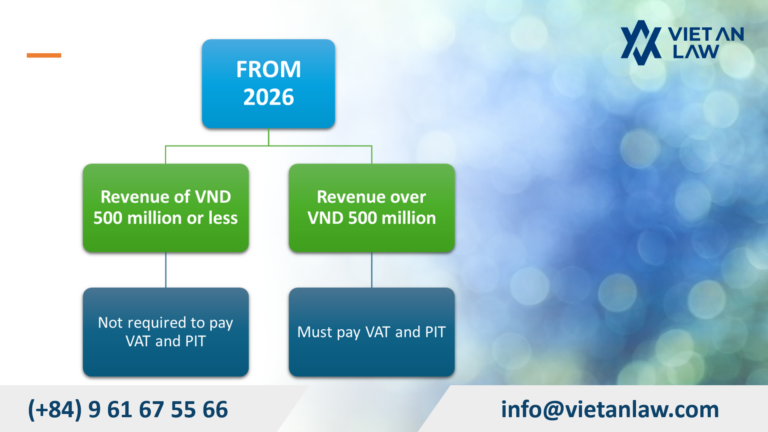
    • For the group of Business Households with revenue of VND 500 million or less, they are not required to pay VAT and PIT.
    • For the group of Business Households with revenue over VND 500 million, they must pay VAT and PIT.

    From 2026, business households will only have to pay two types of taxes and fees VAT and PIT

    Calculating Business Household Tax in Vietnam 2026

    According to Table 2 of the tax management model for business households and individuals in the Project accompanying Decision 3389/QĐ-BTC in 2025, there is guidance on the detailed calculation when moving from presumptive tax to declaration and self-payment for 03 groups of Business Households.

    Accordingly, the detailed calculating business household tax in Vietnam 2026 is as follows:
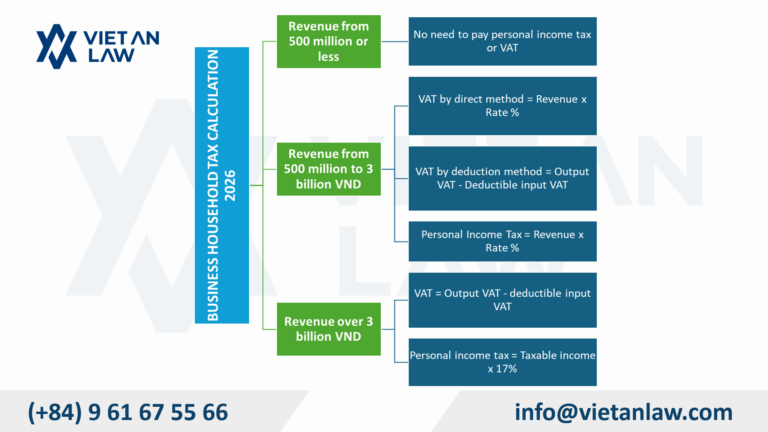
    How to calculate business household tax from 2026

    Calculating Business Household Tax in Vietnam 2026

    Revenue from 500 million VND or less

    Not required to pay Value Added Tax or Personal Income Tax.

    Revenue over 500 million VND to 3 billion VND

    For Business Households and business individuals with revenue from over VND 500 million to under or equal to VND 3 billion/year, it is mandatory to pay tax under the direct method based on % of revenue, and they may voluntarily register for the credit method if eligible. Accordingly:

    • VAT payable under direct method based on % of revenue: Revenue x % Rate;
    • VAT payable under credit method: Output VAT – Creditable input VAT.
    • PIT payable: Revenue x % Rate (Calculated by % rate on revenue according to each business line).

    Different business lines will have different % rates according to Appendix I attached to Circular 40/2021/TT-BTC as follows:

    Sector VAT Rate PIT Rate
    Commercial sector, sales of goods 1% 0.5%
    Service sector, construction excluding materials 5% 2%
    Production sector, services attached to goods, transport, construction including materials 3% 1.5%
    Service sector, production of products subject to 5% VAT rate under credit method and other sectors not belonging to the above groups 2% 1%

    Example: A small grocery Business Household has a revenue of VND 700 million/year. The tax calculation is as follows:

    • VAT: VND 700 million x 1% = VND 7 million
    • PIT: VND 700 million x 0.5% = VND 3.5 million

    Thus, the total tax the grocery Business Household must pay in 2026 is VND 10.5 million.

    Revenue over 3 billion VND

    This is the group applying the credit method, managed similarly to micro or small enterprises. In which the Business Household will pay tax as follows:

    • VAT payable: Output VAT – Creditable input VAT.
    • PIT payable: Taxable income x 17%, where taxable income = Revenue – Reasonable expenses.

    Example: Mechanical Joint Stock Company A has a revenue of VND 4 billion/year, and reasonable expenses that can be proven are VND 3.5 billion. The tax calculation is as follows:

    • VAT calculated by credit method: Assuming the mechanical industry applies a 10% VAT rate.
    • Output VAT: 4 billion x 10% = VND 400 million. Input VAT is, for example, VND 250 million from purchasing materials. VAT payable = 400 – 250 = VND 150 million.
    • PIT: Calculation of PIT = Revenue – Expenses = 4 billion – 3.5 billion = VND 500 million. Expected tax rate 17%. PIT: 500 million x 17% = VND 85 million.

    Thus, Company A must pay VND 150 million of VAT and VND 85 million of PIT. The total tax payable in 2026 is VND 235 million.

    Some notes when switching from the presumptive tax regime to declaration and self-payment

    Responsibility to declare revenue

    • Revenue of 500 million or less: Not required to pay tax but still must declare 2 times/year (beginning/middle of the year and end of the year) to determine tax obligations.
    • Revenue over 500 million to 3 billion: Declare quarterly (4 times/year) + annual settlement.
    • Revenue over 3 billion: Declare monthly (if annual revenue is over 50 billion) or quarterly, annual settlement.

    Use of electronic invoices

    • Revenue of 500 million or less: Encouraged to use e-invoices with codes (in transactions with consumers).
    • Revenue over 500 million to 3 billion: Mandatory to use e-invoices generated from cash registers if revenue is under 1 billion and there are business activities of selling goods and providing services directly to consumers.
    • Revenue over 3 billion: Mandatory to use e-invoices with codes or e-invoices generated from cash registers.

    Accounting books

    • Revenue of 500 million or less: Simple recording (supported by simple free software).
    • Revenue over 500 million to 3 billion: Simple accounting books, free software.
    • Revenue over 3 billion: Mandatory to follow the accounting regime of micro-enterprises or medium-sized enterprises.

    Opening bank accounts

    • Revenue of 500 million or less: Not mandatory.
    • Revenue over 500 million to 3 billion: Mandatory to open a separate account serving business.
    • Revenue over 3 billion: Mandatory to open a separate account serving business.

    Conversion of tax calculation method

    • Revenue of 500 million or less: Not applicable.
    • Revenue over 500 million to 3 billion: If revenue is over 3 billion for 2 consecutive years, apply as Group 3 from the following year.
    • Revenue over 3 billion: Apply as an enterprise, allowed to deduct input VAT from the first period.

    Business via e-commerce platforms

    If the platform has a payment function:

    • The platform deducts, declares, and pays VAT and PIT on behalf based on the % rate on revenue.
    • If the final annual revenue is under 500 million, the overpaid tax paid on behalf will be handled for a refund.

    If the platform does not have a payment function, Individuals must self-declare and pay tax upon each occurrence, monthly or quarterly.

    The above is the consultation on Calculating Business Household Tax in Vietnam 2026. If customers have related questions or need advice on tax and accounting, please contact the Tax Agent – Viet An Law Firm for the best advice and support!
    Related Acticle

    Compliance with VAT Law Amendments 2025 in Vietnam

    Compliance with VAT Law Amendments 2025 in Vietnam

    Compliance with VAT Law Amendments 2025 in Vietnam: Key changes including 0% export rates, 500M VND threshold for businesses, agricultural exemptions, and simplified tax refunds effective July 2025.
    Procedures for setting up a company in the Netherlands

    Procedures for setting up a company in the Netherlands

    Setting up a company in Netherlands made simple. Complete guide to business registration procedures, KVK registration, tax ID, and legal requirements for 2025.
    Cashless Business: Mandatory Digital Payments Starting Dec 15 in Vietnam

    Cashless Business: Mandatory Digital Payments Starting Dec 15 in Vietnam

    Cashless Business rules in Vietnam: Mandatory digital payments starting Dec 15, 2025 for transactions ≥5M VND. New CIT deduction requirements under Decree 320/2025.
    Mandatory Bank Transfers: New Salary Payment Rules in Vietnam

    Mandatory Bank Transfers: New Salary Payment Rules in Vietnam

    Mandatory bank transfers for salary payments in Vietnam from Dec 15, 2025. Learn new corporate income tax deduction rules for salaries exceeding 5 million VND.
    Legal Shift: Abolishing 38 Conditional Business Lines in Vietnam 2026

    Legal Shift: Abolishing 38 Conditional Business Lines in Vietnam 2026

    Vietnam abolishes 38 conditional business lines from July 2026 under new Investment Law. Learn about deregulation, prohibited sectors, and business impacts.

    CONTACT VIET AN LAW

    In Hanoi: (+84) 9 61 67 55 66
    (Zalo, Viber, Whatsapp, Wechat)

    WhatsApp Chat

    whatsapp-1

    In Hochiminh: (+84) 9 61 67 55 66
    (Zalo, Viber, Whatsapp, Wechat)

    WhatsApp Chat

    whatsapp-1

    ASSOCIATE MEMBERSHIP