Currently, Vietnam has over 5.2 million business households, with total state budget revenue from this group estimated at approximately 26,000 billion VND in 2024. From 2026, business households will switch to paying taxes using the declaration method instead of the lump-sum tax. Simultaneously, many new tax policy regulations will be applied to business households. Viet An Law has received many questions regarding how taxes for business households will be calculated under the new regulations. Below, Viet An Law will provide detailed advice on new 2026 rules for household enterprises tax in Vietnam.
Tax management has traditionally involved the majority of business households paying taxes using a lump-sum method, meaning the Tax Authority sets a fixed revenue level for the entire year, and the business household pays taxes based on this lump-sum amount.
On May 4, 2025, the Politburo issued Resolution 68-NQ/TW on the development of the private economy, in which one of the proposed solutions is to “Abolish the lump-sum tax method for business households no later than 2026”. At the same time, Clause 6, Article 10 of Resolution 198/2025/QH15 stipulates as follows: “…6. Business households and individual businesses shall not apply the lump-sum tax method from January 1, 2026. Business households and individual businesses shall pay taxes according to the law on tax administration.”
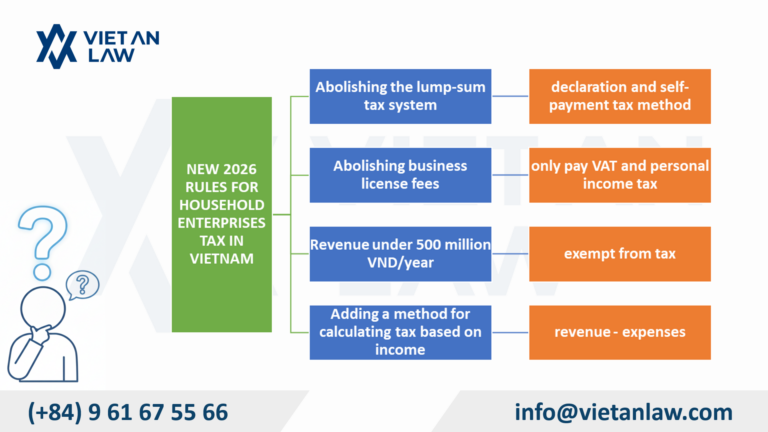
Therefore, for business households, the lump-sum tax method will be abolished, and the declaration method will be applied entirely from January 1, 2026.
Before 2026, business households will pay three types of taxes and fees when conducting business, including:
However, Article 10 of Resolution 198/2025/QH15 officially abolished the business license fee from January 1, 2026. Therefore, from 2026 onwards, business households will only have to pay two types of taxes and fees: VAT and personal income tax.
Previously, according to Clause 2, Article 4 of Circular 40/2021/TT-BTC, business households and individuals business with revenue from production and business activities in a calendar year of 100 million VND or less were exempt from paying personal income tax and value-added tax.
At the same time, according to Clause 2, Article 18 of the Value-added Tax Law 2024, from January 1, 2026, business households with revenue of 200 million VND/year or more must pay personal income tax and value added tax.
However, according to the new regulations of the amended Law on Personal Income Tax 2025, passed on December 10, 2025, from January 1, 2026:
This is a significant change from the current regulation of 100 million VND, helping to reduce the tax burden for small households and individuals. According to tax authorities’ estimates, the total amount of tax reduction for households and individuals is approximately 11,800 billion VND per year.
A notable point of the Law on Personal Income Tax 2025 is the addition of a method for calculating tax based on income (revenue – expenses), meaning taxing the profit portion for households and individuals engaged in business with annual revenue exceeding 500 million VND up to 3 billion VND.
A tax rate of 15%, similar to the corporate income tax rate, will be applied to businesses with annual revenue below 3 billion VND. Furthermore, these individuals will be allowed to choose between a percentage-based tax calculation method based on revenue or based on total income.
According to the new regulation stipulating that only business households with annual revenue of 500 million VND or more are required to pay taxes, the tax calculation method for business households from January 1, 2026, will be divided into groups based on revenue for tax calculation purposes as follows:
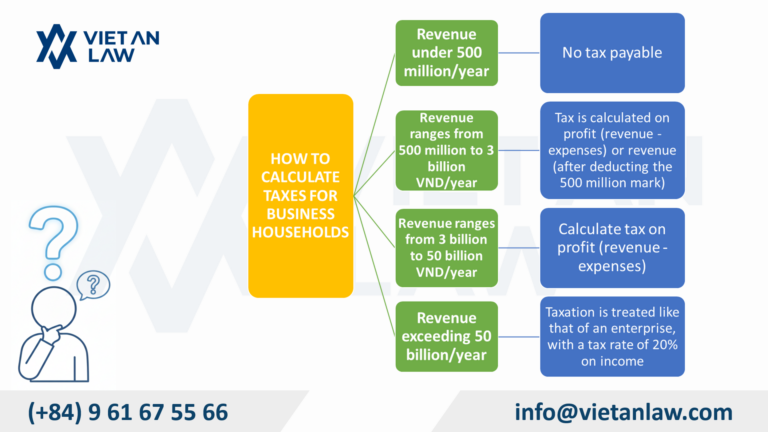
If a business household has revenue under 500 million VND/year, it is not required to pay VAT and personal income tax. However, the business household must still declare taxes fully according to regulations, specifically:
In cases where business households or individual business owners determine their annual revenue from the production and sale of goods and services to be 500 million VND or less, they must notify the tax authorities of their actual revenue generated during the year no later than January 31st of each year.
The commonly used declaration forms for business households, as stipulated in the Appendix attached to Circular 40/2021/TT-BTC, include:
Business households with annual revenue ranging from 500 million to 3 billion VND must pay VAT and personal income tax with two options:
VAT:
Personal Income Tax: Personal Income Tax = (Revenue – Expenses) x 15%
This option is for small business households that lack the necessary accounting capabilities and electronic invoicing infrastructure, and therefore cannot determine input costs:
VAT: VAT payable = Revenue x Percentage Rate
Accordingly, the percentage rate for calculating value-added tax is stipulated as follows:
Personal Income Tax: Personal income tax payable = (Revenue – 500 million) x Percentage Rate
Revenue is the total amount of sales, processing fees, commissions, and service fees generated during the tax period from the production and business activities of goods and services. If an individual business cannot determine its revenue, the competent tax authority may determine it in accordance with the law on tax administration.
The tax rates are stipulated as follows:
Business households with annual revenue between 3 billion and 50 billion VND must calculate tax on profit (revenue – expenses) at the same tax rate as enterprises with equivalent revenue. They are not allowed to choose to calculate tax based on revenue.
Business households in this group will be taxed similarly to enterprises at a rate of 20% on income, and will be guided by the tax authorities to convert to enterprises to enjoy incentives, including:
The above is advice on the new 2026 rules for household enterprise tax in Vietnam. If you have any related questions or require tax or accounting advice, please contact Viet An Law – Tax Agency for the best consultation and support!