India, with its dynamic economy and vast market, is becoming an attractive destination for international businesses looking to expand their operations. However, in order to invest effectively in this market, it is extremely important to understand the types of companies that are allowed to be set up in India. Viet An Law would like to introduce some information about the common legal forms that foreign businesses can choose when showing a commercial presence in India.
Types of companies that can be set up in India
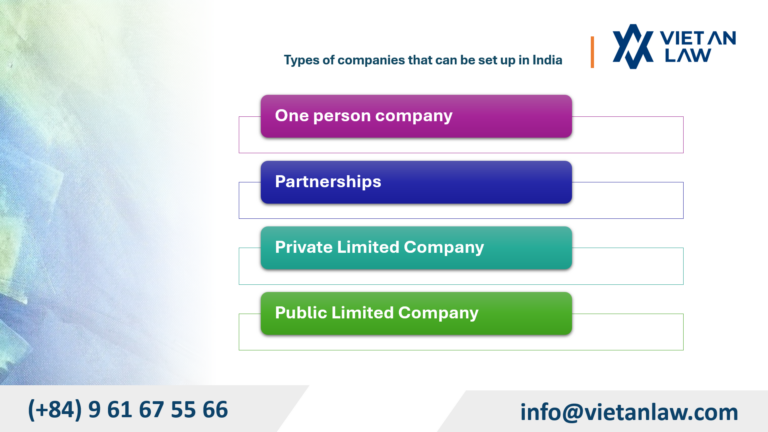
One person company
An OPC is a type of company in which only one person is a member. In India, the form of a Single Member Company is regulated in the Companies Act 2013. OPC is a type of company in which only one individual acts as a member, and is also the manager and operator of the company. This allows a single individual to take complete control of the business without having to share decision-making power with anyone else.
OPC Highlights
- Absolute Control: As a sole member, you have full control over all matters related to the company, from business strategy to day-to-day operations.
- Limited Liability: This is one of the most important benefits of OPC. Your liability for corporate debts is limited to the amount of capital you have contributed. This helps protect your personal assets from potential risks in business.
- Successor: To ensure continuity in the company’s operations, the OPC requires a successor. This person will replace you and become a member of the company in the event of your death or loss of civil act capacity.
Who is OPC suitable for?
OPC is particularly suitable for:
- Independent entrepreneurs want to start and run their own businesses.
- Professionals, consultants, or freelancers who want to legitimize their personal business.
- Small businesses want to take advantage of the benefits of limited liability without having to share ownership with others.
Some limitations to note
- Limited ability to raise capital: Due to the fact that there is only one member, raising capital from outside investors can be more difficult than other types of companies.
- Management pressure: You will be responsible for the entire operation of the company, which requires effort and effective time management.
Partnerships
In India, the form of Partnership Firm is a popular choice for individuals who want to do business together and share the profits together. This is a flexible way to combine the resources, knowledge and experience of many people, creating synergy for the business.
Types of Partnerships
Indian law provides for two main types of Partnerships:
- General Partnership: This is the traditional form in which all partners jointly manage and run the company, and are liable for unlimited liability for the company’s debts and obligations.
- Limited Liability Partnership (LLP): This is the more preferred form in India today, as it combines the advantages of both a regular Partnership and a Limited Liability Company. In an LLP, each partner’s liability is limited to the extent of their capital contribution to the company, which helps protect personal assets from business risks. LLPs also offer flexibility in management and operations, similar to regular Partnerships.
Key features of a Partnership
- Profit and Loss Sharing: Profits and losses are divided among the partners according to the ratio agreed in the Partnership.
- Number of partners: As a rule, the number of partners in a regular Partnership is a minimum of two and a maximum of 50. However, for LLPs, there is no limit to the number of partners.
- No separate legal entity (for ordinary partnerships): A common partnership is not considered a separate legal entity from the partners. Meanwhile, LLPs have separate legal status.
Private Limited Company
In India, a Private Limited Company (PLC) is one of the most popular forms of legal form for businesses, especially small and medium-sized enterprises, as well as foreign subsidiaries.
Basic Requirements for Establishing a PLC in India
To set up a PLC in India, you need to meet the following minimum requirements:
- Number of Directors: A minimum of 2 Directors is required. One of these Directors is required to be an Indian citizen and reside in India. This is an important point to note for foreign investors.
- Number of Shareholders: A minimum of 2 Shareholders is required. Directors may also be Shareholders.
- Registered Office: The company must have a registered office in India.
Especially important for foreign investors
- 100% Permitted Foreign Direct Investment (FDI): One of the most attractive aspects of establishing a PLC in India is that the government allows 100% foreign direct investment (FDI) in most sectors. This facilitates foreign investors who want to set up subsidiaries or expand their business in India Degree.
- No restriction on foreign shareholding: There is no limit to the percentage of foreign investors’ shareholdings in a PLC. This means that foreign investors can own the entire company. For this reason, the majority of foreign subsidiaries in India are established in the form of PLCs.
Public Limited Company
The registration of a Public Limited Company in India has many similarities with the registration of a Private Limited Liability Company (PLC). However, the key and most important difference lies in the ability to raise capital. Specifically, Public Limited Companies are allowed to list and trade their shares on the stock market, opening up access to vast capital from the public.
Key Differences
Unlike a Private Limited Liability Company, which is only contributed by a limited number of shareholders (usually relatives, friends or private investors), a Public Limited Company can issue shares to the public (Initial Public Offering (IPO) to raise capital from anyone interested in investing in the company. Therefore, the transfer of shares between members of a Public Limited Company takes place easily and flexibly through the stock market.