(+84) 9 61 67 55 66
info@vietanlaw.vn

Circular 27/2025/TT-NHNN: New Era for Anti-Money Laundering in Vietnam

On September 15, 2025, the State Bank of Vietnam issued Circular No. 27/2025/TT-NHNN guiding the implementation of a number of articles of the Law on Anti-Money Laundering 2022. This Circular takes effect from November 1, 2025, replacing and expanding the provisions of Circular No. 09/2023/TT-NHNN. Circular No. 27/2025/TT-NHNN marks an important step forward in legalizing and technicalizing anti-money laundering work in Vietnam. This Circular not only expands the scope of transaction monitoring and raises risk management standards, but also creates major challenges for banks, businesses and management agencies in the process of practical implementation. Below, Luat Viet An will clarify the notable content of Circular 27/2025/TT-NHNN: New Era for Anti-Money Laundering in Vietnam.
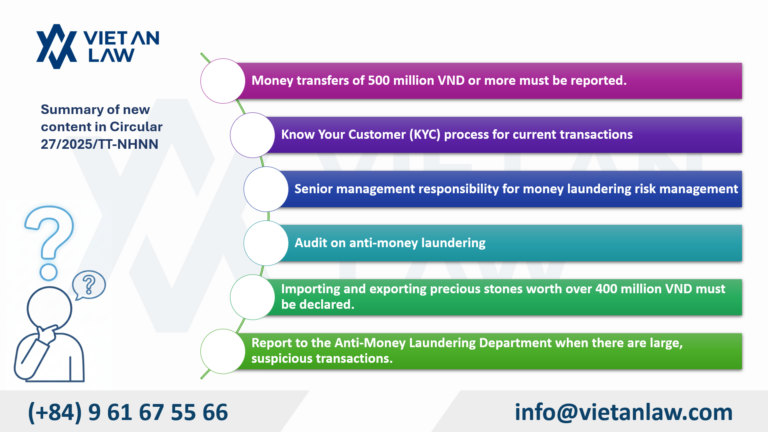
Table of contents

Hide

    Summary of new points in Circular 27/2025/TT-NHNN: new era for anti-money laundering in Vietnam

    Summary of new content in Circular 272025TT-NHNN

    Circular 27/2025/TT-NHNN has made major changes in anti-money laundering in Vietnam, especially some notable new contents such as:

    • Transfers of 500 million VND or more must be reported to the Anti-Money Laundering Department;
    • Regulations on customer identification (KYC) procedures for current transactions;
    • Regulations on senior management responsibilities in money laundering risk management;
    • Regulations on internal audit on anti-money laundering;
    • Importing and exporting precious stones worth over 400 million VND must be declared to customs;
    • Report to the Anti-Money Laundering Department when there are large, suspicious transactions;
    • Shorten the deadline for submitting internal regulations on anti-money laundering;…

    From November 1, 2025, money transfers of 500 million VND or more must be reported to the Anti-Money Laundering Department

    According to Point a, Clause 1, Article 9 of Circular 27/2025/TT-NHNN on reporting regime of electronic money transfer transactions as follows:

    Article 9. Reporting regime for electronic money transfer transactions

    … 1. The reporting entity is responsible for collecting information in Clause 3 of this Article and reporting to the Anti-Money Laundering Department using electronic data as prescribed in Clause 1, Article 10 of this Circular when conducting electronic money transfer transactions in the following cases:

    …a) Electronic money transfer transactions in which all financial institutions participating in electronic money transfer transactions specified in Clause 1, Article 8 of this Circular are located in Vietnam (hereinafter referred to as domestic electronic money transfer transactions) have an electronic money transfer transaction value of 500,000,000 (five hundred million) VND or more or in foreign currency with equivalent value;

    …b) Electronic money transfer transactions in which at least one of the financial institutions participating in the electronic money transfer transaction specified in Clause 1, Article 8 of this Circular in countries and territories outside Vietnam (hereinafter referred to as international electronic money transfer transactions) have an electronic money transfer transaction value of 1,000 (one thousand) US dollars or more or in other foreign currencies of equivalent value.”

    Accordingly, entities must report when money transfer transactions involving domestic organizations have a value of VND500 million or more or equivalent foreign currency. For international transactions, the reporting threshold applies when electronic money transfer transactions have a value of USD1,000 or more.

    The report must include complete information about the initiating and beneficiary organizations, the sender and the recipient, and details of the account number, amount, currency, purpose and date of the transaction. The information must be submitted electronically, ensuring accuracy and timeliness as required by the regulatory agency.

    • In fact, the VND 500 million level for domestic electronic money transfer transactions that must be reported is not a new regulation in Circular 27/2025/TT-NHNN, but has been maintained since 2007 until now.
    • Since 2005, Decree 74/2005 of the Government on anti-money laundering has stipulated the transaction value that must be reported. Accordingly, cash transactions with a value of 200 million VND and savings deposit transactions with a value of 500 million VND (or equivalent value in foreign currency or gold) must be reported.
    • Subsequent documents such as the 2012 Law on Anti-Money Laundering, the 2022 Law on Anti-Money Laundering and guiding Circulars, including Circular No. 27/2025, continue to inherit and perfect legal regulations on electronic money transfer transactions and the reporting regime for electronic money transfer transactions to meet international standards of FATF (Financial Action Task Force on Anti-Money Laundering).
    • The threshold for reporting electronic funds transfers alone has remained unchanged since 2007.

    Circular No. 27/2025/TT-NHNN does not change the reporting value threshold but clarifies the responsibilities of electronic money transfer service providers in ensuring consistent and timely data and applying scanning and filtering technology to detect transactions with signs of risk.

    Regulations on Know Your Customer (KYC) procedures for current transactions

    • According to current regulations, financial institutions are obliged to carry out the KYC process even in cases where customers do not have an account or do not make regular transactions, if the total value of deposits, withdrawals or transfers in a day reaches VND 400 million or more.
    • Specifically, Article 6 of Circular No. 27/2025/TT-NHNN stipulates: Reporting entities must report large-value transactions according to Clause 1, Article 25 of the Law on Anti-Money Laundering 2022.
    • Notably, Circular No. 27/2025/TT-NHNN adds the following provision: Cash transactions conducted through automatic deposit and withdrawal machines or automatic transaction machines are also subject to reporting. In the case where a customer deposits large amounts of foreign currency in cash to buy Vietnamese Dong, or deposits large amounts of Vietnamese Dong in cash (from 400 million VND or more1) to buy foreign currency in cash, the financial institution only has to report the cash deposit transaction.

    Thus, compared with Circular No. 09/2023/TT-NHNN, this Circular only stipulates the obligation to report large-value transactions according to the form in Appendix I and does not mention transactions via deposit, withdrawal or automatic transaction machines, while Circular No. 27/2025/TT-NHNN has expanded the scope, covering transactions conducted through electronic transaction channels, contributing to tightening the anti-money laundering mechanism.

    Regulations on senior management responsibilities in money laundering risk management

    • According to Circular No. 27/2025/TT-NHNN, each organization must assign a senior manager or authorized person to be directly responsible for anti-money laundering work. This assignment is no longer a formality or general responsibility as before, but requires the organization, depending on its size, to establish a specialized department or appoint a specific individual.
    • Clause 9, Article 5 of this Circular stipulates that the assigned person called “person responsible for anti-money laundering” is responsible for organizing, directing and inspecting compliance with legal regulations on anti-money laundering within the scope of the organization.
    • This is an important new point, because for the first time, a sub-law document establishes the role of “senior manager” in the anti-money laundering mechanism, while the 2022 Law on Anti-Money Laundering has not yet provided a concept or regulations on this position.

    The new regulation shows the trend of increasing transparency and accountability in the money laundering risk management system, while creating a legal basis to link the direct responsibility of management levels with the effectiveness of anti-money laundering implementation at each organization.

    Regulations on internal audit on anti-money laundering in Vietnam

    Circular No. 27/2025/TT-NHNN stipulates that anti-money laundering content must be integrated into a separate part of the annual internal audit report. This report must be sent to the competent authority within 60 days from the end of the fiscal year. Specifically, according to Point c, Clause 10, Article 5 of the Circular stipulates:

    • Reporting entities in the monetary and banking sectors must send internal audit reports on anti-money laundering to the Anti-Money Laundering Department, State Bank of Vietnam;
    • Reporting entities operating in other fields must submit reports to the ministries and branches of state management according to the field;
    • In cases where the reporting entity is not required to conduct annual internal audits as required by law, anti-money laundering reports must still be prepared and submitted to the competent authority for the audited years.

    This regulation demonstrates an effort to tighten internal control responsibilities in anti-money laundering work, while ensuring that state management agencies have a regular, complete and systematic source of information to assess the compliance effectiveness of organizations.

    Importing and exporting precious stones worth over 400 million VND must be declared to customs

    According to Article 11 of Circular No. 27/2025/TT-NHNN, individuals when exiting or entering the country carrying foreign currency in cash, Vietnamese Dong in cash, precious metals, gemstones or negotiable instruments with a value of 400 million VND or more must make a customs declaration and present documents as prescribed.

    In which: Precious metals (except gold) include silver, platinum, silver or platinum handicrafts and jewelry, as well as alloys containing silver and platinum; precious stones include diamonds, rubies, sapphires, and emeralds; negotiable instruments with a value of VND 400 million or more.

    This regulation both ensures transparency in circulation and contributes to controlling the risks of money laundering and cross-border terrorist financing.

    Report to the Anti-Money Laundering Department when there are large, suspicious transactions.

    When detecting a transaction of large value or suspicious signs, the reporting entity must report to the Anti-Money Laundering Department according to Article 6 and Article 7 of Circular No. 27/2025/TT-NHNN. The Anti-Money Laundering Department is the competent authority to receive reports on large-value transactions and suspicious transactions. Accordingly:

    • A large value transaction is a transaction of 400 million VND or more in one day, according to the prescribed threshold.
    • Suspicious transactions are transactions related to money laundering or other crimes related to money laundering; terrorist financing; financing the proliferation of weapons of mass destruction as prescribed in Article 26 of the Law on Anti-Money Laundering.

    Shorten the deadline for submitting internal regulations on anti-money laundering

    The provisions of Circular No. 09/2023/TT-NHNN previously required that reporting entities must submit internal regulations on anti-money laundering within 30 days from the date of promulgation or amendment, supplementation or replacement of internal regulations on anti-money laundering to the agency performing the functions and tasks of anti-money laundering under the State Bank of Vietnam.

    However, from November 1, 2025, according to Circular No. 27/2025/TT-NHNN, this period has been shortened to only 10 days and the agency receiving internal regulations on anti-money laundering has also been changed as follows:
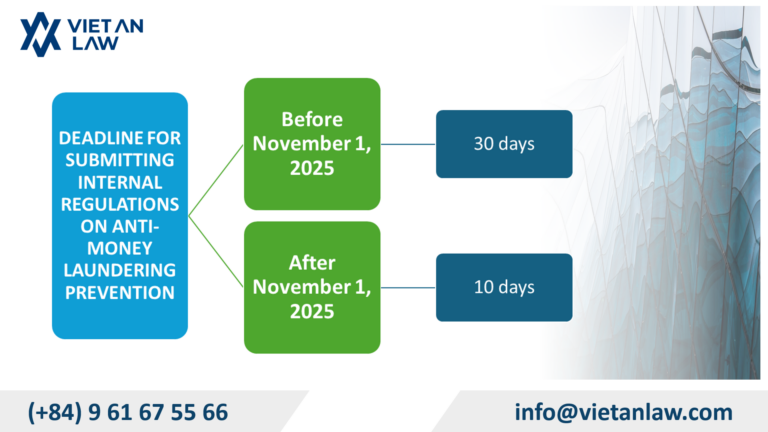
    • Anti-Money Laundering Department: Reporting subjects in the field of currency and banking;
    • Ministries and branches of state management by field: Other reporting subjects.

    Shorten the deadline for submitting internal regulations on anti-money laundering

    Assessing the significance and impact of Circular No. 27/2025/TT-NHNN: new era for anti-money laundering in Vietnam

    Circular No. 27/2025/TT-NHNN marks an important step forward in legalizing and technicalizing anti-money laundering work in Vietnam.

    • The issuance of this Circular marks an important step forward in perfecting the legal framework to improve the effectiveness of anti-money laundering work, preventing terrorist financing and other illegal activities through the financial system.
    • This is not only a legal duty but also Vietnam’s commitment to the international community, especially in the context of our country actively integrating deeply into the global economy and implementing Action No. 5 of the National Action Plan that Vietnam has committed to FATF.
    • By improving governance standards and monitoring mechanisms, Vietnam can reduce the risk of being placed on the greylist or blacklist, which are factors that potentially increase cross-border transaction costs and restrict international capital flows. In contrast, compliance with international standards helps strengthen the confidence of the global financial community, improve the international cooperation environment, and create favorable conditions to attract foreign investment.

    Above is the update of Circular 27/2025/TT-NHNN: new era for anti-money laundering in Vietnam. If you have any related questions or need advice on anti-money laundering regulations, please contact Luat Viet An for the best advice and support!
    Related Acticle

    Change business registration in Hoang Mai Ward, Hanoi City

    Change business registration in Hoang Mai Ward after administrative merger. Learn when updates are mandatory, required documents, fees, and online submission procedures for Hanoi businesses.
    Change business registration in Vinh Hung Ward, Hanoi City

    Change business registration in Vinh Hung Ward, Hanoi City

    According to the policy of arranging and consolidating the city’s administrative units, Vinh Hung ward has been established and operated under the new organizational structure after the merger. This event…
    Credit Card to E-Wallet in Vietnam: Why Transfers are Restricted from 2026

    Credit Card to E-Wallet in Vietnam: Why Transfers are Restricted from 2026

    Credit Card to E-Wallet transfers in Vietnam are restricted from 2026 under Circular 45/2025. Learn why this regulation protects users and ensures payment system transparency.
    How to Complete the Year-End 6-Month Labor Usage Report in Vietnam

    How to Complete the Year-End 6-Month Labor Usage Report in Vietnam

    Complete guide to Vietnam's year-end 6-month labor usage report (Form 01/PLI). Learn filing deadlines, requirements, and avoid penalties. Submit before December 5, 2025.
    Key Changes in Enterprise Accounting in Vietnam under Circular 99/2025

    Key Changes in Enterprise Accounting in Vietnam under Circular 99/2025

    Circular 99/2025 Vietnam: Complete guide to key enterprise accounting changes effective January 2026. New regulations on financial reporting, accounting software, and IFRS compliance.

    CONTACT VIET AN LAW

    In Hanoi: (+84) 9 61 67 55 66
    (Zalo, Viber, Whatsapp, Wechat)

    WhatsApp Chat

    whatsapp-1

    In Hochiminh: (+84) 9 61 67 55 66
    (Zalo, Viber, Whatsapp, Wechat)

    WhatsApp Chat

    whatsapp-1

    ASSOCIATE MEMBERSHIP