


Completing year-end accounting book closing for businesses in Vietnam is a critical step that helps enterprises aggregate source documents, reconcile accounting figures, determine receivables and payables, and verify items prior to book closing. This workflow encompasses reviewing year-end accounting records, recording missing transactions, making adjustment and transfer entries, and preparing data for financial statement compilation. If accounting books remain incomplete, enterprises may encounter difficulties in determining business performance, conducting tax finalization, or explaining financial figures. Notably, starting from the 2026 financial year, enterprises must pay close attention to the accounting regime applied under Vietnamese Circular 99/2025/TT-BTC and related regulations. Viet An Tax Agent provides guidance on the steps to finalize accounting books, document checklists, and key issues to address before the end of the fiscal year.
What is year-end accounting book closing for businesses in Vietnam?
Finalizing accounting records at year-end is the process of consolidating supporting documents, updating any missing transactions, reconciling figures, and performing adjusting and closing entries in preparation for closing the books and, subsequently, preparing financial statements.
According to Article 26 of the Vietnamese Law on Accounting 2015, an accounting entity must close its books at the end of an accounting period before preparing financial statements. In this context, it is necessary to distinguish between the following:
- Finalizing accounting records: Supplementing supporting documents, updating transactions, and completing accounting data.
- Reviewing accounting records: Examining the records to identify errors and assessing the accuracy of the data.
- Closing the accounting books: Aggregating transactions, determining ending balances, and finalizing the recording process in accordance with regulations.
An enterprise should only proceed to close its books after all necessary transactions have been processed.
Regulations on year-end accounting book closing in Vietnam 2026
When preparing year-end financial data, businesses must identify the accounting regime and the fiscal year they are currently following.
Key legal bases include:
- The Law on Accounting No. 88/2015/QH13, along with its amendments and supplements.
- Circular 99/2025/TT-BTC, which provides guidance on the accounting regime for enterprises; it takes effect on January 1, 2026, and applies to fiscal years beginning on or after that date.
- Circular 58/2026/TT-BTC, issued by the Ministry of Finance, providing guidance on the accounting regime for micro-enterprises.
- Circular 133/2016/TT-BTC, which provides guidance on the accounting regime for small and medium-sized enterprises (SMEs), along with any applicable amendments and supplements.
- Relevant regulations concerning taxes, invoices, supporting documents, and document retention.
Circular 99/2025/TT-BTC supersedes the majority of Circular 200/2014/TT-BTC and introduces changes to the chart of accounts, supporting documents, accounting ledgers, and financial statements. Businesses should verify which accounting regime they are currently applying before setting up data or recording year-end journal entries.
For enterprises whose fiscal year coincides with the calendar year, December 31 typically marks the end of the annual accounting period. However, the processes of reconciliation, adjustment, and the preparation of financial statements may continue beyond this date, in accordance with legally prescribed deadlines.
Note: Finalizing accounting records does not imply that every transaction or adjustment must be processed by December 31. Businesses must record transactions in the correct accounting period, ensure they are supported by valid documentation, and complete their financial statements within the applicable regulatory deadlines.
Required documents for year-end accounting book closing in Vietnam
Before carrying out end-of-period procedures, the accountant should compile a list of documents, categorized by group, and identify which documents are already on hand and which are still missing.
| Document category | Required documents | Purpose |
| Cash | Cash receipt vouchers, cash payment vouchers, cash book | Verify cash receipts, disbursements, and cash-on-hand balance |
| Bank | Bank statements, debit/credit advices, remittance vouchers | Reconcile bank balances and transactions |
| Purchases & sales | Contracts, invoices, delivery and acceptance minutes | Verify purchase and sale transactions |
| Receivables & payables | Sub-ledgers, contracts, debt reconciliation minutes | Confirm accounts receivable and accounts payable |
| Inventory | Goods receipt notes, goods issue notes, physical inventory count minutes | Determine inventory quantities and valuation |
| Fixed assets | Procurement records, handover minutes, depreciation schedules | Review fixed assets and related depreciation expenses |
| Human resources | Payroll sheets, labor contracts, social insurance records | Determine personnel obligations and labor costs |
| Taxation | Tax returns, tax payment slips, tax authority notices | Reconcile accounting figures with statutory tax liabilities |
| Accounting | General ledger, detailed sub-ledgers, trial balance | Consolidate year-end financial figures |
Not every business requires all of the aforementioned documents. The actual list depends on the nature of the business operations, the accounting methods employed, and the specific transactions that occur.
For electronic documents, businesses must ensure they remain accessible, verifiable, and stored in compliance with regulations. Relying solely on images or printed copies in place of the original data is insufficient when the law mandates the retention of electronic records.
Businesses should organize accounting documents by month and by transaction category, ensuring that contracts, invoices, payment vouchers, and accounting ledgers can be cross-referenced. For any missing documentation, a tracking list should be maintained – noting when the transaction occurred, what documents are required, and who is responsible for obtaining them. The storage system must ensure completeness, ease of retrieval, and full compliance with regulations governing electronic documents.
10 key tasks for year-end accounting book completion in Vietnam
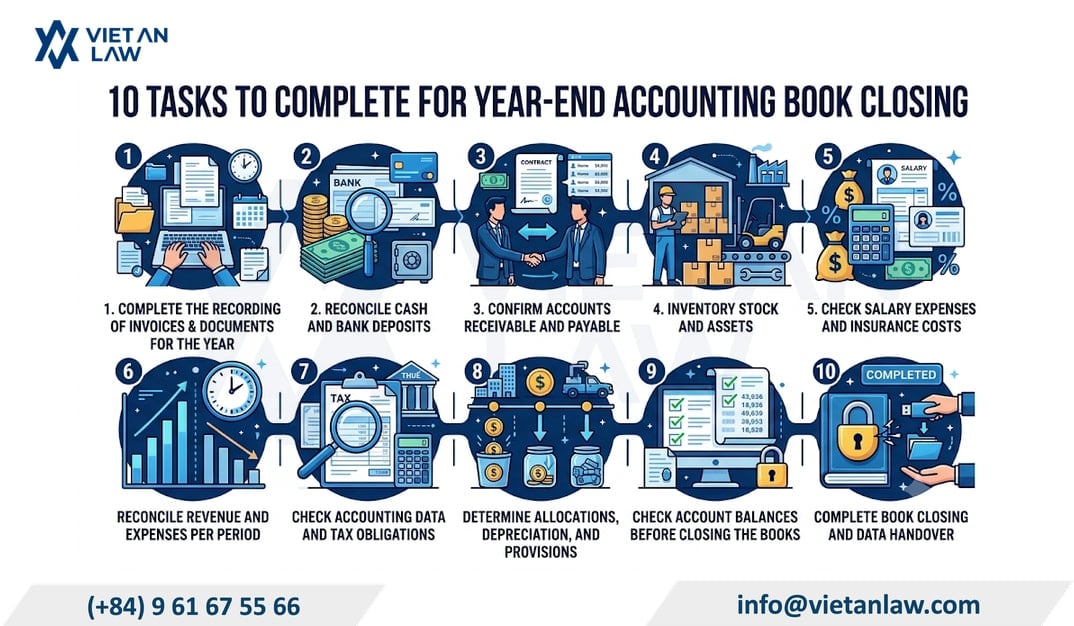
Tasks to be completed for finalizing accounting records
Below are 10 categories of tasks that businesses can use to perform a self-check before preparing financial statements.
Finalizing the recording of documents for the year
Accountants must identify transactions that have occurred but have not yet been recorded – specifically those related to purchases, sales, expenses, and payment obligations – as the year-end approaches.
Required tasks include:
- Consolidating documents generated each month.
- Identifying invoices that have not yet been accounted for.
- Reviewing expenses incurred for which full documentation has not yet been received.
- Categorizing transactions based on whether they belong to the current year or the following year.
- Recording or adjusting entries based on available documentation and the applicable accounting standards.
Example: If a business utilizes transportation services in December but does not receive the invoice until January of the following year, the accountant must evaluate when the service was completed, the criteria for expense recognition, the available documentation, and the regulations regarding invoices to ensure the transaction is recorded in the correct period; the entire expense should not simply be assigned to the year in which the invoice is received.
Reconciliation of cash and bank deposits
The cash balance in the accounting records must align with supporting documentation and confirmation data as of the period-end.
For cash, the entity should verify the cash book, receipts and payment vouchers, and the results of the physical cash count.
For bank deposits, the balance of each account must be reconciled against bank statements or official bank confirmations.
Common discrepancies that require clarification include:
- Unrecorded bank charges.
- Unrecorded interest income.
- Funds in transit (transfers currently being processed).
- Duplicate entries or transactions recorded in the wrong account.
- Foreign currency exchange differences at the period-end.
Entities should prepare a separate reconciliation schedule for each bank account and maintain documentation regarding the resolution of any identified discrepancies.
Confirmation of accounts receivable and accounts payable
Accounts receivable and payable are prone to discrepancies due to factors such as partial payments, offsetting, advance payments, or inconsistent recording practices between the parties involved.
Before closing the books, it is necessary to:
- Categorize accounts receivable and payable by individual customer or supplier.
- Reconcile opening balances, transactions during the year, and closing balances.
- Verify advance payments, deposits, and prepayments.
- Identify overdue debts or those deemed difficult to collect.
- Prepare a debt reconciliation statement when necessary.
Example: The accounting records show that Customer A has an outstanding balance of 200 million VND, whereas the customer claims the balance is only 150 million VND, citing a 50 million VND payment made at the end of December.
The accountant must examine the date the funds were received in the bank account, the payment documentation, and the timing of the accounting entries to determine the cause of the discrepancy before finalizing the year-end balance.
Inventory and asset stocktaking
Businesses holding goods, raw materials, finished products, or assets used in their operations must conduct stocktaking in accordance with legal requirements and their own management policies.
For inventory, it is necessary to verify actual quantities, including goods held on consignment, goods in transit, and items that are damaged or slow-moving.
For fixed assets, it is necessary to reconcile the asset register, current usage status, records of additions or disposals, and depreciation figures.
Specific scenarios that require separate consideration include:
- Actual inventory quantities being lower than those recorded in the books.
- Goods already delivered for which the timing of revenue or cost-of-goods-sold recognition has not been correctly determined.
- Assets that have been disposed of but remain in the accounting records.
- Assets that no longer meet the criteria for recognition.
- Goods or assets showing signs of impairment.
The stocktaking report must document the actual findings, any discrepancies, and the proposed resolution, which must be approved by the appropriate authority.
Review of payroll and insurance expenses
Before the end of the year, accountants should reconcile payroll figures against personnel records and actual payments.
Key areas to examine include:
- Recorded salaries and allowances.
- Accrued payroll liabilities (salaries payable).
- Whether bonuses are supported by sufficient documentation for recognition.
- Mandatory social insurance contributions.
- Personal income tax withheld.
- Salary advances and deductions.
It is important to distinguish between the timing of expense recognition for accounting purposes and the criteria for tax-deductible expenses when calculating corporate income tax. These two matters may be subject to different regulations.
Matching revenue and expenses by period
A key requirement for finalizing accounting data is ensuring that revenue and expenses are attributed to the correct reporting period.
Businesses must review transactions – such as product deliveries or the completion of services – that occur near the end of the fiscal year, as well as deferred revenue, prepaid expenses, and accrued expenses (costs incurred but not yet paid).
For example, if a company signs a 12-month service contract and collects the full payment in October, recognizing the entire amount as revenue for that year may be inappropriate if the service obligations are fulfilled over multiple periods.
Accountants must evaluate the nature of the transaction, the terms of the contract, and the applicable accounting policies to determine the appropriate treatment for revenue, advance payments, and the portions that need to be allocated across periods.
Reconciling accounting data and tax obligations
Accounting records and tax filings are closely linked, though not every figure is required to be identical.
Accountants should prepare a reconciliation between revenue recorded in the accounting books and revenue reported for tax purposes, as well as for input and output VAT, taxes payable, taxes already paid, and the outstanding tax liability balance at year-end.
If discrepancies are identified, the underlying causes – such as differences in the timing of recognition, calculation methods, tax policies, or data errors – must be determined.
Accounting figures should not be arbitrarily adjusted to match tax returns without first establishing the cause and the legal basis for such an adjustment.
Determining allocations, depreciation, and provisions
Once routine transactions have been completed, a business must review its year-end (or period-end) accounting entries in accordance with the applicable accounting framework.
Depending on the circumstances, these tasks may include:
- Allocating prepaid expenses.
- Calculating and recording depreciation for fixed assets.
- Recognizing accrued expenses.
- Revaluing monetary items denominated in foreign currencies.
- Assessing and recognizing qualifying provisions.
- Identifying and addressing inventory discrepancies.
These entries directly impact the business’s financial performance and its year-end financial position.
Each adjustment must be supported by appropriate calculations, a clear rationale, and relevant documentation; entries should not be made solely for the purpose of artificially increasing or decreasing profit based on subjective preferences.
Reviewing account balances before closing the books
Once the aforementioned tasks are completed, the accountant should compile a trial balance and examine any accounts with unusual balances or fluctuations.
For instance, it is necessary to investigate instances such as an inconsistent cash balance, accounts receivable or payable with balances that contradict their typical nature (without a clear explanation), long-standing cash advances, or prepaid expenses that have not been allocated to the correct period.
An unusual balance does not necessarily imply an error. Nevertheless, the business must be able to provide a justification and take appropriate action before using these figures to prepare financial statements.
Closing the books and handing over data
Once all entries have been recorded and reconciled, the accountant performs closing entries, determines the ending balances for the period, and closes the books in accordance with established regulations.
The handover documentation should include:
- A complete set of general and subsidiary accounting ledgers.
- The year-end trial balance.
- Key reconciliation schedules.
- Inventory count reports and records of any adjustments for discrepancies.
- Schedules for allocations, depreciation, and provisions.
- Documentation supporting any adjusting entries.
- Data and backups from the accounting software.
Before closing the books, the business must verify consistency between the general ledger, subsidiary ledgers, and the trial balance; investigate and clarify any material discrepancies; and finalize all substantiated adjusting entries. Once the figures are finalized, the accountant should back up the data, archive explanatory documentation, and implement controls to prevent unauthorized modifications to the recorded information.
Businesses may refer to guidelines on steps to prepare year-end financial statements to proceed with the necessary reporting tasks in compliance with applicable regulations.
Year-end accounting book closing for FDI enterprises in Vietnam
For foreign-invested enterprises (FDI), the year-end finalization of accounting records requires a focus on cross-border transactions, capital contributions, foreign currency matters, and statutory financial statement audit requirements. In addition to standard accounting procedures, such enterprises should verify the following:
- Capital contributions and foreign loans: Reconcile actual capital contributions, capital transfer documentation, direct investment capital accounts (where applicable), loans from the parent company, and relevant registered data.
- Foreign currency and exchange rate differences: Review foreign currency-denominated payables and receivables, account balances, and the year-end revaluation of monetary items denominated in foreign currencies, in accordance with the applicable accounting standards.
- Related-party transactions: Reconcile management fees, royalties, interest expenses, and other transactions with the parent company; assess obligations regarding the disclosure and preparation of transfer pricing documentation as required by current regulations.
- Financial statement audits: Prepare reconciliations for payables and receivables, obtain bank confirmations, compile asset records, gather documentation for significant transactions, and organize data required for the mandatory annual audit.
For enterprises required to prepare reports for a foreign parent group, it is essential to distinguish between data prepared under Vietnamese accounting standards and the adjustments necessary for consolidated reporting. Finalizing documentation prior to the audit period helps minimize the need for repeated adjustments and enhances the consistency of financial information.
Timeline for year-end accounting book closing for enterprises in Vietnam
Businesses should break down the task of finalizing accounting records into distinct phases, allowing them to proactively collect supporting documents, conduct inventories, and process data well before the time comes to prepare financial statements.
| Timeline | Key Tasks | Expected Deliverables/Results |
| November | Review missing records and outstanding debts/payables | List of issues requiring resolution |
| December | Prepare for inventory counts, reconcile, and determine year-end transactions | Preliminary inventory and reconciliation dossiers |
| January of the following year | Receive complete source documents and finalize transactions pertaining to the previous year | Updated accounting data |
| Prior to financial statement compilation | Complete adjustment entries, closing entries, and book closing | Verified year-end figures |
| After financial statement compilation | Archive, handover, and fulfill statutory reporting obligations | Complete accounting records |
The above schedule serves as a reference for businesses whose fiscal year coincides with the calendar year. In cases where the fiscal year differs or there are specific reporting obligations, businesses should adjust their timelines accordingly.
When do accounting books meet the criteria for year-end closing in Vietnam?
Businesses can use the five criteria below to self-assess their level of readiness.
| Criteria | Items to be confirmed/verified |
| Completeness | All transactions pertaining to the accounting period have been recorded based on appropriate source documents |
| Cut-off / proper period | Revenues, expenses, assets, and liabilities are recognized at the correct timing |
| Reconciliation | Material items have been reconciled with relevant records or confirmations |
| Basis for adjustment | Discrepancies have been explained, resolved, or appropriate adjustment plans have been established |
| Traceability | Figures are traceable from reports down to detailed sub-ledgers and original source documents |
The above criteria serve as a reference tool for internal control; they do not replace the requirements for closing the books and preparing financial statements in accordance with the applicable corporate accounting regime.
Handling common scenarios before year-end book closing in Vietnam
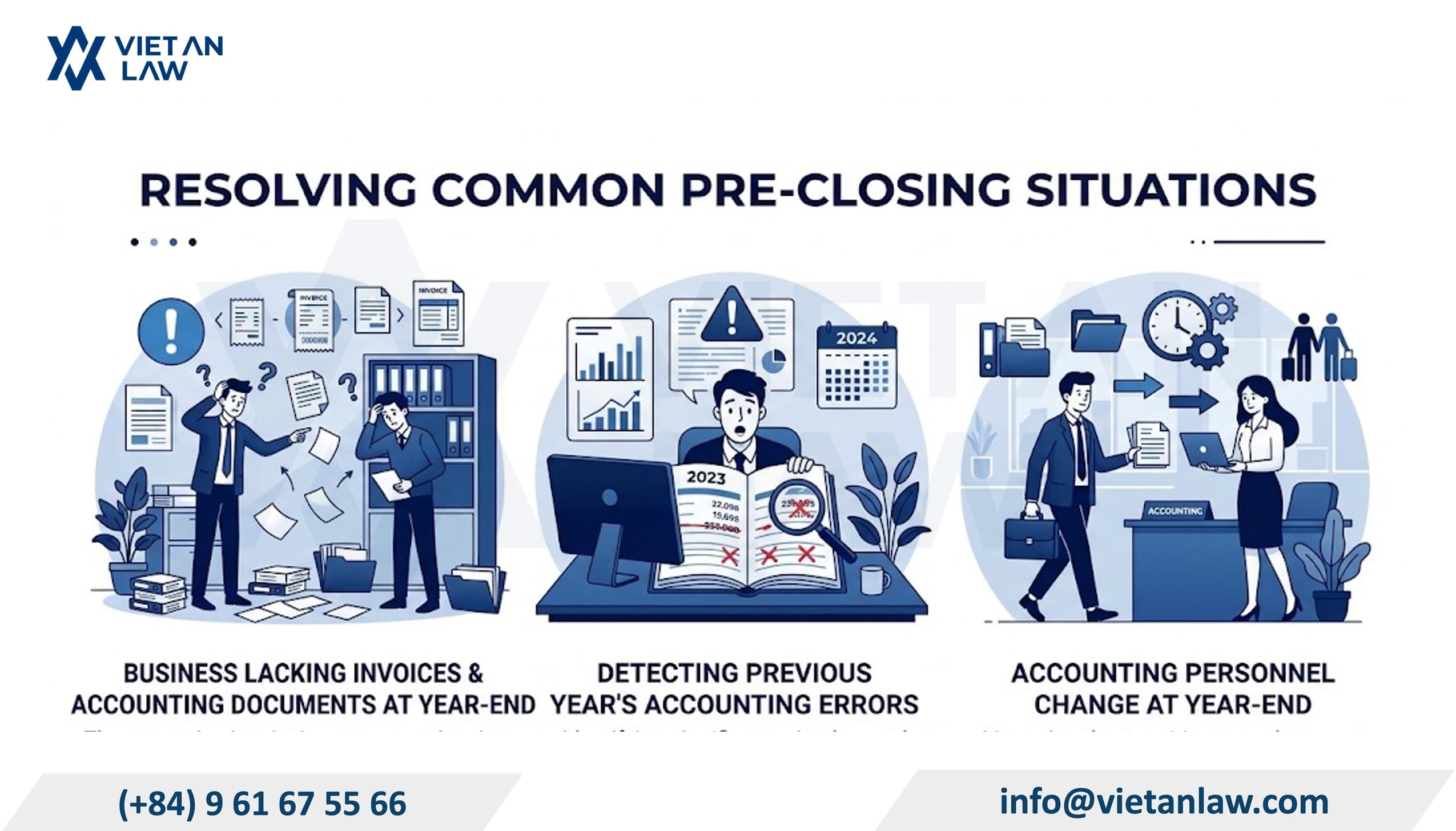
Missing accounting documents or vouchers at year-end
Accountants must identify the actual business transactions, the dates they occurred, and any missing documentation, then request that these be provided. Any recording or adjustment must be based on appropriate evidence; it is strictly prohibited to create fictitious vouchers or alter transaction dates for the purpose of legitimizing expenses.
Discovery of accounting errors from previous years
The business must determine the nature of the errors, their impact, and when they were discovered. Adjustments must comply with regulations regarding the correction of accounting records and the handling of errors from prior periods; supplementary tax filings may also be required if applicable. Data must not be deleted, and the accounting audit trail (history) must be preserved.
Changes in accounting personnel at year-end
A comprehensive handover must take place, covering all vouchers, software data, account balances, outstanding payables/receivables, and any incomplete transactions. A handover report should clearly document the records transferred, any outstanding issues, and the responsibilities for ongoing tasks, ensuring the continuity of the accounting function.
Frequently asked questionsabout year-end accounting book closing for businesses in Vietnam
By what deadline must a business finalize its year-end accounting records?
For businesses whose fiscal year coincides with the calendar year, December 31 marks the end of the annual accounting period. While the reconciliation of supporting documents, the recording of adjusting entries, and the closing of books may continue beyond this date, these tasks must be completed before the financial statements are prepared. Businesses must ensure compliance with the applicable filing deadlines – typically no later than 90 days after the end of the fiscal year for entities subject to this requirement.
What documentation should a business prepare to finalize its year-end accounting records?
Required documentation generally includes purchase and sales invoices, contracts, payment and receipt vouchers, bank statements, payroll records, insurance documentation, accounts receivable/payable ledgers, and inventory and fixed asset physical count reports. Additionally, the accounting team should prepare general ledgers, subsidiary ledgers, trial balances, and tax filing records for reconciliation purposes. The specific list of documents depends on the nature of the business operations and the accounting framework adopted by the entity.
How should a business address missing documentation or discrepancies in its year-end accounting records?
The business must identify the underlying transactions and the reasons for the missing documents or discrepancies, then obtain the necessary supplementary records and perform evidence-based adjustments. In cases of discrepancies between accounting records and bank statements, accounts receivable/payable, or tax filings, a reconciliation statement must be prepared before any adjusting entries are recorded. It is strictly prohibited to create fictitious documents or arbitrarily alter figures to justify expenses.
Are businesses with no revenue still required to finalize and close their accounting records at year-end?
Yes, provided the business remains subject to mandatory accounting regulations. The absence of revenue does not imply an absence of accounting transactions. Businesses may still incur management expenses, bank charges, outstanding liabilities, asset-related costs, or other financial obligations. In cases where a business has temporarily suspended operations, it is necessary to review its legal status and determine which obligations are waived and which must still be fulfilled in accordance with applicable regulations.
Can a business correct errors discovered after the year-end closing of its accounting books?
Yes, such corrections are permitted, provided they comply with the regulations governing the rectification of accounting records and the handling of errors from prior periods. The appropriate method for addressing an error depends on its nature, when it was discovered, the extent of its impact, and whether the financial statements have already been prepared, issued, or submitted. If an error affects tax obligations, the business must consider filing supplementary tax returns as required by law. It is strictly prohibited to delete or overwrite data in a way that erases the accounting audit trail.
Conclusion
Finalizing accounting records at year-end enables businesses to consolidate all transactions, reconcile figures, address discrepancies, and prepare the data necessary for financial statements. Adhering to proper procedures, maintaining strict control over supporting documentation, and closing the books in accordance with the applicable accounting framework are essential for ensuring the accuracy and transparency of financial information.
For businesses with a backlog of records or complex discrepancies, Viet An Tax Agency offers accounting books review services to help identify and resolve such issues. Companies requiring ongoing accounting management may consider our comprehensive accounting and tax services, which ensure that accounting records are maintained consistently, continuously, and in full compliance with regulatory requirements.
Author: Tax Specialist Nguyen Thi Thuy Trang
Reviewer: Tax Agency Specialist Nguyen Thi Ngoc Diệp
Hotline/ Zalo/ Whatsapp: (+84) 961 571 818
Email: info@vietanlaw.com
Hanoi Office: 3rd Floor, Hoang Ngan Plaza Building, 125 Hoang Ngan, Yen Hoa Ward, Hanoi
Ho Chi Minh City Office: Units 2.26–2.27, Charmington La Pointe Building, 181 Cao Thang, Hoa Hung Ward, Ho Chi Minh City