


In the course of their operations, businesses often engage external providers for cloud storage, client management, payroll, marketing, client care or IT system operation services. To perform these services, a provider may access and process the personal data of clients, employees or other related individuals. If the contract only contains general confidentiality provisions without clearly defining the processing scope, access rights, responsibilities in case of incidents and the obligation to return or delete data, the business may find it difficult to control risks. This is why data processing agreements in Vietnam: key clauses and legal obligations deserve careful attention. Accordingly, personal data processing agreements (DPA) with service providers in Vietnam: essential clauses and legal requirements is a topic businesses should pay attention to in order to comply with the law, allocate responsibilities, and protect data throughout the cooperation.
What is a data processing agreement in Vietnam?
A personal data processing agreement (DPA) is an agreement that sets out the rights, obligations and responsibilities of the parties when one party processes personal data within the scope of work assigned by the other party.
In practice, a business may assign a provider to carry out one or more activities such as collecting, storing, analyzing, editing, retrieving, transmitting or deleting personal data. Where the provider acts as the personal data processor, the relationship between the parties should be established in line with the requirements of the law on personal data protection in Vietnam.
A DPA may be drawn up as a stand-alone contract or as an appendix to the service contract, depending on the transaction model and how the business organizes its records. What matters is that the agreement clearly reflects the processing scope, purpose, responsibilities and the data protection measures to be applied.
When should businesses consider DPA legal requirements in Vietnam?
Businesses should review the need to sign a data processing agreement with service providers that may access or process personal data, for example:
- Providers of cloud-based data storage services;
- Providers of client relationship management (CRM) or human resource management (HRM) software;
- Payroll, benefits management or recruitment support providers;
- Companies providing client care, call center or marketing services;
- Providers of data analytics, system operation or technical support services;
- Partners managing data for delivery, payment or the performance of contracts with clients.
Not every provider is automatically a personal data processor. If the provider does not access or process personal data, or determines its own processing purposes, the business needs to assess the nature of the relationship in order to choose the appropriate form of agreement and determine the applicable legal obligations.
Personal data processing agreements (DPA) with service providers in Vietnam: essential clauses and legal requirements
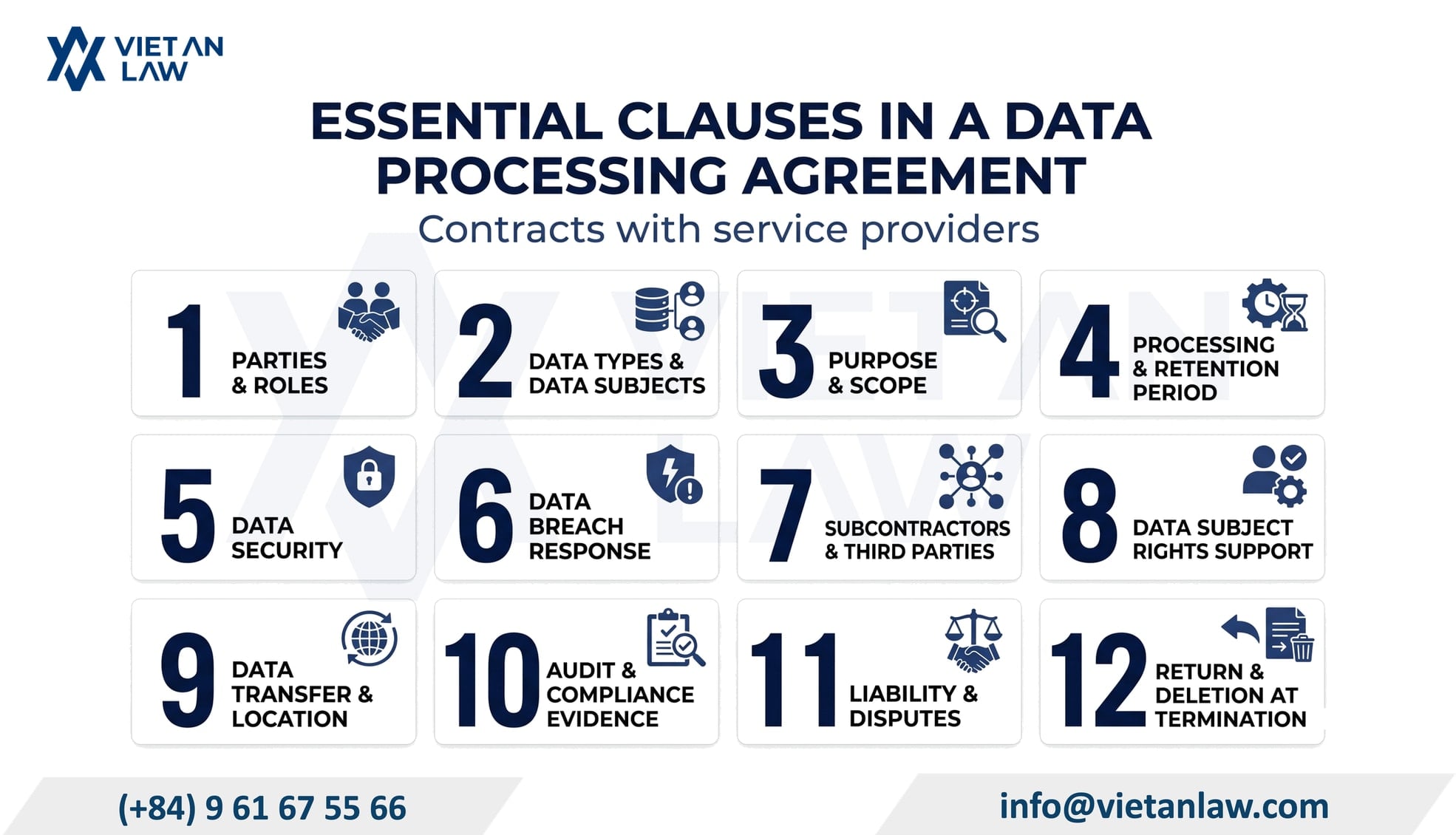
Clause identifying the parties
The contract should clearly state the names and legal information of the business and the provider, and clarify the role of each party in the data processing activities.
Typically, the business engaging the service, which determines the purposes and means of processing, may act as the personal data controller. The provider, which processes data on the business’s instructions, may act as the personal data processor. In some cases, one party may assume different roles depending on the specific activity.
This clause should specify:
- The party that determines the purposes of data processing;
- The party that processes data on instructions;
- The contact point of each party;
- The scope of responsibility of each party;
- The coordination mechanism when requests or data incidents arise.
Clause on data types and data subjects
The DPA should identify the categories of data that the provider is permitted to access and process. The data scope should be described clearly enough for both parties to verify compliance.
For example, for client management services, the data may include full names, phone numbers, email addresses and transaction history. For payroll services, the data may include personnel information, salaries, salary accounts and information related to social insurance and tax obligations.
The contract should specify:
- The groups of individuals whose data is processed;
- The list or categories of data that may be received;
- Data that may not be accessed without approval;
- How sensitive data, if any, is handled;
- The approval procedure when the data scope needs to be expanded.
Clause on purpose and scope of processing
Among the essential DPA clauses, this is one of the most important. The contract should specify what work the provider may process data for, by what methods and for how long.
For instance, if the provider is engaged to send order notifications, the contract should not automatically allow it to use client data to advertise its own products or to build its own client database.
The clause should clarify:
- The permitted processing purposes;
- The processing activities to be performed;
- The scope of the business’s instructions;
- Prohibited purposes of use;
- How changes to the processing scope are requested and approved.
The provider should not unilaterally expand the purposes of data use. If the service or processing needs change, the parties should reassess the legal basis and amend the agreement where necessary.
Clause on processing and data retention period
The contract should specify when processing starts, the service term and the conditions for ending data processing.
In addition, it should clearly state when the data must be returned, deleted or destroyed upon expiry or termination of the contract, or upon a lawful request from the business.
This clause should address issues such as:
- The data retention period in the main system;
- How data copies and backup data are handled;
- The time limit for returning or deleting data;
- Cases where data must continue to be retained as required by law;
- The mechanism for confirming the deletion or return of data.
Clause on data security and safety
The contract should require the provider to apply data protection measures appropriate to the type of data, the scale of processing and the level of risk.
These measures may include:
- Role-based access control;
- User authentication and account management;
- Encryption of data in transit or at rest where appropriate;
- Logging of access and processing activities;
- Control over copying, downloading and transferring data;
- Training for personnel with access to data;
- Periodic review, assessment and updating of protection measures.
Clause on personal data incidents and breaches
The contract should clearly set out the handling procedure when data is accessed without authorization, lost, disclosed or used for the wrong purpose.
The contents should include:
- The obligation to notify upon detecting or suspecting an incident;
- Contact points and methods of notification;
- The minimum information to be provided about the incident;
- Responsibilities to cooperate in investigation and remediation;
- The obligation to preserve logs, evidence and related data;
- The mechanism for status updates and reporting on the handling results;
- Allocation of responsibility for costs and damages under the contract, in accordance with the law.
Clause on subcontractors and third parties
A provider may use other entities for data storage, technical support, analytics or system operation. Without control over this, data may be passed on to parties that the business has not assessed.
The DPA should specify:
- Cases where subcontractors may be used;
- The obligation to notify or obtain approval before adding a subcontractor;
- The requirement that subcontractors comply with corresponding data protection obligations;
- The provider’s responsibility for the acts of its subcontractors under the contract and the law;
- The notification mechanism when subcontractors or processing locations change.
Clause on support for the exercise of data subject rights
Under Article 4 of the Law on Personal Data Protection 2025, data subjects have rights such as the right to be informed about processing activities, to consent or not to consent, to withdraw consent, to request access to or correction of their data, to request the provision, deletion or restriction of processing of their data, and other rights as prescribed.
Therefore, the contract should set out how the provider cooperates when the business receives requests from clients, employees or other individuals whose data is being processed.
The contents should include:
- How support requests from the business are received;
- Time limits for responding and providing information;
- How data is searched, retrieved, corrected or deleted;
- Responsibility to support the verification and handling of requests;
- The handling mechanism where data has been transferred to subcontractors.
Clause on data transfer and processing location
For providers using servers or personnel in multiple countries, the contract should clarify the storage and processing locations and whether the data can be accessed from abroad.
Matters to be considered include:
- The countries or regions where data is stored;
- The locations from which data may be accessed or processed;
- Conditions for transferring data to other parties or other countries;
- The obligation to notify of changes in infrastructure or processing locations;
- Responsibility to cooperate in fulfilling legal requirements on cross-border transfer of personal data.
Clause on audits and evidence of compliance
Businesses need a mechanism to check that the provider performs its data protection obligations. The contract should provide for the right to request documents, reports, assessment results or other appropriate evidence demonstrating compliance.
The contents may include:
- Providing information on data protection measures;
- Reporting the results of security checks or assessments;
- Cooperating when requested by the business or competent authorities;
- Scheduled audits or audits when risks are detected;
- Protection of the provider’s confidential information during audits.
Clause on liability, compensation and dispute resolution
The DPA should determine how to handle cases where a party breaches its obligations, causes damage or fails to perform the agreement properly.
Matters to be considered include:
- Responsibility to remedy breaches;
- The obligation to cooperate in mitigating damage;
- Principles for allocating incident handling costs;
- Liability for compensation on the grounds and within the scope permitted by law;
- Mechanisms for notification, negotiation and dispute resolution;
- The relationship between the DPA and the main service contract.
Clause on return, deletion and destruction of data upon termination
When the service ends, the provider should return or delete the data in accordance with the agreement and the law. This clause is especially important for cloud storage, human resource management and client data processing services.
The contract should specify:
- The method of returning data and the handover format;
- The time limit for deleting data from live systems;
- How copies, backups and data held by subcontractors are handled;
- Cases where data must continue to be retained under the law;
- How the return or deletion of data is confirmed.
Comparison of ordinary service contracts and personal data processing agreements in Vietnam
| Criteria | Ordinary service contract | Data processing agreement (DPA) |
| Main purpose | Governs the service, price, timeline and acceptance | Governs the scope, conditions and responsibilities for processing personal data |
| Data scope | May only refer generally to confidential information | Identifies data categories, data subjects and processing purposes |
| Roles of the parties | Identifies the service provider and the service user | Clarifies the legal roles in data processing activities |
| Confidentiality | Usually provides for a general confidentiality obligation | May specify protection measures, access rights and access control |
| Data incidents | May have no dedicated procedure | Sets out mechanisms for notification, cooperation and remediation of incidents |
| Subcontractors | Governed by general outsourcing clauses | Controls subcontractors’ access to and processing of data |
| Data subject rights | Usually not fully addressed | Defines obligations to support the exercise of rights under the law |
| Contract termination | Handover or termination of the service | Provides for return, deletion, destruction and handling of data copies |
| Legal basis | Depends on the contract type and sector | Checked against personal data processing obligations, especially Article 37 of the Law on Personal Data Protection 2025. |
Mistakes businesses in Vietnam should avoid when drafting essential DPA clauses
Relying only on a general confidentiality clause
A confidentiality undertaking cannot replace provisions on purpose, processing scope, access rights, subcontractors, incident handling and data deletion. Businesses should review the entire data lifecycle instead of merely adding a short confidentiality clause.
Failing to clearly define the provider’s role
If the provider determines the purposes of data use on its own, it may be acting as more than a processor following the business’s instructions. Misidentifying the role may lead to an unsuitable contract design and overlooked legal obligations.
Allowing data use beyond the scope of the service
Clauses allowing the provider to use data for analytics, advertising or product improvement should be reviewed carefully. Businesses need to determine the purpose, legal basis and corresponding limits of use, rather than accepting overly broad data use rights.
Not providing for an incident handling mechanism
If the contract does not specify contact points, notification time limits and cooperation obligations, the business may not receive timely information when an incident occurs. This is a priority point when negotiating a DPA.
Not reviewing data after the cooperation ends
Terminating the service contract does not automatically ensure that the data has been deleted from the provider’s systems. Businesses need a procedure to revoke access, return or delete data and keep evidence of completion.
Process for reviewing and signing a data processing agreement with service providers in Vietnam
To limit risks, businesses may implement a process consisting of the following steps:
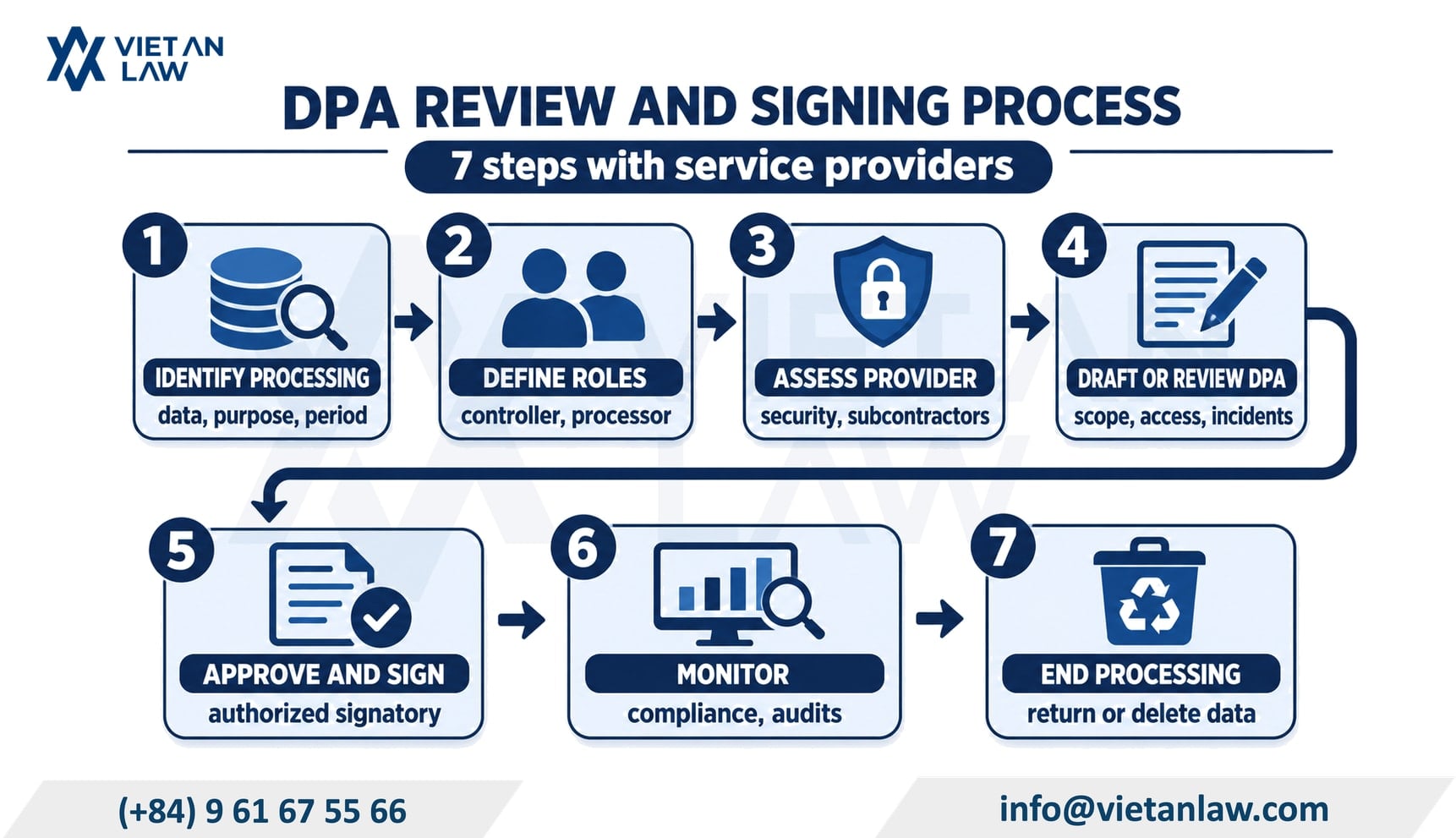
- Step 1: Identify the data processing activities. Take stock of the data the provider needs to access, the processing purposes and the period of use.
- Step 2: Allocate the roles and responsibilities of the parties. Clarify whether the business and the provider act as data controller, data processor or in another role based on the actual activities.
- Step 3: Assess the provider. Check its security measures, processing capability, subcontractors, storage locations and ability to meet contractual obligations.
- Step 4: Draft or review the DPA. Define the data scope, processing purposes, access rights, security, incidents, data transfers and obligations upon termination.
- Step 5: Approve and sign. Ensure the agreement is signed by an authorized person and is consistent with the main service contract.
- Step 6: Monitor performance. Track compliance, conduct audits when necessary and update the agreement if there are significant changes to the service or data flows.
- Step 7: End the processing. Revoke access, receive the data back or request its deletion as agreed, and keep confirmation records.
Personal data protection legal advisory services in Vietnam by Viet An Law Firm
When it comes to data processing agreements in Vietnam: key clauses must both ensure legal compliance and be workable in practice. An overly general contract may fail to control risks, while unclear or impractical obligations may lead to disputes between the business and the provider.
Businesses may refer to Viet An Law Firm’s personal data protection legal advisory services in Vietnam for support in reviewing legal obligations, assessing data processing activities, finalizing contracts and building appropriate risk management solutions. Details at the following link: https://vietanlaw.com/protection-of-personal-data-in-vietnam/
Frequently asked questions about personal data processing agreements with service providers
Are businesses required to sign a data processing agreement in Vietnam with their service providers?
Under Clause 2, Article 37 of the Law on Personal Data Protection 2025, a personal data processor may only receive data after concluding a data processing agreement or contract with the personal data controller or the personal data controller-processor. Businesses need to correctly identify the provider’s role and the specific processing activities in order to apply this provision.
Must a personal data processing agreement (DPA) be a separate contract?
Not necessarily. Businesses may draw up a DPA as a separate contract or as an appendix to the service contract, provided that the agreement meets the applicable legal requirements and clearly defines the responsibilities of the parties in processing personal data.
Should a data processing agreement specify a time limit for incident notification?
Businesses should specify the time limit and method of notification to ensure a timely response. The contractual time limit should be designed in line with the applicable DPA legal requirements in Vietnam and must not delay the performance of the parties’ mandatory obligations.
May the provider use client data for its own purposes?
This cannot be allowed by default. The provider must comply with the agreed processing scope and purposes. If it wishes to use the data for its own purposes, the parties need to reassess the roles, legal basis and applicable conditions before doing so.
Personal Data Processing Agreements (DPA) with service providers in Vietnam: essential clauses and legal requirements is a topic businesses should review to ensure compliance and control risks. If your business needs advice on drafting or reviewing a personal data processing agreement with a provider, Viet An Law Firm is ready to accompany and support your business in complying with the law, protecting personal data in line with the rules on personal data protection in Vietnam and minimizing potential legal risks.