


Company registration in Vietnam is only the first step. To exist lawfully and avoid fines from the tax authorities, an enterprise must pay its periodic business maintenance costs. So in practice, what do the first-year company costs after incorporation include? Viet An Law presents first-year maintenance costs for a newly registered company in Vietnam in the article below.
Business Maintenance Costs for Electronic Tools in Vietnam
A newly established company may have no customers and no revenue yet. It is still required to buy the following tools so that it can meet its reporting obligations to the state authorities under the law.
Digital signature maintenance fees (Token)
- A digital signature (USB Token) serves as the enterprise’s legal seal in the online environment. It is used to authenticate tax returns, customs declarations and social insurance filings submitted electronically.
- Indicative cost: Market prices currently range from about VND 1,500,000 to VND 2,500,000 for a three-year package (the exact price depends on the provider, such as MISA, Viettel or VNPT,…)
E-invoicing software costs
- Mandatory requirement: Under the regulations of the Tax authorities, all enterprises must now adopt and issue electronic invoices.
- Starting cost: Newly established and small enterprises can choose a basic package costing about VND 800,000 to VND 1,500,000, which covers roughly 300 to 500 invoices per year. A larger package can be bought later, depending on how many invoices the enterprise issues.
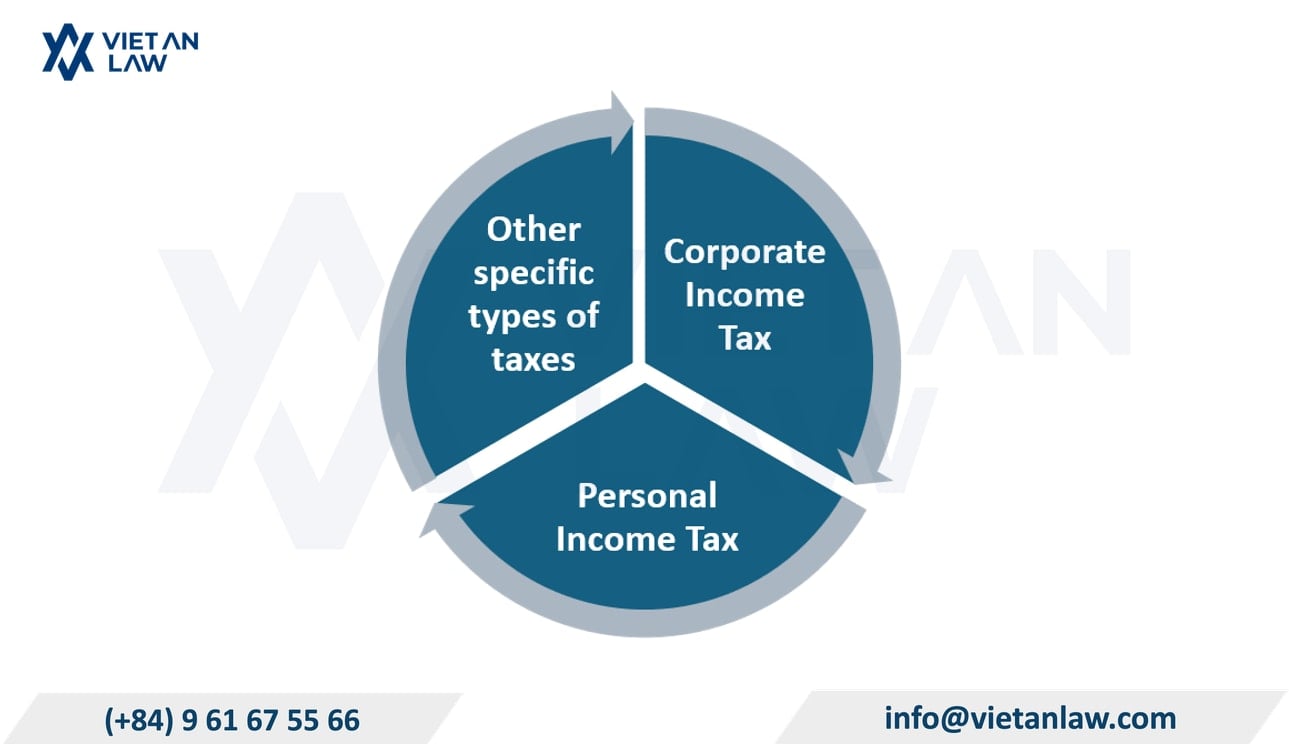
Types of taxes as first-year maintenance costs for a newly registered company in Vietnam
Licensing fee in Vietnam: Officially abolished from 2026
- Key change: Under Resolution No. 198/2025/QH15, the State stopped collecting the business license fee from taxpayers with effect from 1 January 2026.
- As a result, enterprises established in 2026 do not have to pay the business license fee at all.
Value Added Tax (VAT)
- VAT is an indirect tax on the value added to goods and services as they move from production and distribution to the end consumer. The enterprise only declares and pays the tax on the consumer’s behalf. The consumer is the one who actually bears it.
- Calculation method: An enterprise may declare VAT under either the credit method or the direct method.
- Filing period: A newly established enterprise must file VAT returns quarterly.
- Note: A new enterprise must still file its VAT return on time every quarter, even if it has issued no invoices or earned no revenue. In that case it files a “nil return”. Late filing results in penalties.
Corporate Income Tax (CIT)
- CIT is a direct tax on the profit (taxable income) the enterprise earns during the tax period.
- Formula: CIT payable = Taxable income × Tax rate.
- First-year note: If the enterprise makes no profit, or makes a loss, in its first year, it has no CIT to pay. However, it must still prepare and file a CIT finalisation dossier at the end of the year.
Personal Income Tax (PIT)
- The enterprise does not itself pay this tax. Instead, it must withhold PIT from its employees’ salaries, where their income reaches the taxable threshold, and pay it to the tax authorities on their behalf.
- Note: If the enterprise pays any salaries or wages during the year, it must file a PIT finalisation return at year end. This applies even if none of its employees earned enough to owe tax.
Other specific types of taxes
Depending on the business lines in which it operates, a company may be liable for additional taxes, including:
- Import and Export taxes, where the company engages in the import or export of goods;
- Special consumption tax, where the company trades in goods such as alcohol, beer or tobacco products;
- Environmental protection tax and natural resource tax, depending on the specific sector concerned.
Accounting costs for a newly established company in Vietnam
A newly established company remains legally obliged to submit all periodic tax returns and reports in full, even if it has not yet generated revenue or has issued only a small number of invoices. To handle this, enterprises usually weigh two options in terms of Company Maintenance Costs in Vietnam:
Hiring an in-house accountant
- Estimated cost: Approximately VND 7,000,000 – 15,000,000 per month for the base salary.
- Additional costs: The enterprise will also bear the costs of social insurance contributions, bonuses, computer equipment, accounting software and workspace.
- Assessment: This option often puts significant financial pressure on First-Year Company Costs for startups or small businesses, at a stage when cash flow is not yet stable and the accounting workload is still small.
Using full-package accounting services (optimal solution)
Instead of keeping a permanent employee, outsourcing accounting services in Vietnam allows new enterprises to save up to 80% of costs. Current market fees typically range from only VND 500,000 to VND 2,000,000 per month (depending on the volume of documents generated).
To ensure accuracy and legal safety, clients may consider the full-package accounting and tax services in Vietnam provided by Viet An Law, a reputable firm with many years of experience in supporting newly established enterprises. Using Viet An Law’s services offers the following key advantages:
- Cost optimisation: Service fees are set flexibly based on the enterprise’s scale and its actual number of invoices, so you do not waste your budget.
- Safety and accuracy: Viet An’s team of accounting specialists and lawyers keeps closely up to date with the latest tax laws (including the major changes in 2026). This ensures that accounting records are valid and reports are filed on time.
- 100% accountability: Viet An Law will work directly with the tax authorities on the enterprise’s behalf and explain the figures. It will bear full legal responsibility for any errors that are the service provider’s fault.
- Parallel legal advice: Beyond bookkeeping, enterprises also receive free advice from Viet An Law’s experts on contracts, labour matters and other legal risks that arise during operations.
Other basic costs after company formation in Vietnam
In addition to the fees for company registration in Vietnam and the initial taxes, an enterprise needs to budget for the following basic costs of running a company in Vietnam in order to operate lawfully and smoothly:
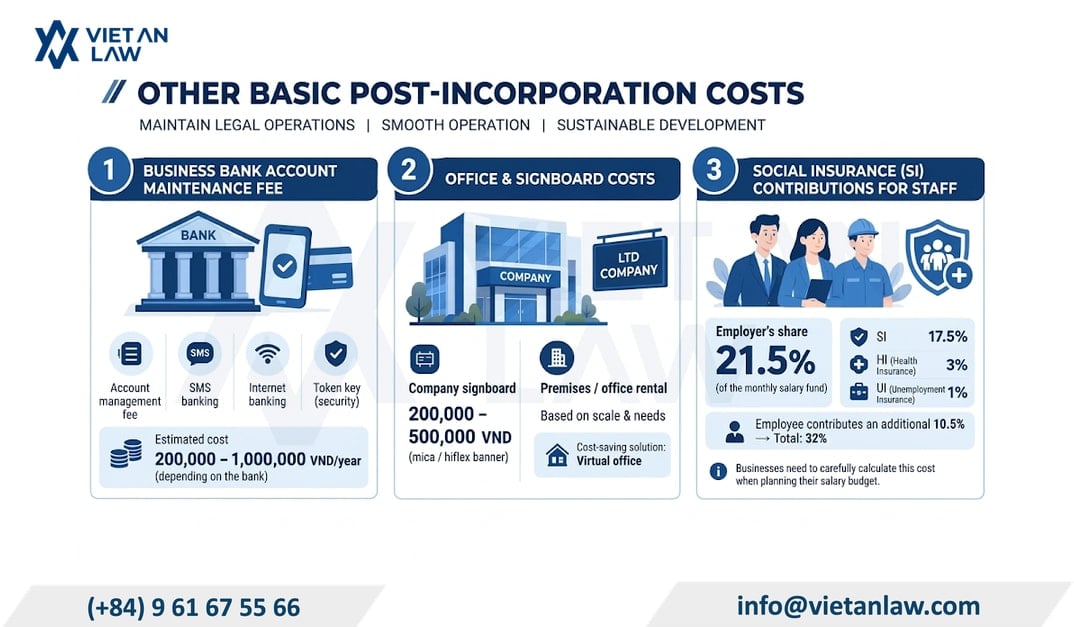
Corporate bank account maintenance fees
- After opening a bank account for the company, the enterprise will have to pay certain annual fees to keep the service running, which form part of its business maintenance costs. Common fees include account management fees, SMS banking fees, Internet banking fees and maintenance fees for the security Token key (used to approve transaction orders).
- The amount depends on the policy and fee schedule of the bank the enterprise chooses. These costs are g,enerally modest, ranging from a few hundred thousand VND to about VND 1,000,000 per year.
Office and signboard costs
These costs are essential for identifying the enterprise and its actual place of business:
- Company signboard: Hanging a signboard at the head office is a mandatory legal requirement. The tax authority will inspect the registered address in person. If there is no signboard, the enterprise’s tax identification number may be suspended. A standard-sized acrylic (mica) or hiflex banner signboard is quite economical, usually costing only about VND 200,000 – 500,000.
- Premises/office rental costs: Depending on its scale, needs and financial capacity, the company may rent an actual working office. Where the company wants to keep costs as low as possible (especially in the early start-up stage), renting a “virtual office” is a common and reasonable choice. A virtual office means renting only an address for business registration and for receiving correspondence.
Social insurance contributions for employees
Once the enterprise is operating steadily and begins signing official employment contracts (with a term of one full month or more) with employees, participating in compulsory insurance becomes an obligation it cannot avoid.
Under current law, compulsory insurance contributions are calculated on the monthly salary used as the basis for the employee’s social insurance contributions. Specifically, the enterprise (as employer) must pay 21.5%, consisting of:
- Social insurance (retirement and survivorship, sickness, maternity, and occupational accident funds): 17.5%
- Health insurance: 3%
- Unemployment insurance: 1%
(Note: Employees also contribute 10.5% of their monthly salary to these funds, bringing the total contribution of the enterprise and the employee to 32%.)
Business owners should therefore calculate this cost carefully when planning the payroll budget.
Comparison table of first-year company maintenance costs in Vietnam
| First-year maintenance cost item | Case 1: Company has NOT generated revenue (maintaining the licence only) | Case 2: Company is operating steadily | Notes / Legal basis |
| Digital signature (Token) | ~ VND 1.500.000 | ~ VND 1.500.000 | Mandatory for filing tax returns (purchased once, valid for 3 years) |
| E-invoices | ~ VND 800.000 | ~ VND 1.500.000 | Depends on the invoice package registered (300 or 1,000 invoices) |
| Tax accounting services | ~ VND 6.000.000 (Fee for making basic quarterly/annual reports) | ~ VND 18.000.000 – VND 30.000.000 (full-package monthly service) | Even without revenue, tax reports must still be filed on time. |
| Bank account maintenance | ~ VND 500.000 | ~ VND 2.000.000 | Minimum balance maintenance fee, SMS fees, Internet Banking. |
| VAT & CIT | VND 0 | Depends on actual revenue and profit | CIT is payable only when the company makes a profit. |
| TOTAL ESTIMATE (First year) | ~ VND 8.800.000/ year | From VND 25.000.000 | This is an estimate and does not include staff salaries or premises rental. |
Tips for optimising business maintenance costs for startups in Vietnam
Below are comprehensive solutions that help startups cut costs effectively while keeping their operations productive:
Optimising facility costs
Purchasing liquidated or second-hand equipment: It is not necessary to buy all office equipment (desks, chairs, printers, computers) brand new. Buying from enterprises that are transferring or liquidating their assets can save 40–60% of the initial investment cost.
Streamlining the workforce
- Remote/Hybrid working model: Encouraging employees to work remotely part-time or full-time helps the enterprise save significantly on electricity and water, internet, lunch allowances and office space.
- Using freelancers and collaborators: Instead of recruiting full-time staff for every position and bearing additional insurance and benefit costs, retain only the core team. Seasonal or project-based work (such as graphic design, content writing and website programming) should be outsourced to optimise the payroll budget.
Optimising administrative, accounting and legal costs
- Outsourcing Accounting and Tax Services in Vietnam during the first 1–2 years: An experienced general accountant may cost you VND 10–15 million per month. By contrast, hiring an external full-package accounting service costs only about VND 1–3 million per month, while still ensuring accuracy and compliance with current law.
- Purchasing small-scale software and service packages: When a company is newly established, it does not issue many invoices. You should register only for small e-invoice packages (100–300 invoices) and use a 1-year digital signature package, rather than buying large packages that tie up capital unnecessarily.
Applying technology and “zero-cost” marketing
- Making the most of free tools: Use the ecosystem of free tools for small businesses, such as Google Drive/Docs (storage and document drafting), Trello/Lark (task management and internal communication) and Canva (graphic design), instead of spending money on expensive software.
- Focusing on Organic Marketing and AI: Instead of pouring money into advertising (Facebook Ads, Google Ads) before the product is truly complete, use AI tools (such as ChatGPT and Gemini) to help with brainstorming and writing articles. Promote the business through zero-cost channels, such as building communities on Facebook Groups, making short videos on TikTok or website SEO.
Disciplined k
- Separating personal and business finances: Open a separate bank account for the company and never mix personal and business spending. This helps you track the enterprise’s burn rate accurately.
- The “Spend only on what generates revenue” rule: Review your entire cash flow report every month. Any expense that does not directly or indirectly bring in customers, revenue or legal stability should be considered for cutting.
FAQs on first-year maintenance costs for a newly registered company in Vietnam
How much does it initially cost to purchase a digital signature (Token) and e-invoices?
The cost ranges from about VND 1.5 to 2.5 million. Of this, a digital signature (1–2 year package) costs about VND 1–1.5 million, and a basic e-invoice package (100–300 invoices) costs about VND 300,000–500,000.
How much does it cost to outsource accounting/tax reporting services?
For a newly established enterprise that issues few or no invoices, outsourced accounting services in Vietnam cost only about VND 1–3 million per month.
How much does it cost to open and maintain a corporate bank account?
Account opening is usually free of charge. However, the enterprise must maintain a minimum balance (usually VND 1,000,000) and pay account management/SMS Banking fees of about several tens of thousands of VND per month, depending on the bank.
Is it mandatory to spend money on renting expensive office premises?
No. If it does not need a physical workspace, the enterprise can rent a virtual office to serve as its legal business registration address at a low cost, from only VND 500,000–1,000,000 per month.
In its first year of operation, if the company has not made a profit, does it have to pay Corporate Income Tax (CIT)?
No. CIT (at the standard rate of 20%) applies only when the enterprise makes a profit. If the company breaks even or makes a loss, you do not have to pay this tax, but you must still submit the year-end Financial Statements.
The above is Viet An Law’s article on first-year company maintenance costs in Vietnam. If you have any questions, please contact Viet An Law for advice!