


The International Patent Classification in Vietnam: The Strasbourg Agreement (International Patent Classification – IPC) is a technical classification system applied uniformly across many countries to arrange, search for patents, and manage patent information scientifically. Understanding the structure, classification principles, and significance of the IPC not only helps applicants prepare accurate dossiers for patent registration in Vietnam but also effectively supports the process of searching and assessing patentability. The article below will comprehensively analyze the Strasbourg Agreement and the international patent classification.
What is the Strasbourg Agreement?
The Strasbourg Agreement Concerning the International Patent Classification is an international treaty adopted in Strasbourg (France) on March 24, 1971, and entered into force on October 7, 1975.
The Agreement is administered by the World Intellectual Property Organization (WIPO) with the goal of establishing a uniform patent classification system for member states to apply together.
Under this Agreement, member states share a common technical classification system for subjects protected in the form of patents, utility solutions, and certain documents related to industrial property rights.
Applying a uniform Strasbourg Agreement patent classification standard helps reduce differences in patent data management between countries, while simultaneously facilitating international cooperation in the field of intellectual property.
What is the International Patent Classification (IPC)?
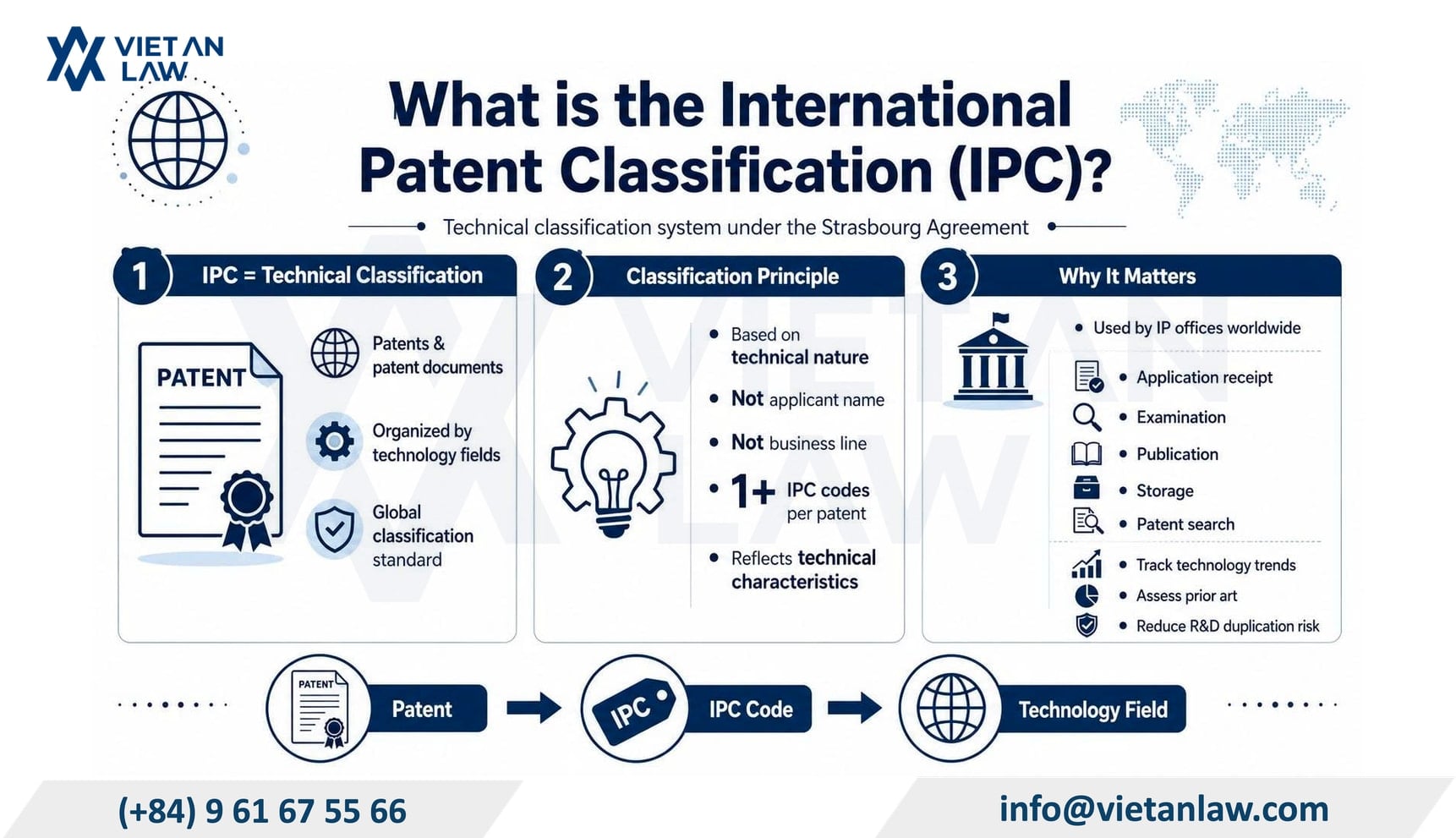 The International Patent Classification (IPC) is a technical classification system built under the Strasbourg Agreement to arrange patents and patent documents according to specific technology fields.
Instead of classifying by the name or business line of the applicant, the IPC classifies based on the technical nature of the protected solution. Each patent will be assigned one or more IPC codes corresponding to the technical characteristics of the solution, thereby helping to accurately identify the technology field to which the patent belongs.
Currently, this IPC system is widely used by the intellectual property offices of many countries and international organizations in the process of receiving applications, examining, publishing, storing, and searching for patent information. It is also an important tool supporting businesses, research institutes, and inventors in tracking technology development trends, assessing the state of the art, and limiting the risk of duplication in research and development activities.
Purposes of establishing the International Patent Classification
The establishment of the IPC is not only to create a unified coding system but also aims at many important objectives in the protection of industrial property rights:
The IPC helps standardize the classification of patent documents on an international scale. When countries use the same patent classification system, exchanging and exploiting patent data becomes more convenient, accurate, and synchronized.
This system effectively supports patent search in Vietnam and globally. Instead of searching by keywords or names that may differ between countries and languages, searchers can use IPC codes to quickly identify relevant documents in the same technical field.
The IPC contributes to improving the quality of substantive examination of patent applications. Accurate classification helps the intellectual property office identify the correct specialized field, select suitable reference document sources, and accurately evaluate the novelty, inventive step, as well as the industrial applicability of the technical solution.
This is a valuable data source for research, statistics, and science and technology development policy planning. Through classification data, regulatory agencies and businesses can identify innovation trends, strongly developing technology fields, and direct future research investments.
It can be seen that the International Patent Classification in Vietnam: The Strasbourg Agreement has created an important foundation for managing patent information globally. To effectively apply this system, it is necessary to clearly understand the structure of the IPC as well as the meaning of each classification level in the system.
Structure of the International Patent Classification (IPC)
The IPC system is organized into 05 classification levels, including: Section, Class, Subclass, Main Group, and Subgroup. Each level has its own function in describing and identifying the technology field of the patent.
Section
The section is the highest classification level in the IPC system, reflecting broad technical fields. The entire system is currently divided into 08 sections, designated by letters from A to H, including:
- Section A: Human necessities
- Section B: Performing operations; transporting (B01-B43)
- Section B: Performing operations; transporting (B44-B99)
- Section C: Chemistry; metallurgy (C01-C07)
- Section C: Chemistry; metallurgy (C08-C99)
- Section D: Textiles; paper
- Section E: Fixed constructions
- Section F: Mechanical engineering; lighting; heating; weapons; blasting
- Section G: Physics
- Section H: Electricity
Dividing into sections helps quickly orient the technical field to which the patent belongs before continuing with classifying patents at more detailed levels.
Class
Each section includes many classes. Each class is designated by two digits following the section letter and reflects a more specific technology group.
For example, in Section A (Human necessities), there is Class A61 relating to medical or veterinary science; hygiene.
Subclass
Subclass is the next level of the class and is designated by a capital letter.
At this level, the technical field is further subdivided to accurately reflect the nature of the technical solution. For instance, in A61, subclass A61K is used to classify preparations for medical, dental, or toilet purposes.
Main Group
The Main Group further divides the content of the subclass into larger technical groups. Each main group is designated by one or more digits followed by “/00”.
This is a classification level that helps identify groups of technical solutions with the same nature or function.
Subgroup
The Subgroup is the most detailed level in the IPC system. After the slash will be numbers other than 00, reflecting the specific technical characteristics of each patent.
Classifying down to the subgroup helps precisely determine the technical scope of the solution, while enhancing the efficiency of search and examination of patents.
How to read an IPC code
An IPC code is usually composed of components corresponding to each classification level in the system.
For example: A61K 31/7088. In which:
- A is Section;
- 61 is Class;
- K is Subclass;
- 31/00 is Main Group;
- 7088 is Subgroup.
Just by looking at the IPC code, a searcher can determine the technology field of the patent as well as the position of the patent in the international classification system. This is the basis for intellectual property offices around the world to share a common patent data management method.
Summary of the structure of the International Patent Classification (IPC)
| Classification Level | Symbol | Content | Example |
| Section | Letters from A to H | The highest classification level, dividing the entire technology field into 08 broad sections. | A – Human necessities |
| Class | 02 digits after the section symbol | Divides each section into more specific technology groups. | A61 – Medical and veterinary; hygiene |
| Subclass | 01 letter after the class | Divides the class into specialized technical fields. | A61K – Preparations for medical, dental, or toilet purposes |
| Main Group | Number before the “/” and ending with /00 | Classifies groups of technical solutions with the same nature or function. | A61K 31/00 |
| Subgroup | Number after the “/” (other than 00) | The most detailed classification level, describing specific technical characteristics of the patent. | A61K 31/7088 |
Note: Each IPC code is formed in the sequence from Section → Class → Subclass → Main Group → Subgroup, where the technical scope is gradually narrowed from general to specific. A patent can be assigned to one or more IPC codes if the technical solution relates to multiple different technology fields.
How does Vietnam apply the International Patent Classification?
The international patent classification mechanism is strictly guided by Vietnamese regulations on intellectual property.
 Requirement to declare IPC down to the third index level
 Requirement to declare IPC down to the third index level
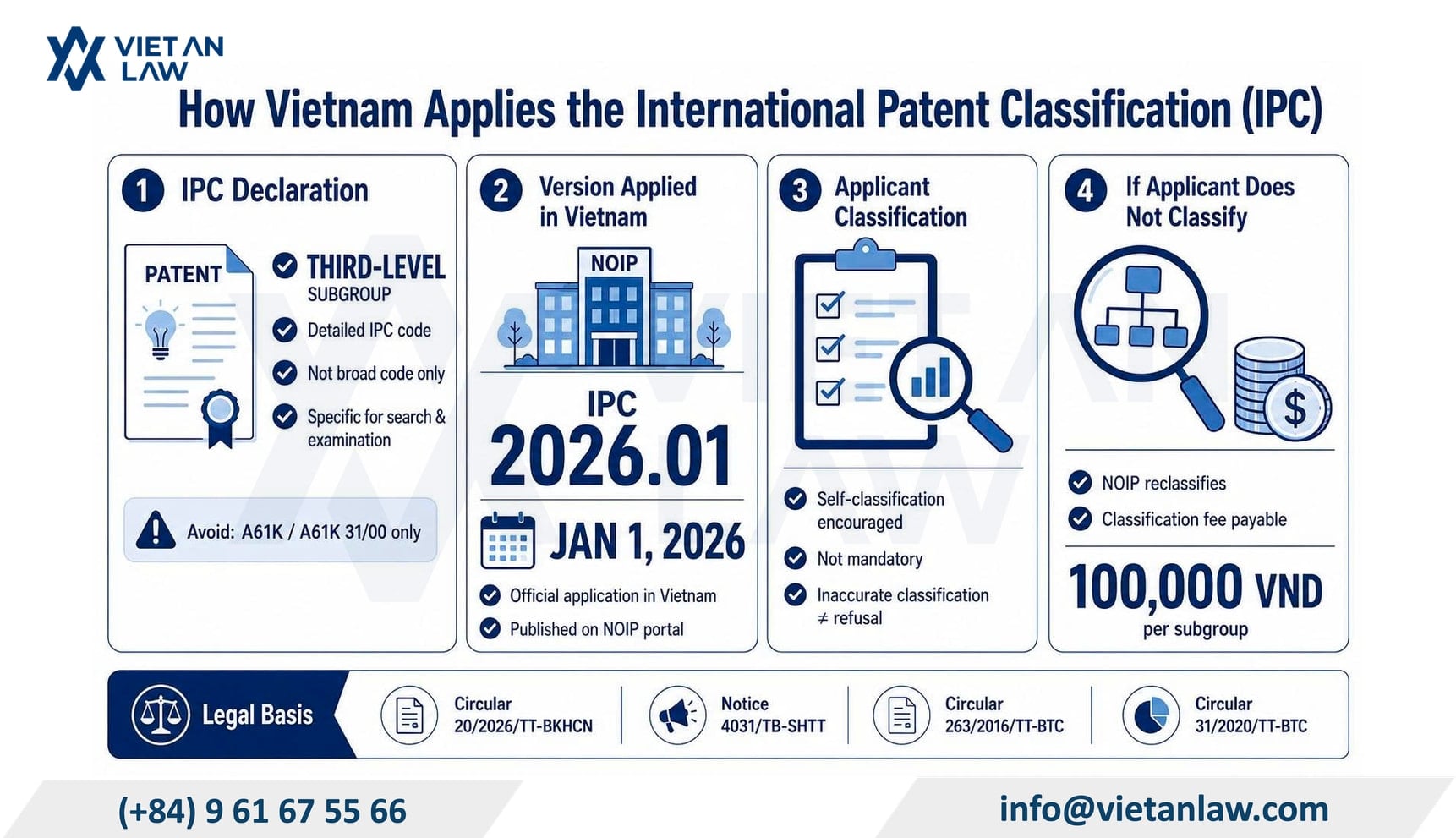
According to Form No. 01 Appendix I issued alongside Circular No. 20/2026/TT-BKHCN in the Patent Registration Declaration, at the “International patent classification” section in the declaration, the applicant needs to state the international classification index for the patent seeking protection down to the third hierarchical level.
In addition, according to Notice No. 4031/TB-SHTT dated December 26, 2024 of the National Office of Intellectual Property (NOIP), the International Patent Classification (according to the Strasbourg Agreement concerning the international patent classification, abbreviated as IPC) version 2026.01 was published by the National Office of Intellectual Property (NOIP) on its electronic portal on December 25, 2025, and will be officially applied in Vietnam from January 1, 2026.
This means:
- The applicant needs to identify the detailed IPC code down to at least the subgroup at the third level, if the IPC has hierarchies to that extent.
- Not only write general codes like A61K or A61K 31/00, but it is necessary to write a more detailed code according to the IPC 2026.01 version.
In other words, the third level index is the level of detail of the subgroup in the IPC, not the third level of the IPC structure. This is a requirement to make classifying patents specific enough to serve search and examination.
Is the applicant required to classify the patent themselves?
Current law encourages applicants to proactively identify the IPC code of the technical solution before filing the dossier. However, the fact that the applicant does not classify or classifies inaccurately is not a basis for refusing to receive the patent application.
In case the applicant does not classify or classifies inaccurately, the National Office of Intellectual Property (NOIP) will conduct the classification according to regulations. At that time, the applicant must pay the patent classification fee according to the current state fees for industrial property.
The international patent classification fee according to Circular 263/2016/TT-BTC, amended and supplemented by Circular 31/2020/TT-BTC is 100,000 VND/subgroup.
Some related questions
Where can I look up the IPC code of a patent myself?
Applicants can look up IPC codes through the IPC database published by the World Intellectual Property Organization (WIPO) or the patent databases of intellectual property offices. Conducting a patent search in Vietnam and classifying before filing helps correctly identify the technical field of the patent and supports a preliminary assessment of similar technical solutions that have been published.
Can a patent be classified under multiple IPC codes?
A patent can be assigned one or more IPC codes if the technical solution involves multiple technology fields or has many technical features that need to be classified. Classifying multiple codes helps fully reflect the technical content of the patent and improves the efficiency of the international patent classification mechanism.
Will an incorrect IPC code classification cause the patent application to be rejected?
Usually no. In case the applicant does not classify or classifies inaccurately, the National Office of Intellectual Property (NOIP) will carry out the classification according to regulations. However, the applicant must pay the classification fee according to current regulations. Correctly identifying the Strasbourg Agreement patent classification from the beginning is still encouraged to reduce costs and facilitate the application processing for patent registration in Vietnam.
Is the international patent classification updated regularly?
Yes. The IPC system is revised and updated periodically to supplement new technology fields and adjust classification content in accordance with the development of science and technology. Therefore, applicants should use the IPC version currently in effect at the time of filing to ensure accurate classification.
For clients needing advice on intellectual property law, please contact Viet An Law Firm, an intellectual property law firm, for the fastest support.
Article censored by Lawyer: Dr. Lawyer Do Thi Thu Ha
As an expert at an intellectual property law firm, she ensures the accuracy of our guides regarding the International Patent Classification in Vietnam: The Strasbourg Agreement.
Hotline/ Zalo/ Whatsapp: (+84) 961 571 818
Email: info@vietanlaw.com
Hanoi Office: 3rd Floor, Hoang Ngan Plaza Building, No. 125 Hoang Ngan, Yen Hoa Ward, Hanoi City
Ho Chi Minh City Office: Room 04.68, 4th Floor, Hall A, RiverGate Residence Building, 151-155 Ben Van Don, Khanh Hoi Ward, Ho Chi Minh City.