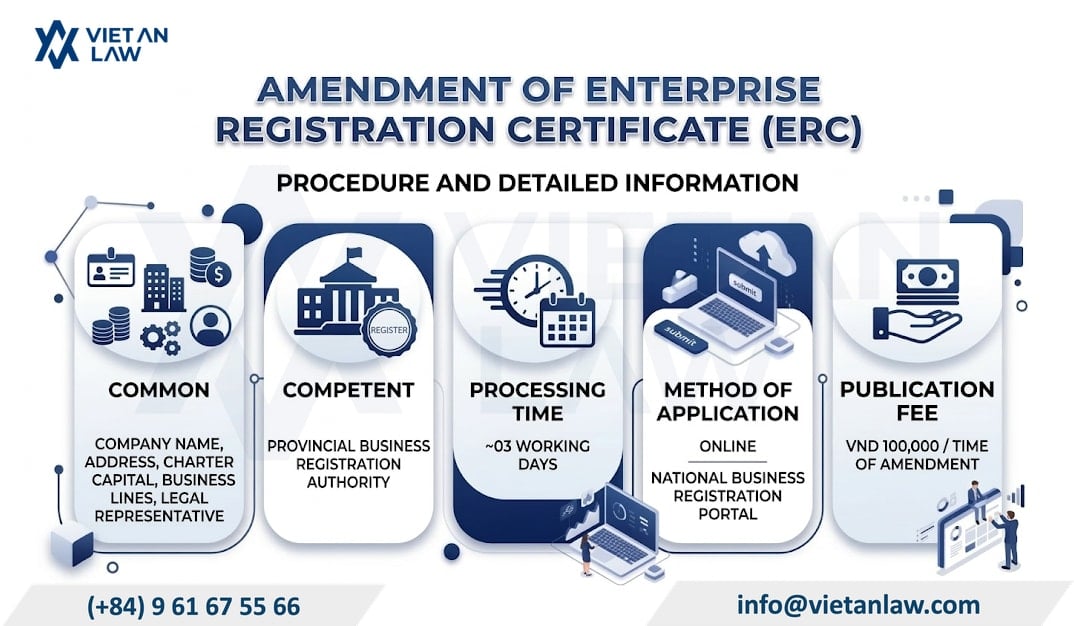
Changing company registration in Vietnam is a mandatory legal procedure when a company needs to update its registered business information, such as its company name, head office address, charter capital, business lines, or legal representative. Under the Law on Enterprises in Vietnam, companies must amend their Enterprise Registration Certificate (ERC) with the competent Business Registration Authority whenever such changes occur.
In practice, businesses need to change company registration in Vietnam due to operational adjustments, corporate restructuring, capital increases or decreases, relocation of the head office, or updates to corporate management information. Failure to amend the enterprise registration may lead to administrative penalties and potential legal compliance risks.
This article by Viet An Law provides a guide on Enterprise Registration Certificate (ERC) amendment procedures in Vietnam, including cases requiring amendment, required documents, procedures, processing time, and important legal considerations for enterprises.
Companies with Vietnamese capital and foreign-invested companies (FDI) that make changes to the information in their enterprise registration dossier or Enterprise Registration Certificate (ERC), except for share transfers in joint-stock companies, must carry out business registration amendment procedures with the provincial Business Registration Authority.
Changes to information on the Enterprise Registration Certificate
When a company changes any information recorded in its Enterprise Registration Certificate, it must carry out procedures to amend its business registration, including:
Change of company name (including Vietnamese name, foreign name, and abbreviated name).
Change of enterprise type, such as:
Conversion from a single-member limited liability company to a multi-member limited liability company;
Conversion from a limited liability company to a joint-stock company;
Conversion from a joint-stock company to a limited liability company;
Conversion from a private enterprise to a company.
Change of the company’s head office address.
Change of the company’s contact information, including telephone number, fax number, email address, or website.
Change of the charter capital (including increase/decrease of charter capital) and changes in the capital structure of members.
Change of the company’s legal representative.
Change of information relating to the legal representative, including:
Change of title or position;
Change of ID card, citizen identification card, or passport number;
Change of permanent or current residential address.
Change of information of the owner of a single-member limited liability company, including:
Transfer of ownership;
Change of the business registration certificate of the owner (if the owner is an organisation);
Change of personal information of the owner (if the owner is an individual).
Changes to information in the Enterprise Registration dossier
Enterprises must also notify the authority when there are changes to the enterprise registration dossier, including:
Addition of new business lines;
Modification of registered business sectors;
Changes in tax registration information, accounting manager, or tax notification address;
Changes in information of foreign shareholders, including:
Change of foreign shareholders;
Change in the capital contribution ratio of foreign shareholders;
Changes in the passport or residential information of foreign shareholders.
Changes in beneficial owner information under the new regulations are effective from 01 July 2025.
Amendments for foreign-invested companies in Vietnam
For companies with foreign investment:
Changes to information in the Enterprise Registration Certificate and enterprise registration dossier follow procedures similar to those applied to Vietnamese-owned companies.
However, if the foreign-invested company has been granted an Investment Registration Certificate (IRC) and the changes affect information related to the investment project, such as:
Business sectors related to project objectives;
Company name (if it is identical to the project name);
Project location (if it is the same as the company’s address);
Increase in charter capital (increase in contributed capital within the total investment capital);
Change of investors,
Then the enterprise must also carry out procedures to amend the Investment Registration Certificate at the same time.
In cases where new investors contribute capital or purchase shares, the company must take procedures for registration of capital contributions or share purchases.
Cases where it is not necessary to submit a business registration amendment application
Enterprises are not required to submit an application for business registration amendment in the following cases:
Changes to shareholder information in a joint-stock company, including share transfers;
Changes to founding shareholders (except where the change occurs because the founding shareholders have not fully paid or have only partially paid for the shares they registered to purchase in accordance with regulations).
In these cases, the enterprise is advised to complete the internal documentation within the company and is not required to undertake procedures with the Business Registration Authority. However, the parties involved must still declare and pay personal income tax arising from the share transfer under tax regulations.
Cases where enterprises are not allowed to register business registration amendments
Enterprises are not allowed to register changes to their business registration in the following situations:
The Business Registration Office has issued a notice of violation indicating that the enterprise falls under cases subject to revocation of the Enterprise Registration Certificate, or a decision on revocation of the certificate has already been issued.
The enterprise is currently undergoing dissolution procedures according to its dissolution decision.
The amendment is restricted pursuant to requests from the Court, enforcement authorities, or police authorities.
Documents required for business registration amendment
When an enterprise wants to change its business registration and uses the services of Viet An Law Firm, clients need to provide Viet An Law with the information of the intended changes and the relevant documents, and sign the prepared dossiers.
All remaining tasks, including drafting documents, filing procedures with competent state authorities, and receiving the results according to the requested amendments, will be handled by the lawyers of Viet An Law.
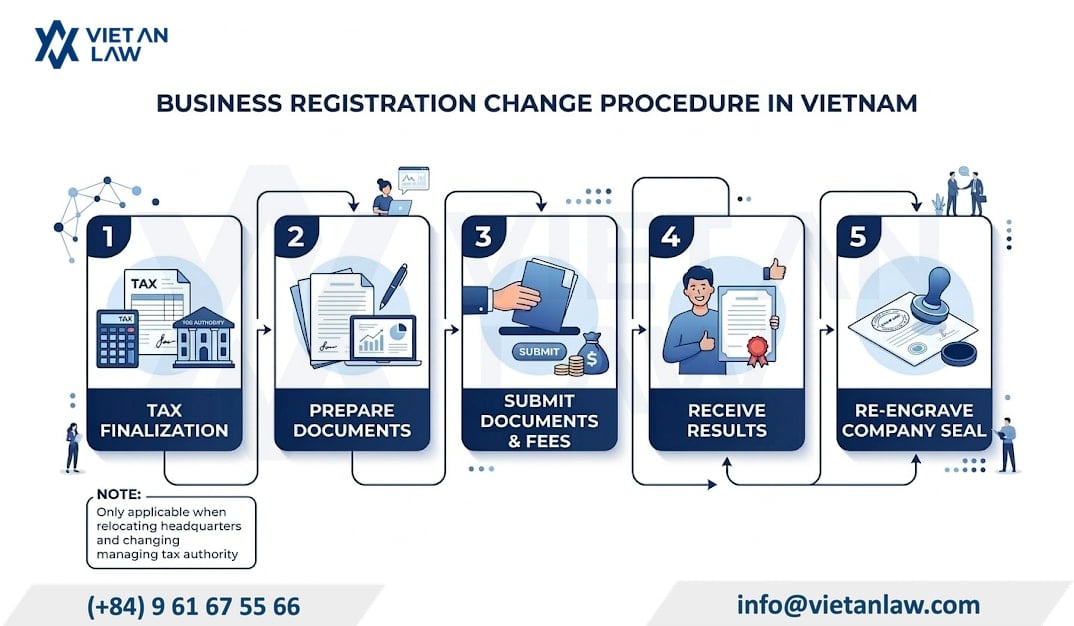
Business registration amendment procedures in 2025, depending on the specific content of the amendment, the procedure for amending enterprise registration information will include the following steps.
Procedure for changing company registration in Vietnam
Step 1: Tax finalisation with the current tax authority
(This step is only required when the company relocates its head office to an area under a different tax authority.)
Tax finalisation obligations
When a company changes its head office address to another district or province, it must complete tax finalisation procedures with the current tax authority before carrying out the business registration amendment at the Business Registration Office.
This requirement is one of the new regulations applied in 2025 when enterprises change their head office to another district or province.
Confirmation of tax obligations
Except for newly established companies or companies that have recently completed tax finalisation with the current tax authority, enterprises relocating to another district or province must perform procedures to confirm tax obligations with the previous tax authority.
After receiving confirmation from the tax authority, the enterprise may proceed with the business registration amendment at the Business Registration Authority where the new head office is located.
Step 2: Preparation of amendment documents
Viet An Law will advise enterprises on the legal conditions, procedures, and requirements related to each type of amendment.
If clients use Viet An Law’s services, we will prepare the required documents and send them to the client for signature before proceeding with the next steps.
If the client submits the application independently, the enterprise must prepare the amendment dossier corresponding to the specific content of the amendment and submit it to the Business Registration Office.
Step 3: Submission of the amendment dossier and disclosure fee
The enterprise submits the dossier to the provincial Business Registration Authority, where the company’s head office is located.
The enterprise must submit one set of documents and pay the enterprise information disclosure fee.
Method of submitting business registration amendment applications
According to Clause 1, Article 37 of Decree 168/2025/ND-CP on enterprise registration: “Online enterprise registration means that the enterprise founder or enterprise uses an electronic identification account to undertake enterprise registration through the National Business Registration Portal.”
According to the Law on Enterprises 2025 and Chapter IV of Decree 168/2025/ND-CP, enterprise registration procedures must now be conducted entirely online, and the Business Registration Authority no longer accepts direct submissions for enterprise registration amendments.
All procedures are carried out through the enterprise’s online registration account, and the results will be sent to the enterprise by postal service. Enterprises must pay amendment fees and information disclosure fees via bank transfer or ATM card payment.
Step 4: Receiving the results of the amendment
Within 03 working days from the receipt of a valid application, the Business Registration Office will update the enterprise information in the National Enterprise Registration Database.
At the same time, the authority will issue one of the following documents:
A new Enterprise Registration Certificate reflecting the amended information; or
A certificate confirming changes to enterprise registration information.
Note: From 01st July 2025, the Enterprise Registration Certificate will only be issued in electronic form and will no longer be issued in paper format.
If the dossier is incomplete or invalid, the Business Registration Office will issue a notice requesting the company to amend or supplement the dossier and state the reasons.
Step 5: Re-engraving the company seal
(This step is required only if the amendment affects information on the company seal.)
Cases where enterprises may need to change their seal include:
Change of the company’s Vietnamese name;
Change of enterprise type;
Relocation of the head office to another province;
Relocation of the head office to another district (if the seal contains the old district address).
Enterprises may engrave and manage their own seal without taking any notification procedures with state authorities.
Dossier for changing company registration in Vietnam
According to the latest regulations under Decree No. 168/2025/ND-CP, depending on the content of the amendment, the application dossier for enterprise registration amendment will include one of the following sets of documents.
Under the new regulations, a change is that the meeting minutes and personal legal documents will no longer be required if the individual has already been identified through the personal identification number declared in the application dossier.
Dossier for company name change
Application for amendment of enterprise registration information according to the form prescribed in Circular No. 68/2025/TT-BTC;
A copy or original of the resolution or decision approving the change of the
enterprise name issued by:
The owner of a single-member limited liability company;
The Members’ Council for multi-member limited liability companies or partnerships;
The General Meeting of Shareholders for joint-stock companies;
Power of Attorney authorising the amendment procedure (if applicable).
Dossier for change of company address
Application for amendment of enterprise registration information according to the form prescribed in Circular No. 68/2025/TT-BTC;
A copy or original of the resolution or decision approving the change of the
company’s head office address issued by:
The owner of a single-member limited liability company;
The Members’ Council for multi-member limited liability companies or partnerships;
The General Meeting of Shareholders for joint-stock companies;
Power of Attorney for the amendment procedure (if any).
Dossier for change of legal representative
Application for change of the legal representative according to the form prescribed in Circular No. 68/2025/TT-BTC;
A copy or original of the resolution or decision approving the change of legal representative issued by:
The owner of a single-member limited liability company;
The members’ Council for multi-member limited liability companies;
The general meeting of shareholders for joint-stock companies in cases where the change affects the company charter;
The board of directors, in cases where the change does not affect the charter, except for personal information and the signature of the legal representative.
Power of Attorney for the amendment procedure (if applicable).
Dossier for the increase/decrease of charter capital
Application for amendment of enterprise registration information according to the form prescribed in Circular No. 68/2025/TT-BTC;
A copy or original of the resolution or decision approving the change of charter capital issued by:
The owner of a single-member limited liability company;
The Members’ Council for multi-member limited liability companies or partnerships;
The General Meeting of Shareholders for joint-stock companies;
Original or copy of documents proving capital contribution or share purchase under the increased charter capital (in case of capital increase);
A copy of the approval document issued by the Investment Registration Authority regarding capital contribution, share purchase, or capital acquisition by foreign investors or foreign-invested economic organisations (if required under the Law on Investment);
Power of Attorney for carrying out the amendment procedure (if applicable).
Dossier for change of business lines
Notice of amendment of enterprise registration information according to the form prescribed in Circular No. 68/2025/TT-BTC;
A copy or original of the resolution or decision approving the change of business sectors issued by:
The owner of a single-member limited liability company;
The Members’ Council for multi-member limited liability companies or partnerships;
The General Meeting of Shareholders for joint-stock companies;
Power of Attorney for carrying out the amendment procedure (if applicable).
The provincial Business Registration Authority, where the enterprise’s head office is located, has the authority to handle applications for amendments to the enterprise registration of the company.
The provincial Business Registration Authority, where the dependent unit is located, has the authority to handle applications related to branches, representative offices, or business locations.
Important note for each type of business registration amendment
Notes on changing the company name
The new enterprise name must not be identical to or confuse with an already registered enterprise name.
If the company converts its enterprise type, it may generally retain its existing name.
When changing the company name, enterprises should consider updating brand identification elements such as trademarks and domain names consistent with the new name.
Changing the company name may require many additional procedures, such as updating the company seal, digital signature, signage, invoices, business licenses, and asset ownership certificates. Therefore, enterprises should carefully consider the decision before changing the company name.
Notes on changing the company’s head office address
The new address must be clear, specific, and reachable through all forms of communication, including direct contact and correspondence. If authorities cannot contact the enterprise, the enterprise identification number may be suspended.
The head office address cannot be located in residential apartments used for housing purposes. Business registration authorities will not approve enterprise registration amendments for companies registered at residential apartments.
During the process of changing the head office address, enterprises should limit issuing invoices using the old address, as the timing of the new address may not yet be confirmed, or the invoice system may have been closed for district/province relocation procedures.
Notes on adding new business lines
Existing business sectors that have not yet been coded must be updated under Level 4 industry codes.
Newly added business sectors must also follow the Level 4 industry classification under Decision No. 27/2018/QD-TT.
For sectors without an official industry code but regulated by specialised legislation, enterprises should use the closest corresponding industry code and specify the relevant legal basis.
For conditional business sectors, enterprises must obtain the required business licenses or satisfy relevant conditions before commencing operations.
Notes on increasing charter capital
Enterprises can increase charter capital as needed, but they must notify the business registration authority within 10 days of the date of capital increase.
When an organisation contributes additional capital, the contribution must be made via bank transfer to the company’s account. Individuals may contribute capital either via bank transfer or in cash.
Increasing charter capital may affect the license tax level. Enterprises must declare and pay additional license tax if applicable.
Notes on decreasing charter capital
Enterprises can reduce charter capital only after at least two years of operation and must satisfy the relevant legal conditions.
The capital reduction must be implemented proportionally according to ownership ratios.
Enterprises should also consider whether their business sectors require statutory capital requirements.
During the capital reduction procedure, authorities may request evidence proving that the company has fully contributed the registered capital.
Notes on adding members to a single-member LLC
When a single-member limited liability company adds a new member, the company must simultaneously carry out procedures to convert the enterprise type.
The new member must provide valid notarised identification documents.
The transferring member must also ensure that their identification documents are valid and comply with legal requirements.
Notes on share transfers in joint-stock companies
Share transfers in a joint-stock company do not require procedures at the Business Registration Office.
However, the company must declare and pay personal income tax on share transfers at a fixed rate of 0.1% of the transfer value, similar to securities transfers, regardless of whether the company makes a profit or loss.
In the case of share gifting or transfers with zero value, the recipient must pay 10% personal income tax.
Notes on capital transfer in limited liability companies
When capital contributions in a limited liability company are transferred, procedures must be carried out at the Business Registration Office, and the transferring party must declare personal income tax.
The transferring party must pay tax if there is a capital gain. Even if the transfer price is equal to the capital contribution, tax authorities may still impose tax based on the profit ratio shown in the company’s most recent financial statements.
Similar to joint-stock companies, if the capital contribution is gifted or transferred for zero value, the recipient must pay 10% personal income tax.
Notes on changing the legal representative
A company may have one or multiple legal representatives.
If there are more than two legal representatives, besides the typical titles such as Chairperson of the Board of Directors / Chairperson of the Members’ Council and General Director/Director, the enterprise may appoint other titles such as Deputy Director, Executive Director, Department Head, … However, the company charter must clearly specify the powers and responsibilities of each legal representative.
One individual may act as the legal representative of multiple companies, except in certain cases involving public companies.
If the former legal representative’s tax identification number is suspended, the enterprise cannot change the legal representative.
Individuals currently managing enterprises with suspended tax identification numbers cannot register as legal representatives of other companies.
Individuals who previously served as legal representatives of a company that was declared bankrupt are not allowed to become legal representatives of another company within 1 to 3 years from the bankruptcy declaration.
If the legal representative is a hired manager, the company must keep the labour contract and appointment decision for the new representative.
If the change of legal representative results in changes to the company charter, the meeting minutes must clearly state the amended provisions.
When changing the legal representative, the enterprise should update bank account registration information and notify business partners and social insurance authorities.
For enterprises holding sub-licenses linked to the legal representative, those licenses must also be updated.
If the change of legal representative is accompanied by capital transfer to the new representative, personal income tax declaration obligations must also be considered.
After completing the business registration amendment, enterprises may need to perform several additional procedures, including:
Notifying banks, social insurance authorities, relevant government agencies, partners, and clients if there are changes in the company name, company address, or legal representative.
Updating the company signboard if the company name or head office address has changed.
Updating information on digital signatures and electronic invoices if the company name or head office address has changed.
Updating enterprise information on the operation certificates of business locations, branches, and representative offices.
Updating enterprise information on conditional business licenses, such as travel licenses, business licenses, transport licenses, trademark registration certificates, and other relevant permits.
Specific guidelines for post-amendment procedures
Change of company name
Re-engraving the company seal;
Replacing the company signboard at the head office;
Submitting a notice to the tax authority regarding changes to invoice information;
Updating information with banks and social insurance authorities;
Updating the name on sub-licenses owned by the company, such as international travel licenses, domestic travel licenses, or trademark registration certificates;
Amending the company charter;
Notifying business partners of the company name change.
Change of head office address
Re-engraving the company seal (if the head office is moved to another district);
Replacing the company signboard;
Amending the company charter;
Submitting a notice to the tax authority regarding invoice information changes;
Updating information with banks and social insurance authorities (if necessary);
Updating information on related sub-licenses;
Notifying partners of the change of company address.
Change of business lines
For conditional business sectors, enterprises may operate once they satisfy the legal requirements and obtain the necessary licenses.
Amending the company charter.
If the company engages in retail activities or provides services directly to individuals, it must register to issue electronic invoices generated from cash registers (effective from 01 June 2025).
Change of charter capital
Enterprises must ensure that changes in charter capital are properly reflected in the financial statements under owners’ equity.
Amending the company charter.
Change of capital ownership structure
Updating the shareholder register or member register;
Amending the company charter;
Declaring and paying personal income tax on capital transfer (for joint-stock companies) or filing tax declarations for capital transfer (for limited liability companies).
Change of legal representative
Updating bank account information;
Notifying business partners;
Amending the company charter;
Updating related sub-licenses.
Establishment or amendment of business locations, branches, or representative offices
Paying license tax for branches or business locations;
Declaring taxes for branches, business locations, or representative offices;
Installing company signboards at the branch, representative office, or business location.
Is tax finalisation or reissuance of VAT invoices required when making changes?
When relocating the head office to another district or province, enterprises must complete tax closing procedures but are not required to perform a full tax finalisation.
When converting the enterprise type and the new entity inherits all tax obligations of the previous entity, tax finalisation before conversion is not required.
When changing the company name or address, enterprises must notify the tax authority to update information on issued invoices.
When must the company seal be re-engraved?
A new company seal is required in the following cases:
Change of company name;
Change of enterprise type;
Change of head office to another district or province (although not mandatory, enterprises are recommended to replace the seal if the old seal shows the previous district or province).
According to the amended Law on Enterprises 2025, effective 01st July 2025, enterprises that engrave a new seal with the updated company name may choose the number, form, and design of the seal, provided that it contains at least the company name and enterprise code.
Enterprises may even retain the old seal with the previous company name.
The amended Law on Enterprises 2025 also stipulates that enterprises are no longer required to notify the Department of Finance of their seal specimen before using it.
Where can enterprises look up amended registration information?
Amended enterprise registration information can be searched on the National Enterprise Registration Portal: www.dangkykinhdoanh.gov.vn
Can applications for amendment be submitted online?
Yes. Applications for enterprise registration amendments are submitted through the National Business Registration Portal.
How long does the amendment procedure take?
Normally, the processing time is 03 working days from the date the valid dossier is received.
What is the fee for business registration amendment?
The current enterprise information disclosure fee is VND 100,000 per submission.
The amendment registration fee may be waived if the application is submitted electronically.
Viet An Law’s services for changing company registration in Vietnam
Viet An Law provides a range of services, including:
Advising and preparing documents for company name changes;
Advising and preparing documents for the change of company address;
Advising and preparing documents for charter capital changes;
Advising and preparing documents for the change of legal representative;
Advising and preparing documents for the amendment of registered business lines;
Advising and carrying out capital transfer procedures and changes in ownership structure;
Providing consultation on post-amendment procedures;
Advising on enterprise account registration with the Department of Finance;
Guiding clients on issuing invoices and updating invoice information;
Confirming tax obligations when changing the company address across districts or provinces;
Advising on other legal issues arising during business operations.
Viet An Law provides a full-package service for changing company registration in Vietnam, including reviewing legal conditions, preparing documents, submitting applications online, monitoring the results, and supporting related procedures such as invoices, banking, sub-licenses, and tax obligations
Fast & Reliable Legal Assistance
Fill out the form below and get connected with a lawyer quickly.
Business Registration Application vs ERC in Vietnam explained. Complete guide covering forms, content differences, issuance procedures, and legal requirements for enterprises.
Conditions for seizing collateral of bad debt in Vietnam explained. Learn legal requirements, sole residence protections, and creditor rights under 2025 laws.
Is cheap company formation service in Vietnam trustworthy? Learn about risks and why Viet An Law offers transparent, reliable company formation with no hidden fees.
Can a person abroad file for Cross-Border Divorce in Vietnam? Complete legal guide covering procedures, required documents, court jurisdiction, and applicable laws for Vietnamese citizens overseas.
Trademark for the household appliance industry in Vietnam: Complete guide on registration requirements, Nice classification (Class 7, 9, 11, 21), application process, and brand protection strategies.