Recently, rumors have been circulating across social media and business forums claiming that “salary payments exceeding 5 million VND must be made via bank transfer”. This information has caused significant confusion for many enterprises – particularly SMEs – regarding cash payroll regulations, deductible expense accounting, and tax compliance. To provide definitive clarity on mandatory non-cash payment Vietnam, the Ministry of Finance issued Official Dispatch 218: Must salaries over 5 million VND Be Paid via Bank Transfer? (Official Dispatch No. 218/CST-TN dated January 27, 2026), offering official guidance on the application of non-cash payment vouchers for wages and salaries when determining corporate income tax (CIT) obligations.
In Official Dispatch 218/CST-TN, the Ministry of Finance clarified the guidelines on the application of non-cash payment documents when paying salaries and wages to employees for inclusion in deductible expenses when determining taxable corporate income. Specifically:
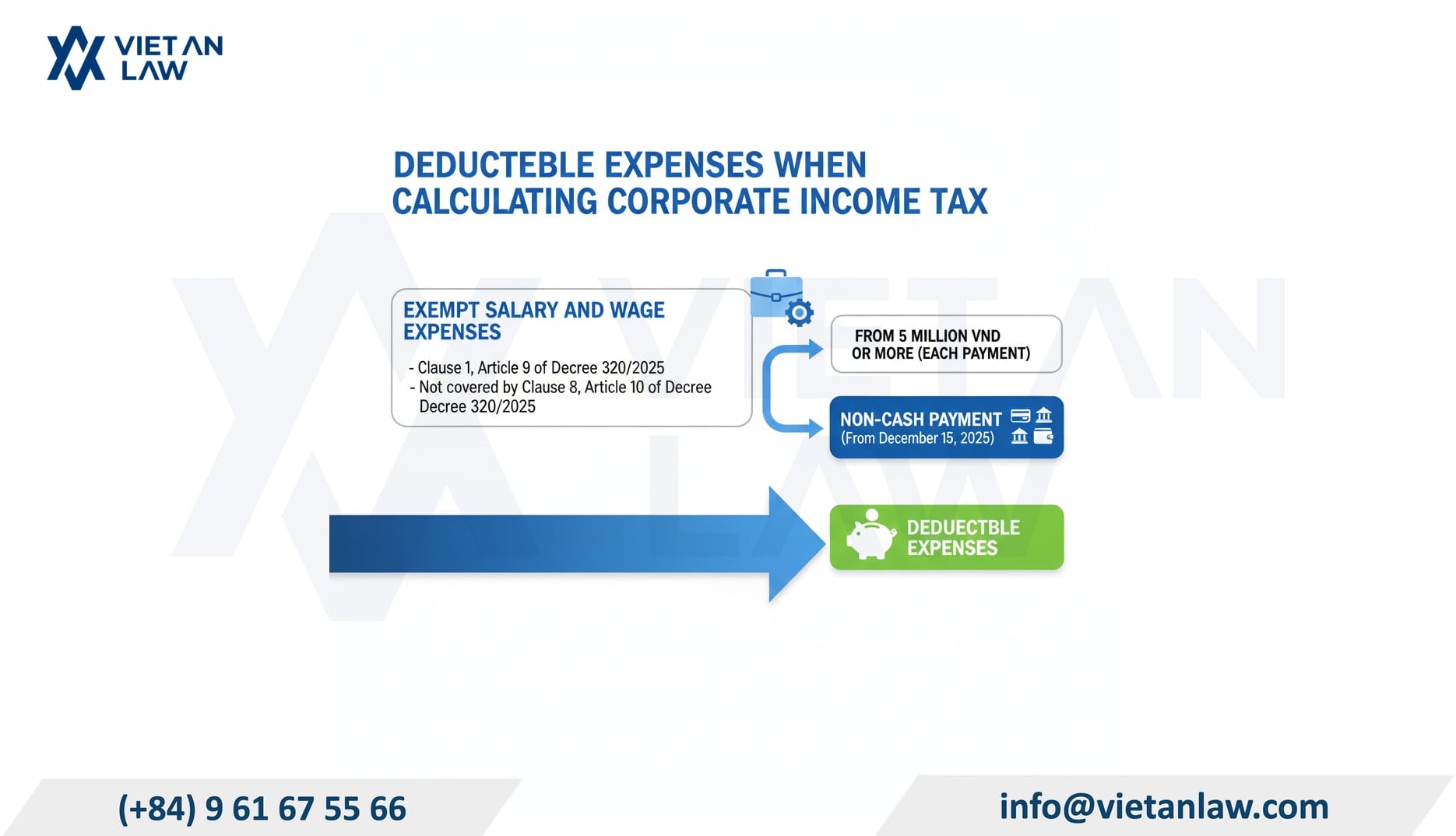
According to point c, clause 1, Article 9 of the Law on CIT 67/2025/QH15, it is stipulated that:
“Article 9. Deductible and non-deductible expenses when determining taxable income
1. Except for the expenses specified in Clause 2 of this Article, enterprises may deduct expenses when determining taxable income if they meet the following conditions:
…c) Expenses with sufficient invoices and non-cash payment documents as prescribed by law, except for specific cases as prescribed by the Government.”
Clause 1, Article 9 of Decree No. 320/2025/ND-CP specifically stipulates point c, clause 1, Article 9 of the Law on CIT, according to which enterprises are allowed to deduct expenses if they simultaneously meet three conditions:
At the same time, point a, clause 8, Article 10 of Decree No. 320/2025/ND-CP stipulates expenses that are not deductible when determining taxable income, including salaries, wages, and other payments to employees that the enterprise has accounted for as production and business expenses in the period but were not actually paid or for which there are no payment documents as prescribed by law.
Thus, salaries and wages are payments to employees, arising from the labor relationship, and are not expenses for purchasing goods or services. Therefore:
Official Dispatch 218 emphasizes that salaries and wages are classified as “other payments” related to the production and business activities of enterprises. Therefore, when these payments are 5 million VND or more per transaction, in order to be included as deductible expenses, the enterprise must have non-cash payment documents and not fall under the non-deductible expenses stipulated in Clause 8, Article 10 of Decree 320/2025/ND-CP.
According to the guidelines in Official Letter 218/CST-TN, from the effective date of Decree 320/2025/ND-CP (December 15, 2025):
Therefore, this expense does not qualify to be accounted for as a deductible expense when calculating corporate income tax.
In other words, paying salaries in cash is not prohibited, but for payments of 5 million VND or more per transaction, if there is no non-cash payment document, the business will not be able to deduct these expenses when calculating corporate income tax.
Based on Article 26 of Decree 181/2025/ND-CP, non-cash payment vouchers are documents proving non-cash payment as stipulated in Decree 52/2024/ND-CP on non-cash payments, excluding documents where the buyer deposits cash into the seller’s account.
Conversely, payments made in cash, or where the payer provides cash for the beneficiary to deposit into their own account, even with bank confirmation, are not considered non-cash payments and are not eligible as deductible expenses when determining taxable income.
To mitigate tax risks in the context of new policies, enterprises need to pay special attention to the following:
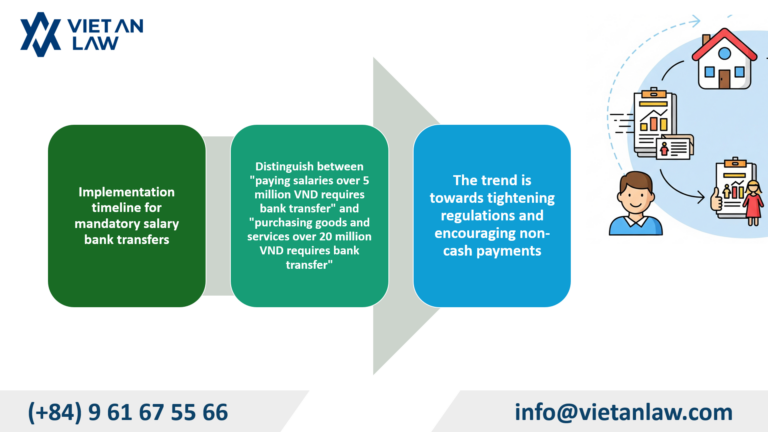
One common mistake enterprises make is incorrectly applying the effective date of mandatory non-cash payment Vietnam.
According to Clause b, Point 1, Article 24 of Decree 320/2025/ND-CP, the requirement for non-cash payment documents for individual payments of 5 million VND or more only applies from the effective date of the Decree (December 15, 2025).
Therefore:
Failure to clearly distinguish timeframes can lead to two risks: either the incorrect exclusion of legitimate expenses, or the exclusion of expenses due to a lack of application of regulations.
In reality, many enterprises still confuse:
It should be emphasized that:
Salary payments are regulated by specific provisions of corporate income tax law, namely the Law on CIT 2025 and Decree 320/2025/ND-CP, with an applicable threshold of 5 million VND or more per payment. Confusion between these two mechanisms can easily lead to incorrect application of regulations, increasing risks in accounting and tax matters.
Although the law does not absolutely prohibit paying salaries in cash in all cases, it is clear that the government’s management trend is to gradually restrict cash payments, especially for large-value expenditures.
Encouraging cashless payments aims to achieve several management objectives, such as:
In this context, Vietnam salary bank transfer regulations is not only a tax requirement for payments of 5 million VND or more, but also a safe financial management solution that aligns with current tax management trends.
The above is an explanation regarding Official Dispatch 218: Must salaries over 5 million vnd be paid via bank transfer? For any further questions, please contact Viet An Law – Tax Agency for the best advice and support!