


Singapore, with its dynamic and stable business environment, is one of the world’s leading economic centers. When deciding to set foot in this potential market, choosing the right type of business is one of the most important decisions. Singapore’s corporate legal system has many forms of businesses for investors to choose from, from small-scale private limited companies (Pte Ltd) to large-scale public companies, capable of raising capital from the public. Each type brings its own benefits and opportunities, helping businesses optimize their business operations, protect their assets and make the most of the government’s preferential policies. Viet An Law would like to introduce you to the types of businesses in Singapore through the article below, thereby making the most suitable choice for your business goals and strategies.
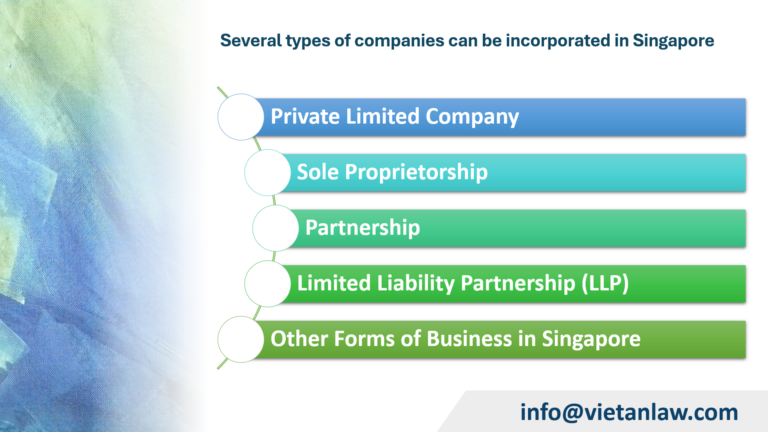
Several types of companies can be incorporated in Singapore
Private Limited Company (Pte Ltd)
A Private Limited Company (Pte Ltd) is the most popular and flexible type of business in Singapore. It is an ideal choice for small and medium-sized businesses, as well as start-ups. Key features of the Pte Ltd type:
- Limited Liability: Shareholders are only responsible for the capital contributed to the company. This protects the shareholders’ personal assets in case the company encounters financial difficulties.
- Separate legal entity: Pte Ltd is an independent legal entity, with separate rights and obligations from shareholders.
- Limited number of shareholders: Pte Ltd has a maximum of 50 shareholders.
- No public offering of shares: The company’s shares may only be transferred to selected investors.
Sole Proprietorship
Sole Proprietorship is the simplest form of business in Singapore, where an individual owns and operates the entire business. This type is suitable for small businesses, just starting out, or individuals who want to do business independently. Main characteristics of the type of private enterprise:
- A single owner: Only one individual owns and operates the business.
- There is no separate legal status: The business and the owner are one.
- Unlimited Liability: The owner is fully responsible for all debts and obligations of the business.
- Easy to establish and manage: The establishment procedure is simple, does not require many administrative procedures.
Partnership
A partnership is a form of business in which two or more people work together to do business, share profits, and are jointly responsible for the company’s debts. In Singapore, there are three forms of partnerships:
- General Partnership: This is the most common form of partnership, in which all partners are liable for unlimited liability for the company’s debts.
- Limited Partnership: In this type, there are two types of partners: general partners and limited partners. Limited partners are only responsible for the amount of capital contributed.
- Limited Liability Partnership (LLP): This is a special type of partnership in which all partners have limited liability. LLP combines the advantages of a partnership and a limited liability company.
General characteristics of a partnership
- Multiple owners: At least two or more people co-own and operate the business.
- Profit sharing and responsibility: Partners share profits and are jointly responsible for the company’s debts (except in the case of limited liability partners).
- Joint decisions: Important company decisions are usually made based on the consensus of all partners.
- No separate legal status: A partnership is not an independent legal entity, but just a combination of individuals.
Limited Liability Partnership (LLP)
A limited liability partnership (LLP) is a form of business that combines the advantages of a partnership and a private limited company. The main characteristics of the LLP type:
- Limited Liability: Like a limited company, the partners in an LLP are only liable for the company’s debts to the extent of the capital contributed. This protects the personal assets of the partners.
- Legal Status: An LLP has a separate legal status, just like a limited liability company. This makes it possible for the LLP to own assets, enter into contracts, and litigate.
- Flexibility: LLPs allow partners a lot of freedom in managing and running the company.
- Multiple partners: An LLP can have two or more partners.
- Combination of management and ownership: Partners can be both investors and involved in the management of the company.
Other Forms of Business in Singapore
| Company Limited by Guarantee (CLG) | Variable Capital Company (VCC) | Representative Office | Branch | |
| Character | The responsibilities of members are limited to the level to which they have committed to contribute to the company in the event of the dissolution of the company. | VCC is a unique corporate structure, designed specifically for investment funds. It provides high flexibility in structuring and operating funds, suitable for various investment strategies such as venture capital, private equity, and real estate funds. | A representative office is not an independent legal entity but only an extension of the foreign parent company. This type is not allowed to engage in business activities, but can only carry out activities such as promoting the parent company’s products and services, market research, and communication. | A branch is an extension of a foreign parent company and is not an independent legal entity. The branch may engage in business activities but must strictly comply with Singapore’s regulations and have a close relationship with the parent company. |
| When should you register for this form | CLG is commonly used for non-profit organizations and associations | VCC is widely used in the field of investment fund management | Usually registered when the company wants the presence of a legal entity to understand the market before making a major investment decision. | Often used when the company wants to expand its business to Singapore. |
What form should investors choose when setting up a company in Singapore?
Choosing the right type of business in Singapore is an important decision, directly affecting the rights, obligations and development of your business. To make the right decision, you need to carefully consider the following factors:
- Business goals: What do you want to achieve with your business? As a startup, a multinational company, or a non-profit organization?
- Business Size: Is your business big or small? Do you have any plans to expand in the future?
- Ownership structure: Who do you want to share profits and management rights with?
- Liability: To what extent do you want to be responsible?
- Investment capital: How much capital do you need to start and maintain a business?
If you need assistance in setting up a company, please contact Viet An Law Firm for quick support!