


Understanding the company registered office address in Vietnam is an issue that individuals and organizations must thoroughly research before establishing an enterprise or changing their registered head office address. Selecting a compliant location for company address registration in Vietnam is not merely a matter of completing business registration procedures; it also directly affects tax administration, commercial transactions with partners, and the receipt of official notices from state authorities. The article below analyzes the registered office requirements in Vietnam, the statutory conditions that must be satisfied, and the specific locations permitted for use as a head office under current Vietnamese law.
What is the head office of an enterprise in Vietnam?
The head office of an enterprise is the official contact address of the business, registered with the business registration authority upon incorporation and stated on the Enterprise Registration Certificate.
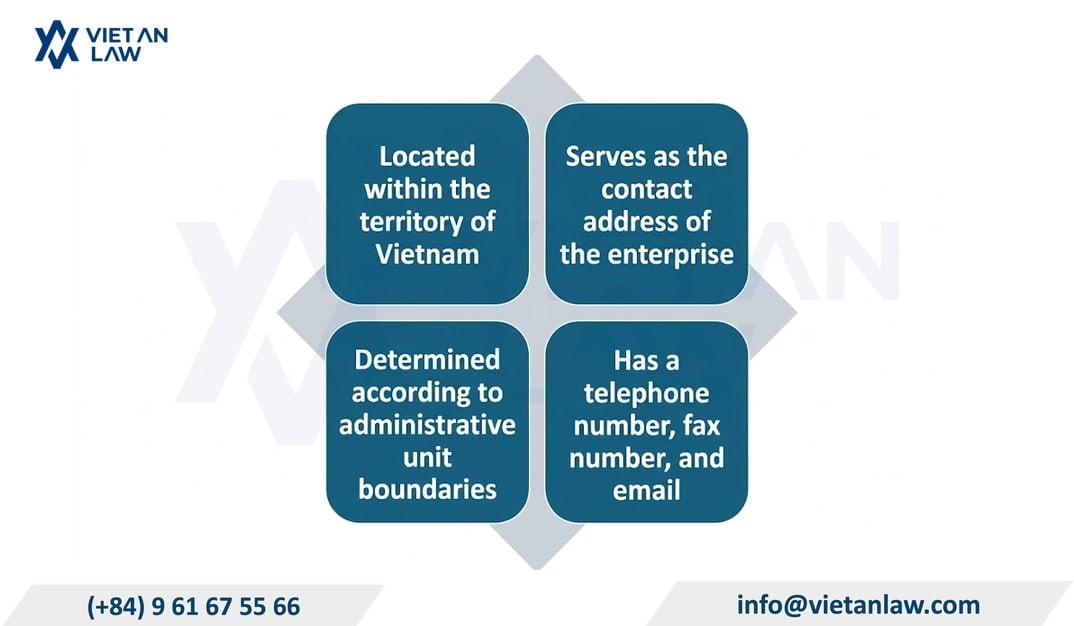
Pursuant to Article 42 of the Vietnamese Law on Enterprises 2020, the head office of an enterprise must satisfy the following fundamental requirements:
- It must be located within the territory of Vietnam;
- It must serve as the contact address of the enterprise;
- It must be determined according to administrative division boundaries;
- It must have a telephone number, fax number, and email address (if any).
Registered office requirements for company establishment in Vietnam
To determine the exact business address requirements in Vietnam, an enterprise should sequentially verify each of the statutory criteria below before submitting its incorporation dossier.
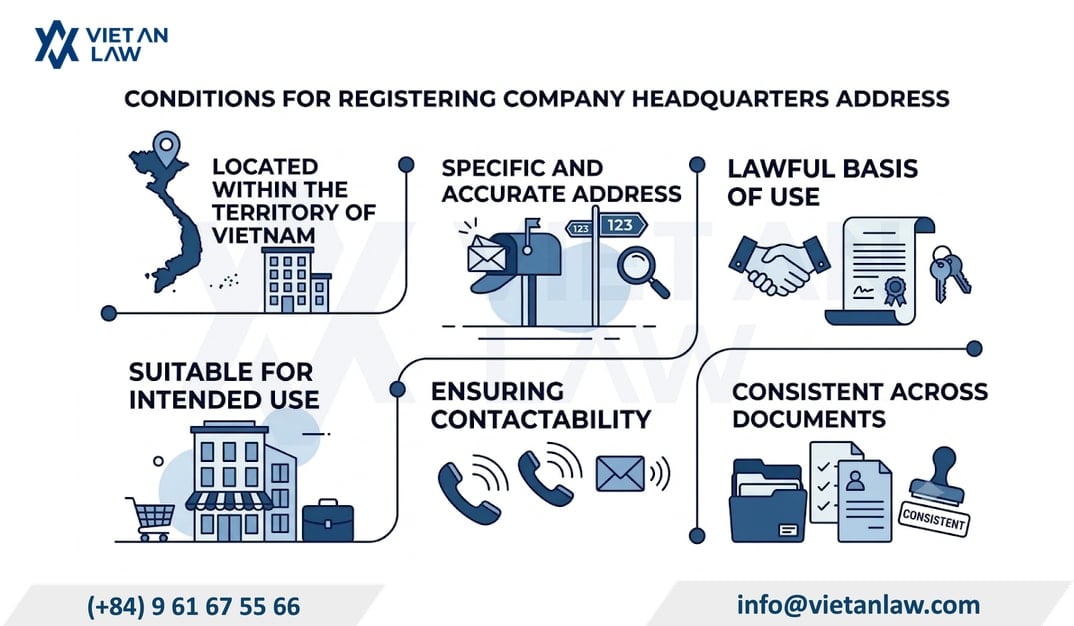
The address must be located within the territory of Vietnam
Under Article 42 of the Law on Enterprises 2020, the head office of an enterprise must be situated within the territory of Vietnam.
Accordingly, any enterprise established and registered under Vietnamese law must declare a head office address in Vietnam. This legal address for company registration in Vietnam must align with the official administrative boundary data and the actual physical location of the premises intended for use.
Regarding the registered office address for foreign-invested companies in Vietnam, the registration of the head office must likewise comply with Vietnamese regulations governing enterprises, investment, and any sector-specific conditions applicable to the projected business activities.
The address must be declared specifically and accurately
The head office address must be defined with sufficient clarity to identify the physical location and facilitate official communication. Depending on the characteristics of the location, the declared information typically comprises:
- House number, street name, or thoroughfare name;
- Hamlet, residential group, or equivalent unit, if any;
- Ward, commune, or corresponding administrative unit;
- Province or centrally-run city.
For an address located inside an office building, the enterprise should clearly specify the building name, floor number, and room number, if available. For a private house, it is necessary to accurately identify the house number, alley, street, and corresponding administrative unit.
Because the rearrangement or adjustment of administrative boundaries may alter how an address is recorded, enterprises must verify the administrative unit data currently in force at the time of registration. Enterprises should not use outdated addresses or state the names of administrative units that no longer conform to current administrative records.
The premises must have a lawful basis for use
An enterprise must possess a lawful basis to use the premises as its head office, such as:
- Premises under the lawful ownership of the enterprise;
- Premises leased from the owner or from another individual or organization;
- Premises borrowed or permitted for use under a lawful agreement;
- Office space allocated within a building that has an appropriate registered function.
For leased premises, the enterprise should execute a house lease contract or office lease agreement with a party legally entitled to lease the property. The contract must clearly specify the address, leased area, purpose of use, lease term, and the rights and obligations of the parties.
It should be noted that while Article 42 of the Law on Enterprises 2020 stipulates the substantive requirements for a head office, the components of an enterprise registration dossier are governed by the Law on Enterprises and Decree No. 168/2025/ND-CP on enterprise registration. One should not automatically assume that every standard company incorporation filing requires submitting the lease contract or certificate of land use rights and ownership of assets attached to land within the registration dossier. Nevertheless, the enterprise must still ensure its lawful right to use the premises and remain ready to provide supporting documentation when requested by competent state authorities under relevant regulations.
The premises must be consistent with the permitted purpose of use
Not every physical location that an enterprise can lease or occupy in practice is legally permitted to be registered as a company head office.
- The location intended for use must conform to the designated function of the construction work, as well as regulations on housing, construction, building management, and other relevant laws.
- For example, if an enterprise leases an apartment unit designated solely for residential purposes, it cannot automatically use that apartment as a company head office. Conversely, commercial, service, or office zones within a mixed-use building may be considered for company address registration in Vietnam if such use matches the approved building function and complies with applicable laws.
- Furthermore, for conditional business lines, the enterprise must examine additional statutory requirements concerning location, minimum area, physical facilities, fire prevention and fighting, or other sector-specific licensing conditions prescribed by law.
The address must ensure the ability to maintain contact with the enterprise
- The head office serves as the official contact address of the enterprise. Therefore, the business must select a location capable of receiving correspondence, official notices, transaction documents, and communications from state agencies and commercial partners.
- Enterprises should verify mail delivery capabilities, reception desk management, office access hours, and the lessor’s responsibilities regarding incoming mail and official notices.
- For enterprises utilizing shared offices or virtual offices, a clear distinction must be drawn between a service providing a mailing address and the lawful right to use physical premises to register a head office. The commercial name of a service package does not automatically prove that the address satisfies all business address requirements in Vietnam.
The address must be consistent throughout the enterprise registration dossier
Information regarding the head office address must be declared consistently across the application for enterprise registration and all related corporate documents corresponding to the specific enterprise type.
If the address is recorded incompletely, contains an incorrect house number or street name, or contradicts other declared information, the registration dossier may require amendment and supplementation.
In addition, enterprises must bear in mind that the address stated in the enterprise registration dossier must accurately reflect the location intended for actual use; businesses should not declare a nominal address merely to complete administrative procedures without having a genuine basis to use the site in practice.
Can a Vietnamese company head office be located at a private house, apartment unit, or virtual office?
This is one of the most common practical questions when individuals establish a company with a limited initial budget and seek a valid legal address for company registration in Vietnam.
Locating a company head office at a private house
An enterprise may select a private house as its head office if the location satisfies statutory regulations and the enterprise holds a lawful basis for use.
Where the house is owned by the company founder, it is necessary to verify the land and housing use rights and the suitability of the premises for the projected corporate use. If the house belongs to another party, the enterprise should execute a lease contract, borrowing agreement, or equivalent lawful arrangement.
For residential houses combined with business operations, the enterprise must check regulations governing building function, construction order, fire prevention and fighting, and the operational conditions of its specific business lines. Registering a head office at a residential house does not mean the enterprise is permitted to conduct all types of manufacturing or commercial activities at that site.
Locating a company head office at an apartment unit
Pursuant to Clause 8, Article 3 of the Vietnamese Law on Housing 2023, using an apartment unit for non-residential purposes falls under the category of strictly prohibited acts.
Consequently, an enterprise may not automatically use an apartment designated for residential occupancy as its company head office simply because it has signed a lease or obtained the apartment owner’s consent.
For mixed-use apartment buildings, the enterprise must distinguish residential apartment units from floor areas specifically designed and approved for office, commercial, or service functions. Businesses should only select spaces that possess an appropriate approved function and satisfy all related legal provisions.
Before signing a lease contract, the enterprise should inspect the legal dossier confirming the building’s designated functions, the exact layout of the leased area, and the internal management and use regulations of the apartment building.
Locating a company head office at a shared office or virtual office
Shared offices typically provide workstations, meeting rooms, receptionists, and administrative support services. Virtual offices generally focus on providing a contact address, mail handling, and certain basic administrative utilities.
Corporate law should not be interpreted to mean that any service marketed under the label “virtual office” is automatically accepted or automatically prohibited. The selection must be evaluated based on the substantive nature of the service, the lawful right to use the premises, the approved function of the floor space, and the capacity to meet relevant statutory requirements.
Enterprises should verify the following matters before executing a service contract:
- Whether the service provider holds the legal right to lease or grant the right to use the premises;
- Whether the address conforms to the approved functional use of the building;
- Whether the contract explicitly permits the client to use the address for company head office registration;
- Whether an effective mechanism is in place to receive mail, official notices, and support regulatory contact when necessary;
- Whether the service meets the specific spatial or operational requirements of the projected business lines.
Is the head office address the same as a business location?
The head office and a business location are distinct legal concepts under Vietnamese corporate law.
The head office is the official contact address of the enterprise. Meanwhile, a business location is a place where the enterprise conducts specific business activities. Pursuant to Article 44 of the Law on Enterprises 2020, an enterprise may establish branches, representative offices, and business locations in accordance with the law.
Under Point a, Clause 2, Article 30 of Decree No. 168/2025/ND-CP on enterprise registration, an enterprise may establish a business location at an address different from the place where its head office or branch is situated.
Therefore, an enterprise does not necessarily have to place its head office at the site where it directly sells goods, provides services, or deploys all commercial operations. Even so, both domestic firms and investors arranging a registered office address for foreign-invested companies in Vietnam must ensure that the head office address is accurately registered and meets all applicable statutory conditions.
Comparison table of locations commonly selected as a company head office
| Type of location | Eligibility for use as a head office | Important legal notes |
|---|---|---|
| Private house owned by the founder | May be used if it satisfies statutory regulations | Verify the exact address, land/house use rights, and building function |
| Leased house | May be used if supported by a lawful lease basis | Execute a clear lease contract specifying the exact purpose of lease |
| Leased office building space | May be used if consistent with the building’s function | Verify the floor, room number, lease term, and lessor’s right to lease |
| Apartment unit designated solely for residential use | Prohibited from being used as a head office under the ban on using residential apartments for non-residential purposes | Pursuant to Clause 8, Article 3 of the Law on Housing 2023 |
| Office or commercial floor area within a mixed-use building | May be used if it satisfies relevant legal conditions | Verify the approved construction function and building management regulations |
| Shared office or virtual office | Must be assessed on a case-by-case basis | Do not rely solely on the commercial service name; verify the right to use the premises and building function |
What procedures are required when changing a company head office address?
After incorporation, an enterprise may relocate its head office to another address due to operational needs, business expansion, or changes in leased premises. The enterprise must carry out procedures to register a change of head office address in accordance with Article 40 of Decree No. 168/2025/ND-CP.
The dossier for registering a change of head office address includes:
- An application form for registering changes to enterprise registration contents;
- A copy or original of the resolution or decision of the company owner, the Board of Members, or the General Meeting of Shareholders, corresponding to the specific type of enterprise.
Where changing the head office address results in a change of the managing tax authority of the taxpayer, the enterprise must complete tax relocation procedures with the relevant tax authority before registering the address change with the provincial-level business registration authority.
The registration dossier is submitted to the provincial-level business registration authority where the new head office is situated. Pursuant to Clause 4, Article 40 of Decree No. 168/2025/ND-CP, changing the head office address does not alter the rights and obligations of the enterprise.
Beyond the business registration procedure, the enterprise must review and update its address across value-added tax invoices, commercial contracts, bank accounts, sub-licenses, and other related regulatory records in accordance with applicable laws.
Frequently asked questions regarding legal address for company registration in Vietnam
What are the penalties for intentionally declaring untruthful or inaccurate information regarding the head office address in an enterprise registration dossier?
Pursuant to Article 43 of Decree No. 122/2021/ND-CP, as amended by Article 1 of Decree No. 288/2026/ND-CP, a monetary fine ranging from VND 30,000,000 to VND 70,000,000 shall be imposed for the act of declaring untruthful or inaccurate contents in an enterprise registration dossier or a dossier for registering changes to enterprise registration contents in order to be granted an Enterprise Registration Certificate or a Certificate of Change to Enterprise Registration Contents.
What are the penalties for violating the statutory time limit for registering a change of company head office address stated on the Enterprise Registration Certificate?
Pursuant to Article 44 of Decree No. 122/2021/ND-CP, as amended by Article 1 of Decree No. 288/2026/ND-CP, violating the statutory deadline for registering a change to the company’s head office address recorded on the Enterprise Registration Certificate is subject to a warning or a monetary fine ranging from VND 10,000,000 to VND 100,000,000, with the specific fine bracket determined by the duration of the overdue violation.
Is a house lease contract mandatory for company address registration in Vietnam?
Not every case requires submitting a house lease contract inside a standard enterprise incorporation dossier. However, if the enterprise uses leased premises, it should maintain a valid lease contract or lawful documentation proving its right to use the location.
Can a company head office be placed at a private house?
Yes, provided that the private house satisfies relevant statutory regulations, the address is declared accurately, and the enterprise holds a lawful basis to use the property. It is also necessary to verify the building function and any sector-specific business conditions, if applicable.
Can a company register its head office at an apartment unit?
An enterprise is prohibited from using a residential apartment unit for non-residential purposes. For office or commercial floor areas located within a mixed-use apartment building, the enterprise must verify the approved building function and relevant legal regulations before registration.
Can a company register its head office at a virtual office?
Each case must be evaluated individually. The enterprise must verify the provider’s legal right to use the premises, the approved function of the floor space, the terms of the service contract, and the capacity to satisfy statutory regulations. The commercial term “virtual office” does not automatically determine the legality of the address.
The above constitutes our legal analysis and guidance addressing the company registered office address in Vietnam. Clients who require further consultation regarding the conditions and procedures for registering a company head office are invited to contact Viet An Law for comprehensive legal support.