


Foreign investors are permitted to own up to what percentage of capital in Vietnamese enterprises? Under the Vietnamese Law on Investment 2025 and Decree 96/2026/ND-CP, there is no general ownership limit of 49%, 50% or 51% applicable to all business lines. Foreign investors may own up to 100% of the charter capital if the business line, applicable international treaties and specialized laws do not prescribe a lower limit.
However, certain sectors such as banking, aviation and conditional market access industries are subject to specific ownership limits. The permitted ownership ratio also depends on the investor’s nationality, the actual business activities and the enterprise’s capital structure.
Viet An Law summarizes the foreign ownership limits in Vietnam 2026, sector-specific caps, methods for calculating the capital ratio, common legal scenarios and key issues that must be checked before conducting an investment transaction.
How much capital may a foreign investor own in Vietnam?
Pursuant to Article 8 of the Law on Investment No. 143/2025/QH15, the ratio of charter capital ownership is one of the market access conditions applicable to foreign investors.
In principle, foreign investors are subject to the same market access conditions as domestic investors, except where the business line is restricted under the law.
Conditions for foreign investors to own 100% capital
A foreign investor may own the entire charter capital of an enterprise if the business activities are permitted under market access and no lower ownership limit is prescribed under the applicable regulations.
To determine the possibility of 100% ownership, the following must be checked:
- Whether the business line is on the list of restricted market access sectors;
- Whether the applicable international treaty prescribes a maximum ownership ratio;
- Whether specialized laws require a minimum Vietnamese capital ratio or a Vietnamese partner;
- Whether other conditions affect the form of investment, scope of operations or ownership structure.
For example, ordinary software development activities are not subject to ownership restrictions; therefore, a foreign investor may establish a 100% foreign-owned enterprise.
Conversely, certain telecommunications, transport or financial services may be subject to specific limits.
Legal note: Classification of a business line as a conditional market access sector does not automatically mean that the sector is subject to a capital ownership limit. Conditions may relate to the form of investment, scope of activities, investor capacity or participating partners.
When is the foreign ownership ratio restricted?
Ownership limits normally arise from three groups of regulations:
- The Law on Investment and its guiding instruments: Identify restricted market access sectors.
- International treaties: Prescribe market-opening conditions and levels consistent with the investor’s status. Particular attention is paid to WTO commitments, bilateral and multilateral agreements between Vietnam and the investor’s country of nationality.
- Specialized laws: Impose specific limits on certain business activities.
Pursuant to Article 17 of Decree 96/2026/ND-CP, the investor must satisfy the conditions corresponding to the business line. Where multiple international treaties apply, the selection must comply with the principles set out in the Decree.
For the list of restricted sectors and related conditions, investors may refer to Viet An Law’s article on Market Access Conditions for Foreign Investors in Vietnam.
Legal bases for determining foreign ownership ratios in Vietnam
Key legal instruments include:
| Legal instrument | Points to note |
| Law on Investment No. 143/2025/QH15 | Article 8 on market access conditions; Articles 20 and 21 on investment activities, capital contribution and share purchase |
| Decree 96/2026/ND-CP | List of restricted sectors and principles for determining ownership ratios |
| Resolution 66.18/2026/NQ-CP | Certain amendments relating to investment and business conditions during the applicable period |
| Law on Enterprises 2020 (as amended in 2025) | Charter capital, member/shareholder structure and governance rights |
| Banking, securities and aviation laws | Sector-specific foreign ownership limits |
The Law on Investment 2025 took effect on 1 March 2026; Decree 96/2026/ND-CP took effect on 31 March 2026.
When determining the capital ratio, priority must be given to the regulations in force at the time of the transaction, while transitional provisions must also be considered if the enterprise has already been operating or has obtained investment approval under previous legislation.
Table of foreign ownership limits by sector in Vietnam
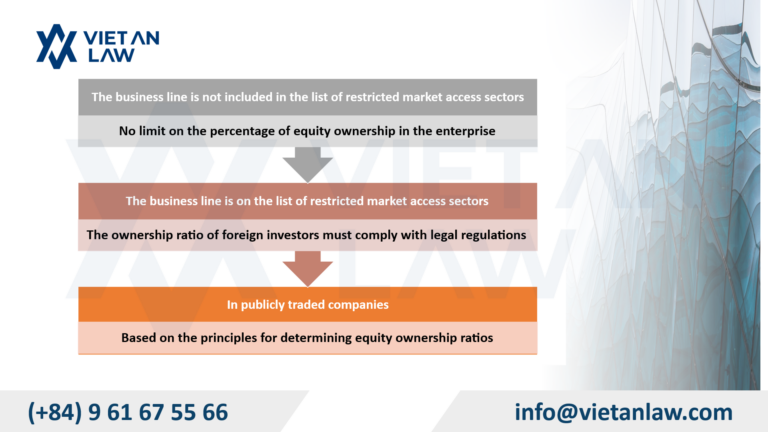
Some sectors have specific limits on foreign ownership ratios:
| Sector, type of enterprise | Foreign ownership limit | Legal basis |
| Vietnamese commercial banks | Aggregate ownership not exceeding 30% under the general principle | Decree 01/2014/ND-CP, as amended by Decree 69/2025/ND-CP |
| Commercial banks receiving a compulsory transfer under a special mechanism | May exceed 30% but not more than 49%, subject to the approved plan | Decree 69/2025/ND-CP |
| Vietnamese non-bank credit institutions | Aggregate ownership not exceeding 50%, unless otherwise provided | Credit institution legislation |
| Commercial air transport | Not exceeding 34% of charter capital | Decree 208/2026/ND-CP |
| Airport business operations | Not exceeding 30%, unless an international treaty provides otherwise | Decree 205/2026/ND-CP |
| Certain terminal, cargo warehouse and commercial ground-handling activities | Not exceeding 30%, unless an international treaty provides otherwise | Decree 205/2026/ND-CP |
| Public companies not subject to restrictions | No general foreign ownership ceiling applies | Decree 155/2020/ND-CP, as amended by Decree 245/2025/ND-CP |
Note: The table above is for initial reference only. Actual limits may depend on the type of entity, the transaction, specialized regulations and any applicable exceptions.
Ownership limits in multi-subsector industries
For telecommunications, transport, transport support services, goods distribution and certain other service sectors, a single ownership ratio should not be applied to the entire industry.
For instance, warehousing, road transport and maritime transport may be subject to different market access conditions even though all relate to goods movement.
Similarly, the right to own 100% of a trading company’s capital does not automatically allow the enterprise to conduct every retail activity without satisfying the corresponding conditions or business licenses.
Therefore, precise identification of the specific business activities is decisive before concluding on the capital ratio.
Ownership ratio in multi-sector enterprises
Pursuant to point d, clause 10, Article 17 of Decree 96/2026/ND-CP, where an economic organization engages in multiple business lines for which international treaties prescribe different ownership limits, the foreign ownership ratio must not exceed the lowest of those limits.
Example: an enterprise operates three business lines with respective limits of 100%, 70% and 49%. If all three limits apply simultaneously, the maximum foreign ownership ratio is 49%.
In acquisition transactions, both registered but inactive business lines must also be reviewed. Adjustment or reorganization of business lines may be considered if consistent with actual operations and the law.
Method of calculating the foreign ownership ratio under Vietnamese law
Formula for direct ownership ratio
Foreign ownership ratio (%) = (Charter capital portion held directly by foreign investors / Total charter capital of the enterprise) × 100%.
Example, Company A has charter capital of VND 100 billion, of which:
- Vietnamese investor: VND 60 billion.
- Singaporean investor: VND 25 billion.
- Japanese investor: VND 15 billion.
The total capital held by foreign investors is VND 40 billion, equivalent to 40% of charter capital.
If the business line is subject to a 49% limit, the remaining available ratio is 9 percentage points of the current charter capital, provided there is no change in charter capital or other legal limits.
Distinction between purchasing existing capital and contributing additional capital
This is a point investors must note when calculating the post-transaction ownership ratio.
Assume a company has charter capital of VND 100 billion, of which foreign investors already hold VND 40 billion.
Case 1: Purchase of additional capital from a Vietnamese member
The foreign investor purchases a capital portion valued at VND 10 billion from a Vietnamese member.
Charter capital remains unchanged.
Post-transaction ownership ratio:
(40 + 10) / 100 × 100% = 50%.
Case 2: Additional contribution of VND 10 billion to increase charter capital
The foreign investor contributes an additional VND 10 billion, increasing charter capital to VND 110 billion.
Post-contribution ownership ratio:
(40 + 10) / (100 + 10) × 100% = 45.45%.
Thus, the same additional investment of VND 10 billion produces different ownership ratios depending on the method used.
When the enterprise increases capital, lawyers must calculate the post-issuance structure rather than simply adding the new capital portion to the previous ratio.
Determination of indirect ownership
In multi-entity investment structures, the economic interest ratio and the legal regime under the Law on Investment are not identical.
Example: Foreign company X owns 80% of Company A; Company A owns 60% of Company B.
Under simple multiplication of ownership ratios, X’s indirect economic interest in B is 48%.
However, 48% must not automatically be used to conclude that Company B is subject to the same conditions and procedures as a domestic investor.
Pursuant to Article 20 of the Law on Investment 2025, cases in which an economic organization with foreign capital holds more than 50%, as well as ownership structures among related economic organizations, must be examined.
Viet An Law’s recommendation: For multi-tier ownership structures, an ownership chart should be prepared and the economic interest ratio, voting rights and applicable investment regime analyzed separately.
How does the ownership threshold of over 50% affect investment activities in Vietnam?
The threshold of more than 50% of charter capital is not a general foreign ownership limit; it is an important criterion for determining the investment conditions and procedures applicable to certain foreign-invested economic organizations.
Pursuant to Article 20 of the Law on Investment 2025, economic organizations falling within the statutory cases must satisfy the same conditions and perform the same procedures as foreign investors when establishing another economic organization, contributing capital, purchasing shares or implementing a new investment project.
In addition to direct ownership exceeding 50%, the law also regulates cases of ownership through other economic organizations and combined holding structures.
When must an increase in ownership ratio be registered in advance?
Pursuant to Article 21 of the Law on Investment 2025, notable cases include:
- Increasing the foreign ownership ratio in an enterprise operating in a conditional market access sector;
- Increasing the ownership ratio from 50% or less to more than 50%;
- Further increasing the ownership ratio when already holding more than 50%, in the cases prescribed by law;
- Purchasing capital in an enterprise that has land-use rights in areas subject to national defense or security control.
Consequently, a transaction that remains within the permitted ownership limit may still require prior registration before any change of members or shareholders.
Details of the dossier and sequence are guided by Viet An Law in the article: Foreign investors contribute capital to Vietnamese companies.
Legal analysis of foreign ownership scenarios from a lawyer’s perspective in Vietnam
When advising on an investment transaction, determining the capital ratio is only the first step. Lawyers must also assess the legality of the ownership structure, the feasibility of completing the transaction and the conditions that must be resolved before the transfer.
The following table uses hypothetical scenarios to illustrate the analytical method.
| Scenario | Legal issues to examine | Recommended approach |
| Foreign investor acquires 49% of a Vietnamese company | Ownership below 50% does not automatically exempt the transaction from registration | Check conditional business lines, land factors and Article 21 of the Law on Investment |
| Two foreign investors jointly hold 70% | Aggregate ratio must comply with the applicable limit and relevant international treaties | Determine total foreign capital and the status of each investor |
| Company operates three sectors, one of which is limited to 49% | The sector with the lowest limit may determine the company’s maximum ratio | Review actual business lines and the feasibility of adjustment |
| Investor increases ownership from 50% to 60% | Transaction crosses the >50% threshold and triggers investment procedure issues | Check prior registration obligations and impact on subsequent investment activities |
| Investment through an intermediate company | Indirect economic interest may differ from the criteria for determining the investment regime | Analyze each ownership tier under Article 20 and specialized laws |
| Public company still has unused foreign ownership room | Remaining room alone is insufficient to conclude that the transaction can proceed immediately | Check the notified maximum ownership ratio and transaction conditions |
Scenarios requiring consideration of restructuring options
Assume a foreign investor intends to acquire 75% of a Vietnamese company that is registered for multiple activities, one of which is subject to a 49% ownership limit.
If the 49% limit applies to the proposed structure, the 75% acquisition does not satisfy the ownership condition.
Before concluding that the transaction is impossible, the lawyer must determine:
- Whether the restricted business line is still actually conducted by the enterprise;
- Whether the scope of activities and licenses can be lawfully adjusted;
- Whether spinning the activity off into a separate legal entity is feasible and compliant;
- Whether the change would affect existing contracts, tax, assets or obligations.
Where appropriate, the enterprise may consider reorganizing its activities before the capital transaction.
However, any restructuring must have a genuine business basis and must not be used to conceal restricted activities or circumvent investment conditions.
Scenarios in which capital ratio and control rights are not aligned
Assume a foreign investor holds 49% of a joint-stock company’s capital and a Vietnamese shareholder holds 51%.
Although the Vietnamese shareholder holds the higher capital ratio, these two ratios alone cannot support the conclusion that every decision is under the control of the Vietnamese shareholder.
The lawyer must examine the voting rights of each class of shares, the company’s charter, the thresholds for adopting resolutions, and any lawful agreements among shareholders.
Conversely, holding more than 50% of capital does not automatically guarantee decision-making power over all material matters of the enterprise.
Legal observation: When designing an investment structure, capital ratio, voting rights and governance mechanisms must be assessed simultaneously to minimize post-transaction disputes.
Issues to check before determining the foreign ownership ratio in Vietnam
Instead of merely looking up capital limits by sector name, investors should examine all factors that directly affect the transaction.
| Review item | Questions to resolve |
|---|---|
| Business activities | What sectors does the company actually operate in? Are there specialized sub-sectors? |
| Investor nationality | Which international treaty applies and does it contain specific conditions? |
| Capital structure | What is the total foreign ownership before and after the transaction? |
| Specialized laws | Does the sector have a maximum ownership ratio or a Vietnamese-partner requirement? |
| Indirect ownership | Are there intermediate economic organizations or related shareholder groups? |
| Transaction conditions | Is prior registration of capital contribution or share purchase required before changing shareholders? |
| Governance rights | Does the capital ratio correspond to the intended voting rights and control? |
This checklist is particularly useful for acquisitions of Vietnamese enterprises with multiple business lines or multi-tier ownership structures.
Investors should complete the determination of ownership limits before making irrevocable commitments or making payment under a transfer contract.
FAQs on foreign ownership ratios in Vietnam
If a foreign investor holds only 1% of capital, is the company a foreign-invested economic organization?
Yes. Under the definition in the Law on Investment, an economic organization that has a foreign investor as a member or shareholder is regarded as a foreign-invested economic organization. However, the regime of conditions and procedures applicable when the enterprise itself makes further investments must be determined under Article 20 and related provisions.
May a foreign investor own 100% of a trading company?
Yes, if the business activities are not subject to an ownership ratio limit under the applicable regulations. However, a foreign-invested enterprise conducting distribution, retail or establishment of retail outlets may still have to satisfy specialized conditions and obtain a license.
May a public company voluntarily set a lower foreign ownership limit in its charter?
Decree 245/2025/ND-CP abolished the previous mechanism that allowed the General Meeting of Shareholders or the charter of a public company to set a foreign ownership limit lower than the statutory ceiling. Cases that have already notified a lower limit must be handled in accordance with the transitional provision.
Viet An Law’s advisory services on foreign ownership ratios in Vietnam
Viet An Law assists foreign investors in determining the maximum ownership ratio, assessing the proposed capital structure and formulating an investment plan compliant with Vietnamese law.
The scope of advice focuses on:
- Determining ownership limits according to business line, international treaties, and specialized laws;
- Calculating capital ratios before and after the transaction and assessing direct and indirect ownership structures;
- Reviewing legal conditions for share or capital contribution purchases or corporate restructuring;
- Advising on 100% foreign-owned structures or joint ventures with Vietnamese investors.
For investors establishing a new legal entity, Viet An Law provides FDI company registration in Vietnam, supporting selection of the capital structure and completion of the necessary legal procedures.
To receive advice, investors should provide nationality, legal information, intended business lines, desired capital ratio, and the current ownership structure of the target enterprise if an acquisition is contemplated.
Conclusion
Foreign Ownership Limits in Vietnam 2026 may reach 100% or be restricted according to each business line, international treaty, and specialized law. There is no uniform 49%, 50% or 51% ownership ceiling applicable to all enterprises.
Correct determination of the ownership ratio requires a combined assessment of the business line, capital structure and pre-transaction legal conditions. In particular, for enterprises operating in multiple sectors or with complex ownership structures, Viet An Law recommends that investors conduct a legal review before deciding on capital contribution, share purchase or corporate restructuring.
Author: Apprentice Lawyer Nguyen Thi Mai Huong
Supervising and reviewing lawyer: Lawyer Trung Thi Lieu
Hotline / Zalo / WhatsApp: (+84) 961 571 818
Email: info@vietanlaw.com
Hanoi Office: 3rd Floor, Hoang Ngan Plaza Building, 125 Hoang Ngan Street,
Yen Hoa Ward, Hanoi City
Ho Chi Minh City Office: Rooms 2.26 – 2.27, Charmington La Pointe Building, 181 Cao Thang Street, Hoa Hung Ward, Ho Chi Minh City