


After completing the process of registering to establish a company in Thailand, customers need to continue to carry out a number of post-establishment procedures so that the company can conduct operations. These procedures include a number of important tasks such as registering taxes with the Tax Department of Thailand to obtain a corporate tax identification number and complying with tax obligations, opening a corporate bank account for effective financial management, registering for social insurance (Social Security Fund – SSF) for employees (if any) to ensure the benefits of employees, etc comply with labor regulations, including entering into labor contracts and ensuring employee benefits, and establish and maintain an adequate and accurate accounting system for periodic financial reporting. Viet An Law would like to guide customers to provide consulting services after establishing a company in Thailand through the article below. Stuffs need doing after setting up a company include:
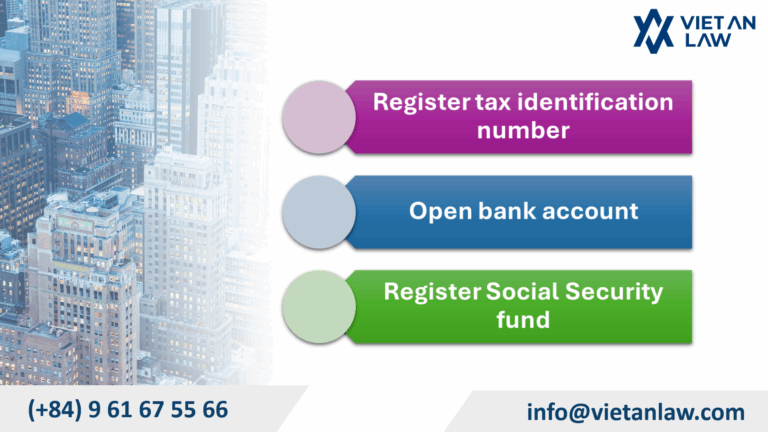
Consulting services for regisering tax identification number after setting up a company in Thailand
Registering for a tax identification number and corporate income tax, VAT is an important and mandatory step for any business operating in Thailand.
Register for Corporate Tax ID (Tax ID)
- Deadline: Within 60 days from the date of incorporation or the date of commencement of business, you need to register and receive a Corporate Tax Identification Number from the Revenue Department of Thailand.
- File:
- Company Registration Certificate.
- Copy of passport/identity card of the legal representative.
- Process:
- Submit the dossier directly at the nearest Tax Department office or register online (if any).
- Once your application is approved, you will receive a Business Tax ID.
Value Added Tax (VAT) Registration
VAT registration is mandatory in the following cases:
- Revenue exceeding THB 1.8 million per year: If your annual revenue exceeds this threshold, you are required to register for VAT within 30 days of reaching the revenue threshold.
- Hiring foreign employees: Even if the revenue does not reach 1.8 million THB, hiring foreign employees means that you need to register for VAT.
- Trading in VAT-liable goods/services: Certain regulated goods and services are subject to VAT, regardless of revenue.
- File:
- Business registration certificate.
- Certificate of Enterprise Tax Identification Number.
- Documents proving the business location (e.g., a copy of the location lease contract, documents proving ownership).
- Other papers at the request of the Tax Department.
- Process: Similar to applying for a Business Tax ID, you can file in person or online.
Tax obligations after registration
- Monthly VAT declaration and payment: The deadline is the 15th of the following month. For example, VAT for January must be paid before February 15.
- Declaration and payment of corporate income tax: To be carried out annually according to the regulations of the Department of Taxation.
- Keeping accounting books: The complete and accurate storage of vouchers, invoices, and accounting books is mandatory to serve tax declaration and tax audit.
Tax rates
- VAT rate: Currently 7%. However, the Thai government may adjust this tax rate.
- Corporate Income Tax Rate: The standard tax rate is 20%. However, small and medium-sized enterprises (SMEs) and investment sectors are encouraged to enjoy tax incentives.
Consulting services for opening a bank account after setting up a company in Thailand
Thailand has many domestic and international banks that provide services to businesses. Some popular banks include Bangkok Bank, Siam Commercial Bank (SCB), Kasikornbank (KBank), Krungthai Bank, and HSBC. Customers should consider the following factors when choosing a bank:
- Prestige and size of the bank: Choose a reputable bank and an extensive branch network to facilitate transactions.
- Types of business accounts: Learn about the types of accounts that banks offer, including current accounts, savings accounts, and other services such as cash management and international money transfers.
- Service fees: Compare account opening fees, account maintenance fees, transaction fees, and other fees between banks.
- Online service and customer support: Evaluate the bank’s online service quality and customer support capabilities.
- Document and Procedure Requirements: Each bank may have different requirements for documents and procedures for opening an account.
List of documents and documents for opening a bank account
Usually, you will need to prepare the following documents to open a corporate bank account in Thailand:
- Business registration certificate (notarized copy)
- Tax identification number certificate (notarized copy)
Consulting service for registering Social Security fund after setting up a company in Thailand
Registration for the Social Security Fund (SSF) is a mandatory obligation for businesses with employees working in Thailand, including Thai and foreign employees.
- Mandatory participants: All companies with one or more employees, regardless of whether they are Thai employees or foreigners legally working in Thailand, must register their employees to participate in the SSF.
- Registration period: The company must register at the Social Security Office within 30 days of the first hire.
- Application Process:
- Apply directly at the nearest Social Security Office or register online (if any).
- After the application is approved, the company and employees will be issued an SSF number.
Customers who need post-establishment service support in Thailand, please contact Viet An Law for the fastest support!